Within Decision Routines
What else is genuinely on the table?
A useful routine protects judgement by forcing the favourite plan to compete with a different route, a smaller test and the cost of doing nothing.
On this page
- Why favourite options crowd out rivals
- How to build three live alternatives
- Comparing options against the same criteria
Page outline Jump by section
Introduction
One of the most reliable ways to improve a high-stakes decision is to prevent the first attractive option from becoming the only option. The initial proposal often feels compelling because it arrives first, fits existing assumptions or offers immediate relief. Once attention narrows around it, other possibilities receive less effort, weaker scrutiny or no consideration at all. Research on judgement and decision-making consistently shows that people tend to stop searching once they find a plausible answer rather than the best available one. [Wikipedia]WikipediaOpen source on wikipedia.org.
 A practical decision routine counters this tendency by requiring the preferred option to compete against genuine alternatives. A useful comparison includes at least three live choices: the current favourite, a fundamentally different route, and either a small-scale experiment or the option of delaying action when waiting has genuine value. The purpose is not to create artificial complexity but to widen the frame before commitment.
Why favourite options crowd out rivals
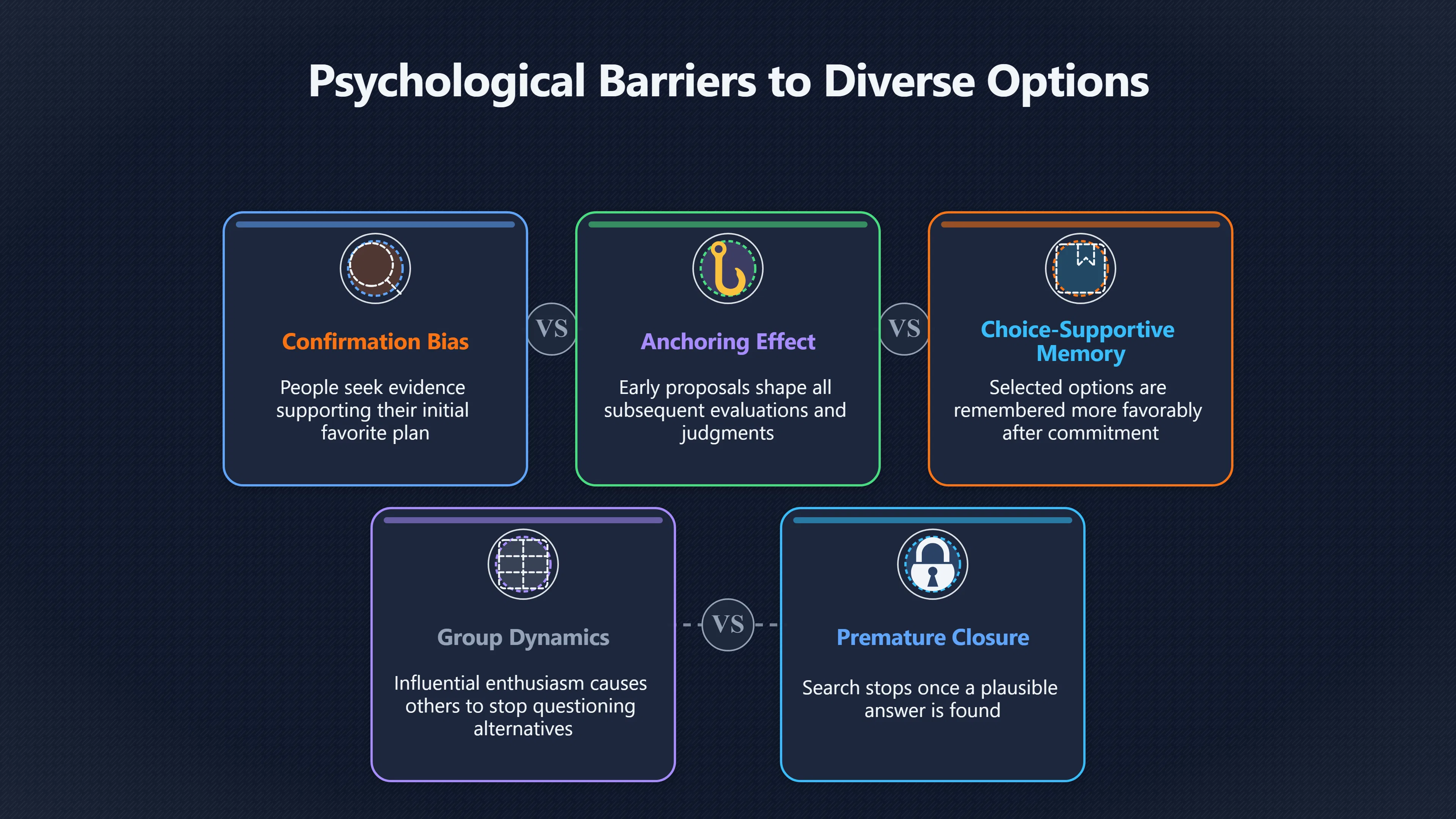
The first credible solution has psychological advantages that later options struggle to overcome. Once people begin imagining themselves succeeding with one plan, they naturally search for confirming evidence, explain away weaknesses and devote less attention to competing ideas. This “premature closure” is well documented across research on judgement and decision-making. [Wikipedia]WikipediaOpen source on wikipedia.org.
Several mechanisms reinforce this narrowing.
- Confirmation bias encourages evidence gathering that supports the emerging favourite while neglecting conflicting information. [Wikipedia]WikipediaOpen source on wikipedia.org.
- Anchoring causes early information or the first proposal to shape later evaluations, even when it was only a starting point. [Wikipedia]WikipediaOpen source on wikipedia.org.
- Choice-supportive memory makes people remember selected options more favourably after they have mentally committed to them. [Wikipedia]WikipediaOpen source on wikipedia.org.
- Group dynamics can amplify the effect. Once influential people express enthusiasm, others often spend their effort improving the preferred option instead of questioning whether another path should replace it altogether. [PMC]pmc.ncbi.nlm.nih.govPMCDecision-Making Processes in Social Contextsby E Bruch · 2017 · Cited by 421 — Sociological research on choice emphasizes how features of the social environment shape individual…
The result is usually not a bad comparison between many alternatives. It is the absence of comparison altogether.
How to build three live alternatives
A “live” alternative is one that could realistically be chosen today. It is not a straw man designed to make the favourite look stronger.
A simple routine is to insist on three distinct options before deciding.
- The leading proposal. The option currently attracting the most support.
- A genuinely different approach. This should solve the same problem through a different mechanism rather than being a minor variation. If the favourite is buying a company, the alternative might be forming a partnership. If the favourite is hiring immediately, the alternative might be redesigning the work instead.
- A smaller or lower-commitment path. This might be a pilot project, staged rollout, temporary measure or limited experiment that gathers information before making the irreversible decision.
An additional question often improves the comparison:
What if we deliberately did nothing for now?
Doing nothing is frequently ignored because people assume action is the default. Behavioural research shows that maintaining the status quo is itself an alternative, with both costs and benefits that deserve explicit comparison. Sometimes delay simply postpones problems. In other situations it preserves flexibility while uncertainty resolves. Treating “wait” as a formal option prevents hidden assumptions about urgency from dominating the decision. [ResearchGate]researchgate.netResearch Gate(PDF) Status Quo Bias in Decision-MakingResearchGate(PDF) Status Quo Bias in Decision-MakingFebruary 1, 1988 — Most real decisions, unlike those of economics texts, have a statu…
Comparing options against the same criteria
Generating alternatives only helps if they are judged consistently. Teams often evaluate the favourite on its strengths while judging competitors by their weaknesses.
A better routine is to score every live alternative against the same questions.
- Does it achieve the primary objective?
- What are the largest downside risks?
- How reversible is the decision?
- What assumptions must be true?
- How much time, money and organisational effort does it require?
- What evidence over the next month or quarter would suggest this option is failing?
Using identical criteria reduces the temptation to change the rules simply because one option feels attractive. Decision-quality research argues that good choices depend not only on analysing consequences but also on generating a sufficiently diverse set of feasible options before comparison. [Wikipedia]WikipediaDecision qualityDecision quality
One useful discipline is to write the comparison before discussing preferences. Recording strengths, weaknesses and uncertainties side by side makes later reasoning more transparent and reduces hindsight bias if the decision is reviewed.
The value of a fundamentally different option
Many decision meetings produce several versions of the same idea rather than true alternatives.
For example:
Favourite optionWeak alternativeBetter competing alternativeLaunch nationwide immediatelyLaunch one month laterPilot in one region and expand only if predefined targets are metRecruit more staffRecruit fewer staffAutomate part of the workflow before hiringBuild internallyBuild internally with another supplierBuy an existing solution or partner externally
The objective is to create meaningful competition between different strategies rather than cosmetic variation. If every option shares the same underlying assumptions, comparing them reveals little.
Why small experiments deserve a permanent place
Large commitments often force decisions before enough evidence exists. A pilot, prototype or trial changes the question from “Which option do we believe?” to “Which option survives contact with reality?”
Small experiments have several advantages.
- They expose hidden operational problems.
- They reduce the cost of being wrong.
- They generate evidence instead of relying solely on forecasts.
- They make it easier to abandon weak ideas because commitment remains limited.
Not every decision can be tested this way, but where experimentation is possible it frequently creates a better alternative than choosing immediately between two fully committed plans.
A practical example
Imagine a hospital deciding whether to adopt a new digital triage system.
A narrow framing compares: [youtube.com]youtube.comPremature Closure in MedicineWiden your options" "narrow framing" decision making 4 Steps to Clearer Thinking: The WRAP Process Explained Blink Brain Wave…
- Adopt the new system.
- Keep the existing system.
A broader framing introduces live alternatives:
- Implement the full system across the hospital.
- Run a six-month pilot in one department with predefined success measures.
- Improve the current process using targeted workflow changes while monitoring whether the larger investment remains justified.
All three address the same problem but involve different levels of commitment, uncertainty and learning. The decision becomes less about defending the first proposal and more about selecting the strongest path under uncertainty.
Common mistakes when generating alternatives
Several habits weaken the value of alternative generation.
- Producing token options that nobody expects to choose.
- Creating several variations of one strategy instead of genuinely different approaches.
- Ignoring the option of waiting when information is likely to improve.
- Allowing different evaluation standards for preferred and competing options.
- Stopping the search after finding the first workable solution instead of asking whether another route changes the balance of risks.
Intelligence analysts have long used structured techniques such as analysing competing hypotheses to force multiple explanations to compete against the same evidence rather than allowing one attractive interpretation to dominate prematurely. Although developed for intelligence work, the underlying principle applies broadly: judgement improves when plausible alternatives are actively compared instead of merely acknowledged. [Wikipedia]WikipediaAnalysis of competing hypothesesAnalysis of competing hypotheses
The mechanism in practice
The purpose of generating live alternatives is not to maximise the number of options. Too many choices can become distracting, while too few encourage premature commitment. The aim is to ensure that the preferred plan has earned its position by outperforming credible competitors under consistent evaluation.
For high-stakes choices, a routine as simple as requiring one different strategy, one smaller test and explicit consideration of doing nothing can substantially improve the quality of comparison. It shifts attention from defending an early favourite towards understanding which option remains strongest once realistic alternatives have been given an equal chance.
Amazon book picks
Further Reading
Books and field guides related to What else is genuinely on the table?. Use these as the next step if you want deeper reading beyond the article.
Decisive
Directly teaches how to avoid narrow framing and generate real alternatives before committing.
Thinking, Fast and Slow
Explains why first impressions, anchors, and coherent stories can dominate later evidence.
Smart Choices
Covers objectives, alternatives, consequences, trade-offs, and systematic option comparison.
The Art of Thinking Clearly
Addresses confirmation bias, anchoring, sunk cost, and other forces that make favourite options crowd out rivals.
eBay marketplace picks
Marketplace Samples
Topic-anchored marketplace searches for visual, collectible, or second-hand items related to this page.



Endnotes
-
Source: Wikipedia
Link: https://en.wikipedia.org/wiki/Decision-making -
Source: pmc.ncbi.nlm.nih.gov
Title: PMCDecision-Making Processes in Social Contexts
Link: https://pmc.ncbi.nlm.nih.gov/articles/PMC5543983/Source snippet
by E Bruch · 2017 · Cited by 421 — Sociological research on choice emphasizes how features of the social environment shape individual...
-
Source: researchgate.net
Title: Research Gate(PDF) Status Quo Bias in Decision-Making
Link: https://www.researchgate.net/publication/5152072_Status_Quo_Bias_in_Decision-MakingSource snippet
ResearchGate(PDF) Status Quo Bias in Decision-MakingFebruary 1, 1988 — Most real decisions, unlike those of economics texts, have a statu...
Published: February 1, 1988
-
Source: Wikipedia
Title: Decision quality
Link: https://en.wikipedia.org/wiki/Decision_quality -
Source: Wikipedia
Title: Analysis of competing hypotheses
Link: https://en.wikipedia.org/wiki/Analysis_of_competing_hypotheses -
Source: umassd.edu
Link: https://www.umassd.edu/fycm/decision-making/process/Source snippet
Decision-making process2 Apr 2026 — Decision making is the process of making choices by identifying a decision, gathering information, an...
Additional References
-
Source: fs.blog
Link: https://fs.blog/mental-models/Source snippet
Mental Models: The Best Way to Make Intelligent DecisionsA mental model is a simplified explanation of how something works. Any idea, bel...
-
Source: linkedin.com
Link: https://www.linkedin.com/top-content/soft-skills-emotional-intelligence/enhancing-decision-making-skills/techniques-for-evaluating-alternatives-in-decisions/Source snippet
Techniques For Evaluating Alternatives In DecisionsTechniques for evaluating alternatives in decisions help you compare different options...
-
Source: sosintel.co.uk
Link: https://sosintel.co.uk/mastering-the-analysis-of-competing-hypotheses-ach-a-practical-framework-for-clear-thinking/Source snippet
SOS IntelligenceMastering the Analysis of Competing Hypotheses (ACH)20 Jun 2025 — At its core, ACH shifts the analytical focus from provi...
-
Source: thedecisionlab.com
Link: https://thedecisionlab.com/biases/status-quo-biasSource snippet
Status Quo BiasThe status quo bias describes our preference for the current state of affairs, resulting in resistance to change.Read more...
-
Source: productanonymous.com
Title: Is that enough? What are the unwritten alternatives?Read more
Link: https://productanonymous.com/2013/09/the-art-of-decision-making-identifying-alternatives/Source snippet
The Art of Decision Making – Part 4: Identifying alternatives15 Sept 2013 — You've got your problem identified, and you immediately think...
-
Source: youtube.com
Title: Decisive by Chip & Dan Heath Book
Link: https://www.youtube.com/watch?v=YP98UFtArGISource snippet
Decisive: How to Make Better Choices - Chip and Dan Heath - ANIMATED BOOK REVIEW...
-
Source: youtube.com
Title: How To Make Good Decisions
Link: https://www.youtube.com/watch?v=ItVT1iHaGY4Source snippet
Decisive by Chip & Dan Heath Book Summary | The WRAP Framework for Decision Making...
-
Source: youtube.com
Title: Premature Closure in Medicine
Link: https://www.youtube.com/watch?v=EspwZf3lmDMSource snippet
"Widen your options" "narrow framing" decision making 4 Steps to Clearer Thinking: The WRAP Process Explained Blink Brain Wave...
-
Source: youtube.com
Title: 4 Steps to Clearer Thinking: The WRAP Process Explained
Link: https://www.youtube.com/watch?v=oMz7CyOCdEcSource snippet
How To Make Good Decisions - Decision-Making Villains To Avoid...
-
Source: youtube.com
Title: Decisive: How to Make Better Choices
Link: https://www.youtube.com/watch?v=QmZDc5_ffvESource snippet
Premature Closure in Medicine...
Topic Tree