Within Feedback
Why Feedback Timing Changes What You Learn
Feedback works best when it arrives close enough to the original reasoning to fix both errors and underestimated knowledge.
On this page
- Why delayed feedback weakens learning
- How low confidence correct answers reveal hidden knowledge
- Designing review triggers close to the judgement
Page outline Jump by section
Introduction
Fast feedback is one of the most effective ways to improve judgement because it links an outcome to the reasoning that produced it before memory, hindsight and rationalisation distort the connection. When feedback arrives soon after a decision, it helps you identify not only what was wrong, but also whether your level of confidence matched the evidence you had at the time. Equally important, it can reveal occasions when you were correct for good reasons but lacked confidence, allowing you to strengthen knowledge that was already present but poorly recognised. Research on metacognition, memory and expertise consistently shows that timely, specific feedback recalibrates confidence more effectively than delayed summaries or vague performance reviews. [Psychnet+2ResearchGate]psychnet.wustl.eduButler et al 2008 JEPLMCFeedback Increases Retention of Low- Confidence Correct…by AC Butler · 2008 · Cited by 540 — Our hypothesis is that feedback s…

Why delayed feedback weakens learning
Feedback loses much of its value when it arrives long after the original judgement. The longer the delay, the harder it becomes to reconstruct what information was available, which assumptions mattered, and how certain you actually were.
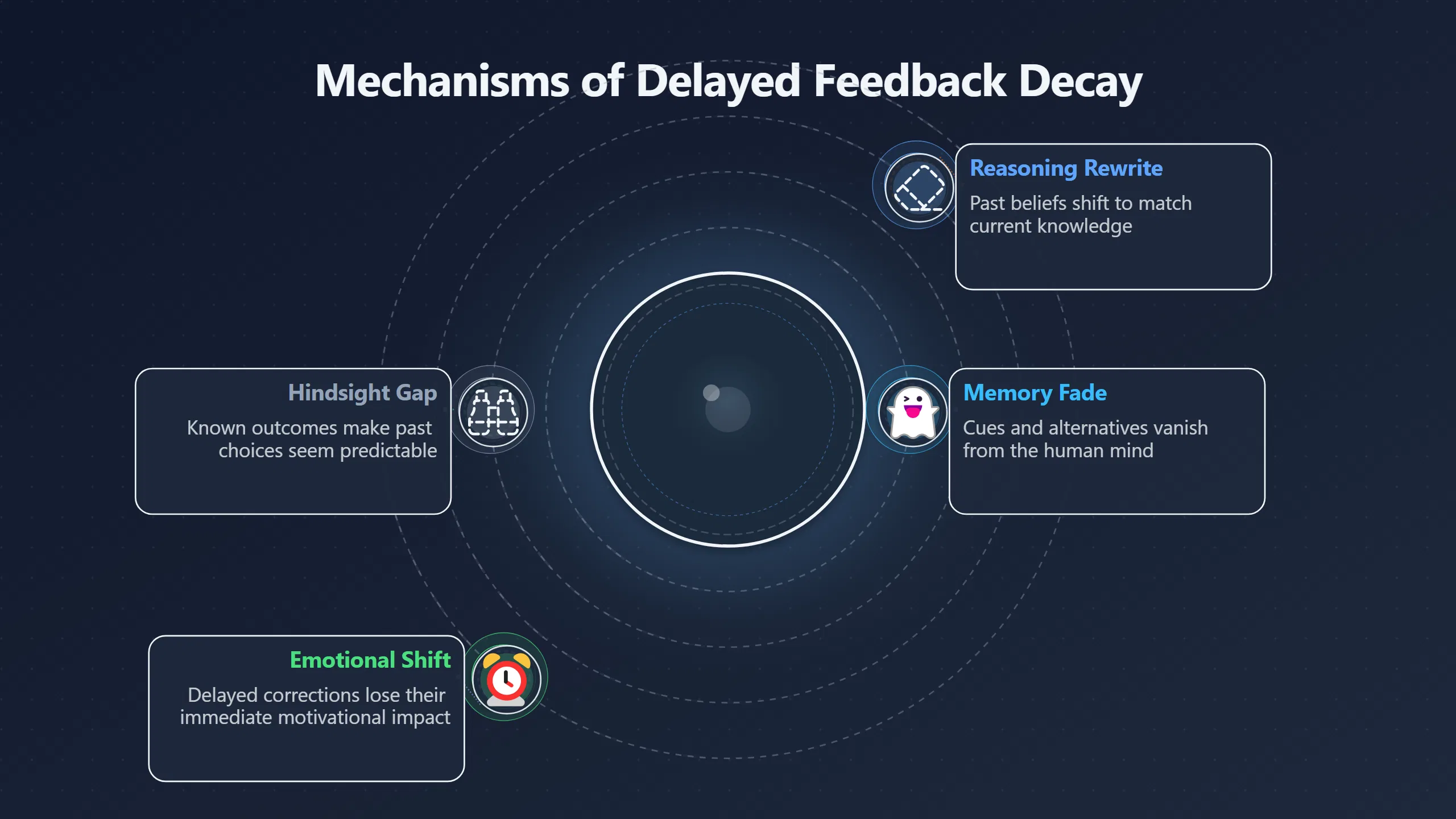
Several processes reduce learning from delayed feedback:
- Memory fades. You forget the cues and alternatives you considered.
- Hindsight fills the gaps. Once the outcome is known, it feels more predictable than it really was.
- Reasoning is rewritten. People unintentionally update their memories so that past beliefs appear more consistent with current knowledge.
- Emotional impact shifts. Immediate surprise often motivates careful revision, whereas delayed correction may feel detached or unimportant.
This is one reason why environments with rapid, accurate feedback tend to produce genuine expertise. In work comparing expert intuition across domains, researchers argued that intuition becomes reliable only when people repeatedly encounter valid patterns and receive prompt, unambiguous feedback linking those patterns to outcomes. In slow or noisy environments, confidence can increase without equivalent improvement in judgement. [ResearchGate]researchgate.netResearchGate(PDF) Conditions for Intuitive ExpertiseAnd intuitive expertise is trustworthy only in environments offering valid cues and f…
The practical implication is straightforward: if you want to improve judgement, shorten the interval between prediction and review whenever possible. A weekly review of forecasts generally teaches more than an annual retrospective, even if both cover the same decisions.
How low-confidence correct answers reveal hidden knowledge
One of the most overlooked functions of feedback is correcting misplaced underconfidence.
Most people think feedback exists to fix mistakes. However, experiments by Andrew Butler, Jeffrey Karpicke and Henry Roediger demonstrated that feedback also strengthens answers that were already correct but given with little confidence. Participants who received confirmation after low-confidence correct responses remembered those answers substantially better later than participants who received no feedback. The feedback corrected a metacognitive error rather than a factual one: they had known the answer, but failed to recognise that they knew it. [Psychnet]psychnet.wustl.eduButler et al 2008 JEPLMCFeedback Increases Retention of Low- Confidence Correct…by AC Butler · 2008 · Cited by 540 — Our hypothesis is that feedback s…
This distinction matters because confidence and knowledge are not identical.
Someone may answer correctly while believing they guessed. Without confirmation, that success is easily dismissed as luck. The knowledge remains fragile because the learner never updates their estimate of what they genuinely understand.
Fast confirmation changes this process by telling the learner:
- “Your reasoning was more reliable than you believed.”
- “This answer belongs in your trusted knowledge rather than your uncertain guesses.”
- “Your confidence should increase for similar problems.”
In other words, good feedback calibrates upward as well as downward. Improving judgement is not simply about becoming less confident; it is about making confidence more accurately reflect actual competence.
Why surprise makes correction memorable
Feedback has its strongest effect when it violates expectations.
Research on the hypercorrection effect found an apparently counterintuitive pattern: people often correct high-confidence mistakes more successfully than low-confidence mistakes after receiving immediate corrective feedback. Rather than resisting correction, strongly held but incorrect beliefs can become especially memorable once they are disproved because the contradiction captures attention. [PMC+2PMC]pmc.ncbi.nlm.nih.govPMCSurprising feedback improves later memoryNIHby LK Fazio · 2009 · Cited by 203 — The hypercorrection effect is the finding that high-confidence errors are more likely to be…
The proposed mechanism is prediction error.
When reality differs sharply from expectation:
- The mismatch attracts attention.
- Attention increases encoding of the corrective information.
- The corrected answer becomes easier to retrieve later.
Laboratory studies support this explanation by showing greater attention and neural responses when highly confident errors receive corrective feedback than when uncertain errors are corrected. [PMC+2PMC]pmc.ncbi.nlm.nih.govPMCSurprising feedback improves later memoryNIHby LK Fazio · 2009 · Cited by 203 — The hypercorrection effect is the finding that high-confidence errors are more likely to be…
However, this should not be misunderstood as evidence that confident misconceptions are harmless. The benefit appears only when the learner actually receives clear corrective feedback. Without correction, high-confidence errors can become even more entrenched.
Designing review triggers close to the judgement
The timing of feedback matters because reviews are most useful while the original reasoning is still accessible.
Instead of relying on occasional large retrospectives, create small review triggers that occur naturally alongside important judgements.
Effective review triggers include:
- Recording a prediction and confidence estimate before seeing the outcome.
- Reviewing decisions immediately after results become available.
- Comparing the outcome with the original reasoning rather than with reconstructed memories.
- Identifying whether any confidence mismatch occurred:
Wrong and highly confident: investigate the misconception. Right but uncertain: strengthen confidence in valid reasoning. Wrong and uncertain: identify missing knowledge. Right and appropriately confident: reinforce successful judgement.
These short cycles create many more opportunities for calibration than waiting until the end of a project or quarter.
The key question during review is not simply, “Was I right?” but, “Did my confidence accurately represent the evidence I had?”
Keeping feedback specific enough to change confidence
Generic comments such as “good job” or “incorrect” rarely improve calibration because they provide little information about why confidence should change.
Useful feedback identifies:
- which assumption failed,
- which evidence was overlooked,
- whether the reasoning was sound despite an unfavourable outcome,
- and whether confidence should increase, decrease or remain unchanged for similar future decisions.
This distinction helps prevent two common mistakes:
- becoming globally less confident after isolated failures, and
- becoming overconfident after isolated successes.
Instead, confidence is adjusted selectively, matching the quality of the underlying reasoning rather than the emotional impact of individual outcomes.
The mechanism that speeds judgement calibration
Fast feedback improves analytical thinking because it preserves the relationship between three elements that naturally drift apart over time:
- the judgement you made,
- the confidence you felt,
- and the evidence that eventually became available.
When those elements remain closely connected, mistakes become easier to diagnose, hidden knowledge becomes easier to recognise, and confidence gradually becomes better calibrated to reality. Rather than rewarding only correctness, timely feedback teaches something more valuable: when you should trust your judgement, when you should question it, and how much certainty the available evidence genuinely deserves. [Psychnet+2PMC]psychnet.wustl.eduButler et al 2008 JEPLMCFeedback Increases Retention of Low- Confidence Correct…by AC Butler · 2008 · Cited by 540 — Our hypothesis is that feedback s…
Amazon book picks
Further Reading
Books and field guides related to Why Feedback Timing Changes What You Learn. Use these as the next step if you want deeper reading beyond the article.
How We Learn
Covers memory, timing, review, and evidence-based learning strategies closely aligned with feedback timing.
The Art of Learning
Shows how reflection, correction, and iterative feedback improve performance.
eBay marketplace picks
Marketplace Samples
Live-tested eBay searches with available results related to this page.


Endnotes
-
Source: researchgate.net
Link: https://www.researchgate.net/publication/26798603_Conditions_for_Intuitive_ExpertiseSource snippet
ResearchGate(PDF) Conditions for Intuitive ExpertiseAnd intuitive expertise is trustworthy only in environments offering valid cues and f...
-
Source: pmc.ncbi.nlm.nih.gov
Title: PMCRe-assessing confidence improves visual metacognition
Link: https://pmc.ncbi.nlm.nih.gov/articles/PMC10805928/Source snippet
nih.govRe-assessing confidence improves visual metacognition - PMCby P Elosegi · 2023 · Cited by 14 — The results of the two experiments...
-
Source: pmc.ncbi.nlm.nih.gov
Title: PMCSurprising feedback improves later memory
Link: https://pmc.ncbi.nlm.nih.gov/articles/PMC4036076/Source snippet
NIHby LK Fazio · 2009 · Cited by 203 — The hypercorrection effect is the finding that high-confidence errors are more likely to be...
-
Source: pmc.ncbi.nlm.nih.gov
Title: PMCPeople’s Hypercorrection of High Confidence Errors
Link: https://pmc.ncbi.nlm.nih.gov/articles/PMC3079415/Source snippet
nih.govPeople's Hypercorrection of High Confidence Errors - PMC - NIHby J Metcalfe · 2011 · Cited by 119 — The hypercorrection effect ref...
-
Source: researchgate.net
Link: https://www.researchgate.net/publication/226571304_The_correction_of_errors_committed_with_high_confidenceSource snippet
The correction of errors committed with high confidenceInterestingly, people correct these high confidence errors more easily...
-
Source: researchgate.net
Link: https://www.researchgate.net/publication/5246898_Correcting_a_Metacognitive_Error_Feedback_Increases_Retention_of_Low-Confidence_Correct_ResponsesSource snippet
ck serves to correct this initial metacognitive error, enhancing retention.Read more...
-
Source: psychnet.wustl.edu
Title: Butler et al 2008 JEPLMC
Link: https://psychnet.wustl.edu/memory/wp-content/uploads/2018/04/Butler-et-al-2008_JEPLMC.pdfSource snippet
Feedback Increases Retention of Low- Confidence Correct...by AC Butler · 2008 · Cited by 540 — Our hypothesis is that feedback s...
-
Source: pubmed.ncbi.nlm.nih.gov
Link: https://pubmed.ncbi.nlm.nih.gov/18605878/Source snippet
increases retention of low-confidence correct...by AC Butler · 2008 · Cited by 540 — The authors show that when correct responses are ma...
Additional References
-
Source: ovid.com
Title: 0278 7393.34.4.918~correcting a metacognitive error feedback increases
Link: https://www.ovid.com/journals/jeplm/fulltext/10.1037/0278-7393.34.4.918~correcting-a-metacognitive-error-feedback-increasesSource snippet
Correcting a Metacognitive Errorby AC Butler · 2008 · Cited by 540 — Here, the authors show that when correct responses are made with low...
-
Source: journal.opted.org
Title: feedback changes metacognitive accuracy over different time scales
Link: https://journal.opted.org/article/feedback-changes-metacognitive-accuracy-over-different-time-scales/Source snippet
Changes Metacognitive Accuracy Over Different...2023 — Our results showed that providing feedback over short, medium and longer time sca...
-
Source: researchschool.org.uk
Title: the hypercorrection effect spaced practice and remote learning
Link: https://researchschool.org.uk/durrington/news/the-hypercorrection-effect-spaced-practice-and-remote-learningSource snippet
The hypercorrection effect, spaced… | Durrington...3 Jan 2021 — The hypercorrection effect persists for about a week, but longer than th...
-
Source: improvewithmetacognition.com
Title: hypercorrection overcoming overconfidence metacognition
Link: https://www.improvewithmetacognition.com/hypercorrection-overcoming-overconfidence-metacognition/Source snippet
Hypercorrection: Overcoming overconfidence with...Jul 18, 2016 — Research on a process called hypercorrection demonstrates that when lea...
-
Source: academia.edu
Link: https://www.academia.edu/83864006/Correcting_a_metacognitive_error_Feedback_increases_retention_of_low_confidence_correct_responsesSource snippet
feedback serves to correct this initial metacognitive error, enhancing...Read more...
-
Source: structural-learning.com
Title: hypercorrection effect teachers guide
Link: https://www.structural-learning.com/post/hypercorrection-effect-teachers-guideSource snippet
The Hypercorrection Effect29 Dec 2025 — The hypercorrection effect shows confident errors are more easily corrected than uncertain ones...
-
Source: youtube.com
Title: Metacognition Tricks That Make You Smarter
Link: https://www.youtube.com/watch?v=CFt-E8v4Y2USource snippet
Philosophy Roulette 534 - Conditions for Intuitive Expertise. Daniel Kahneman & Gary Klein...
-
Source: columbia.edu
Link: https://www.columbia.edu/cu/psychology/metcalfe/PDFs/MetcalfeFinn2011.pdfSource snippet
Columbia UniversityPeople's Hypercorrection of High-Confidence Errorsby J Metcalfe · 2011 · Cited by 119 — The hypercor- rection effect r...
-
Source: digitalcommons.cwu.edu
Link: https://digitalcommons.cwu.edu/cgi/viewcontent.cgi?article=1222&context=ijurcaSource snippet
Metacognitive Awareness Relates to Overconfidence...by D Klein · 2023 · Cited by 2 — Two potential factors influencing overconfidence ar...
-
Source: trump.org.il
Title: מאמר גון האטי
Link: https://trump.org.il/wp-content/uploads/2018/09/%D7%9E%D7%90%D7%9E%D7%A8-%D7%92%D7%95%D7%9F-%D7%94%D7%90%D7%98%D7%99.pdfSource snippet
Calibration and confidence: Where to next?by J Hattie · 2013 · Cited by 183 — May be the most fruitful next step in calibration research...
Topic Tree