Within Search Bias
When Autocomplete Finishes Your Thought for You
Autocomplete can save time, but accepting its suggestions may also pull a search toward popular framings rather than careful questions.
On this page
- Why suggested completions feel harmless
- How autocomplete can lock in a frame
- Safer ways to use search suggestions
Page outline Jump by section
Introduction
Autocomplete is designed to save time, but it can also shape the direction of an investigation before you have fully decided what you want to ask. As you begin typing, suggested completions present ready-made ways of framing the topic. Choosing one is often efficient, yet it may also steer the search towards popular assumptions, familiar controversies or emotionally charged questions instead of the balanced question you intended. This matters because confirmation bias does not begin only after you read search results; it can begin at the moment you accept a suggested query. Research on the “narrow search effect” shows that the wording of search terms influences the range of information people encounter and how much they update their beliefs. [PubMed]pubmed.ncbi.nlm.nih.govThe narrow search effect and how broadening…by E Leung · 2025 · Cited by 13 — Studies 1 to 5 show that users' prior beliefs infl…
Why Suggested Completions Feel Harmless
Autocomplete feels like a convenience rather than a recommendation. The suggestions appear automatically, are presented neutrally and require only a single click. This makes them easy to treat as objective rather than as one possible framing among many.
Search providers themselves describe autocomplete primarily as a speed feature. Google’s documentation explains that predictions are generated automatically to help people complete searches more quickly, drawing on factors such as common searches and language patterns rather than acting as an expert guide to the best question to ask. [Google Help]support.google.comGoogle HelpHow Google autocomplete predictions workAutocomplete is a feature within Google Search that makes it faster to complete search…
The problem is psychological rather than purely technical. People often interpret an easily available suggestion as a reasonable place to begin. When the suggestion happens to align with an existing suspicion, it removes the small moment of reflection in which a different, more neutral question might have been written instead.
For example, someone investigating a health claim may begin typing “does coffee…” and immediately encounter completions that focus on a particular disease or benefit. Even without intending to confirm a belief, selecting one of those suggestions narrows the investigation to a predefined relationship instead of asking a broader question such as “What does the evidence say about coffee and health?”
How Autocomplete Can Lock In a Frame
Autocomplete does not usually tell users what to believe directly. Instead, it influences which questions appear natural enough to ask.
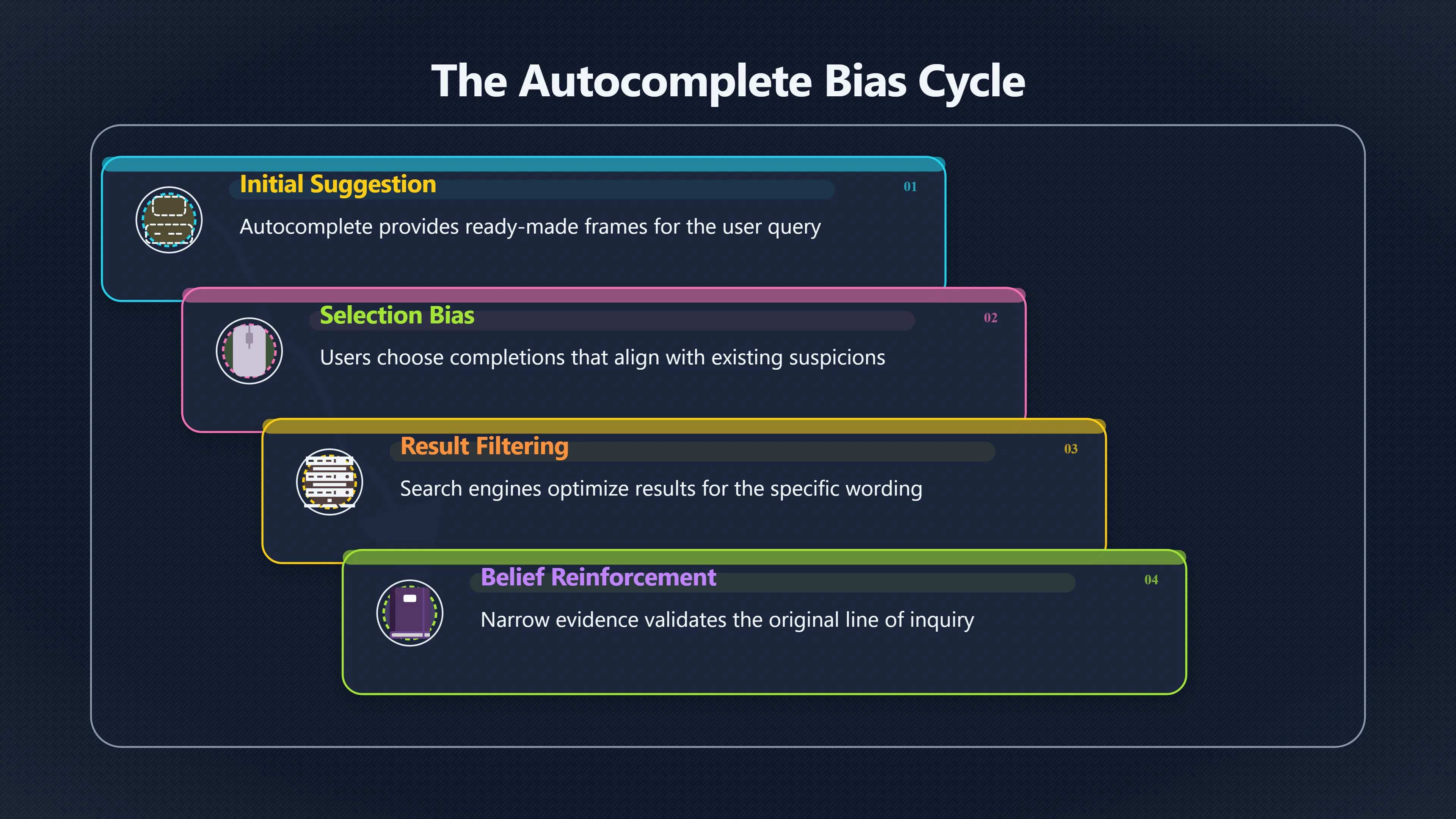
Once a suggested completion is selected, several reinforcing steps can follow:
- The completed query already contains an assumption or emphasis.
- Search results are optimised for that specific wording.
- The user is exposed mainly to material answering that framed question.
- The resulting evidence appears to validate the original line of enquiry because alternative questions were never explored.
This complements the broader “narrow search effect” identified in experimental research. Studies found that people’s prior beliefs influenced the search terms they chose, which then produced narrower evidence and reduced later belief updating across multiple topics and across both traditional search engines and AI-assisted search systems. [PubMed]pubmed.ncbi.nlm.nih.govThe narrow search effect and how broadening…by E Leung · 2025 · Cited by 13 — Studies 1 to 5 show that users' prior beliefs infl…
Autocomplete can accelerate this process because it supplies candidate queries before the user has consciously considered alternative ways of framing the issue.
A subtle example illustrates the difference:
- “Why do electric cars catch fire?”
- “How often do electric cars catch fire?”
- “Electric vehicle fire rates compared with petrol cars”
All three concern the same topic, but they ask fundamentally different questions. The first assumes the phenomenon is notable enough to explain. The second asks about frequency. The third invites comparison, making it harder for a single dramatic example to dominate the investigation.
Popular Does Not Mean Representative
Autocomplete suggestions often reflect patterns in previous searches, current events and other signals of user behaviour. As a result, they tend to amplify questions that many people have already asked rather than questions that are necessarily the most informative. [Google Help]support.google.comGoogle HelpHow Google autocomplete predictions workAutocomplete is a feature within Google Search that makes it faster to complete search…
Popularity creates two risks.
First, unusual events receive disproportionate attention. A widely reported incident can generate large volumes of searches, making related completions appear more prominent even when the underlying event is statistically rare.
Second, controversy is often more searchable than careful analysis. Questions beginning with “why is…”, “is it true that…” or “does X cause…” frequently spread because they are memorable and emotionally engaging. Their appearance in autocomplete should not be mistaken for evidence that the implied premise is correct.
Researchers studying search suggestions have also shown that users frequently develop informal theories about how autocomplete works, often assuming suggestions represent objective importance rather than the outcome of automated systems responding to aggregate behaviour. Misunderstanding this process can lead people to place greater trust in suggested queries than is warranted. [Sage Journals]journals.sagepub.comSage JournalsExamining how search engine users understand the…27 Dec 2025 — In this research, I examine regular end-users' folk theori…

When Suggested Queries Reflect Existing Biases
Autocomplete systems have attracted attention because they sometimes reproduce social biases or encourage problematic lines of enquiry.
Academic work has examined ethical concerns surrounding autocomplete, including how automated suggestions can reinforce stereotypes or amplify patterns already present in search behaviour. Researchers emphasise that the feature is not simply a passive mirror of society; design choices about filtering, ranking and suppression also influence which suggestions appear. [University of Birmingham]research.birmingham.ac.ukUniversity of BirminghamThe ethical dimensions of Google autocompleteby R Graham · 2023 · Cited by 21 — This article highlights some of t…
Past public controversies illustrate the issue. Google has repeatedly modified autocomplete policies after offensive or misleading suggestions involving race, religion, gender and politics attracted criticism. These cases demonstrate that autocomplete is neither entirely neutral nor entirely fixed: providers actively intervene when particular categories of suggestions are judged harmful or misleading. [WIRED+2Them]wired.comGoogle Autocomplete Still Makes Vile SuggestionsSuggestions like “are jews evil?” and “Hitler is my hero” were previously adjusted, yet new offensive autocompletions related to gender…
For someone trying to think analytically, the lesson is practical rather than political. A suggested completion should be treated as evidence that people have searched for a phrase—not that the phrase represents the best question to investigate.
Safer Ways to Use Search Suggestions
Autocomplete remains genuinely useful. The goal is not to avoid it but to use it deliberately.
A few habits reduce the chance that suggested completions will narrow an investigation prematurely:
- Pause before selecting a suggestion. Ask whether it contains an assumption you have not yet tested.
- Write your own neutral question first. Compare it with the suggested versions instead of accepting the first completion.
- Search multiple framings. Investigate supportive, critical and neutral formulations of the same topic.
- Prefer comparison questions over causal assumptions. Asking “How do these compare?” usually produces a broader evidence base than “Why does X happen?”
- Replace emotionally loaded wording with measurable terms. For example, use “evidence”, “rates”, “frequency”, “systematic review” or “comparison” where appropriate.
- Notice what is missing. If autocomplete repeatedly offers only one direction, deliberately search the obvious alternative wording yourself.
These small changes interrupt the automatic progression from suggestion to assumption to selective evidence.
Better Questions Lead to Better Thinking
Autocomplete is valuable because it reduces effort, but analytical thinking sometimes requires adding effort back into the process. The few seconds spent reformulating a query can determine whether a search becomes an exercise in testing an idea or simply collecting material that fits an existing impression.
Improving online reasoning is therefore not only about evaluating sources after they appear. It also begins with recognising that the search box itself influences the investigation. Treat autocomplete as a brainstorming aid rather than an instruction, and consciously choose the question that best tests the issue instead of the one that merely finishes your sentence.
Amazon book picks
Further Reading
Books and field guides related to When Autocomplete Finishes Your Thought for You. Use these as the next step if you want deeper reading beyond the article.
The Scout Mindset
Directly addresses how to resist confirmation bias and seek balanced evidence.
Thinking, Fast and Slow
Explains the mental shortcuts and biases that make autocomplete suggestions and framing effects persuasive.
The Art of Thinking Clearly
Covers confirmation bias and related cognitive traps relevant to search behaviour.
Noise
Explores systematic judgment errors and better decision-making practices applicable to online information seeking.
eBay marketplace picks
Marketplace Samples
Live-tested eBay searches with available results related to this page.


Endnotes
-
Source: support.google.com
Link: https://support.google.com/websearch/answer/7368877?hl=enSource snippet
Google HelpHow Google autocomplete predictions workAutocomplete is a feature within Google Search that makes it faster to complete search...
-
Source: wired.com
Title: Google Autocomplete Still Makes Vile Suggestions
Link: https://www.wired.com/story/google-autocomplete-vile-suggestionsSource snippet
Suggestions like “are jews evil?” and “Hitler is my hero” were previously adjusted, yet new offensive autocompletions related to gender...
-
Source: them.us
Link: https://www.them.us/story/google-autocomplete-suggestions-transphobia-celebritiesSource snippet
The problematic suggestions include [prompts]({{ 'prompts/' | relative_url }}) to search for trans celebrities' "dead names," appearances before transitioning, and surgery...
-
Source: wired.com
Link: https://www.wired.com/story/googles-autocomplete-ban-politics-glitchesSource snippet
WIRED identified an issue where typing "donate" would prompt suggestions for donating to Joe Biden's campaign, but not Donald Trump’s. Th...
-
Source: developers.google.com
Title: place autocomplete
Link: https://developers.google.com/maps/documentation/places/web-service/place-autocompleteSource snippet
(New) | Places APIAutocomplete (New) is a web service that returns place predictions and query predictions in response to an HTTP request...
-
Source: pubmed.ncbi.nlm.nih.gov
Link: https://pubmed.ncbi.nlm.nih.gov/40127267/Source snippet
The narrow search effect and how broadening...by E Leung · 2025 · Cited by 13 — Studies 1 to 5 show that users' prior beliefs infl...
-
Source: journals.sagepub.com
Link: https://journals.sagepub.com/doi/10.1177/14614448251406282Source snippet
Sage JournalsExamining how search engine users understand the...27 Dec 2025 — In this research, I examine regular end-users' folk theori...
-
Source: research.birmingham.ac.uk
Link: https://research.birmingham.ac.uk/files/191405983/20539517231156518.pdfSource snippet
University of BirminghamThe ethical dimensions of Google autocompleteby R Graham · 2023 · Cited by 21 — This article highlights some of t...
-
Source: pmc.ncbi.nlm.nih.gov
Link: https://pmc.ncbi.nlm.nih.gov/articles/PMC8460288/Source snippet
internet search data to understand information seeking...by V Vijay · 2021 · Cited by 16 — We used Google autocomplete to try to determi...
-
Source: journals.sagepub.com
Link: https://journals.sagepub.com/doi/abs/10.1177/14614448251406282Source snippet
how search engine users understand the...by S Jhaver — (2024) The search suggestion effect (SSE): a quantification of how autocomplete s...
-
Source: design-guide.publishing.service.gov.uk
Title: publishing.service.gov.uk Search autocomplete
Link: https://design-guide.publishing.service.gov.uk/components/search-autocomplete/Source snippet
autocomplete - GOV.UK Publishing Design GuideUse search autocomplete when you are dealing with dynamic data and want to reduce typing eff...
-
Source: aipavilion.github.io
Link: https://aipavilion.github.io/docs/papers/autocomplete.pdfSource snippet
Considering the Impact of Autocomplete on Users10 Dec 2018 — Autocomplete impacts users in various ways ranging from benefiting those wit...
-
Source: dragonmetrics.com
Title: confirmation bias
Link: https://www.dragonmetrics.com/confirmation-bias/Source snippet
What People are REALLY Searching for29 Apr 2024 — Confirmation bias is the human tendency to search for, interpret, and remember informat...
Additional References
-
Source: wiideman.com
Link: https://www.wiideman.com/research/google-autocomplete/study-resultsSource snippet
Google Autocomplete Study ResultsGoogle will analyze patterns of keyword usage to help AdWords advertisers find keyword opportunities and...
-
Source: upperdog.co.uk
Link: https://upperdog.co.uk/blog/how-to-influence-google-autocomplete/Source snippet
How To Influence Google Autocomplete | Upperdog SEO BlogInfluence google autocomplete with this SEO strategy. Find out how to appear in a...
-
Source: spinutech.com
Title: google autocomplete is more than a simple feature its a powerful tool
Link: https://www.spinutech.com/digital-marketing/seo/google-autocomplete-is-more-than-a-simple-feature-its-a-powerful-tool/Source snippet
Google Autocomplete is a Powerful Tool11 Oct 2024 — It is a powerful tool that subtly guides users' search behavior, often leading them t...
-
Source: marketing.wharton.upenn.edu
Link: https://marketing.wharton.upenn.edu/wp-content/uploads/2025/09/leung-urminsky-2025-the-narrow-search-effect-and-how-broadening-search-promotes-belief-updating.pdfSource snippet
Marketing DepartmentThe narrow search effect and how broadening search...by E Leunga · 2025 · Cited by 13 — Directionally narrow search...
-
Source: thehalogroup.com
Link: https://www.thehalogroup.com/understanding-and-addressing-google-autocomplete-reputation-issues/Source snippet
ons about what they might be looking for prior to them completing a given...Read more...
-
Source: researchgate.net
Title: 368793995 The ethical dimensions of Google autocomplete
Link: https://www.researchgate.net/publication/368793995_The_ethical_dimensions_of_Google_autocompleteSource snippet
(PDF) The ethical dimensions of Google autocompleteMar 6, 2026 — PDF | On Feb 24, 2023, Rosie Graham published The ethical dimensions of...
-
Source: phys.org
Title: 2025 03 narrowminded algorithms polarized perceptions
Link: https://phys.org/news/2025-03-narrowminded-algorithms-polarized-perceptions.htmlSource snippet
Do narrow‑minded search algorithms cause polarized...26 Mar 2025 — Search engines optimized for relevance reinforce confirmation bias, r...
-
Source: researchgate.net
Title: 284583661 Autocomplete as Research Tool A Study on Providing Search Suggestions
Link: https://www.researchgate.net/publication/284583661_Autocomplete_as_Research_Tool_A_Study_on_Providing_Search_SuggestionsSource snippet
(PDF) Autocomplete as Research Tool: A Study on...Mar 14, 2026 — This study examines one such method, the use of autocompletion in searc...
-
Source: core.ac.uk
Link: https://core.ac.uk/download/pdf/301367349.pdfSource snippet
bate confirmation bias by generating results that consist only of confirming evidence for search...Read more...
-
Source: microsoft.com
Title: Problematic Autocompletes
Link: https://www.microsoft.com/en-us/research/wp-content/uploads/2020/08/Problematic-Autocompletes.pdfSource snippet
When Are Search Completion Suggestions Problematic?by A OLTEANU · 2020 · Cited by 51 — Grounding our study in web search query logs, we e...
Topic Tree