Within Problem Parts
Which assumption could break the plan?
A plan is only as strong as the assumptions that quietly hold its most important steps together.
On this page
- How hidden assumptions carry an argument
- Prompts for surfacing load bearing beliefs
- Prioritising assumptions by damage if they fail
Page outline Jump by section
Introduction
Every plan depends on assumptions: beliefs about customers, costs, timing, technology, people, competitors or the wider environment that are treated as true even when they have not been fully proven. Most assumptions are harmless, but a small number are load-bearing. If one of these turns out to be wrong, the entire plan can fail despite flawless execution.
 Stress-testing assumptions is therefore not about eliminating uncertainty. It is about identifying which beliefs the plan cannot survive without, challenging them before committing resources, and preparing alternatives if they fail. This approach fits naturally within analytical thinking because it shifts attention from defending a preferred solution to examining the conditions that make the solution work. Research on assumption-based planning and strategic assumption testing consistently shows that many avoidable failures stem not from poor implementation but from hidden assumptions that were never made explicit or questioned. [RAND Corporation]rand.orgRAND CorporationAssumption-Based Planning: A Tool for Reducing…Assumption-based planning (ABP) is a tool for identifying as many of th…
How hidden assumptions carry an argument
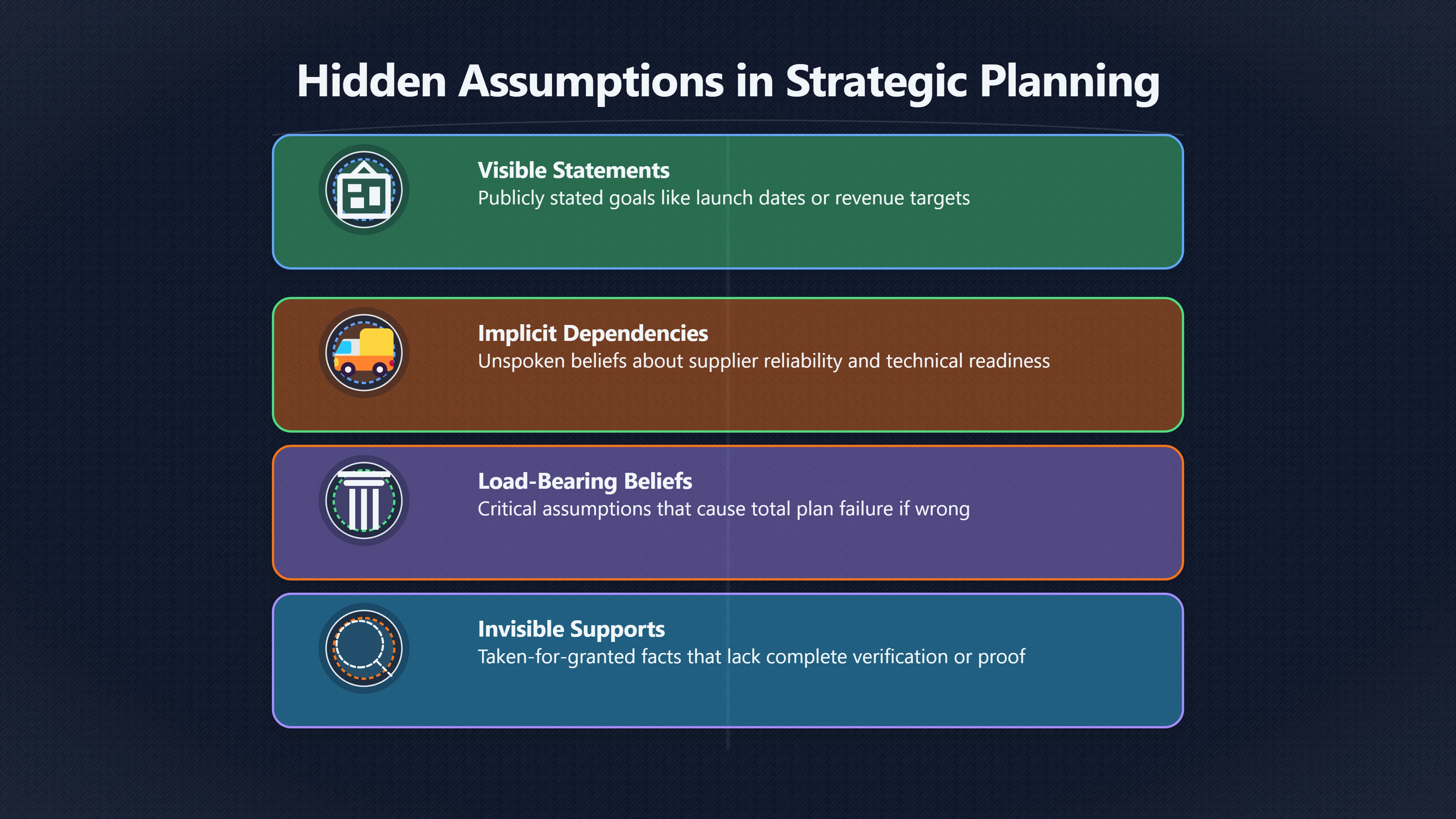
Every argument or plan contains visible statements and invisible dependencies.
A visible statement might be, “We should launch in September.” Beneath it sit several assumptions:
- Customers will still have the same priorities.
- The product will be technically ready.
- Suppliers will deliver on time.
- No competitor will fundamentally change the market.
- The available budget will remain sufficient.
The recommendation appears to stand on evidence, but in reality it rests on these supporting beliefs. If even one critical assumption fails, the evidence may no longer justify the conclusion.
This is why hidden assumptions are dangerous. Teams often debate conclusions while never discussing the beliefs supporting them. Once an assumption becomes familiar, it starts to feel like a fact rather than an informed guess. RAND’s work on Assumption-Based Planning argues that many organisational surprises occur because decision-makers forget they were making assumptions at all. The purpose of assumption analysis is therefore to make those invisible supports visible before reality tests them instead. [RAND Corporation]rand.orgRAND CorporationAssumption-Based Planning: A Tool for Reducing…Assumption-based planning (ABP) is a tool for identifying as many of th…
A useful distinction is between:
- Facts: supported by current evidence.
- Predictions: expectations about future events.
- Assumptions: statements accepted without complete verification because planning must continue.
Confusing these categories often creates false confidence.
Prompts for surfacing load-bearing beliefs
Finding assumptions requires deliberately asking questions that expose what has become taken for granted.
Instead of asking only “Is the plan good?”, analytical thinkers ask questions such as:
- What must be true for this plan to succeed?
- Which part of the plan depends most heavily on something outside our control?
- Which assumption would most surprise us if it failed?
- What have we treated as certain simply because it has always been true before?
- What would someone who disagrees with us say we are overlooking?
- If this plan failed completely in six months, which assumption would probably have been wrong?
These prompts shift discussion away from defending the proposal and towards examining its foundations.
One useful technique is to rewrite every major planning statement as an explicit assumption.
Instead of:
“Revenue will grow by 20%.”
Write:
“We assume existing customers will continue purchasing at current rates while new customer acquisition improves.”
Once written this way, the assumption becomes testable rather than invisible.
Strategic Assumption Surfacing and Testing (SAST) formalises this idea by encouraging participants to identify assumptions, deliberately challenge them from opposing viewpoints, and then integrate the strongest evidence into a revised plan. Rather than treating disagreement as an obstacle, it treats structured opposition as a way to improve decision quality. [ifm.eng.cam.ac.uk]ifm.eng.cam.ac.ukStrategic Assumptions Surfacing and TestingSAST is a process which reveals the underlying assumptions of a policy or plan and helps creat…
Which assumptions deserve the most attention?
Not every assumption needs extensive investigation.
The most valuable stress-testing focuses on assumptions that combine two characteristics:
- High uncertainty: there is genuine reason to think the assumption could be wrong.
- High impact: if wrong, the plan changes substantially.
This creates four broad categories.
Assumption typePriorityLikely true, low impactMonitor lightlyLikely true, high impactValidate if practicalUncertain, low impactAccept or monitorUncertain, high impactTest immediately
Many organisations waste effort checking assumptions that are easy to verify but relatively unimportant, while ignoring assumptions that are difficult to test but capable of destroying the project.
Project risk guidance often recommends converting assumptions into explicit risk statements by asking:
If this assumption proves false, then what happens?
This simple “if–then” framing naturally combines likelihood with consequences and reveals which assumptions deserve active management. [projectmanagement.com]projectmanagement.comAnalysing Assumptions & ConstraintsThe IF side tests how likely the assumption is to be unsafe, and the THEN side tests whether it matters…
Practical ways to stress-test assumptions
Stress-testing is stronger when it moves beyond discussion into evidence.
Useful approaches include:
- Seek disconfirming evidence. Rather than collecting support for an assumption, actively search for situations where it failed.
- Run small experiments. Test the assumption at low cost before scaling the plan.
- Use independent reviewers. People not invested in the proposal often identify assumptions insiders overlook.
- Compare multiple futures. Ask whether the plan still succeeds under different plausible economic, competitive or regulatory conditions.
- Reverse the assumption. Imagine the opposite is true and examine how the plan would need to change.
For example, instead of assuming customers value a new feature, release a limited prototype or conduct structured user testing before investing in a full launch. The objective is to learn while mistakes are still inexpensive.
RAND’s Assumption-Based Planning extends this process further by identifying vulnerable assumptions, defining observable “signposts” that indicate when an assumption is weakening, and preparing both shaping actions (to influence events) and hedging actions (to reduce damage if the assumption fails). This transforms assumption testing from a one-time exercise into an ongoing monitoring process. [RAND Corporation]rand.orgRAND CorporationAssumption-Based Planning: A Tool for Reducing…Assumption-based planning (ABP) is a tool for identifying as many of th…
Common traps when testing assumptions
Stress-testing itself can become ineffective if several predictable errors occur.
Testing only convenient assumptions. Teams often verify details that are easy to measure while ignoring politically sensitive assumptions.
Mistaking confidence for evidence. Strong agreement within a group does not increase the probability that an assumption is correct.
Confusing historical stability with future certainty. An assumption may have held for years but still become vulnerable after technological, regulatory or market changes.
Stopping after one successful test. Conditions evolve. Critical assumptions should be monitored rather than treated as permanently validated.
Treating assumptions independently. Several individually reasonable assumptions may become unrealistic when combined. For example, expecting rapid hiring, falling costs, increasing demand and shorter delivery times simultaneously may produce an internally inconsistent plan.
Prioritising assumptions by damage if they fail
A practical review begins by listing every important assumption, then scoring each using two simple questions:
- How likely is this assumption to fail during the planning period? [thelaterallens.substack.com]thelaterallens.substack.comassumption based planningsubstack.comAssumption-Based Planning - The Lateral LensAssumption-Based Planning, or ABP, is an approach to strategic planning originall…
- If it fails, how much of the plan becomes invalid?
Those with both high likelihood and high consequences become the first candidates for evidence gathering, contingency planning or redesign.
For each critical assumption, it is useful to record:
- The assumption itself.
- Evidence supporting it.
- Evidence against it.
- Early warning indicators that it may no longer hold.
- What action will be taken if it fails.
This transforms assumptions from forgotten background beliefs into managed decision variables.
The most resilient plans are rarely those built on the most optimistic assumptions. They are the ones whose creators knew exactly which assumptions mattered, challenged them before committing fully, and prepared realistic alternatives for the ones most likely to fail.
Amazon book picks
Further Reading
Books and field guides related to Which assumption could break the plan?. Use these as the next step if you want deeper reading beyond the article.
Decisive
Introduces practical techniques for stress-testing options and challenging key assumptions before acting.
Super Thinking
Provides frameworks for testing assumptions and evaluating decision quality.
Thinking, Fast and Slow
Explains systematic judgment errors that often hide inside planning assumptions.
The Art of Thinking Clearly
Helps readers identify flawed assumptions and cognitive biases that can undermine plans.
eBay marketplace picks
Marketplace Samples
Live-tested eBay searches with available results related to this page.



Endnotes
-
Source: rand.org
Link: https://www.rand.org/pubs/commercial_books/CB399.htmlSource snippet
RAND CorporationAssumption-Based Planning: A Tool for Reducing...Assumption-based planning (ABP) is a tool for identifying as many of th...
-
Source: ifm.eng.cam.ac.uk
Link: https://www.ifm.eng.cam.ac.uk/research/dstools/strategic-assumptions-surfacing-and-testing/Source snippet
Strategic Assumptions Surfacing and TestingSAST is a process which reveals the underlying assumptions of a policy or plan and helps creat...
-
Source: projectmanagement.com
Link: https://www.projectmanagement.com/blog-post/14114/Analysing-Assumptions—ConstraintsSource snippet
Analysing Assumptions & ConstraintsThe IF side tests how likely the assumption is to be unsafe, and the THEN side tests whether it matters...
-
Source: Wikipedia
Title: Strategic assumption surfacing and testing
Link: https://en.wikipedia.org/wiki/Strategic_assumption_surfacing_and_testing -
Source: thelaterallens.substack.com
Title: assumption based planning
Link: https://thelaterallens.substack.com/p/assumption-based-planningSource snippet
substack.comAssumption-Based Planning - The Lateral LensAssumption-Based Planning, or ABP, is an approach to strategic planning originall...
Additional References
-
Source: catdir.loc.gov
Link: https://catdir.loc.gov/catdir/samples/cam033/2002073460.pdfSource snippet
Assumption-Based PlanningABP generates scenarios from broken load-bearing, vulnerable assumptions as a means of identifying hedging actio...
-
Source: betterevaluation.org
Link: https://www.betterevaluation.org/sites/default/files/abp.pdfSource snippet
Assumption-Based planning (ABP)Assumption-Based planning (ABP) is a planning method that helps an organisation to prepare to change its o...
-
Source: linkedin.com
Link: https://www.linkedin.com/pulse/reality-check-can-assumptions-your-strategic-plan-zcqxcSource snippet
Can the assumptions in your strategic plan survive a stress...The following framework is the one we use at FrontierView to stress-test t...
-
Source: pmi.org
Link: https://www.pmi.org/learning/library/assumptions-based-planning-analyze-techniques-6582Source snippet
Project Management InstituteDon't make an ass out of you and me--using assumptions...This paper will examine the various models of findi...
-
Source: polgovpro.blog
Title: working with assumptions risky but necessary
Link: https://polgovpro.blog/2023/05/03/working-with-assumptions-risky-but-necessary/Source snippet
Working with assumptions – risky but necessary3 May 2023 — Testing or validating assumptions is important to the extent that's possible...
Published: May 2023
-
Source: youtube.com
Title: Why Most Strategies Fail — And How Assumption-Based Planning Fixes It
Link: https://www.youtube.com/watch?v=K2XQqXzkNTUSource snippet
How to Lead Growth When Strategy Can't Keep up with Change...
-
Source: youtube.com
Title: FPA Insights Scenario Analysis and Planning
Link: https://www.youtube.com/watch?v=1oFoNG7S8-YSource snippet
Using Data Modelling to Test Business Assumptions...
-
Source: youtube.com
Title: Navigating Uncertainty with David Bland
Link: https://www.youtube.com/watch?v=jogqhWte88kSource snippet
FPA Insights Scenario Analysis and Planning...
-
Source: youtube.com
Title: How to Lead Growth When Strategy Can’t Keep up with Change
Link: https://www.youtube.com/watch?v=QbR9uuJeaMwSource snippet
Navigating Uncertainty with David Bland...
-
Source: youtube.com
Title: Using Data Modelling to Test Business Assumptions
Link: https://www.youtube.com/watch?v=iUFxPMA8SdE
Topic Tree