Within Source Quality
Repeating Words Is Not Replicating Evidence
Scientific agreement is strongest when separate studies with their own data point in the same direction.
On this page
- Reproducibility with the same data and code
- Replicability across separate studies
- How to read scientific consensus carefully
Page outline Jump by section
Introduction
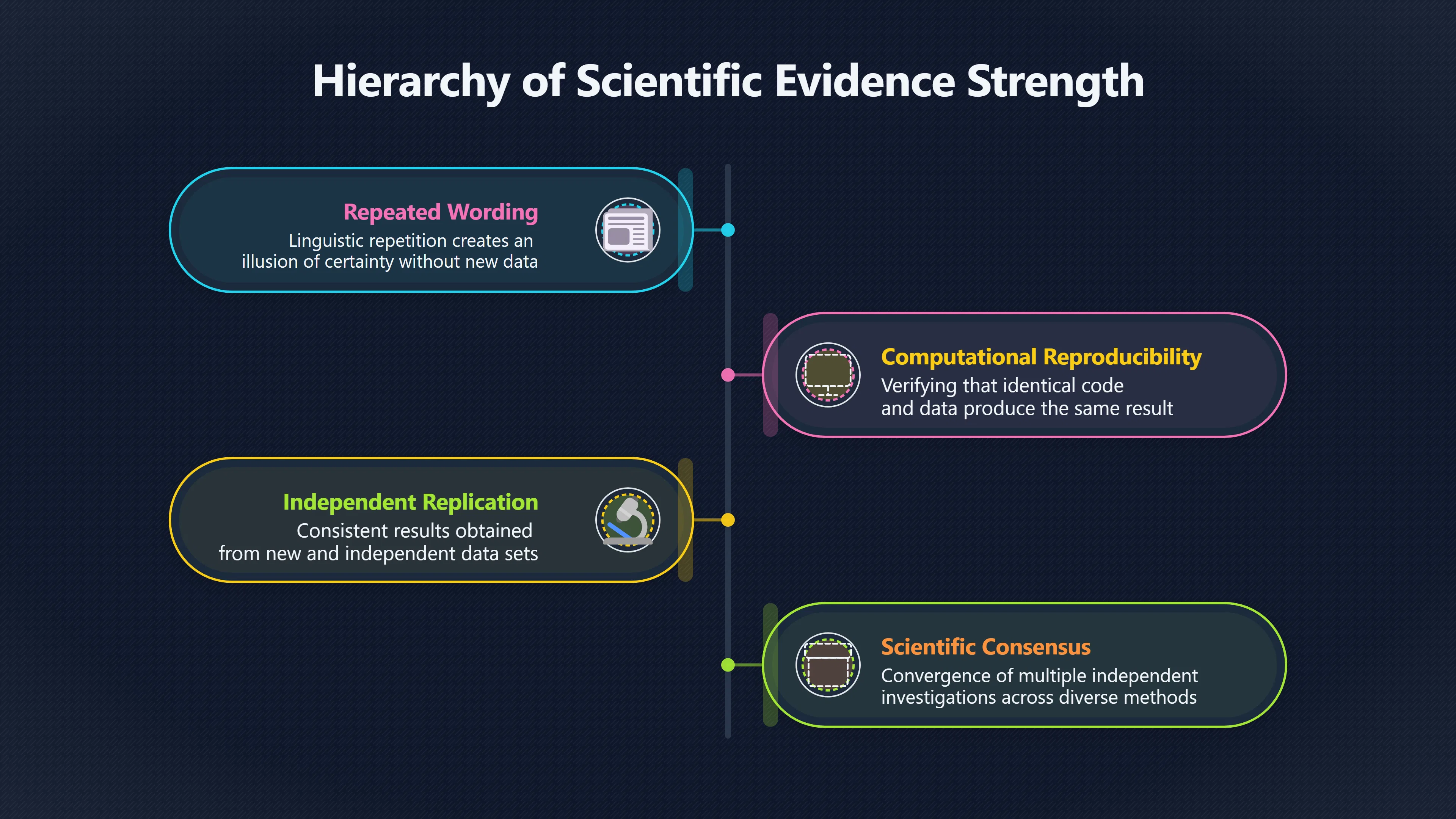
When several scientific papers appear to say the same thing, it is tempting to assume the evidence is strong. However, repeated wording is not the same as repeated evidence. Scientific confidence grows primarily when independent researchers, using their own data and appropriate methods, arrive at broadly consistent conclusions. Simply restating an earlier claim, citing the same experiment, or repeating the same analysis does not provide new evidence. Understanding this distinction is one of the most valuable analytical habits because it helps separate genuine corroboration from the illusion of agreement.
 Science therefore offers an excellent model for evaluating sources. Rather than counting how many times a claim has been repeated, ask how many genuinely independent investigations support it, how similar or different their methods are, and whether they converge despite those differences.
Reproducibility with the same data and code
One important form of verification asks a simple question: if another researcher uses exactly the same data, computer code and analytical procedures, do they obtain the same result?
The US National Academies define this as reproducibility (sometimes called computational reproducibility). If the published analysis cannot be reproduced using the original materials, confidence in the reported findings is reduced because the result may depend on undocumented steps, software errors, or mistakes in the analysis. [National Academies]nationalacademies.orgNational AcademiesReproducibility and Replicability in Science (2019)Replicability is obtaining consistent results across studies aimed a…
Reproducibility is valuable because it checks whether:
- the published methods accurately describe what was done;
- calculations are free from coding or transcription errors;
- statistical analyses can be independently verified;
- other researchers can inspect the reasoning behind the conclusions.
However, reproducibility alone does not establish that a scientific claim is true. If the original dataset is biased, incomplete or collected under flawed conditions, perfectly reproducing the same analysis merely confirms that the same inputs produce the same outputs. It does not show that the underlying conclusion reflects reality.
This is an important distinction for analytical thinking. Repeating a calculation is stronger than merely repeating a sentence, but it still relies on a single body of evidence.
Replicability across separate studies
The stronger test is replicability: whether independent researchers addressing the same scientific question, but collecting new and independent data, obtain broadly consistent results.
The National Academies define replicability as obtaining consistent results across studies that answer the same question while using their own independently gathered evidence. Because every study contains uncertainty, replication does not require identical numerical results; it requires findings that are consistent within reasonable scientific expectations. [National Academies]nationalacademies.orgNational AcademiesReproducibility and Replicability in Science (2019)Replicability is obtaining consistent results across studies aimed a…
Independent replication is powerful because it reduces the likelihood that an apparent discovery depends on:
- an unusual sample;
- measurement error;
- accidental statistical fluctuations;
- unnoticed methodological mistakes;
- local conditions unique to one laboratory or dataset.
If multiple research teams working independently continue to find similar effects, confidence gradually increases that the finding reflects a genuine feature of the world rather than an artefact of one investigation.
Conversely, numerous review articles or news stories discussing one influential experiment do not increase the amount of evidence if they all rely on that original experiment.
Why repeated wording creates an illusion of certainty
Outside science, agreement is often measured by counting how many sources make the same claim. Scientific practice shows why this shortcut can be misleading.
Imagine one influential study reports a surprising result. Over the following years:
- textbooks summarise it;
- review papers discuss it;
- journalists report it;
- blogs explain it;
- presentations quote it.
The wording becomes increasingly familiar. Yet all these sources may ultimately trace back to a single dataset.
The apparent agreement is therefore largely linguistic rather than evidential.
Analytically, this is similar to tracing citations backwards. A hundred articles may appear independent until one discovers they all cite the same original publication. The number of repeated claims has increased, but the amount of underlying evidence has not.

When replication strengthens confidence
Replication is not merely repetition. Good replication introduces new opportunities for error to appear—and therefore new opportunities for confidence to grow when they do not.
Useful replication often involves:
- different researchers;
- different institutions;
- new participants or observations;
- independent funding;
- different equipment or laboratories;
- alternative but appropriate measurement techniques.
If similar conclusions emerge despite these differences, the evidence becomes more persuasive because multiple potential sources of bias have been tested independently.
Science therefore values convergence more than uniformity. Identical wording contributes little. Independent agreement produced under different conditions contributes much more.
Why failed replications matter
A failure to replicate is often misunderstood as proof that the original study was fraudulent or worthless. In reality, science expects some findings to weaken, disappear or become more precisely estimated as additional evidence accumulates.
Large-scale investigations in several disciplines have shown that some published findings do not replicate as strongly as initially reported. These projects have encouraged improvements in study design, statistical practice, data sharing and transparency rather than undermining the scientific method itself. The National Academies emphasise that replication is only one route to building confidence, alongside systematic reviews, meta-analysis and the accumulation of diverse evidence. [National Academies]nationalacademies.orgNational AcademiesNew Report Examines Reproducibility and Replicability in…Apr 7, 2019 — Replicability and reproducibility, useful as…
This illustrates an important lesson for critical thinking:
- replication failures do not necessarily invalidate an entire field;
- successful replications do not guarantee permanent certainty;
- scientific confidence develops from many independent investigations over time.
Science advances partly because claims remain open to continued testing.
How to read scientific consensus carefully
Scientific consensus should not be confused with simple numerical agreement among publications.
When evaluating whether a scientific conclusion is well supported, ask questions such as:
- How many independent datasets exist? Multiple studies using separate data are generally more informative than repeated discussion of one study.
- Are different research groups involved? Independence reduces shared sources of error.
- Have different methods reached similar conclusions? Convergence across approaches is stronger than identical procedures repeated by the same team.
- Have systematic reviews or meta-analyses assessed the entire body of evidence? These methods evaluate patterns across many studies rather than relying on isolated findings. [National Academies]nationalacademies.orgNational AcademiesNew Report Examines Reproducibility and Replicability in…Apr 7, 2019 — Replicability and reproducibility, useful as…
- Do later studies refine rather than simply repeat earlier claims? Mature scientific understanding usually develops through incremental improvement rather than endless citation of the original paper.
A genuine scientific consensus therefore reflects accumulated independent inquiry, not widespread repetition of a familiar statement.
The analytical lesson
The distinction between replication and repeated wording applies well beyond science. Whenever many sources appear to agree, the key question is whether they represent multiple independent investigations or merely multiple retellings of the same information.
Scientific practice deliberately rewards independent verification because repeated language can amplify confidence without increasing evidence. Replication, by contrast, increases confidence precisely because it introduces fresh opportunities for claims to fail. When they continue to succeed under independent testing, agreement becomes evidence rather than echo.
Amazon book picks
Further Reading
Books and field guides related to Repeating Words Is Not Replicating Evidence. Use these as the next step if you want deeper reading beyond the article.
The Art of Statistics
Explains how scientific evidence, uncertainty, and replication should be interpreted.
The Book of Why
Helps readers understand evidence beyond simple repetition of findings.
eBay marketplace picks
Marketplace Samples
Live-tested eBay searches with available results related to this page.



Endnotes
-
Source: nationalacademies.org
Link: https://www.nationalacademies.org/read/25303/chapter/3Source snippet
National AcademiesReproducibility and Replicability in Science (2019)Replicability is obtaining consistent results across studies aimed a...
-
Source: nationalacademies.org
Link: https://www.nationalacademies.org/read/25303/chapter/5Source snippet
Chapter: 2 Scientific Methods and Knowledgethe consideration of reproducibility and replicability in science is intended to maintain and...
-
Source: nationalacademies.org
Link: https://www.nationalacademies.org/news/new-report-examines-reproducibility-and-replicability-in-science-recommends-ways-to-improve-transparency-and-rigor-in-researchSource snippet
National AcademiesNew Report Examines Reproducibility and Replicability in...Apr 7, 2019 — Replicability and reproducibility, useful as...
-
Source: nationalacademies.org
Link: https://www.nationalacademies.org/read/25303/chapter/10Source snippet
Reproducibility and Replicability in Science (2019)In this chapter, the committee illustrates a spectrum of pathways to attain rigor and...
-
Source: nationalacademies.org
Link: https://www.nationalacademies.org/projects/DBASSE-BBCSS-17-03/publication/25303Source snippet
Reproducibility and Replicability in Science2019 · Cited by 1214 — As the result of a mandate from Congress, the National Academies will...
-
Source: psychologicalscience.org
Link: https://www.psychologicalscience.org/policy/national-academies-issues-consensus-report-on-reproducibility-and-replicability-in-science.htmlSource snippet
May 8, 2019 — The report defines key terms, examines the state of reproducibility and replicability in science, and reviews current activ...
Published: May 8, 2019
-
Source: storage.knaw.nl
Title: 20180115 replication studies web
Link: https://storage.knaw.nl/2022-08/20180115-replication-studies-web.pdfSource snippet
reproducibility in the empirical sciencesStatistical challenges in assessing and fostering the reproducibility of scientific results: Sum...
Additional References
-
Source: cra.org
Link: https://cra.org/crn/2019/06/nas-report-on-reproducibility-and-repeatability-in-science/Source snippet
NAS Report on Reproducibility and Repeatability in ScienceThe report provides a series of recommendations to scientists, funding agencies...
-
Source: bioterio.facmed.unam.mx
Link: https://bioterio.facmed.unam.mx/docs/Libro_Reproducibilidad_y_replicabilidad_NAS-press.pdfSource snippet
and Replicability in ScienceConsensus Study Reports published by the National Academies of Sciences. Engineering, and Medicine document...
-
Source: ncbi.nlm.nih.gov
Title: NCBIReproducibility and Replicability in Science
Link: https://www.ncbi.nlm.nih.gov/books/NBK547537/Source snippet
and Replicability in Science - NCBI Bookshelf7 May 2019 — This report provides recommendations to researchers, academic institutions, jou...
Published: May 2019
-
Source: goodreads.com
Title: 48984704 reproducibility and replicability in science
Link: https://www.goodreads.com/book/show/48984704-reproducibility-and-replicability-in-scienceSource snippet
Reproducibility and Replicability in Science16 Oct 2019 — This report provides recommendations to researchers, academic institutions, jou...
-
Source: facebook.com
Link: https://www.facebook.com/neurosciencenews/posts/new-report-examines-reproducibility-and-replicability-in-sciencewhile-computatio/10156261128068803/Source snippet
ic disruptiveness, persistent reproducibility problems, and...Read more...
-
Source: vimeo.com
Link: https://vimeo.com/335923468Source snippet
Report" by The National Academies on Vimeo, the home for high...
-
Source: hdsr.mitpress.mit.edu
Title: nas report highlights
Link: https://hdsr.mitpress.mit.edu/pub/nas-report-highlightsSource snippet
and Replicability in Science: Report Highlights2020 — A National Academies' report, Reproducibility and Replicability in Science (2019)...
-
Source: youtube.com
Link: https://www.youtube.com/watch?v=BD-CUcE-GDwSource snippet
5 Reproducibility and Replicability - Harvey Fineberg...
-
Source: youtube.com
Title: Is there a reproducibility crisis in science?
Link: https://www.youtube.com/watch?v=FpCrY7x5nEESource snippet
4 In scientific method we don't just trust: or why replication has more value than discovery...
-
Source: ncbi.nlm.nih.gov
Link: https://www.ncbi.nlm.nih.gov/books/NBK547531/Source snippet
Reproducibility and Replicability in Science - NCBIOne of the pathways by which scientists confirm the validity of a new finding or disco...
Topic Tree