Within Decision Journal
Why outcomes make old choices look obvious
Knowing the outcome can make past uncertainty feel falsely obvious, so a journal review needs to protect the original forecast.
On this page
- What hindsight bias changes in memory
- How original entries preserve uncertainty
- Review questions that resist rewriting the past
Page outline Jump by section
Introduction
A decision journal only improves judgement if it preserves what you genuinely believed before events unfolded. Once an outcome is known, the mind tends to rewrite the past, making uncertainty feel smaller and the eventual result seem far more predictable than it really was. This is known as hindsight bias, sometimes called the “knew-it-all-along” effect. It can cause people to misremember their forecasts, exaggerate how obvious warning signs were, and learn the wrong lessons from both successes and failures. [The Decision Lab]thedecisionlab.comThe Decision LabHindsight BiasAlso called the “knew-it-all-along” effect, this bias occurs when our current knowledge of an event's outco…
 For decision journal reviews, hindsight bias is not merely an interesting psychological finding. It is the main reason for keeping written records in the first place. A well-kept journal allows the review to compare the original reasoning with reality instead of comparing reality with a reconstructed memory.
What hindsight bias changes in memory
Hindsight bias works by allowing outcome knowledge to contaminate memory of earlier beliefs. After learning the result, people commonly believe they expected it all along, even when contemporaneous evidence shows they did not. Research beginning with Baruch Fischhoff’s classic experiments demonstrated that simply telling people an outcome changes how likely they judge it to have been beforehand. The distortion often occurs without people recognising that their memories have shifted. [Wikipedia]WikipediaHindsight biasHindsight bias
Several changes typically occur during a retrospective review:
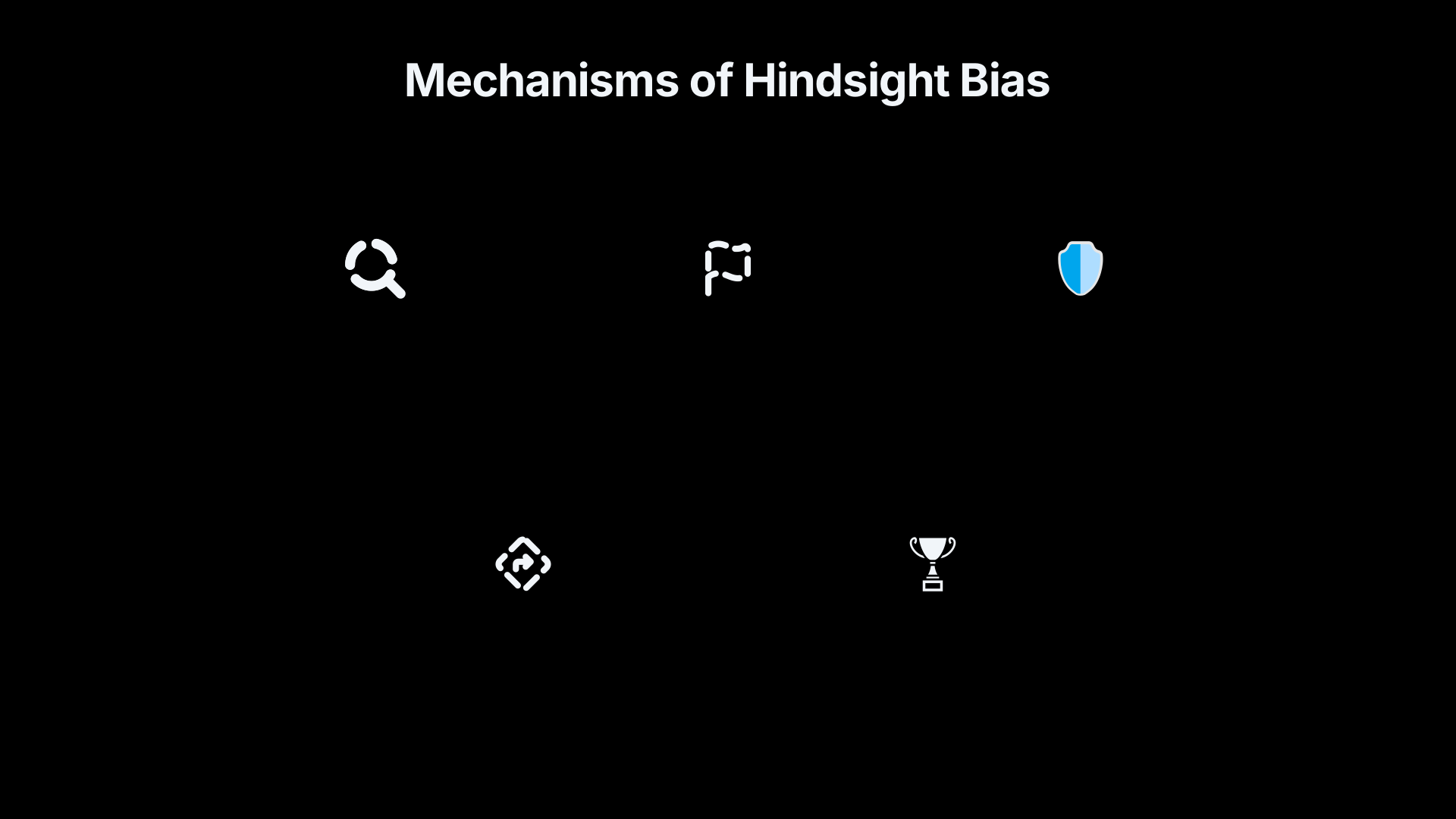
- Original uncertainty shrinks. Possibilities that once seemed plausible disappear from memory.
- Signals become exaggerated. Ordinary facts are reinterpreted as clear warning signs or obvious opportunities.
- Confidence is rewritten. People remember having been more certain than they actually were.
- Alternative futures vanish. Once one path becomes reality, the other realistic possibilities receive little attention.
These distortions matter because learning depends on accurately reconstructing the decision environment, not simply explaining the outcome after the fact. If the past appears more predictable than it was, future confidence grows without corresponding improvements in judgement. [The Decision Lab]thedecisionlab.comThe Decision LabHindsight BiasAlso called the “knew-it-all-along” effect, this bias occurs when our current knowledge of an event's outco…
How original entries preserve uncertainty
The greatest value of a decision journal is that it freezes an “ex ante” view—the perspective before the outcome was known. Rather than relying on memory, the reviewer can inspect what was actually written at the time.
A strong journal entry typically captures:
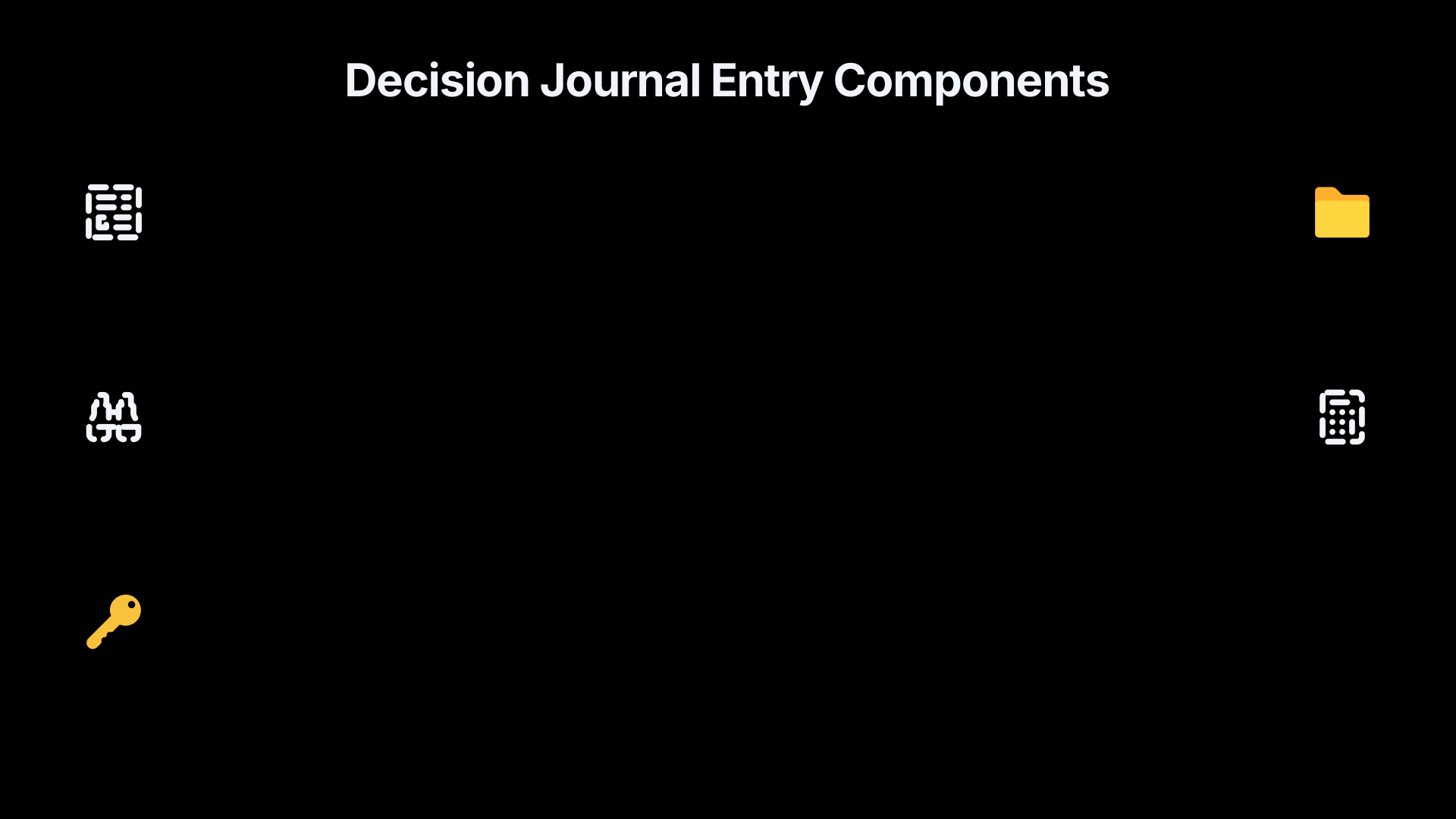
- the decision being made;
- the evidence available at that moment;
- competing explanations or scenarios;
- explicit probability estimates or confidence levels;
- assumptions that would change the decision if proven false.
These records make later revision difficult. Instead of asking, “Didn’t I always think this would happen?”, the reviewer confronts statements such as, “I estimated a 35% chance of this outcome.” The written record replaces reconstructed memory with contemporaneous evidence.
This is particularly valuable because hindsight bias is resistant to simple warnings. Studies have repeatedly found that merely telling people about the bias does not reliably eliminate it once the outcome is known. Preserving original forecasts is therefore more effective than trusting memory alone. [RJ Starr]profrjstarr.comhindsight bias why we always knew it all alongRJ StarrHindsight Bias: Why We Always Knew It All Along27 Jan 2025 — Hindsight bias reassures us that we're perceptive, rational, and in…
Why outcomes alone are poor teachers
A decision review should distinguish between the quality of the reasoning process and the quality of the outcome. Hindsight bias encourages the mistaken belief that a bad result proves poor judgement or that a good result confirms good judgement.
This overlaps with, but differs from, outcome bias. Outcome bias occurs when people judge the quality of a decision primarily by how it turned out rather than by the information available when it was made. Hindsight bias alters memory of what seemed predictable, whereas outcome bias changes evaluation of the decision itself. Together they create a powerful illusion that successful outcomes were both obvious and well reasoned. [Wikipedia]WikipediaOutcome biasOutcome bias
A practical consequence is that luck becomes invisible. A fortunate gamble may be remembered as skilful prediction, while an intelligent decision exposed to bad luck may be unfairly dismissed as poor thinking.
Review questions that resist rewriting the past
A useful review deliberately recreates the original perspective instead of starting from the known result. Questions that encourage this include:
- What information did I actually have when I decided?
- Which realistic alternatives did I record at the time?
- Did the outcome fall within the probability range I expected, even if it was not the most likely case?
- Which assumptions proved correct, and which proved false?
- Would I make the same decision again with exactly the same information?
- Am I criticising the process because of the result, or because the reasoning itself contained identifiable weaknesses?
These questions shift attention away from storytelling and back towards calibration—how well beliefs matched uncertainty before reality supplied the answer.
A simple example
Imagine a manager deciding whether to launch a new product. Before launch, the journal records:
- a 60% chance of moderate commercial success;
- a 25% chance of weak sales;
- a 15% chance of exceptionally strong demand;
- key assumptions about customer adoption and competitor response.
Suppose the product ultimately fails because a competitor unexpectedly releases a superior alternative.
Without the journal, the manager may later believe the competitive threat was “obvious” and conclude the launch was clearly a mistake. With the journal, the review reveals that the competitor’s move had been recognised as a low-probability risk rather than ignored entirely. The learning changes from “I should have known” to “I underestimated this scenario and should assign higher probability to similar competitive risks in future.”
That distinction produces better forecasting rather than greater self-criticism.

The real lesson from hindsight bias
The purpose of reviewing a decision journal is not to prove that past choices were right or wrong. It is to recover the uncertainty that genuinely existed before events unfolded. By preserving original forecasts, confidence levels and assumptions, a journal prevents memory from quietly rewriting history.
The result is more accurate feedback about judgement itself. Instead of learning from stories constructed after the outcome, the reviewer learns from the actual reasoning that produced the decision—a far more reliable foundation for improving analytical thinking over time. [The Decision Lab+2Wikipedia]thedecisionlab.comThe Decision LabHindsight BiasAlso called the “knew-it-all-along” effect, this bias occurs when our current knowledge of an event's outco…
Amazon book picks
Further Reading
Books and field guides related to Why outcomes make old choices look obvious. Use these as the next step if you want deeper reading beyond the article.
The Art of Thinking Clearly
Includes practical discussions of common cognitive biases.
eBay marketplace picks
Marketplace Samples
Live-tested eBay searches with available results related to this page.



Endnotes
-
Source: Wikipedia
Title: Hindsight bias
Link: https://en.wikipedia.org/wiki/Hindsight_bias -
Source: Wikipedia
Title: Outcome bias
Link: https://en.wikipedia.org/wiki/Outcome_bias -
Source: youtube.com
Title: The Ultimate Guide to Using a Decision Journal
Link: https://www.youtube.com/watch?v=ReetUAwTDKkSource snippet
Hindsight Bias...
-
Source: thedecisionlab.com
Link: https://thedecisionlab.com/biases/hindsight-biasSource snippet
The Decision LabHindsight BiasAlso called the “knew-it-all-along” effect, this bias occurs when our current knowledge of an event's outco...
-
Source: profrjstarr.com
Title: hindsight bias why we always knew it all along
Link: https://profrjstarr.com/cognitive-biases/hindsight-bias-why-we-always-knew-it-all-alongSource snippet
RJ StarrHindsight Bias: Why We Always Knew It All Along27 Jan 2025 — Hindsight bias reassures us that we're perceptive, rational, and in...
-
Source: dictionary.cambridge.org
Link: https://dictionary.cambridge.org/dictionary/english/hindsightSource snippet
English meaning - Cambridge Dictionarythe ability to understand, after something has happened, why or how it was done and how it might...
-
Source: vocabulary.com
Link: https://www.vocabulary.com/dictionary/hindsightSource snippet
Hindsight - Definition, Meaning & SynonymsHindsight is like looking behind you to see what just happened (behind sight, get it?)...
Additional References
-
Source: ai-sdk.dev
Link: https://ai-sdk.dev/providers/community-providers/hindsightSource snippet
Community Providers: HindsightHindsight is a persistent memory service for AI agents. The @vectorize-io/hindsight-ai-sdk package provides...
-
Source: merriam-webster.com
Link: https://www.merriam-webster.com/dictionary/hindsightSource snippet
HINDSIGHT Definition & Meaning: perception of the nature of an event after it has happened. In hindsight, it's clear there were alternati...
-
Source: hindsight.vectorize.io
Link: https://hindsight.vectorize.io/Source snippet
vectorize.ioHindsight: OverviewWhy Hindsight?. AI agents forget everything between sessions. Every conversation starts from zero—no cont...
-
Source: reddit.com
Link: https://www.reddit.com/r/Rag/comments/1po8087/introducing_hindsight_stateoftheart_memory_for/Source snippet
state so the Agent can follow through the historical changes about a...Read more...
-
Source: ycombinator.com
Link: https://www.ycombinator.com/companies/hindsightSource snippet
Hindsight: Deal Intelligence and Sales Coaching PlatformHindsight's AI helps teams understand why they win or lose deals - and use that i...
-
Source: github.com
Link: https://github.com/vectorize-io/hindsightSource snippet
Agent Memory That Learns15 Jun 2025 — Hindsight™ is an agent memory system built to create smarter agents that learn over time. Most agen...
-
Source: arxiv.org
Link: https://arxiv.org/abs/2512.12818Source snippet
Hindsight is 20/20: Building Agent Memory that Retains...by C Latimer · 2025 · Cited by 27 — We present Hindsight, a memory architecture...
-
Source: pmc.ncbi.nlm.nih.gov
Link: https://pmc.ncbi.nlm.nih.gov/articles/PMC8763848/Source snippet
Impact of Cognitive Biases on Professionals' Decision...by V Berthet · 2022 · Cited by 306 — First, the literature reviewed shows that a...
-
Source: bearworks.missouristate.edu
Link: https://bearworks.missouristate.edu/theses/913/Source snippet
Hindsight Bias and Perceived Controlby M Ciaramitaro · 2003 — Hindsight bias, more commonly called the "knew-it-all-along" effect is an e...
-
Source: youtube.com
Title: Behavioural Biases Hindsight Bias
Link: https://www.youtube.com/watch?v=bQv4l9S6jokSource snippet
The Hindsight Bias - I Knew It All Along Phenomenon - Psychology in 5 Minutes...
Topic Tree