Within Reasoning Chain
A Five Minute Chain for Better Decisions
A five-line chain turns a small but meaningful choice into a clear answer, reasons, uncertainty and next check.
On this page
- When a short chain is enough
- How to fill in each line
- Common mistakes and better examples
Page outline Jump by section
Introduction
Many everyday decisions are too important to leave to impulse but too small to justify a lengthy decision memo. Choosing between two job opportunities, deciding whether to buy an expensive item, accepting an invitation, or changing a routine all benefit from a brief pause without demanding pages of analysis. A five-line chain is a practical compromise: it makes your reasoning visible in just a few minutes while keeping the process light enough to use regularly.
 The value of the method is not that it guarantees perfect choices. Instead, it reduces common thinking errors by separating your answer from the reasons supporting it, acknowledging uncertainty, and identifying the next piece of information worth checking. Research on metacognition—the ability to monitor and regulate your own thinking—consistently shows that deliberately planning, monitoring and evaluating your reasoning improves judgement and self-regulation. [EEF+2PMC]educationendowmentfoundation.org.ukEEFMetacognition and self-regulationMetacognition is the learner's ability to be aware of, reflect on, and direct their thinking. Self-re…
When a short chain is enough
A five-line chain is designed for decisions where the consequences matter but the complexity remains limited. It is especially useful when:
- You are choosing between two or three realistic options.
- Time is available for a few minutes of reflection but not for extensive analysis.
- Your first instinct feels plausible, yet you want to avoid acting purely on emotion.
- The cost of a mistake is moderate rather than catastrophic.
Examples include:
- Should I renew this subscription?
- Is now the right time to replace my laptop?
- Which training course offers the best value?
- Should I work from home tomorrow or go into the office?
- Do I accept this social invitation despite a busy week?
The aim is not to suppress intuition. Initial impressions often contain useful experience. The written chain simply tests whether that intuition survives a brief inspection.
How to fill in each line
The structure deliberately stays compact. Limiting yourself to five lines forces clarity instead of encouraging endless justification.
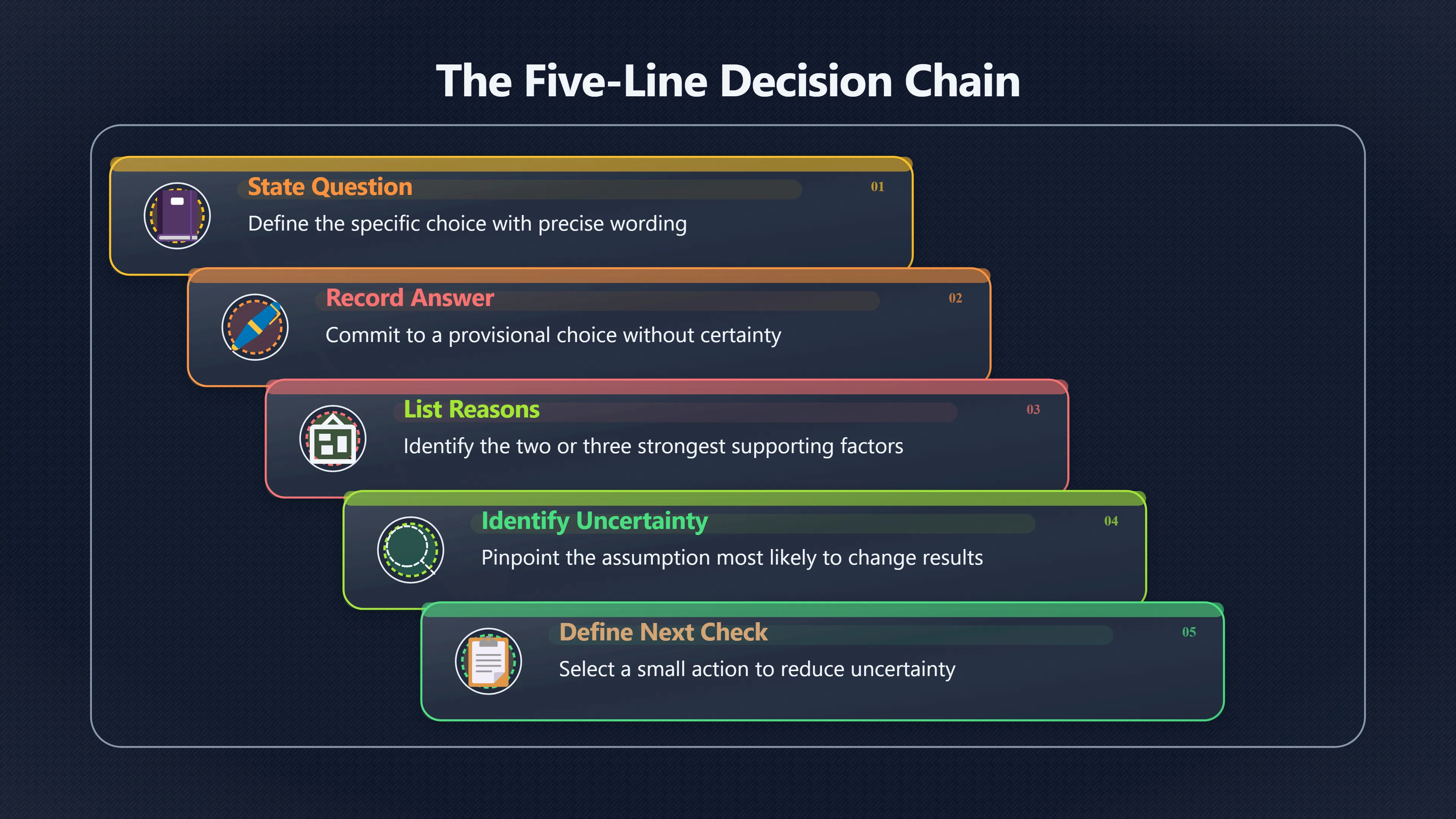
- Decision State the question precisely. Example: Should I buy the annual membership rather than paying monthly?
- Current answer Record your best provisional choice. Example: Yes, the annual plan is probably better.
- Main reasons List the two or three strongest reasons only. Example: Lower overall cost, I use the service weekly, and cancelling is unlikely.
- Biggest uncertainty Identify the assumption most likely to change the decision. Example: Will I still use it regularly six months from now?
- Next check Write the smallest action that would reduce uncertainty. Example: Review my usage over the last three months before purchasing.
Each line performs a distinct function. The first prevents vague questions. The second commits you to a tentative answer without pretending certainty. The third distinguishes reasons from preferences. The fourth highlights the weakest point rather than hiding it. The fifth converts reflection into an immediate action.
A practical example
Imagine deciding whether to commute by bicycle instead of by train.
Decision: Should I cycle to work three days a week?
Current answer: Probably yes.
Main reasons: It saves money, provides regular exercise, and the journey is under 30 minutes.
Biggest uncertainty: I may underestimate how difficult the route feels in bad weather.
Next check: Cycle the route once this weekend and note the travel time and traffic conditions.
Notice what this avoids. Without writing, the decision might simply become, “Cycling seems like a good idea.” The five-line chain exposes the assumption—that the route remains practical—and immediately identifies a low-cost way to test it.
Why the uncertainty line matters most
Most poor everyday decisions are not caused by having no reasons. They result from overlooking the assumption that matters most.
Writing down uncertainty creates a small metacognitive pause. Instead of asking only, “Why am I right?”, you also ask, “What could realistically prove me wrong?” Research on metacognition emphasises monitoring and evaluating one’s own thinking rather than merely generating answers, making this kind of self-check an important part of effective reasoning. [PMC+2cambridgeinternational.org]pmc.ncbi.nlm.nih.govMetacognitive Strategies and Development of Critical Thinking…by SF Rivas · 2022 · Cited by 502 — Metacognition helps form autonomo…
Importantly, the uncertainty line should remain specific. Compare these examples:
- Weak: “I could be wrong.”
- Better: “My estimate of future usage could be too optimistic.”
The second statement can actually be investigated.

Turning reflection into action
Many reflection exercises end with greater awareness but no behavioural change. The fifth line avoids this by requiring a concrete next step.
A useful next check should be:
- Small enough to complete quickly.
- Directly related to the largest uncertainty.
- Capable of changing your decision.
Examples include:
- Read one independent review. [education.nsw.gov.au]education.nsw.gov.auMetacognition: a key to unlocking learningThere is good evidence that metacognition, as one aspect of self‑regulation, is a predictor and…
- Compare last month’s spending.
- Ask one experienced colleague.
- Sleep on the decision until tomorrow.
- Gather one missing price quote.
The objective is not to eliminate every uncertainty. It is to reduce the uncertainty that matters most.
Common mistakes and better examples
Several habits reduce the value of the five-line chain.
Mistake: Writing opinions instead of reasons
Poor:
- “It feels more professional.”
Better:
- “Three experienced colleagues independently recommended it.”
Evidence-based reasons are easier to examine than personal impressions.
Mistake: Listing every possible consideration
Poor:
- Twelve different reasons, many overlapping.
Better:
- The two or three factors most responsible for the decision.
Limiting the list forces prioritisation.
Mistake: Hiding uncertainty
Poor:
- “No major concerns.”
Better:
- “The maintenance costs are largely unknown.”
Good decisions acknowledge uncertainty instead of pretending certainty.
Mistake: Choosing an unhelpful next step
Poor:
- “Think about it more.” [researchschool.org.uk]researchschool.org.ukmetacognition a little elaborationEffective metacognitive approaches get learners to think about their own learning…Read more…
Better:
- “Calculate the total annual cost using last year’s spending.”
The next check should produce new information rather than more rumination.
Building the habit
The greatest benefit comes from repetition rather than perfection. Because the format takes only a few minutes, it can become part of ordinary life instead of being reserved for exceptional decisions.
Over time, reviewing old chains reveals recurring patterns. You may discover that you consistently underestimate time commitments, overestimate future motivation, or neglect maintenance costs. These recurring weaknesses are difficult to spot through memory alone but become visible when decisions are recorded in a consistent format.
Writing also reduces the burden on working memory by placing key elements of the decision outside the mind, making it easier to compare reasons, identify contradictions and revise conclusions before acting. Research on cognitive offloading and external representations suggests that this externalisation can free mental resources for higher-quality evaluation rather than simply remembering details. [education.nsw.gov.au]education.nsw.gov.auMetacognition: a key to unlocking learningThere is good evidence that metacognition, as one aspect of self‑regulation, is a predictor and…
A simple tool for better everyday judgement
A five-line chain is deliberately modest. It is not intended to replace detailed analysis for major financial, medical or legal decisions. Instead, it fills the gap between impulsive choices and formal decision documents.
By recording a clear answer, the reasons supporting it, the biggest remaining uncertainty and one practical next check, the method makes everyday reasoning visible without making it burdensome. That visibility encourages more deliberate thinking, helps expose hidden assumptions and creates a repeatable habit of learning from ordinary decisions rather than merely reacting to them.
Amazon book picks
Further Reading
Books and field guides related to A Five-Minute Chain for Better Decisions. Use these as the next step if you want deeper reading beyond the article.
Decisive
Focuses on practical frameworks for making better everyday decisions with limited time.
Thinking, Fast and Slow
Explains common cognitive biases and practical ways to improve judgement, directly supporting structured decision methods.
Smart Choices
Presents a practical framework for evaluating options and reasoning through decisions systematically.
The Art of Thinking Clearly
Provides concise explanations of reasoning mistakes that a five-line decision chain is designed to reduce.
eBay marketplace picks
Marketplace Samples
Live-tested eBay searches with available results related to this page.


Endnotes
-
Source: educationendowmentfoundation.org.uk
Link: https://educationendowmentfoundation.org.uk/education-evidence/teaching-learning-toolkit/metacognition-and-self-regulationSource snippet
EEFMetacognition and self-regulationMetacognition is the learner's ability to be aware of, reflect on, and direct their thinking. Self-re...
-
Source: pmc.ncbi.nlm.nih.gov
Link: https://pmc.ncbi.nlm.nih.gov/articles/PMC9242397/Source snippet
Metacognitive Strategies and Development of [Critical Thinking]({{ 'critical-skills/' | relative_url }})...by SF Rivas · 2022 · Cited by 502 — Metacognition helps form autonomo...
-
Source: education.nsw.gov.au
Link: https://education.nsw.gov.au/content/dam/main-education/teaching-and-learning/education-for-a-changing-world/media/documents/Metacognition_Full_Report_FINAL.pdfSource snippet
Metacognition: a key to unlocking learningThere is good evidence that metacognition, as one aspect of self‑regulation, is a predictor and...
-
Source: cambridgeinternational.org
Link: https://www.cambridgeinternational.org/Images/272307-metacognition.pdfSource snippet
Education brief - MetacognitionMetacognition describes the processes involved when learners plan, monitor, evaluate and make changes to t...
Additional References
-
Source: cambridge-community.org.uk
Title: Getting started with Metacognition
Link: https://cambridge-community.org.uk/professional-development/gswmeta/index.htmlSource snippet
Cambridge communityMetacognition describes the processes involved when learners plan, monitor, evaluate and make changes to their own lea...
-
Source: researchschool.org.uk
Title: metacognition a little elaboration
Link: https://researchschool.org.uk/unity/news/metacognition-a-little-elaborationSource snippet
Effective metacognitive approaches get learners to think about their own learning...Read more...
-
Source: youtube.com
Title: Watch This For 18 Minutes, and You’ll Outlearn 99.9% Of People
Link: https://www.youtube.com/watch?v=k9SI2cLS73MSource snippet
The #1 Skill You Need: Critical Thinking for Everyday Problems...
-
Source: dl.acm.org
Link: https://dl.acm.org/doi/10.1145/3613904.3642902Source snippet
Metacognitive Demands and Opportunities of...11 May 2024 — We argue that metacognition—the psychological ability to monitor and control...
Published: May 2024
-
Source: youtube.com
Title: Metacognition: An Important Skill for Modern Times
Link: https://www.youtube.com/watch?v=h68bS4c4kw0Source snippet
Watch This For 18 Minutes, and You'll Outlearn 99.9% Of People...
-
Source: mdpi.com
Link: https://www.mdpi.com/2306-5729/10/11/172Source snippet
From Offloading to Engagement: An Experimental Study on...by M Gerlich · 2025 · Cited by 27 — Results show that unguided AI use fosters...
-
Source: ibo.org
Title: metacognition policy paper
Link: https://ibo.org/globalassets/new-structure/research/pdfs/metacognition-policy-paper.pdfSource snippet
To help make the abstract explicit...Read more...
-
Source: youtube.com
Title: How to Make a Decision
Link: https://www.youtube.com/watch?v=3-ahNeWAGvESource snippet
How to Make Excellent Decisions - The 5Cs Decision Making Process...
-
Source: youtube.com
Title: The #1 Skill You Need: Critical Thinking for Everyday Problems
Link: https://www.youtube.com/watch?v=-Hz84s1MBDMSource snippet
How to Make a Decision...
-
Source: youtube.com
Title: How to Make Excellent Decisions
Link: https://www.youtube.com/watch?v=U_ILEy0wM98
Topic Tree