Within Myside Bias
How to Stop Arguing Like a Lawyer
A few practical checks can shift reasoning from defending a side toward mapping what the evidence actually supports.
On this page
- Search asymmetry and standard shifting in everyday arguments
- Questions that reveal what would count against your view
- Small precommitments that reduce moving goalposts
Page outline Jump by section
Introduction
One of the most effective ways to reduce myside bias is to stop treating every disagreement as if you were a barrister whose job is to win. In everyday life, your goal is rarely to persuade a judge or jury. It is usually to understand what is true, make better decisions, or solve a shared problem. The trouble is that once a conversation becomes a defence of your identity or reputation, your reasoning often shifts into advocacy mode: you search harder for supporting evidence, raise the standard for opposing evidence, and quietly move the goalposts when challenged. Research on myside bias consistently shows that this tendency is widespread and only weakly related to intelligence, making deliberate thinking habits more important than raw cognitive ability. [Association for Psychological Science]psychologicalscience.orgAssociation for Psychological ScienceMyside Bias, Rational Thinking, and IntelligenceAugust 1, 2013 — by KE Stanovich · Cited by 678 — My…
 The practical aim is not to become neutral about everything. It is to build simple habits that interrupt defensive reasoning before it becomes automatic. These “scout checks” help replace the mindset of proving a case with the mindset of mapping reality.
Search asymmetry and shifting standards in everyday arguments
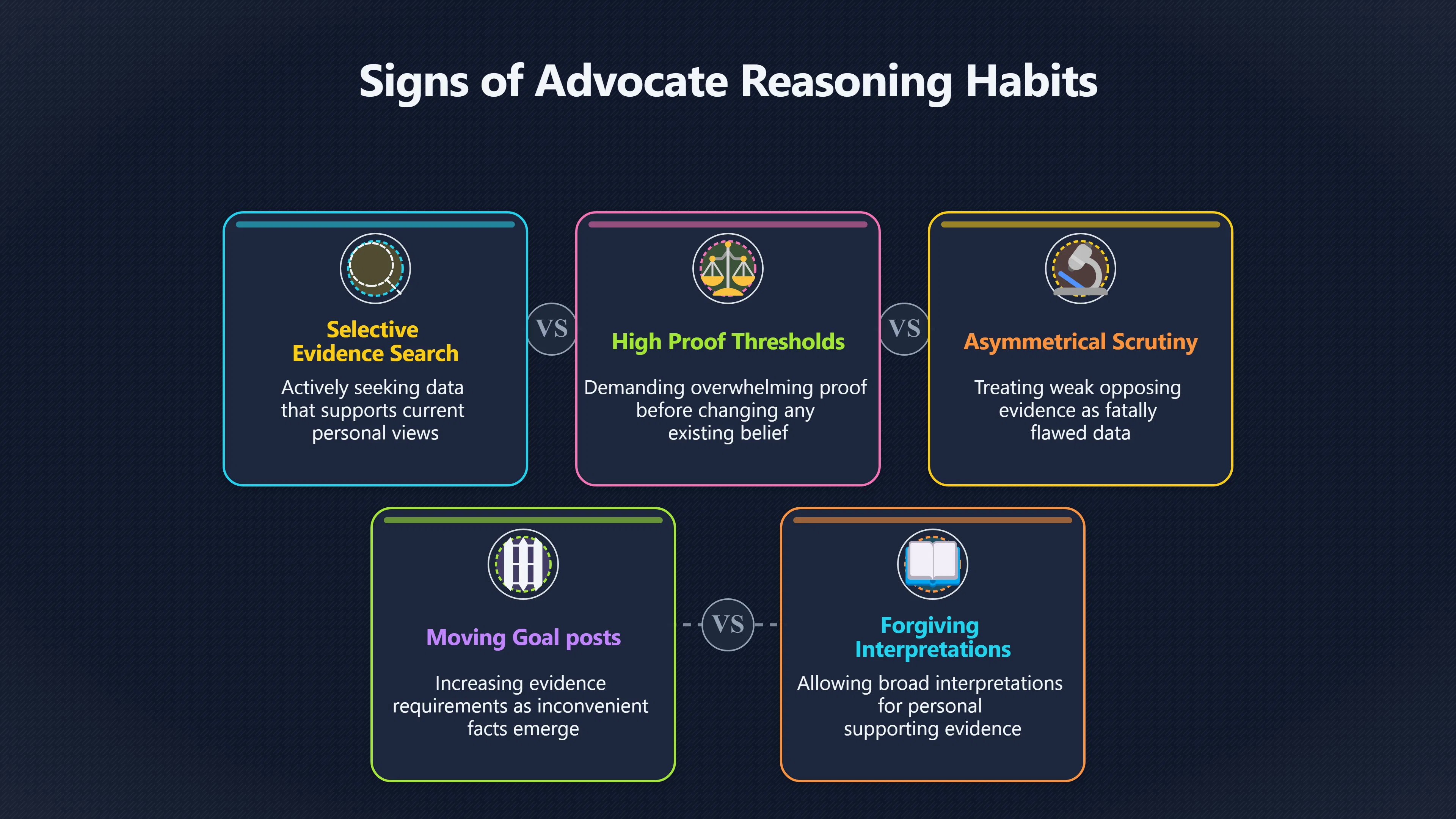
The easiest sign that you are arguing like a lawyer is not that you have a strong opinion. It is that you investigate one side much more critically than the other.
Many disagreements follow the same hidden pattern:
- You actively search for evidence supporting your current view.
- You expect opponents to provide overwhelming proof before changing your mind.
- Weak evidence supporting your position seems “interesting”.
- Equally weak evidence against it seems “fatally flawed”.
- You demand precision from critics while allowing yourself broader, more forgiving interpretations.
None of these habits necessarily feels dishonest. They often feel like careful thinking because your critical skills are genuine. The asymmetry lies in where those skills are directed.
A useful test is to ask whether you would judge the same evidence the same way if it supported the opposite conclusion. If the answer is no, you are probably evaluating the source through the lens of allegiance rather than evidence. This asymmetrical evaluation is one of the defining features of myside bias identified in the reasoning literature. [Association for Psychological Science]psychologicalscience.orgAssociation for Psychological ScienceMyside Bias, Rational Thinking, and IntelligenceAugust 1, 2013 — by KE Stanovich · Cited by 678 — My…
A second warning sign is changing evidential standards during the discussion. Someone may begin by saying, “Show me one good study.” After one appears, the requirement becomes several studies. Then only large meta-analyses count. Then only evidence collected under slightly different conditions is acceptable. Sometimes stronger evidence genuinely should change the standard. The problem is when the standard changes only because the evidence has become inconvenient.
Ask what would actually change your mind
One of the simplest interventions is to answer a difficult question before the debate starts:
What evidence would genuinely make me reduce my confidence?
Many people discover they have no answer. That is revealing. A belief that cannot, even in principle, be revised has stopped functioning as an empirical claim and has become an identity commitment.
Useful questions include:
- What observation would count against my position?
- What finding would make me say, “I was probably wrong”?
- Which expert or institution do I trust enough that contradictory evidence would matter?
- How much confidence do I have now, expressed as a percentage rather than certainty?
These questions force you to specify a possible exit before becoming emotionally invested in defending the entrance.
Research on actively open-minded thinking emphasises willingness to consider evidence that conflicts with existing beliefs as a core component of good reasoning. The goal is not permanent doubt but making belief revision psychologically possible. [PubMed+2JBaron]pubmed.ncbi.nlm.nih.govActively Open-Minded Thinking and Its Measurementby KE Stanovich · 2023 · Cited by 133 — Actively open-minded thinking (AOT) is mea…
Make small precommitments before emotions take over
Reasoning often deteriorates gradually rather than suddenly. Small commitments made before an argument becomes competitive can prevent later rationalisation.
Three precommitments are especially practical.
Commit to symmetrical standards. Decide in advance that identical evidence receives identical scrutiny regardless of whose side it supports.
Commit to updating by degrees. Instead of asking whether one piece of evidence completely overturns your belief, ask whether it should move your confidence by 5%, 10% or 20%. Gradual updating is psychologically easier than dramatic reversals.
Commit to recording your prediction. Before new information arrives, write down what you expect to happen. Afterwards compare prediction with reality rather than with your reconstructed memory. This makes it harder to quietly rewrite your previous position.
These commitments reduce the temptation to move the goalposts after learning inconvenient facts because the evaluation criteria already exist.
Switch from advocate questions to scout questions
Advocates and scouts ask different questions.
An advocate asks:
- How can I defend this?
- Which evidence supports my position?
- What weaknesses exist in the opposing argument?
A scout asks:
- What explanation best fits everything I know?
- Which facts are hardest for my view to explain?
- What competing explanation deserves more attention than I have given it?
- Which assumptions am I taking for granted?
Notice that none of the scout questions require abandoning a preferred conclusion. They simply widen the search.
Research distinguishes between confirmatory thinking, which primarily justifies an existing conclusion, and exploratory thinking, which actively searches for alternative explanations and possible objections before reaching one. [Wikipedia]WikipediaConfirmation biasConfirmation bias
Look first for your strongest opposing evidence
People naturally generate supporting arguments faster than opposing ones. Reversing the order interrupts that habit.
Before defending your position, try writing:
- The strongest argument against your view.
- The strongest evidence supporting that argument.
- The weakest assumption in your own position.
Only then return to your preferred conclusion.
This exercise differs from inventing weak “straw man” objections that are easy to dismiss. The point is to identify the argument that would worry a well-informed supporter of your own position.
Research on debiasing suggests that simply asking people to think harder is usually insufficient. More structured interventions—such as requiring genuine consideration of alternative perspectives or creating accountability for objective evaluation rather than successful advocacy—appear more promising than relying on willpower alone. [King's College London]kclpure.kcl.ac.ukKing's College LondonSuppressing Myside Bias in Civil LitigationToday — Myside bias is an information-processing tendency that causes peo…

Watch for conversational cues that your goal has changed
Arguments often become defensive without anyone noticing. Common signals include:
- Feeling relieved when you find any supporting example rather than the best explanation.
- Interrupting because you already know what the other person “must” mean.
- Spending more effort attacking sources than understanding claims.
- Feeling personally threatened by factual disagreement.
- Celebrating points scored instead of uncertainty reduced.
These moments indicate that the objective has shifted from learning to winning.
Pausing briefly to ask, “Am I trying to discover or defend?” can redirect the conversation before positions harden.
Treat changing your mind as evidence of better reasoning
Many people assume consistency is always a virtue. In reality, consistency without responsiveness to evidence becomes stubbornness.
A healthier norm is to reward yourself for justified updates. Saying, “I had not considered that,” or “That evidence changes my estimate,” should feel like progress rather than defeat.
This does not mean changing your mind frequently or dramatically. It means recognising that good reasoning is measured less by how firmly a belief is defended than by how appropriately it changes when the evidence changes.
The goal is not to stop arguing altogether. It is to stop acting as though every discussion is a courtroom in which your role is to secure a verdict. By replacing advocacy habits with small scout checks—symmetrical standards, explicit falsification criteria, precommitted evidence thresholds, and active searches for the strongest opposing case—you make it more likely that your reasoning tracks reality rather than merely protecting your favourite beliefs.
Amazon book picks
Further Reading
Books and field guides related to How to Stop Arguing Like a Lawyer. Use these as the next step if you want deeper reading beyond the article.
The Scout Mindset
Directly contrasts truth-seeking with advocacy and offers practical habits for avoiding motivated reasoning.
Mistakes Were Made (but Not by Me)
Shows how self-justification, cognitive dissonance, and identity fuel stubborn arguments.
The Demon-Haunted World
Rating: 4.5/5 from 43 Google Books ratings
Promotes skeptical inquiry and evidence-based reasoning instead of advocacy and motivated belief.
How to Have Impossible Conversations
Focuses on asking better questions, reducing defensiveness, and having more productive disagreements.
eBay marketplace picks
Marketplace Samples
Live-tested eBay searches with available results related to this page.



Endnotes
-
Source: jbaron.org
Link: https://jbaron.org/~jbaron/ms/ws/ws.pdfSource snippet
on of all goal- directed thinking (Baron, 1985, 2019, 2023). It is...
-
Source: Wikipedia
Title: Confirmation bias
Link: https://en.wikipedia.org/wiki/Confirmation_bias -
Source: psychologicalscience.org
Link: https://www.psychologicalscience.org/journals/current-directions/0963721413480174/Source snippet
Association for Psychological ScienceMyside Bias, Rational Thinking, and IntelligenceAugust 1, 2013 — by KE Stanovich · Cited by 678 — My...
Published: August 1, 2013
-
Source: pmc.ncbi.nlm.nih.gov
Title: PMCActively Open-Minded Thinking and Its Measurement
Link: https://pmc.ncbi.nlm.nih.gov/articles/PMC9966223/Source snippet
Open-Minded Thinking and Its Measurement - PMCby KE Stanovich · 2023 · Cited by 133 — Macpherson and Stanovich (2007) examined myside bia...
-
Source: pubmed.ncbi.nlm.nih.gov
Link: https://pubmed.ncbi.nlm.nih.gov/36826925/Source snippet
Actively Open-Minded Thinking and Its Measurementby KE Stanovich · 2023 · Cited by 133 — Actively open-minded thinking (AOT) is mea...
-
Source: kclpure.kcl.ac.uk
Link: https://kclpure.kcl.ac.uk/ws/portalfiles/portal/312390325/AAM_-_Suppressing_Myside_Bias.pdfSource snippet
King's College LondonSuppressing Myside Bias in Civil LitigationToday — Myside bias is an information-processing tendency that causes peo...
Additional References
-
Source: researchgate.net
Link: https://www.researchgate.net/publication/390843764_The_Puzzle_of_Myside_Bias_and_Actively_Open-Minded_Thinking_in_the_Conceptualization_of_Critical_ThinkingSource snippet
It is unrelated to intelligence and it is conceptually difficult to show that it is an irrational...
-
Source: keithstanovich.com
Title: Stanovich Toplak 2023 1
Link: https://www.keithstanovich.com/Site/Research_on_Reasoning_files/Stanovich_Toplak_2023_1.pdfSource snippet
The Elusive Search for Individual Differences in Myside Thinkingby KE Stanovich · 1922 · Cited by 4 — In the Macpherson and Stanovich (20...
-
Source: case.hks.harvard.edu
Link: https://case.hks.harvard.edu/content/2148_2.pdfSource snippet
See It My Way! Identifying Psychological...12 Feb 2019 — The overall goal of this exercise is to help participants identify common psych...
-
Source: youtube.com
Link: https://www.youtube.com/watch?v=_h2v13jDPAESource snippet
Think Again by Adam Grant Full Audiobook...
-
Source: youtube.com
Title: How to Win a Debate | World Champion Debater Bo Seo (Part 3)
Link: https://www.youtube.com/watch?v=oiizgS5iagwSource snippet
Michael Shermer with Julia Galef: The Scout Mindset...
-
Source: youtube.com
Title: Think Again by Adam Grant Full Audiobook
Link: https://www.youtube.com/watch?v=r6W0fnQbGGwSource snippet
How to Win a Debate | World Champion Debater Bo Seo (Part 3)...
-
Source: youtube.com
Title: Michael Shermer with Julia Galef: The Scout Mindset
Link: https://www.youtube.com/watch?v=wJb_cGpoR6c
Topic Tree