Within Expert Gut
When Simple Models Beat Expert Judgement
Statistical rules often beat unaided professional judgement because they weight evidence more consistently than memory does.
On this page
- What the clinical versus statistical prediction debate found
- Why experts still matter before and after the model
- Where unaided judgement becomes especially risky
Page outline Jump by section
Introduction
One of the most durable findings in judgement research is that simple statistical rules often predict outcomes at least as well as, and frequently better than, experienced professionals relying on unaided intuition. This does not mean experts lack value. Rather, it means that once the relevant evidence has been collected, a consistent rule for combining that evidence usually outperforms a human who weighs the same information from memory. This debate—often called clinical versus statistical prediction or actuarial prediction versus unaided expert judgement—has reshaped thinking in psychology, medicine, criminal justice, personnel selection and risk assessment. It also provides a practical lesson for improving analytical thinking: whenever a problem has reliable historical data and repeatable outcomes, it is usually safer to trust a validated model than an expert’s unaided impression. [zaldlab.psy.vanderbilt.edu]zaldlab.psy.vanderbilt.eduClinical Versus Mechanical Prediction: A Meta-Analysisby WM Grove · 2000 · Cited by 2793 — To compare the accuracy of clinical and mechan…

What the clinical versus statistical prediction debate found
The debate began with psychologist Paul Meehl’s influential 1954 book Clinical versus Statistical Prediction. Meehl compared situations where professionals made predictions by informally integrating evidence in their heads (“clinical” judgement) with situations where the same information was combined using explicit statistical or actuarial rules. His conclusion was provocative: formal methods generally produced more accurate predictions than unaided professional judgement. [Wikipedia]WikipediaPaul E. MeehlPaul E. Meehl
Subsequent decades of research have repeatedly tested this claim across a wide variety of domains, including:
- psychiatric diagnosis and prognosis;
- medical outcomes;
- university admissions;
- employee selection;
- criminal recidivism;
- child welfare;
- educational performance.
The strongest synthesis remains a major meta-analysis by William Grove and colleagues, which examined 136 comparative studies. Across these studies, mechanical or statistical prediction methods were, on average, about 10% more accurate than clinical prediction. Depending on the method of analysis, statistical approaches substantially outperformed clinicians in roughly one-third to nearly one-half of comparisons, while genuine advantages for unaided judgement were rare. [zaldlab.psy.vanderbilt.edu]zaldlab.psy.vanderbilt.eduClinical Versus Mechanical Prediction: A Meta-Analysisby WM Grove · 2000 · Cited by 2793 — To compare the accuracy of clinical and mechan…
A later meta-analysis focusing on mental health professionals reached essentially the same conclusion after reviewing more than half a century of evidence: statistical prediction showed a modest but consistent advantage overall. [Sage Journals]journals.sagepub.comSage JournalsThe Meta-Analysis of Clinical Judgment Projectby S Ægisdóttir · 2006 · Cited by 1144 — The overall effect of clinical versus…
Perhaps the most surprising aspect of this literature is that the statistical models were often remarkably simple. Many used straightforward linear combinations of a handful of variables rather than sophisticated machine learning or highly complex mathematics. Their strength came less from complexity than from applying the same weighting every time.
Why simple models often outperform experts
The advantage of actuarial prediction is not that statistics “understands” people better. Instead, statistical rules avoid several weaknesses that affect human judgement.
First, models are consistent. Given identical information, they always produce the same prediction. Human experts do not. Fatigue, mood, recent experiences, workload and framing effects can all subtly alter how evidence is weighted. [meehl.umn.edu]meehl.umn.eduClinical Versus Actuarial Judgmentby RM DAWES · Cited by 3897 — In virtually every one of these studies, the actuarial method has equaled…
Second, humans naturally give excessive weight to vivid or memorable information. A dramatic recent case can influence today’s judgement far more than hundreds of ordinary cases stored less vividly in memory. Statistical models instead weight evidence according to observed relationships in historical data.
Third, experts often shift their internal weighting rules without realising it. An experienced clinician may emphasise age heavily in one case, personality in another and laboratory findings in a third, despite having no evidence that these changing priorities improve prediction.
Finally, people are susceptible to what Daniel Kahneman termed the illusion of validity: when available information forms a coherent story, confidence rises even if predictive accuracy does not. Experts may sincerely feel certain while making forecasts that are only moderately accurate. [Wikipedia]WikipediaIllusion of validityIllusion of validity
These problems become especially important whenever outcomes are noisy, probabilities matter more than narratives, and hundreds or thousands of similar decisions accumulate over time.
Why experts still matter before and after the model
The clinical-versus-statistical literature is frequently misunderstood as an argument to replace professionals with algorithms. Meehl himself argued something more nuanced.
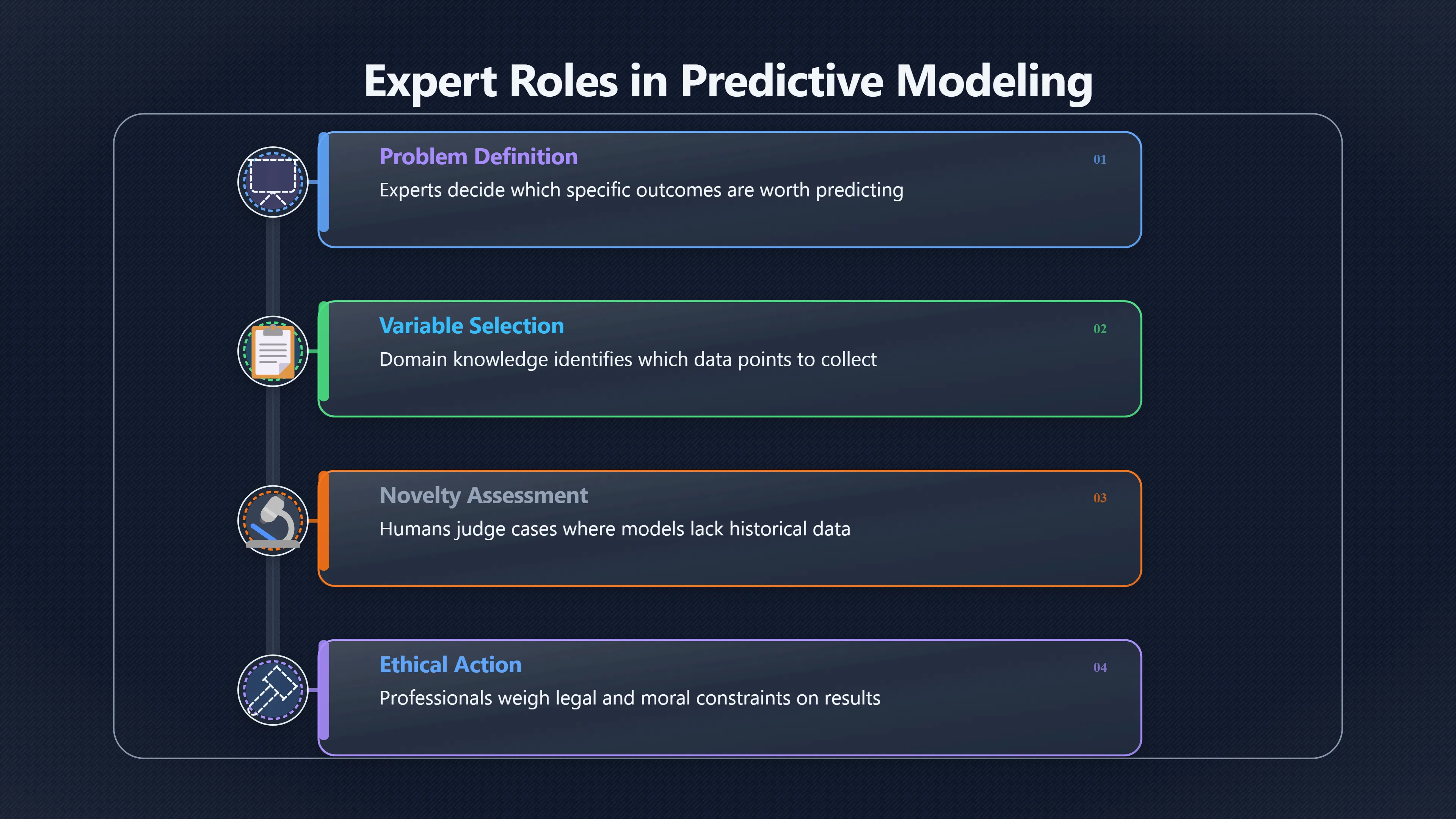
Experts remain indispensable in at least three stages.
Defining the problem
Someone must decide which question is worth answering and what outcome should actually be predicted. Statistical models cannot determine whether the relevant target is mortality, treatment response, employee performance or another outcome.
Experts also identify which information deserves collection. Their domain knowledge determines what variables enter the model in the first place.
Assessing unusual or novel situations
Statistical prediction assumes that current cases resemble those used to build the model. [emilkirkegaard.dk]emilkirkegaard.dkclinical vs statistical predictionClinical vs. statistical prediction5 Jul 2016 — On average, mechanical-prediction techniques were about 10% more accurate than clinical p…
Experts become particularly valuable when:
- circumstances are genuinely unprecedented;
- critical variables are missing;
- data quality is poor;
- the environment has changed substantially since the model was developed.
In these situations, judgement helps determine whether the model’s assumptions still apply.
Acting on predictions
Prediction is only one part of decision-making.
A model may estimate that a patient has a 30% probability of deterioration or that an offender has elevated recidivism risk. Choosing an intervention involves ethics, patient preferences, legal constraints, costs and organisational priorities that extend beyond statistical forecasting.
Modern evidence-based practice increasingly treats prediction models as decision-support tools rather than replacements for professional responsibility. [Wiley Online Library]onlinelibrary.wiley.comOnline Library Clinical versus Statistical PredictionWiley Online LibraryClinical versus Statistical Prediction - Groveby WM Grove · 2014 · Cited by 6 — He concluded that statistical predict…
Where unaided judgement becomes especially risky
Research consistently identifies situations in which relying purely on expert intuition is particularly hazardous.
High-volume repetitive decisions. Hiring, admissions, loan approval and insurance underwriting all involve repeated cases with measurable outcomes. Consistency becomes an important advantage.
Many competing cues. Humans struggle to weight numerous variables simultaneously. Even modest linear models often outperform experts once several predictors interact.
Delayed or ambiguous feedback. If professionals rarely discover whether their predictions were correct, intuition improves slowly. This connects directly with broader research showing that expert intuition develops only in environments providing rapid, accurate feedback.
Emotionally charged cases. Sympathy, charisma, anxiety or compelling narratives can influence human judgement without improving predictive accuracy.
One well-known practical implication concerns personnel selection. Research has repeatedly shown that unstructured interviews often reduce predictive accuracy compared with structured assessments and explicit scoring systems because interviewers inconsistently combine information. [Wikipedia]WikipediaPaul E. MeehlPaul E. Meehl
Common criticisms—and what the evidence says
The debate has generated several recurring objections.
“Experts use information that models cannot capture.”
Sometimes they do. However, Meehl’s original argument never required excluding expert observations. Clinical impressions can be converted into structured variables and incorporated into a statistical model. The issue is not whether expert knowledge matters, but whether experts should combine the evidence informally after gathering it. [Wikipedia]WikipediaPaul E. MeehlPaul E. Meehl
“Simple rules cannot handle complex people.”
People are undoubtedly complex, but prediction accuracy depends on extracting reliable signals rather than explaining every aspect of human behaviour. Many complex systems still contain stable statistical regularities that simple models exploit surprisingly well.
“Artificial intelligence has replaced this debate.”
Modern machine learning changes the technical methods but not the underlying principle. The original question concerned whether evidence should be combined consistently according to explicit rules or informally through intuition. Today’s algorithms extend statistical prediction rather than overturning Meehl’s insight, although they introduce additional concerns such as transparency, fairness, overfitting and model drift. [Wiley Online Library]onlinelibrary.wiley.comOnline Library Clinical versus Statistical PredictionWiley Online LibraryClinical versus Statistical Prediction - Groveby WM Grove · 2014 · Cited by 6 — He concluded that statistical predict…
Practical lessons for better thinking
The actuarial prediction literature suggests several habits that improve reasoning far beyond medicine or psychology.
- Use validated scoring rules whenever reliable evidence exists.
- Separate collecting information from combining information. Experts excel at the former; formal models often excel at the latter.
- Be cautious when confidence exceeds demonstrated predictive accuracy.
- Prefer structured decision processes over purely intuitive ones for recurring decisions.
- Override a model only when there is explicit evidence that this case genuinely falls outside the circumstances for which the model was designed, and record the reasons for doing so.
The central lesson is not that experts are unreliable, but that human cognition is inconsistent. When decisions recur under similar conditions and outcomes can be measured, explicit statistical rules usually produce better calibrated predictions than memory, intuition and confidence alone. The most effective systems therefore combine both strengths: expert judgement to define, interpret and supervise decisions, and validated models to perform the repetitive task of weighing evidence consistently. meehl.umn.edu+2zaldlab.psy.vanderbilt.edu [meehl.umn.edu]meehl.umn.eduClinical Versus Actuarial Judgmentby RM DAWES · Cited by 3897 — In virtually every one of these studies, the actuarial method has equaled…
Amazon book picks
Further Reading
Books and field guides related to When Simple Models Beat Expert Judgement. Use these as the next step if you want deeper reading beyond the article.
Thinking, Fast and Slow
Explains cognitive biases and why structured methods often outperform intuitive expert judgment.
Clinical Versus Statistical Prediction
Directly introduces the actuarial versus expert judgment findings discussed on the page.
The Signal and the Noise
Explores when statistical models succeed and the limits of human judgment.
Superforecasting: The Art and Science of Prediction
Shows how disciplined forecasting methods consistently outperform intuition and conventional expertise.
eBay marketplace picks
Marketplace Samples
Example marketplace items related to this page. Use the search link to explore similar finds on eBay.




Endnotes
-
Source: zaldlab.psy.vanderbilt.edu
Link: https://zaldlab.psy.vanderbilt.edu/resources/wmg00pa.pdfSource snippet
Clinical Versus Mechanical Prediction: A Meta-Analysisby WM Grove · 2000 · Cited by 2793 — To compare the accuracy of clinical and mechan...
-
Source: meehl.umn.edu
Link: https://meehl.umn.edu/sites/meehl.umn.edu/files/files/138cstixdawesfaustmeehl.pdfSource snippet
Clinical Versus Actuarial Judgmentby RM DAWES · Cited by 3897 — In virtually every one of these studies, the actuarial method has equaled...
-
Source: Wikipedia
Title: Paul E. Meehl
Link: https://en.wikipedia.org/wiki/Paul_E._Meehl -
Source: onlinelibrary.wiley.com
Title: Online Library Clinical versus Statistical Prediction
Link: https://onlinelibrary.wiley.com/doi/abs/10.1002/9781118625392.wbecp200Source snippet
Wiley Online LibraryClinical versus Statistical Prediction - Groveby WM Grove · 2014 · Cited by 6 — He concluded that statistical predict...
-
Source: Wikipedia
Title: Illusion of validity
Link: https://en.wikipedia.org/wiki/Illusion_of_validity -
Source: youtube.com
Link: https://www.youtube.com/watch?v=DFOKxUQ2TbASource snippet
Paul Meehl - Philosophical Psychology Lecture 9/12...
-
Source: youtube.com
Title: Paul Meehl
Link: https://www.youtube.com/watch?v=LoGTdhGwSVMSource snippet
The Economics of Wine (Orley Ashenfelter, Princeton)...
-
Source: researchgate.net
Link: https://www.researchgate.net/publication/12564746_Clinical_Versus_Mechanical_Prediction_A_Meta-AnalysisSource snippet
On average, mechanical-prediction techniques were about 10% more accurate than clinical...
-
Source: journals.sagepub.com
Link: https://journals.sagepub.com/doi/10.1177/0011000005285875Source snippet
Sage JournalsThe Meta-Analysis of Clinical Judgment Projectby S Ægisdóttir · 2006 · Cited by 1144 — The overall effect of clinical versus...
-
Source: dictionary.cambridge.org
Link: https://dictionary.cambridge.org/dictionary/english/clinicalSource snippet
English meaning - Cambridge Dictionary4 days ago — (of medical work or teaching) relating to examining and treating someone who is ill...
-
Source: emilkirkegaard.dk
Title: clinical vs statistical prediction
Link: https://emilkirkegaard.dk/en/2016/07/clinical-vs-statistical-prediction/Source snippet
Clinical vs. statistical prediction5 Jul 2016 — On average, mechanical-prediction techniques were about 10% more accurate than clinical p...
Additional References
-
Source: researchgate.net
Link: https://www.researchgate.net/publication/258192136_The_Meta-Analysis_of_Clinical_Judgment_Project_Fifty-Six_Years_of_Accumulated_Research_on_Clinical_Versus_Statistical_PredictionSource snippet
The Meta-Analysis of Clinical Judgment Project: Fifty-Six...The overall effect of clinical versus statistical prediction showed a somewh...
-
Source: bactra.org
Link: https://bactra.org/notebooks/clinical-vs-actuarial.html -
Source: semanticscholar.org
Link: https://www.semanticscholar.org/paper/Clinical-versus-statistical-prediction%3A-the-of-Paul-Grove/ed8636d51135dc780eed76c8a5a96c3a132ecf1cSource snippet
Meehl put the question, of whether clinical or statistical combinations of psychological data yielded better predictions, at center stage...
-
Source: researchgate.net
Title: 7703351 Clinical Versus Statistical Prediction The Contribution of Paul E
Link: https://www.researchgate.net/publication/7703351_Clinical_Versus_Statistical_Prediction_The_Contribution_of_Paul_ESource snippet
Clinical Versus Statistical Prediction: The Contribution of...In the 1950s, Meehl (1954) argued that statistical (i.e., actuarial) metho...
-
Source: rufuspollock.com
Title: notes on meehl 1954 clinical versus statistical prediction
Link: https://rufuspollock.com/post/notes-on-meehl-1954-clinical-versus-statistical-predictionSource snippet
Mar 28, 2017 — There is now a meta- analysis of studies of the comparative efficacy of clinical judgment and actuarial prediction methods...
-
Source: scispace.com
Title: Depending on the specific analysis, mechanical prediction
Link: https://scispace.com/papers/clinical-versus-mechanical-prediction-a-meta-analysis-4wov3bdnn5Source snippet
Clinical versus mechanical prediction: a meta-analysis.On average, mechanical-prediction techniques were about 10% more accurate than cli...
-
Source: argmin.net
Title: Clinical versus Statistical Prediction (III)
Link: https://www.argmin.net/p/clinical-versus-statistical-prediction-5d7Source snippet
by Ben Recht17 Jul 2024 — Statistical prediction is never worse and often better than clinical judgment, that doesn't mean that you still...
-
Source: academia.edu
Link: https://www.academia.edu/26181966/CLINICAL_versus_STATISTICAL_PREDICTION_A_Theoretical_Analysis_and_a_Review_of_the_EvidenceSource snippet
A meta-analysis of 136 studies reveals clinicians often misjudge the...
-
Source: semanticscholar.org
Link: https://www.semanticscholar.org/paper/Clinical-versus-mechanical-prediction%3A-a-Grove-Zald/4e4ee33f48618f91d66ef90a2196c56bc5e770c7Source snippet
predictions of human behaviors are equal or superior to clinical...
-
Source: youtube.com
Title: Ben Recht — The Uses and Abuses of Statistics
Link: https://www.youtube.com/watch?v=KkyT7TtFvAwSource snippet
This video collection directly covers the core arguments, historical background, and empirical evidence surrounding the debate between ac...
Topic Tree
Follow this branch
Parent topic
Expert Gut When Should You Trust Your Gut?Related pages 5
- Chess Patterns What Chess Masters See That Beginners Miss
- Fire Decisions Why Firefighters Sometimes Know Before They Explain
- Forecast Feedback How Forecasting Makes Confidence Accountable
- Kind vs Wicked When Experience Teaches the Wrong Lesson
- Medical Gut When Doctors Should Trust Their First Impression