Within Sharper Thinking
Can You Pass the Opponent's Test?
Steelmanning forces you to answer the strongest version of an opposing view rather than an easy caricature.
On this page
- Steelman versus strawman
- How to restate a rival view fairly
- When steelmanning changes your conclusion
Page outline Jump by section
Introduction
Steelmanning is the habit of restating an opposing argument in its strongest fair form before you rebut it. It matters because weak rebuttals often beat only a caricature: they protect your existing view without testing whether it can survive the best objection. A good steelman does not mean agreeing, flattering, or pretending every position is equally sound. It means passing the opponent’s test: could a reasonable advocate of the rival view say, “Yes, that is what I mean, and you have put it well”? Only then does your criticism land on the real issue rather than on an easier substitute.
Within better thinking and analytical skill, steelmanning is a practical intervention against myside bias, confirmation bias, and premature certainty. Research on biased assimilation shows that people often scrutinise unwelcome evidence more harshly than evidence that supports their existing beliefs, while work on actively open-minded thinking treats willingness to consider opposing arguments as part of sound reasoning rather than mere politeness. [Frank Baumgartner+2keithstanovich.com]fbaum.unc.eduFrank Baumgartner Biased Assimilation and Attitude Polarization: The EffectsROSS, AND M. LEPPER attitudes and beliefs did change after each new piece of evidence was presented, and from the beginning to the end of…
Steelman versus strawman
A strawman argument replaces an opponent’s actual claim with a weaker, simpler, or more extreme version, then refutes that substitute. Argumentation scholars describe this as a failure to attack the position the other side actually defends; recent work on the strawman fallacy emphasises misrepresentation as the core problem, whether the distortion is exaggerated, selective, or falsely attributed. [Springer]link.springer.comThe Straw Man Fallacy | Springer Nature Linkby J Schumann · 2025 — The straw man fallacy constitutes an infringement on this prin…
A steelman reverses that habit. Instead of asking, “What is the easiest version of this view to defeat?”, it asks, “What is the most reasonable version of this view that someone informed, honest, and careful might defend?” This is closely related to the principle of charity in philosophy and critical thinking: when reconstructing an argument, avoid adding obviously false premises if a more plausible interpretation is available. [oercollective.caul.edu.au]oercollective.caul.edu.auOpen source on edu.au.
The contrast is easiest to see in a policy disagreement:
- Strawman: “People who oppose this housing reform just hate new neighbours.”
- Steelman: “The strongest objection is that rapid upzoning may increase land values, accelerate displacement in some neighbourhoods, and overwhelm local services unless protections and infrastructure are planned alongside it.”
- Rebuttal after steelmanning: “Those risks are real, but they can be compared with the current shortage, the cost of exclusionary zoning, and evidence on which anti-displacement policies work best.”
The steelman version makes the disagreement harder, but also more useful. It shifts the target from moral laziness or tribal signalling to the actual tradeoff: housing supply, displacement risk, infrastructure capacity, and policy design.

How to restate a rival view fairly
A strong restatement is not a longer paraphrase. It is a disciplined reconstruction. The aim is to identify the best argument available to the opposing side while keeping it recognisably connected to what its advocates actually believe.
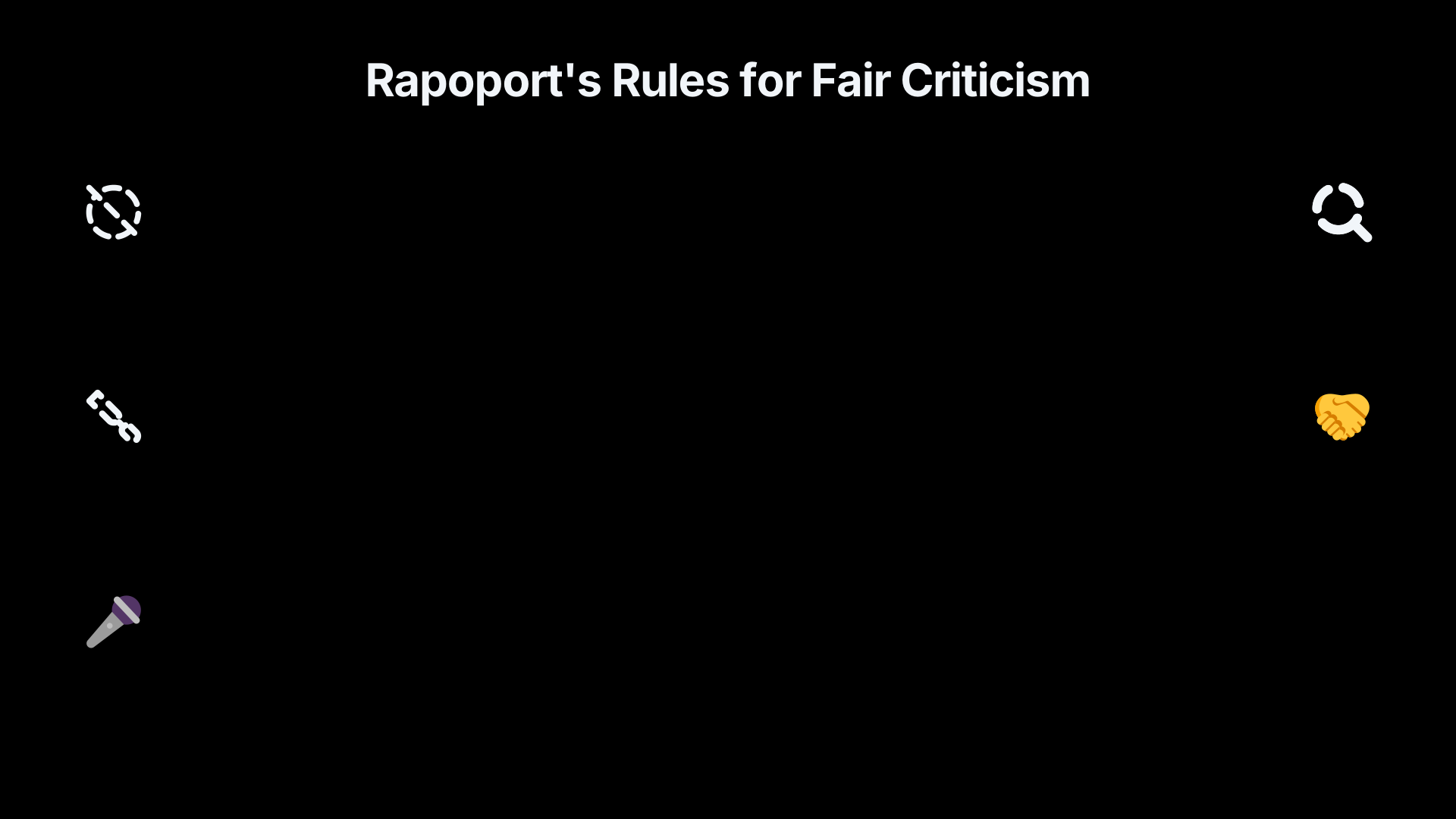
Daniel Dennett popularised a practical version of this norm through “Rapoport’s rules”, attributed to the social psychologist Anatol Rapoport. The rules ask critics to restate the target’s position clearly and fairly, identify points of agreement, say what they have learned, and only then criticise. [The Marginalian]themarginalian.orgThe Marginalian How to Criticize with Kindness: Philosopher Daniel DennettThe Marginalian How to Criticize with Kindness: Philosopher Daniel Dennett
A usable steelman has four parts:
- State the real conclusion. Do not swap in a more convenient claim. If the rival view is “pause this policy until safeguards exist”, do not translate it into “never do anything”.
- Name the strongest reasons. Include the evidence, values, and practical concerns that make the view attractive to reasonable people.
- Remove avoidable weakness, not the core claim. Fix clumsy wording or missing premises, but do not invent a different argument that the other side would not accept.
- Check recognition. In live discussion, ask whether the person would endorse your restatement. In private analysis, compare your version with the best sources and advocates for that view.
This matters because people are skilled at finding flaws in arguments they dislike. In the classic study by Charles Lord, Lee Ross, and Mark Lepper, people with opposing views on capital punishment evaluated mixed evidence in ways that tended to preserve or strengthen their starting position. The broader lesson is not that all disagreement is irrational, but that evidence evaluation is easily pulled towards prior belief. [Frank Baumgartner]fbaum.unc.eduFrank Baumgartner Biased Assimilation and Attitude Polarization: The EffectsROSS, AND M. LEPPER attitudes and beliefs did change after each new piece of evidence was presented, and from the beginning to the end of…
Steelmanning slows that reflex. It forces the question, “What would this view look like if I were not trying to defeat it yet?” That pause is often enough to reveal that your opponent’s position has a valid concern inside it, even if its final conclusion is still wrong.
Why it improves analysis rather than just manners
Steelmanning is often described as civility, but its deeper value is analytical. It improves the quality of your own thinking by making the rival hypothesis stronger before you test it.
A weak objection gives you false confidence. If you rebut only the most foolish version of a rival view, you learn little about whether your own view is robust. By contrast, rebutting the strongest rival case works like stress-testing a bridge: the point is not to be generous for its own sake, but to discover whether the structure holds under real pressure.
This is especially useful in areas where feedback is delayed or ambiguous: policy, strategy, hiring, forecasting, investing, organisational decisions, and personal conflicts. In such settings, people can be wrong for months or years before reality corrects them. Steelmanning creates earlier feedback by making your mind confront the evidence it would rather avoid.
The connection with actively open-minded thinking is direct. Researchers describe this disposition as willingness to consider alternative opinions, attend to evidence that contradicts one’s favoured view, and revise beliefs when warranted. [Society for Judgment and Decision Making]sjdm.orgSociety for Judgment and Decision Making Actively open-minded thinking (AOTSociety for Judgment and Decision Making Actively open-minded thinking (AOT Steelmanning is one concrete way to practise that disposition: instead of merely saying “I am open-minded”, you produce the rival case clearly enough that it can challenge you.
It also overlaps with the “consider the opposite” debiasing strategy. Lord, Lepper, and Preston found that prompting people to consider opposite possibilities could reduce bias in social judgement more effectively than simply telling them to be fair and unbiased. [PubMed]pubmed.ncbi.nlm.nih.govOpen source on nih.gov. Steelmanning is a richer version of that move: do not merely imagine that you might be wrong; build the best route by which you might be wrong.
The opponent’s test
The simplest quality standard is the opponent’s test: would a thoughtful defender of the rival view recognise themselves in your summary?
This does not require the opponent to agree with your rebuttal. It requires them to agree that your target is real. In practice, the test prevents three common failures:
- The cartoon version: You describe the view in terms only its enemies would use.
- The weakest-spokesperson version: You pick the least careful advocate and treat them as representative.
- The motive-only version: You explain why people might want the belief to be true, but never engage the reasons they give for thinking it is true.
Passing the test often changes the emotional tone of disagreement. If someone sees that you understand their concern, they are less likely to treat your rebuttal as hostile dismissal. Research on constructive controversy in education and organisations suggests that structured engagement with opposing views can increase uncertainty, information search, perspective-taking, and more integrated conclusions. [SSRN]papers.ssrn.comOpen source on ssrn.com.
The important word is “structured”. Simply throwing opposing opinions into a room does not guarantee better thinking. Steelmanning gives disagreement a sequence: understand first, criticise second, decide third.
When steelmanning changes your conclusion
The most valuable steelman is sometimes the one that defeats you. That is not a failure of the method. It is the method working.
A serious restatement can change your conclusion in several ways. It may reveal that the opposing side has better evidence than you realised. It may show that your own argument answers a weaker objection but not the central one. It may expose a hidden value conflict: perhaps the dispute is not really about facts, but about how much weight to give to fairness, liberty, safety, cost, reversibility, or institutional trust.
For example, suppose someone supports a strict workplace return-to-office policy. A weak rebuttal might say, “Managers just want control.” A steelman might say, “The strongest case is that some junior staff learn faster through informal exposure, some coordination problems are harder to solve remotely, and a shared workplace can build trust that scheduled video calls do not fully replace.” After that, a critic of the policy may still favour flexibility, but the better conclusion might become more precise: not “remote is always better”, but “hybrid policies should protect mentorship, coordination, and belonging without assuming daily attendance is the only way to get them.”
That is the practical payoff. Steelmanning does not always flip your view, but it often improves it. The result may be a narrower claim, a better exception, a more realistic implementation plan, or a clearer account of what evidence would change your mind.
Where steelmanning can go wrong
Steelmanning has limits. The main danger is that you accidentally create a better argument than the one actually being made, then credit the original speaker with more coherence, evidence, or moral seriousness than they have shown.
This is why steelmanning should be tied to fidelity. Charity is not licence to invent. Some critics argue that steelmanning can blur the line between interpreting an argument fairly and replacing it with a more sophisticated argument the original advocate did not mean. Andrew Gelman, for example, warns that bending over backwards to improve one side’s case can unintentionally distort other positions or import assumptions that do not belong. [Statistical Modeling]statmodeling.stat.columbia.eduOpen source on columbia.edu.
There are also cases where full-strength reconstruction is inappropriate. If a claim depends on dehumanisation, threats, fabricated evidence, or targeted harassment, the better thinking move may be to identify the claim neutrally without helping make it more persuasive. Steelmanning is for testing live arguments, not laundering bad-faith tactics.
A useful boundary is this: strengthen the reasoning, not the manipulation. Clarify the best evidence and logic behind a view; do not sharpen slogans, conceal harms, or make reckless claims more rhetorically effective.
A practical routine before rebuttal
For everyday reasoning, steelmanning works best as a short routine rather than a grand philosophical exercise. Before rebutting a serious opposing view, write three sentences:
- Their strongest claim is: “The best version of this position says…”
- Their strongest reason is: “This matters because…”
- My rebuttal must answer: “To defeat this view, I need to show…”
Then check whether your rebuttal actually answers the third sentence. If it does not, you may have a speech, but you do not yet have an argument.
For high-stakes decisions, add two more checks:
- Evidence check: What source, case, or data point would the other side cite first?
- Revision check: What part of my view would I change if that evidence were stronger than I expected?
These questions make steelmanning more than etiquette. They turn disagreement into a tool for calibration. They help you distinguish between “I can make my side sound good” and “my side survives the best available objection”.

The real goal: stronger beliefs, not softer rebuttals
Steelmanning is sometimes mistaken for weakness because it delays attack. In reality, it makes rebuttal sharper. A criticism that survives the opponent’s best case is harder to dismiss, and a belief revised after serious opposition is more trustworthy than one protected by caricature.
The habit also changes how you experience disagreement. Instead of treating an opposing view as an interruption, you treat it as a diagnostic instrument. It shows where your argument is vague, where your evidence is thin, where your values conflict, and where your confidence may be too high.
Used well, steelmanning does not make you neutral about everything. It makes you harder to fool, including by yourself.
Amazon book picks
Further Reading
Books and field guides related to Can You Pass the Opponent's Test?. Use these as the next step if you want deeper reading beyond the article.
How to Have Impossible Conversations
Focuses on accurately understanding opposing viewpoints.
Mistakes Were Made (but Not by Me)
Explains self-justification and motivated reasoning.
eBay marketplace picks
Marketplace Samples
Live-tested eBay searches with available results related to this page.


Endnotes
-
Source: keithstanovich.com
Title: Stanovich CDPS 2013
Link: https://keithstanovich.com/Site/Research_on_Reasoning_files/Stanovich_CDPS_2013.pdfSource snippet
Myside Bias, Rational Thinking, and Intelligenceby KE Stanovich · 2008 · Cited by 678 — Myside bias can be viewed as a subclass of confir...
-
Source: link.springer.com
Link: https://link.springer.com/chapter/10.1007/978-3-031-94094-1_3Source snippet
The Straw Man Fallacy | Springer Nature Linkby J Schumann · 2025 — The straw man fallacy constitutes an infringement on this prin...
-
Source: oercollective.caul.edu.au
Link: https://oercollective.caul.edu.au/howtothinkcritically/chapter/the-principle-of-charity/ -
Source: papers.ssrn.com
Link: https://papers.ssrn.com/sol3/Delivery.cfm/SSRN_ID1298645_code1083890.pdf?abstractid=1298645&mirid=1 -
Source: keithstanovich.com
Link: https://keithstanovich.com/Site/Research_on_Reasoning_files/LAID07.pdf -
Source: keithstanovich.com
Title: Critical Thinking Across Disciplines, Vol. 1
Link: https://www.keithstanovich.com/Site/Research_on_Reasoning_files/Stanovich_AOT_Myside_2025.pdf -
Source: reason.com
Title: “Steelmanning” and Interpretive Charity
Link: https://reason.com/volokh/2021/05/12/steelmanning-and-interpretive-charity/ -
Source: iphils.uj.edu.pl
Link: https://iphils.uj.edu.pl/~a.trybus/classes/logic/cs/12.Stanovich.Myside.Bias.pdf -
Source: cipp.ug.edu.pl
Link: https://cipp.ug.edu.pl/Intellectual-humility-an-old-problem-in-a-new-psychological-perspective%2C136534%2C0%2C2.html -
Source: link.springer.com
Link: https://link.springer.com/article/10.1007/s10503-023-09615-8 -
Source: link.springer.com
Link: https://link.springer.com/article/10.1007/s10503-024-09648-7 -
Source: fbaum.unc.edu
Title: Frank Baumgartner Biased Assimilation and Attitude Polarization: The Effects
Link: https://fbaum.unc.edu/teaching/articles/jpsp-1979-Lord-Ross-Lepper.pdfSource snippet
ROSS, AND M. LEPPER attitudes and beliefs did change after each new piece of evidence was presented, and from the beginning to the end of...
-
Source: pmc.ncbi.nlm.nih.gov
Title: PMCActively Open-Minded Thinking and Its Measurement
Link: https://pmc.ncbi.nlm.nih.gov/articles/PMC9966223/Source snippet
by KE Stanovich · 2023 · Cited by 133 — Actively open-minded thinking (AOT) is measured by items that tap the willingness to consider...
-
Source: themarginalian.org
Title: The Marginalian How to Criticize with Kindness: Philosopher Daniel Dennett
Link: https://www.themarginalian.org/2014/03/28/daniel-dennett-[rapoport-rules -
Source: sjdm.org
Title: Society for Judgment and Decision Making Actively open-minded thinking (AOT)
Link: https://sjdm.org/~jbaron/ms/talks/aot.pdf -
Source: pubmed.ncbi.nlm.nih.gov
Link: https://pubmed.ncbi.nlm.nih.gov/6527215/ -
Source: statmodeling.stat.columbia.edu
Link: https://statmodeling.stat.columbia.edu/2022/04/28/the-challenge-of-bending-over-backward-to-see-things-from-the-other-persons-point-of-view/ -
Source: steelmananything.com
Link: https://steelmananything.com/topics/steelmanning/ -
Source: opentextbooks.rug.nl
Title: principle of charity
Link: https://opentextbooks.rug.nl/philosophymigration/chapter/principle-of-charity/ -
Source: pmc.ncbi.nlm.nih.gov
Link: https://pmc.ncbi.nlm.nih.gov/articles/PMC8763848/ -
Source: pmc.ncbi.nlm.nih.gov
Link: https://pmc.ncbi.nlm.nih.gov/articles/PMC9244574/ -
Source: intelligentspeculation.com
Title: the principle of charity
Link: https://www.intelligentspeculation.com/blog/the-principle-of-charity -
Source: merriam-webster.com
Link: https://www.merriam-webster.com/slang/steelman -
Source: Wikipedia
Title: Principle of charity
Link: https://en.wikipedia.org/wiki/Principle_of_charity -
Source: karlsmithmn.org
Title: Research On Constructive Controversy
Link: https://karlsmithmn.org/wp-content/uploads/2017/08/Johnson-Constructive_Controversy-2007-Research-Appendix.pdf -
Source: youtube.com
Title: Consider the Opposite
Link: https://www.youtube.com/watch?v=ieVaeYVaOrc -
Source: mindtools.com
Title: constructive controversy
Link: https://www.mindtools.com/absml9b/constructive-controversy/ -
Source: britannica.com
Title: confirmation bias
Link: https://www.britannica.com/science/confirmation-bias -
Source: reachlink.com
Title: confirmation bias
Link: https://www.reachlink.com/advice/general/confirmation-bias/
Additional References
-
Source: youtube.com
Title: Why Winning an Argument Doesn’t Mean You’re Right
Link: https://www.youtube.com/watch?v=3q-v4p5W8qUSource snippet
7-Steps to Make Any Argument Bulletproof | PersonalityHacker.com/Bulletproof...
-
Source: academia.edu
Link: https://www.academia.edu/55787043/Myside_Bias_Rational_Thinking_and_Intelligence -
Source: researchgate.net
Link: https://www.researchgate.net/publication/316486755_Cognitive_Biases_and_Their_Influence_on_Critical_Thinking_and_Scientific_Reasoning_A_Practical_Guide_for_Students_and_Teachers -
Source: researchgate.net
Link: https://www.researchgate.net/publication/390843764_The_Puzzle_of_Myside_Bias_and_Actively_Open-Minded_Thinking_in_the_Conceptualization_of_Critical_Thinking -
Source: researchgate.net
Link: https://www.researchgate.net/profile/David-Johnson-113/publication/299914215_Constructive_Controversy_Teaching_Students_How_to_Think_Creatively/links/570ec0e908aee76b9dadfe1b/Constructive-Controversy-Teaching-Students-How-to-Think-Creatively?origin=scientificContributions -
Source: researchgate.net
Link: https://www.researchgate.net/publication/232555483_Biased_assimilation_and_attitude_polarization_The_effects_of_prior_theories_on_subsequently_considered_evidence -
Source: academia.edu
Link: https://www.academia.edu/80715337/Biased_assimilation_and_attitude_polarization_The_effects_of_prior_theories_on_subsequently_considered_evidence -
Source: cambridge.org
Link: https://www.cambridge.org/core/books/cognitive-science-of-belief/building-better-beliefs-through-actively-openminded-thinking/140F5F32706B3B2CBC5A83CC99F174A4 -
Source: researchgate.net
Link: https://www.researchgate.net/publication/349976242Charity_for_moral_reasons-_A_defense_of_the_principle_of_charity_in_argumentation -
Source: academia.edu
Link: https://www.academia.edu/3723863/Considering_the_opposite_A_corrective_strategy_for_social_judgment
Topic Tree