Within Expert Gut
What Chess Masters See That Beginners Miss
Chess expertise shows why real intuition often feels instant: masters see meaningful patterns that novices miss.
On this page
- Why realistic positions matter
- What chunking explains about expert memory
- Limits of the chess analogy for real life decisions
Page outline Jump by section
Introduction
Chess is one of the clearest demonstrations of how reliable intuition is built rather than born. Strong players often appear to recognise the right move almost instantly, yet decades of psychological research show that this speed comes from extensive exposure to meaningful positions, repeated correction, and the gradual accumulation of thousands of familiar patterns. Instead of consciously calculating every possibility from scratch, experts rapidly match the current position to structures they have encountered before. Chess therefore provides a powerful model for understanding expert intuition: fast judgement can be trustworthy when it rests on stable patterns and continuous feedback, but it should not be mistaken for magic or treated as a universal model for all real-world decisions.[ResearchGate]researchgate.netThought and choice in chessDe Groot found that much of what is important in choosing a move occurs during the first few secon…
What Chess Masters See That Beginners Miss
The most striking difference between experienced and inexperienced players is not simply that masters calculate further ahead. Classic studies beginning with the work of psychologist Adriaan de Groot found that elite players often examined a similar number of candidate moves and searched to similar depths as much weaker players. Their advantage lay in recognising promising ideas almost immediately, allowing them to spend their effort on the right parts of the position rather than wasting time on poor alternatives.[ResearchGate]researchgate.netThought and choice in chessDe Groot found that much of what is important in choosing a move occurs during the first few secon…
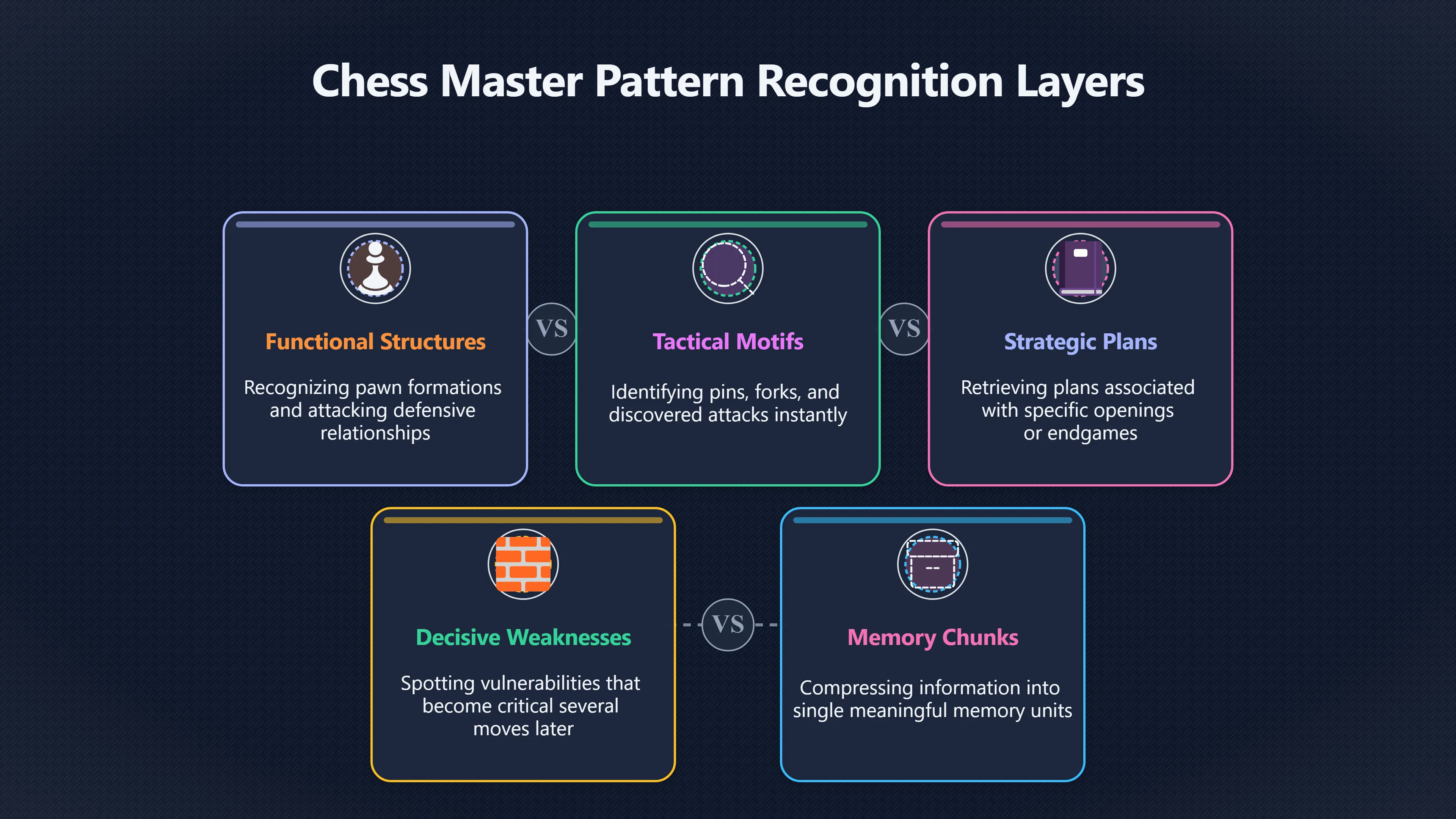
A beginner typically sees thirty-two individual pieces with many unrelated possibilities. A master instead perceives larger functional structures:
- familiar pawn formations;
- attacking and defensive relationships;
- recurring tactical motifs such as pins, forks and discovered attacks;
- typical plans associated with particular openings or endgames;
- weaknesses that are likely to become decisive several moves later.
These structures allow experienced players to compress enormous amounts of information into meaningful units. Rather than consciously identifying every feature, they recognise the position as belonging to a familiar “family” and immediately retrieve associated plans from long-term memory.[Chess Programming Wiki]chessprogramming.orgChess Programming WikiChunkingA chunk is a group of pieces, in some sense a semantic unit, a meaningful pattern that is recognized at a g…
Why Realistic Positions Matter
One of the most influential findings in expertise research came from memory experiments comparing meaningful chess positions with random arrangements of pieces.
When shown a realistic position for only a few seconds, masters can often reconstruct nearly the entire board with remarkable accuracy. At first glance, this appears to suggest extraordinary photographic memory.
The illusion disappears when the same pieces are arranged randomly. Under those conditions, masters lose most of their advantage over novices because the familiar relationships between pieces no longer exist. Without meaningful structure, there are no stored patterns to recognise.[PubMed]pubmed.ncbi.nlm.nih.govExpert chess memory: revisiting the chunking hypothesisby F Gobet · 1998 · Cited by 517 — This paper re-examines experimentally the…
This finding transformed theories of expertise because it showed that expert memory is highly specialised rather than generally superior. Chess masters are not remembering isolated pieces. They are remembering organised configurations that carry strategic meaning.
Later research refined this picture by showing that experts may retain a modest advantage even with partially random positions, suggesting that years of experience also produce more flexible retrieval structures than originally proposed. Nevertheless, the overwhelming benefit still comes from recognising meaningful configurations rather than possessing exceptional raw memory.[PubMed+2ResearchGate]pubmed.ncbi.nlm.nih.govTemplates in chess memory: a mechanism for recalling…by F Gobet · 1996 · Cited by 1042 — This paper addresses empirically and th…
What Chunking Explains About Expert Memory
The dominant explanation for this phenomenon is chunking.
A chunk is a group of pieces that functions as a single meaningful unit in memory. Instead of processing four or five individual pieces separately, an expert treats them as one recognised pattern, much as fluent readers recognise whole words instead of individual letters.[Chess Programming Wiki]chessprogramming.orgChess Programming WikiChunkingA chunk is a group of pieces, in some sense a semantic unit, a meaningful pattern that is recognized at a g…
Research by William Chase and Herbert Simon argued that years of practice allow chess players to store tens of thousands of these chunks in long-term memory. Recognition is rapid because seeing one familiar arrangement automatically activates associated knowledge about likely moves, strategic themes and potential dangers.[chrest.info]chrest.infoPattern recognition makes search possibleby F Gobet · 1998 · Cited by 74 — Abstract Chase and Simon's chunking theory of expert memory, which emphasizes the role of pattern…
Subsequent work expanded this idea with template theory, suggesting that experts do not simply memorise countless fixed patterns. Instead, they develop larger mental frameworks with stable components and flexible slots that can accommodate variations. This helps explain how masters cope with novel positions that have never occurred before while still relying on familiar structures.[PubMed]pubmed.ncbi.nlm.nih.govTemplates in chess memory: a mechanism for recalling…by F Gobet · 1996 · Cited by 1042 — This paper addresses empirically and th…
An important consequence is that intuition and calculation are partners rather than competitors. Pattern recognition narrows the search to promising moves, after which conscious analysis evaluates concrete variations. Recognition makes search efficient; it does not eliminate reasoning.[ResearchGate]researchgate.netResearchGate(PDF) Pattern recognition makes search possibleChase and Simon's chunking theory of expert memory, which emphasizes the role…
Why Practice Changes Perception Rather Than Just Knowledge
The chess evidence suggests that expertise alters perception itself.
With enough deliberate practice, players begin to notice information that beginners literally overlook. Eye-movement studies and think-aloud protocols indicate that stronger players direct attention more efficiently because important features stand out almost automatically. Instead of scanning every square equally, they rapidly focus on tactically or strategically significant areas.[ResearchGate]researchgate.netThought and choice in chessDe Groot found that much of what is important in choosing a move occurs during the first few secon…
Repeated feedback is essential to this transformation. Every analysed game, tactical exercise and post-game review strengthens or weakens stored patterns. Incorrect ideas are gradually discarded, while reliable configurations become easier to recognise in future games.
This explains why simply playing many casual games produces slower improvement than systematic practice combined with immediate feedback. Pattern libraries become accurate only when experience is repeatedly corrected.
Limits of the Chess Analogy for Real-Life Decisions
Chess is often used as a model for expert intuition because it satisfies conditions that many real-world environments do not.
The analogy has important limits.
The rules never change. Every legal position follows the same underlying principles, allowing stable patterns to accumulate across decades.
Feedback is immediate. Good and bad moves usually become apparent within a game or through later analysis.
Outcomes are objective. Winning positions generally remain winning regardless of opinion or organisational politics.
Large numbers of comparable cases exist. Serious players encounter thousands of related positions over many years.
Many professional decisions lack these advantages. Investment markets, hiring decisions, political forecasting and organisational leadership involve hidden variables, delayed consequences and changing environments. Pattern recognition developed in such settings can therefore be much less reliable because feedback is noisy or misleading.
The chess evidence supports trusting intuition only when similar learning conditions exist: repeated exposure, meaningful regularities and dependable correction. Outside those conditions, rapid recognition may simply reflect familiarity or confidence rather than genuine expertise.

What Chess Teaches About Improving Thinking
Chess demonstrates that high-quality intuition is compressed experience rather than instinct.
For improving analytical skills more broadly, its main lessons are practical:
- Build experience around recurring, meaningful situations rather than isolated facts.
- Seek rapid and accurate feedback so that mistaken patterns are corrected instead of reinforced.
- Study complete examples rather than disconnected rules, because experts learn relationships as much as individual features.
- Treat fast recognition as the beginning of good reasoning, not its replacement. Even grandmasters verify promising ideas through calculation before committing to a move.[Wiley Online Library+2chrest.info]onlinelibrary.wiley.comj.1551 6709.2011.01196.xWiley Online LibraryExpertise in Complex Decision Making: The Role of Search…7 Oct 2011 — One of the most influential studies in all e…
Amazon book picks
Further Reading
Books and field guides related to What Chess Masters See That Beginners Miss. Use these as the next step if you want deeper reading beyond the article.
Think Like a Grandmaster
Explains how strong players evaluate positions, recognize patterns, and organize calculation.
The Amateur's Mind
Focuses on the thinking errors beginners make compared with stronger players.
The Psychology of Chess
Directly covers chunking, expert memory, pattern recognition, and psychological research on chess expertise.
How Life Imitates Chess
Connects chess pattern recognition and decision-making to wider questions of judgment while acknowledging real-world differences.
eBay marketplace picks
Marketplace Samples
Live-tested eBay searches with available results related to this page.


Endnotes
1.
Source: researchgate.net
Link:https://www.researchgate.net/publication/332863064_Thought_and_choice_in_chess
Source snippet
Thought and choice in chessDe Groot found that much of what is important in choosing a move occurs during the first few secon...
2.
Source: chrest.info
Title: Pattern recognition makes search possible
Link:https://www.chrest.info/Fribourg_Cours_Expertise/Articles-www/II%20Donnees%20empiriques/Gobet%26Simon–PsycResearch–1998.pdf
Source snippet
by F Gobet · 1998 · Cited by 74 — Abstract Chase and Simon's chunking theory of expert memory, which emphasizes the role of pattern...
3.
Source: onlinelibrary.wiley.com
Title: j.1551 6709.2011.01196.x
Link:https://onlinelibrary.wiley.com/doi/10.1111/j.1551-6709.2011.01196.x
Source snippet
Wiley Online LibraryExpertise in Complex Decision Making: The Role of Search...7 Oct 2011 — One of the most influential studies in all e...
4.
Source: researchgate.net
Link:https://www.researchgate.net/publication/49400725_Memory_for_the_meaningless_How_chunks_help
Source snippet
Memory for the meaningless: How chunks helpPDF | It is a classic result in cognitive science that chess masters can recall briefly presen...
5.
Source: researchgate.net
Link:https://www.researchgate.net/publication/226782174_Pattern_recognition_makes_search_possible_Comments_on_Holding_1992
Source snippet
ResearchGate(PDF) Pattern recognition makes search possibleChase and Simon's chunking theory of expert memory, which emphasizes the role...
6.
Source: researchgate.net
Title: 13576754 Expert [Chess Memory]({{ ‘chess-memory/’ | relative_url }}) Revisiting the Chunking Hypothesis
Link:https://www.researchgate.net/publication/13576754_Expert_Chess_Memory_Revisiting_the_Chunking_Hypothesis
Source snippet
Expert Chess Memory: Revisiting the Chunking HypothesisThis paper re-examines experimentally the finding of Chase and Simon (1973a) that...
7.
Source: researchgate.net
Link:https://www.researchgate.net/publication/283737497_Chess_Expertise_Cognitive_Psychology_of
Source snippet
(PDF) Chess Expertise, Cognitive Psychology ofA pattern-recognition theory of search in expert problem solving. Thinking and Reasoning, 3...
8.
Source: chess.com
Link:https://www.chess.com/
Source snippet
Play Chess Online - Free GamesPlay chess online for free on Chess.com with over 250 million members from around the world. Have fun playi...
9.
Source: chrest.info
Title: Memory for the Meaningless: How Chunks Help
Link:https://chrest.info/fg/papers/Meaningless/Meaningless.html
Source snippet
by F Gobet · Cited by 74 — In this paper, I focus on chess memory and use CHREST (for Chunk Hierarchy and REtrieval STructure; see...
10.
Source: chessprogramming.org
Link:https://www.chessprogramming.org/Chunking
Source snippet
Chess Programming WikiChunkingA chunk is a group of pieces, in some sense a semantic unit, a meaningful pattern that is recognized at a g...
11.
Source: pubmed.ncbi.nlm.nih.gov
Link:https://pubmed.ncbi.nlm.nih.gov/9709441/
Source snippet
Expert chess memory: revisiting the chunking hypothesisby F Gobet · 1998 · Cited by 517 — This paper re-examines experimentally the...
12.
Source: pubmed.ncbi.nlm.nih.gov
Link:https://pubmed.ncbi.nlm.nih.gov/8812020/
Source snippet
Templates in chess memory: a mechanism for recalling...by F Gobet · 1996 · Cited by 1042 — This paper addresses empirically and th...
13.
Source: pubmed.ncbi.nlm.nih.gov
Link:https://pubmed.ncbi.nlm.nih.gov/9677761/
Source snippet
memory: a comparison of four theoriesby F Gobet · 1998 · Cited by 439 — This paper compares four current theories of expertise with respe...
14.
Source: chessprogramming.org
Link:https://www.chessprogramming.org/Adriaan_de_Groot
Source snippet
Adriaan de GrootDutch psychologist and chess master, who conducted a number of ground-breaking experiments in the cognitive processes. In...
Additional References
15.
Source: scispace.com
Link:https://scispace.com/pdf/recall-of-random-and-distorted-chess-positions-implications-1zjia8geik.pdf
Source snippet
Recall of random and distorted chess positionsThis paper explores the question, important to the theory of expert performance, of the nat...
16.
Source: amazon.com.br
Link:https://www.amazon.com.br/Thought-Choice-Chess-Adriaan-Groot/dp/4871877582?tag=searcht-20
Source snippet
Thought and Choice in ChessDe Groot found that much of what is important in choosing a move occurs during the first few seconds of exposu...
17.
Source: jstor.org
Link:https://www.jstor.org/stable/j.ctt46n0r2
Source snippet
Thought and Choice in ChessWhat does a chessmaster think when he prepartes his next move? How are his thoughts organized? Which methods a...
18.
Source: bookschatter.com
Link:https://www.bookschatter.com/recos/thought-and-choice-in-chess
Source snippet
Thought and Choice in Chess by Adriaan de GrootDe Groot concurred with Alfred Binet that visual memory and visual perception are importan...
19.
Source: cambridge.org
Link:https://www.cambridge.org/core/books/cambridge-handbook-of-expertise-and-expert-performance/expertise-in-chess/6E7F07A536AED091520EE9AE31128CCE
Source snippet
Cambridge University Press & AssessmentExpertise in Chess (Chapter 31)De Groot interpreted these findings to support the importance of kn...
20.
Source: ovid.com
Title: 03640210701703725~understanding our understanding of strategic scenarios what
Link:https://www.ovid.com/journals/csamj/pdf/10.1080/03640210701703725~understanding-our-understanding-of-strategic-scenarios-what
Source snippet
What Role Do Chunks Play?by A Linhares · 2007 · Cited by 45 — We propose that underlying the strategic vision of advanced chess players i...
21.
Source: files01.core.ac.uk
Link:https://files01.core.ac.uk/download/pdf/334683.pdf
Source snippet
(for Chunk Hierarchy and REtrieval STructure; see De Groot. & Gobet, 1996, and, Gobet, 1993a, b, for...Read more...
22.
Source: abebooks.com
Title: Thought and Choice in Chess by de Groot, Adriaan Synopsis
Link:https://www.abebooks.com/Thought-Choice-Chess-Groot-Adriaan-Ishi/31444619324/bd
Source snippet
What does a chess master think when he prepares his next move? How are his thoughts organized? Which methods and strategies does he use b...
23.
Source: archive.org
Title: Thought and choice in chess: Groot, Adriaan D
Link:https://archive.org/details/thoughtchoiceinc0000groo
Source snippet
de, authorJan 5, 2021 — Publication date: 1978; Topics: Choice (Psychology), Chess -- Psychological aspects, Problem solving; Publisher...
24.
Source: en.chessbase.com
Title: adriaan de groot che psychologist 1914 2006
Link:https://en.chessbase.com/post/adriaan-de-groot-che-psychologist-1914-2006-
Source snippet
de Groot, chess psychologist (1914–2006)Aug 16, 2006 — He was a psychologist and chess master, The English translation, Thought and Choic...
Topic Tree
Follow this branch
Parent topic
Expert Gut When Should You Trust Your Gut?Related pages 5
- Fire Decisions Why Firefighters Sometimes Know Before They Explain
- Forecast Feedback How Forecasting Makes Confidence Accountable
- Kind vs Wicked When Experience Teaches the Wrong Lesson
- Medical Gut When Doctors Should Trust Their First Impression
- Stats vs Experts When Simple Models Beat Expert Judgement