Within Framing
Same choice, different frame
The same option can look safe or reckless depending on whether the question highlights what you gain, lose, save, or give up.
On this page
- What gain and loss wording changes
- Work and life examples beyond lab tasks
- How to test a decision in both directions
Page outline Jump by section
Introduction
The same decision can feel sensible or reckless depending on whether it is described in terms of what you gain or what you lose. This is one of the most robust findings in decision research: when two options are objectively equivalent but one highlights gains and the other highlights losses, many people reverse their preferences. The effect is especially important in project management, career decisions, health choices and financial planning because these decisions often involve uncertainty. Rather than changing the facts, gain-versus-loss wording changes the reference point from which people judge those facts. Understanding this pattern helps you recognise when a choice is being shaped by presentation rather than substance, making it easier to evaluate options on their actual merits rather than on the language used to describe them.[Columbia University Statistics]sites.stat.columbia.eduColumbia University StatisticsThe Framing of Decisions and the Psychology of Choiceby A Tversky · Cited by 30669 — When faced with a choi…
What gain and loss wording changes
Gain-versus-loss framing is a form of equivalence framing: the underlying outcomes remain the same, but they are described from different perspectives. The classic demonstration is the “Asian disease” experiment by Amos Tversky and Daniel Kahneman. Participants chose between programmes to address a hypothetical epidemic. When outcomes were expressed as lives saved, most preferred the certain option. When mathematically identical outcomes were expressed as lives lost, most preferred the riskier option. Rationally, the two versions should have produced identical preferences, but they did not.[Columbia University Statistics]sites.stat.columbia.eduColumbia University StatisticsThe Framing of Decisions and the Psychology of Choiceby A Tversky · Cited by 30669 — When faced with a choi…
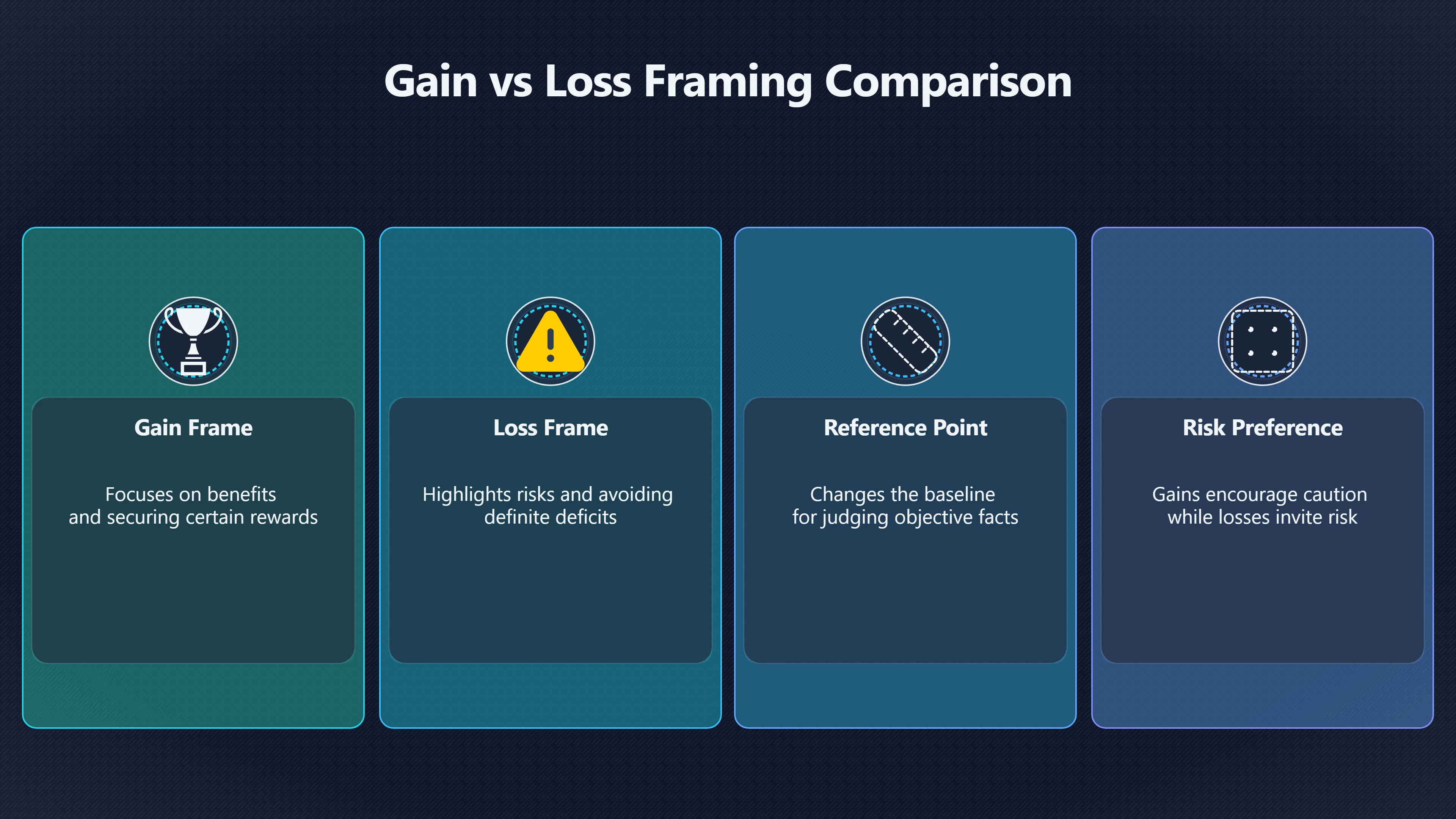
Prospect theory explains why this happens. People evaluate outcomes relative to a reference point rather than in absolute terms. Gains tend to encourage caution because securing a certain benefit feels attractive. Losses often encourage greater risk-taking because people become motivated to avoid accepting a definite loss, even if the gamble itself is objectively worse. This asymmetry is closely related to loss aversion, the tendency for losses to carry greater psychological weight than equally sized gains.[Columbia University Statistics]sites.stat.columbia.eduColumbia University StatisticsThe Framing of Decisions and the Psychology of Choiceby A Tversky · Cited by 30669 — When faced with a choi…
Importantly, gain and loss framing does not guarantee that everyone changes their mind. The size of the effect depends on context, individual differences, familiarity with the decision and how emotionally significant the outcomes appear. Recent reviews show that framing effects are reliable but vary substantially across studies rather than appearing as a fixed universal bias.[PMC]pmc.ncbi.nlm.nih.govPMCA systematic review of risky-choice framing effectsNIHby A Kühberger · 2023 · Cited by 31 — The typical finding, that with positive framing (gains) participants tend to prefer the su…
Work and life examples beyond laboratory tasks
The practical importance of gain-versus-loss wording lies in ordinary decisions rather than artificial experiments.
Projects and business decisions
A proposal can be presented as:
- “This investment has a 70% chance of meeting its targets.”
- “This investment has a 30% chance of failing.”
Although the probabilities are identical, the first description often encourages acceptance while the second encourages caution. The reverse can happen when abandoning a project is framed as “avoiding further losses” instead of “giving up future opportunities”. The reference point shifts from protecting existing investment to preventing additional waste.
In project reviews, another common contrast is:
- “Completing now secures most of the planned benefits.”
- “Cancelling now writes off the work already completed.”
The second wording naturally activates concerns about loss, increasing the temptation to continue despite weak future prospects.
Career decisions
Someone considering changing jobs might hear:
- “You could gain better long-term opportunities.”
- “You would lose the security of your current role.”
Both statements describe the same transition. The second frame makes the current position feel like something valuable that must be surrendered, encouraging greater attachment to the status quo.
Personal finance
Financial advisers sometimes describe increasing pension contributions as either:
- “Building future financial freedom.”
- “Giving up disposable income today.”
The underlying cash flow is identical, but each description draws attention to a different reference point, affecting how attractive the decision feels.
Health communication
Health messaging frequently exploits equivalent wording. Medical treatments may be described using survival rates or mortality rates, while screening programmes can emphasise lives saved or deaths prevented. Research over several decades has shown that patients’ treatment preferences can change when identical statistical information is framed positively or negatively, even though the probabilities themselves do not change.[The Decision Lab]thedecisionlab.comThe Decision Lab Framing effectThe Decision LabFraming effect - The Decision LabAccording to researchers Levin, Schneider, and Gaeth, there are three main types of fram…
These examples illustrate that framing rarely changes objective outcomes. Instead, it changes which consequence becomes psychologically most salient.
Why the loss frame often feels stronger
Losses generally attract more attention than comparable gains. From an evolutionary perspective, overlooking a threat may have been more costly than overlooking an opportunity. Prospect theory captures this tendency through a value function that is steeper for losses than for gains, meaning the emotional impact of losing is usually greater than the pleasure of gaining the same amount.[Columbia University Statistics]sites.stat.columbia.eduColumbia University StatisticsThe Framing of Decisions and the Psychology of Choiceby A Tversky · Cited by 30669 — When faced with a choi…
This does not mean people always become more conservative under loss framing. In risky-choice situations, the opposite frequently occurs. Faced with a certain loss, people often prefer a gamble that offers some chance of escaping the loss entirely, even when that gamble has a lower expected value. This helps explain behaviour such as:
- continuing unsuccessful projects in the hope of recovery;
- doubling down on failing investments;
- delaying difficult organisational decisions because accepting the loss feels worse than risking further losses.
These patterns become especially visible when the decision maker treats the current position as the baseline that must be protected.
What the evidence says about real-world decisions
Laboratory experiments established the phenomenon, but later research has examined whether it survives outside controlled settings.
Systematic reviews and meta-analyses indicate that risky-choice framing effects are consistently observed across many populations, although effect sizes vary with task design, emotional engagement, numeracy and cultural context. The framing effect is therefore better understood as a reliable tendency than as an unavoidable rule governing every decision.[PMC]pmc.ncbi.nlm.nih.govPMCA systematic review of risky-choice framing effectsNIHby A Kühberger · 2023 · Cited by 31 — The typical finding, that with positive framing (gains) participants tend to prefer the su…
Health communication provides some of the strongest applied evidence. Reviews of gain- and loss-framed messages suggest that the most persuasive framing depends on the behaviour being encouraged. Messages promoting preventive behaviours may sometimes benefit from gain-focused wording, whereas behaviours involving disease detection or screening may respond differently depending on perceived risk, uncertainty and the audience. The evidence is therefore more nuanced than the simple claim that “gain framing always works better” or “loss framing always motivates action”.[Tandfonline]tandfonline.comDoes perceived risk influence the effects of message…by J Van’t Riet · 2016 · Cited by 124 — An influential notion holds th…
More recent studies have also examined framing during real crises, including the COVID-19 pandemic. Researchers found that equivalent gain and loss presentations continued to influence preferences, although personal relevance, emotional responses and trust in institutions altered the size of the effect. This reinforces the idea that framing interacts with context rather than replacing rational evaluation altogether.[Research Explorer]pure.uva.nlResearch ExplorerThe effects of gain versus loss framing on risky choices and…Today — The most well-known application of equivalency f…
How to test a decision in both directions
A practical defence against gain-versus-loss framing is not to eliminate emotion but to deliberately examine both descriptions before deciding.
For important decisions:
- Write the option as a gain: “What do I obtain if I choose this?”
- Rewrite it as a loss: “What do I give up if I choose this?”
- Check whether the facts have changed or only the wording.
- Identify your reference point. Are you comparing against today’s situation, your original expectations or your desired future?
- Calculate the underlying outcomes separately from the language. Probabilities, costs and expected consequences should remain identical regardless of frame.
- Ask whether your preference changed only after the wording changed. If so, the framing itself is probably influencing your judgement.
For team decisions, it is often valuable to present both versions together. Instead of choosing between “saving £500,000” and “avoiding a £500,000 loss”, display both descriptions alongside the same financial analysis. Making the equivalence explicit reduces the chance that discussion revolves around rhetoric rather than substance.
Better thinking through dual framing
Gain-versus-loss wording is powerful because it changes the psychological meaning of identical information without changing the information itself. In everyday life, this influences whether opportunities appear safe or risky, whether setbacks feel recoverable or permanent, and whether people cling to existing commitments or embrace change.
The practical lesson is not to ignore gains or dismiss losses. Instead, before making an important project or life decision, deliberately inspect both frames. If an option looks attractive only when described as a gain, or only when described as avoiding a loss, it is worth pausing to ask whether your judgement reflects the underlying choice or merely the way that choice has been presented.
Amazon book picks
Further Reading
Books and field guides related to Same choice, different frame. Use these as the next step if you want deeper reading beyond the article.
Thinking, Fast and Slow
Gain-loss framing and prospect theory are central concepts explained by Kahneman.
Nudge
Shows how presentation and choice architecture alter decisions without changing underlying options.
Predictably Irrational, Revised and Expanded Edition
Rating: 4.0/5 from 15 Google Books ratings
Explores how context and wording influence choices that appear objectively equivalent.
The Undoing Project
Covers the researchers behind framing effects, prospect theory, and modern behavioural decision science.
eBay marketplace picks
Marketplace Samples
Live-tested eBay searches with available results related to this page.

Endnotes
1.
Source: sites.stat.columbia.edu
Link:https://sites.stat.columbia.edu/gelman/surveys.course/TverskyKahneman1981.pdf
Source snippet
Columbia University StatisticsThe Framing of Decisions and the Psychology of Choiceby A Tversky · Cited by 30669 — When faced with a choi...
2.
Source: tandfonline.com
Link:https://www.tandfonline.com/doi/full/10.1080/17437199.2016.1176865
Source snippet
Does perceived risk influence the effects of message...by J Van’t Riet · 2016 · Cited by 124 — An influential notion holds th...
3.
Source: pmc.ncbi.nlm.nih.gov
Title: PMCA systematic review of risky-choice framing effects
Link:https://pmc.ncbi.nlm.nih.gov/articles/PMC10620856/
Source snippet
NIHby A Kühberger · 2023 · Cited by 31 — The typical finding, that with positive framing (gains) participants tend to prefer the su...
4.
Source: thedecisionlab.com
Title: The Decision Lab Framing effect
Link:https://thedecisionlab.com/biases/framing-effect
Source snippet
The Decision LabFraming effect - The Decision LabAccording to researchers Levin, Schneider, and Gaeth, there are three main types of fram...
5.
Source: pure.uva.nl
Link:https://pure.uva.nl/ws/files/63249396/Prospect_Theory_in_Times_of_a_Pandemic_The_Effects_of_Gain_versus_Loss_Framing_on_Risky_Choices_and_Emotional_Responses_during_the_2020_Coronavirus.pdf
Source snippet
Research ExplorerThe effects of gain versus loss framing on risky choices and...Today — The most well-known application of equivalency f...
Additional References
6.
Source: communicationcache.com
Link:https://www.communicationcache.com/uploads/1/0/8/8/10887248/a_new_look_at_framing_effects-_distribution_of_effect_sizes_individual_differences_and_independence_of_types_of_effects.pdf
Source snippet
A New Look at Framing Effects:by IP Levin · Cited by 811 — Typically, as in Tversky and Kahneman's (1981) "Asian disease task," people ar...
7.
Source: youtube.com
Link:https://www.youtube.com/watch?v=s6V210ww6No
Source snippet
Why Does the Same Thing Get Chosen Differently When Described Differently? | The Framing Effect...
8.
Source: youtube.com
Link:https://www.youtube.com/watch?v=l16J-pT43B4
Source snippet
The Framing Effect (Intro Psych Tutorial #94)...
9.
Source: joebm.com
Title: V12N3 803
Link:https://www.joebm.com/vol12/JOEBM-V12N3-803.pdf
Source snippet
Framing Effect: To Frame, or to Be Framed9 Jul 2024 — According to the prospect theory put forward by Kahneman. & Tversky (1984), people...
10.
Source: psicothema.com
Link:https://www.psicothema.com/pdf/3107.pdf
Source snippet
A meta-analytic review of framming effect: risky, attribute...by A Piñon · Cited by 213 — In the early 1980s, Tversky and Kahneman (1981...
11.
Source: youtube.com
Title: What is Prospect Theory? (Easiest Explanation)
Link:https://www.youtube.com/watch?v=wYN1bfOSQSY
Source snippet
Thinking, Fast and Slow | Daniel Kahneman | Talks at Google...
12.
Source: youtube.com
Title: The Framing Effect (Intro Psych Tutorial #94)
Link:https://www.youtube.com/watch?v=Ic_0jSPtx_k
Source snippet
What is Prospect Theory? (Easiest Explanation)...
13.
Source: youtube.com
Title: Thinking, Fast and Slow | Daniel Kahneman | Talks at Google
Link:https://www.youtube.com/watch?v=CjVQJdIrDJ0
Topic Tree