Within Predictions
Why wrong guesses can improve memory
Pretesting can improve later recall when a wrong first attempt is followed by clear corrective feedback.
On this page
- What pretesting asks the learner to do
- Why feedback changes the value of errors
- When guessing before learning is likely to fail
Page outline Jump by section
Introduction
Many people assume that making a wrong guess before learning is harmful because the mistake will become “stuck” in memory. Research on pretesting suggests a more nuanced picture. When learners attempt to answer a question before being taught the material, they usually fail—but if they then receive clear corrective feedback, they often remember the correct answer better than learners who simply studied it without first guessing. This phenomenon, known as the pretesting effect, has been demonstrated across word pairs, factual knowledge, reading passages, videos and classroom learning, although its strength depends on how the activity is designed and what is being learned.[Springer+2PMC]link.springer.comPrequestioning and Pretesting Effects: a Review of Empirical…by SC Pan · 2023 · Cited by 111 — In this review, we summarize th…
 Within the broader habit of making predictions before checking answers, pretesting provides a practical lesson: a well-informed wrong answer is not wasted effort. Instead, it can become the event that prepares the mind to notice, organise and retain the correction.
What pretesting asks the learner to do
Pretesting deliberately asks learners to retrieve or generate an answer before they have been formally taught it. Unlike a conventional test, the goal is not assessment but preparation for learning.
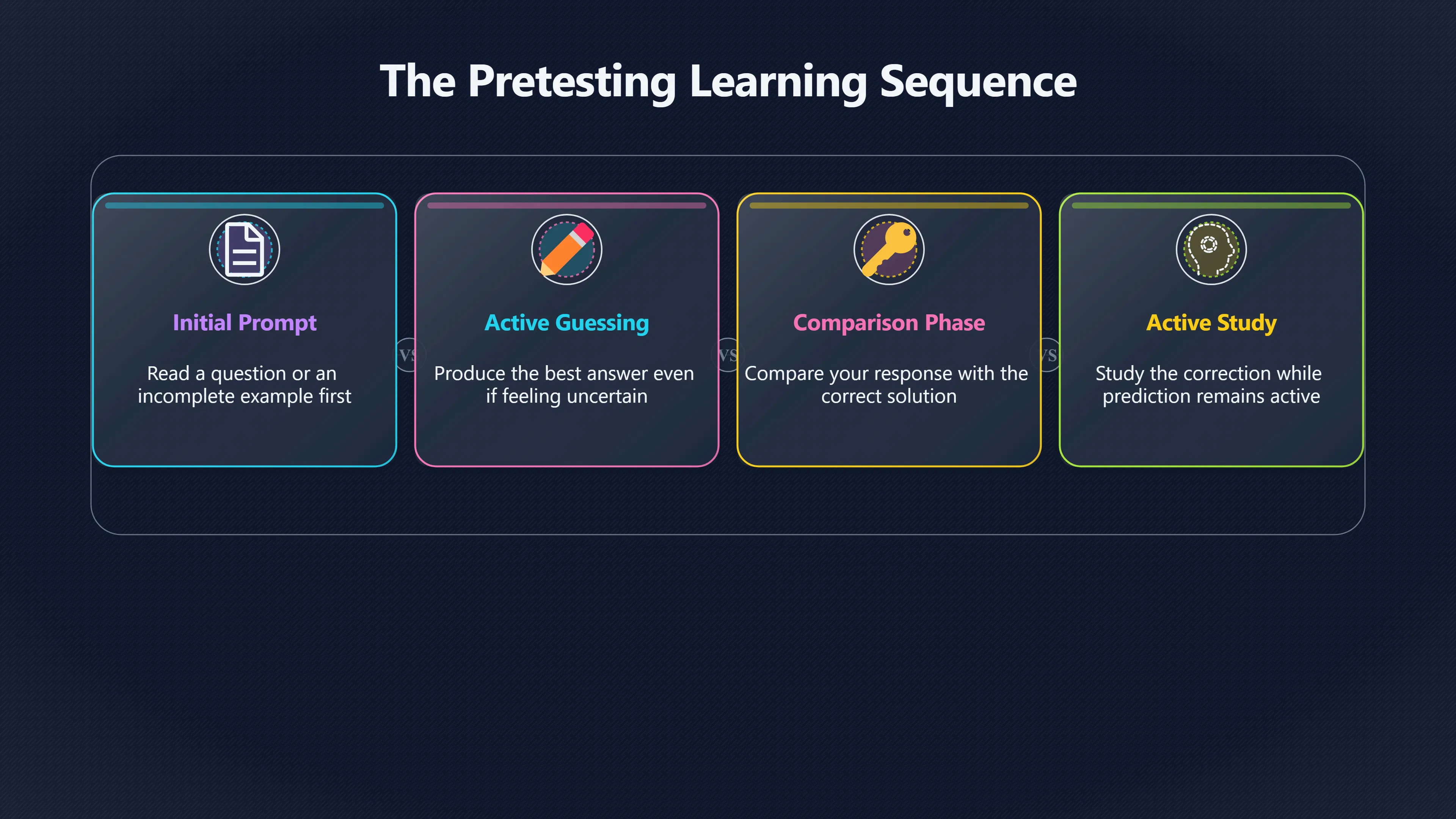
A typical sequence is simple:
- Read a question or incomplete example.
- Produce the best answer you can, even if uncertain.
- Compare your response with the correct answer.
- Study the correction while your original prediction is still active in memory.
The crucial feature is that the learner commits to an answer before seeing the solution. This creates a specific prediction that can later be confirmed or corrected. Simply wondering about the answer without generating one does not consistently produce the same benefits.[Springer]link.springer.comPrequestioning and Pretesting Effects: a Review of Empirical…by SC Pan · 2023 · Cited by 111 — In this review, we summarize th…
Laboratory studies that revived interest in pretesting often used very difficult materials. Participants guessed the second word in unfamiliar word pairs, such as trying to complete a cue before seeing the target. Most guesses were incorrect, yet later recall exceeded that of learners who spent the same amount of time only studying the completed pairs. Similar effects have since been reported using trivia questions, prose passages, lectures and video-based instruction.[Springer+2Journal of Cognition]link.springer.comPrequestioning and Pretesting Effects: a Review of Empirical…by SC Pan · 2023 · Cited by 111 — In this review, we summarize th…
Why feedback changes the value of errors
Wrong guesses do not improve learning by themselves. Their value comes from what happens immediately afterwards.
Several complementary explanations have emerged from the research.
First, generating an answer activates related knowledge already stored in memory. Even if the answer is wrong, relevant concepts become active, making it easier to connect the correct information to existing knowledge once it appears. Rather than reading a fact in isolation, the learner incorporates it into an existing mental network.[PMC]pmc.ncbi.nlm.nih.govPMCPredicting as a learning strategyNIHby G Brod · 2021 · Cited by 77 — This article attempts to delineate the procedural and mechanistic characteristics of predicting…
Second, an incorrect prediction creates a noticeable mismatch between expectation and reality. This prediction error captures attention. Instead of passively reading the correction, learners are more likely to notice precisely what differs from their expectation, making the corrective information more memorable.[PMC]pmc.ncbi.nlm.nih.govPMCPredicting as a learning strategyNIHby G Brod · 2021 · Cited by 77 — This article attempts to delineate the procedural and mechanistic characteristics of predicting…
Third, the learner’s own incorrect response provides additional retrieval routes. Later, remembering the original mistake can help cue the corrected answer. Rather than competing with the correct information, the error can become a reminder of why the correct response matters.[Springer]link.springer.comUnraveling the benefits of experiencing errors during learningby Y Mera · 2022 · Cited by 97 — Experimental evidence has shown th…
Recent reviews increasingly describe these mechanisms as a sequence: pretesting changes how learners attend to subsequent instruction, how they encode new information and how they retrieve it later. The wrong answer is useful not because errors are inherently beneficial, but because they reshape the learning process that follows.[Springer]link.springer.comPrequestioning and Pretesting Effects: a Review of Empirical…by SC Pan · 2023 · Cited by 111 — In this review, we summarize th…

Why fear of “learning the wrong thing” is often misplaced
A common concern is that guessing will reinforce incorrect knowledge. Research suggests this fear is often overstated when corrective feedback is prompt and unambiguous.
Studies on errorful learning consistently show that producing mistakes can improve later memory compared with error-free study, provided that learners subsequently receive the correct answer. Simply making mistakes without correction does not produce the same benefit.[Springer]link.springer.comUnraveling the benefits of experiencing errors during learningby Y Mera · 2022 · Cited by 97 — Experimental evidence has shown th…
This distinction matters because educational advice has sometimes promoted avoiding errors altogether. Modern evidence instead suggests that carefully managed errors can become learning opportunities. The important variable is not whether an error occurred, but whether it was followed by attention-grabbing, accurate correction.[Springer]link.springer.comUnraveling the benefits of experiencing errors during learningby Y Mera · 2022 · Cited by 97 — Experimental evidence has shown th…
Research on hypercorrection offers a related insight. Surprisingly, errors made with high confidence are often corrected especially well once reliable feedback is received. The surprise created by discovering that a confident belief was wrong appears to increase attention to the correction rather than preventing it from being learned.[Wikipedia]WikipediaHypercorrection (psychologyHypercorrection (psychology
When guessing before learning is likely to fail
The benefits of pretesting are real but not universal.
One important condition is the availability of corrective feedback. If learners guess and never discover the correct answer, the strategy offers little educational value and may simply leave misconceptions unchallenged.[Springer]link.springer.comUnraveling the benefits of experiencing errors during learningby Y Mera · 2022 · Cited by 97 — Experimental evidence has shown th…
The quality of the guess also matters. Random responses generated without engaging prior knowledge provide fewer useful connections than genuine attempts based on existing understanding. Productive guessing involves reasoning from what is already known rather than selecting answers arbitrarily.[PMC]pmc.ncbi.nlm.nih.govPMCPredicting as a learning strategyNIHby G Brod · 2021 · Cited by 77 — This article attempts to delineate the procedural and mechanistic characteristics of predicting…
Some evidence also suggests that timing interacts with the type of material. For relatively arbitrary associations, such as unrelated word pairs, immediate corrective feedback appears particularly important. For meaningful questions, such as trivia or conceptually rich material, learning benefits can survive longer delays before feedback because the question itself activates a broader semantic network.[ResearchGate]researchgate.netRecent evidenceAttempting to Answer a Meaningful Question Enhances…July 15, 2013 — PDF | Attempting to retrieve information from memory e…
Finally, pretesting should not be confused with replacing instruction. The strongest results occur when unsuccessful guesses are followed by careful study of the correct explanation, not when learners are expected to discover everything independently.[Springer]link.springer.comPrequestioning and Pretesting Effects: a Review of Empirical…by SC Pan · 2023 · Cited by 111 — In this review, we summarize th…
Applying pretesting to everyday learning
For someone trying to improve analytical thinking, pretesting works best when it becomes a deliberate prediction habit rather than a formal examination.
Before reading a chapter, pause to answer its main question from memory. Before watching an instructional video, predict the explanation it will give. Before revealing the solution to a worked example, write down both your expected answer and the reasoning behind it. The objective is not to maximise correct guesses but to expose your current mental model so that feedback has something concrete to modify.
Equally important is reviewing the difference between prediction and reality. Instead of asking only, “Was I right?”, ask, “Which assumption produced my answer?” That comparison transforms incorrect guesses into evidence about how you think, making later predictions more accurate as well as improving memory for the specific material.
In this way, pretesting serves a dual purpose within the broader practice of prediction before checking answers. It strengthens recall of newly learned information while also cultivating a habit of treating errors as informative feedback rather than personal failure.
eBay marketplace picks
Marketplace Samples
Live-tested eBay searches with available results related to this page.


Endnotes
1.
Source: link.springer.com
Link:https://link.springer.com/article/10.1007/s10648-023-09814-5
Source snippet
Prequestioning and Pretesting Effects: a Review of Empirical...by SC Pan · 2023 · Cited by 111 — In this review, we summarize th...
2.
Source: pmc.ncbi.nlm.nih.gov
Title: PMCPredicting as a learning strategy
Link:https://pmc.ncbi.nlm.nih.gov/articles/PMC8642250/
Source snippet
NIHby G Brod · 2021 · Cited by 77 — This article attempts to delineate the procedural and mechanistic characteristics of predicting...
3.
Source: link.springer.com
Link:https://link.springer.com/article/10.3758/s13423-021-02022-8
Source snippet
Unraveling the benefits of experiencing errors during learningby Y Mera · 2022 · Cited by 97 — Experimental evidence has shown th...
4.
Source: researchgate.net
Link:https://www.researchgate.net/publication/353451805_The_Benefits_of_Impossible_Tests_Assessing_the_Role_of_Error-Correction_in_the_Pretesting_Effect
Source snippet
Assessing the Role of Error-Correction in the Pretesting Effect8 Aug 2021 — The error-correction hypothesis suggests that incorrect guess...
5.
Source: Wikipedia
Title: Hypercorrection (psychology)
Link:https://en.wikipedia.org/wiki/Hypercorrection_%28psychology%29
6.
Source: researchgate.net
Title: Recent evidence
Link:https://www.researchgate.net/publication/249646552_Attempting_to_Answer_a_Meaningful_Question_Enhances_Subsequent_Learning_Even_When_Feedback_Is_Delayed
Source snippet
Attempting to Answer a Meaningful Question Enhances...July 15, 2013 — PDF | Attempting to retrieve information from memory e...
Published: July 15, 2013
7.
Source: researchgate.net
Link:https://www.researchgate.net/publication/374157738_Prequestioning_and_pretesting_effects_a_review_of_empirical_research_theoretical_perspectives_and_implications_for_educational_practice
Source snippet
(PDF) Prequestioning and Pretesting Effects: a Review of...4 Sept 2023 — In this review, we summarize the emerging evidence for prequest...
8.
Source: journalofcognition.org
Link:https://journalofcognition.org/articles/10.5334/joc.455
Source snippet
The Pretesting Effect: Exploring the Impact of Feedback...by Y Mera · 2025 · Cited by 2 — The pretesting effect suggests that attempting...
9.
Source: pmc.ncbi.nlm.nih.gov
Link:https://pmc.ncbi.nlm.nih.gov/articles/PMC12292081/
Source snippet
Pretesting Effect: Exploring the Impact of Feedback and...by Y Mera · 2025 · Cited by 2 — The pretesting effect suggests that attempting...
10.
Source: pmc.ncbi.nlm.nih.gov
Link:https://pmc.ncbi.nlm.nih.gov/articles/PMC11295426/
Source snippet
Examining the potential benefits of truth... - PMCby K Arcos · 2023 · Cited by 2 — Thus, pretesting, or guessing, may create more elabor...
Additional References
11.
Source: pearl.plymouth.ac.uk
Link:https://pearl.plymouth.ac.uk/cgi/viewcontent.cgi?article=1192&context=psy-research
Source snippet
the Role of Error-Correction in the Pretesting Effectby AB Inkster · 2021 — According to the error- correction idea, the learning system...
12.
Source: youtube.com
Title: Using Pretests as Learning Tools, Dr. Elizabeth Bjork
Link:https://www.youtube.com/watch?v=Y24Lh5CXoBA
Source snippet
What Are The Benefits Of Pre-Testing? | with Dr Nick Soderstrom...
13.
Source: youtube.com
Title: The Best Way To Learn You’ve Never Tried
Link:https://www.youtube.com/watch?v=wzjp9uPm_Tw
Source snippet
The study technique that TRAVELS THROUGH TIME...
14.
Source: youtube.com
Title: ALSET Webinar with Dr Steven Pan
Link:https://www.youtube.com/watch?v=blFOgA6zTrE
Source snippet
The Best Way To Learn You've Never Tried...
15.
Source: youtube.com
Title: What Are The Benefits Of Pre-Testing? | with Dr Nick Soderstrom
Link:https://www.youtube.com/watch?v=N75GPCOHF7g
Source snippet
ALSET Webinar with Dr Steven Pan...
16.
Source: youtube.com
Title: The study technique that TRAVELS THROUGH TIME
Link:https://www.youtube.com/watch?v=hI5ATajLxl8
Topic Tree