Within Problem Parts
Do not stop at the first plausible story
Comparing live explanations protects analysis from settling too quickly on the story that feels most coherent.
On this page
- Why a single explanation can feel falsely complete
- Building a small set of competing explanations
- Looking for evidence that separates the options
Page outline Jump by section
Introduction
When a problem first appears, the first explanation that makes sense often feels like the right one. That feeling of coherence is useful for generating ideas, but it is a poor test of whether an explanation is correct. Analytical thinking improves when several plausible explanations remain alive until the available evidence can separate them. Instead of asking, “How can I prove my idea?”, a better question is, “What other explanations could also account for these facts, and what evidence would distinguish between them?”
 This habit is widely used in intelligence analysis, scientific research and accident investigation because it reduces the risk of settling too quickly on an appealing story. The goal is not to create endless doubt or to treat every explanation as equally likely. It is to delay commitment until the evidence has had a fair chance to eliminate weaker alternatives. [Wikipedia]WikipediaAnalysis of competing hypothesesAnalysis of competing hypotheses
Why a single explanation can feel falsely complete
People naturally build coherent stories from incomplete information. Once an explanation fits the known facts, the mind tends to notice supporting evidence more readily than contradictory evidence. Psychologists describe this tendency as confirmation bias: the inclination to search for, interpret and remember information in ways that reinforce existing beliefs. [Encyclopedia Britannica]britannica.comconfirmation biasEncyclopedia BritannicaConfirmation bias | Definition, Examples, Psychology, & Facts11 Jun 2026 — Confirmation bias, people's tendency to…
This creates several common problems:
- Early closure: analysis stops because one explanation seems “good enough”.
- Selective evidence gathering: information that supports the preferred explanation receives more attention.
- Reinterpretation of conflicting evidence: contradictory facts are dismissed as exceptions instead of prompting reconsideration.
- False confidence: the explanation feels increasingly certain simply because more supporting details have been collected.
The danger is not that the first explanation is always wrong. Often it is correct. The problem is that confidence grows before competing explanations have been tested, making it difficult to recognise when the initial story should be abandoned. [GOV.UK]assets.publishing.service.gov.ukUK Forensic Science Regulator GuidanceConfirmation bias is closely related to expectation bias, whereby people test hypotheses by looking for confirming evidence rather than f…
A project that misses deadlines illustrates this well. The team may immediately conclude that poor planning caused the delay because several examples support that idea. Yet the same evidence might also fit alternative explanations such as changing customer requirements, unrealistic executive deadlines or hidden technical dependencies. Until these possibilities are compared directly, the apparent certainty comes from the attractiveness of the story rather than from the strength of the evidence.
Building a small set of competing explanations
Keeping multiple explanations alive does not require dozens of theories. In everyday analytical work, three to five genuinely plausible explanations are usually enough to prevent premature closure.
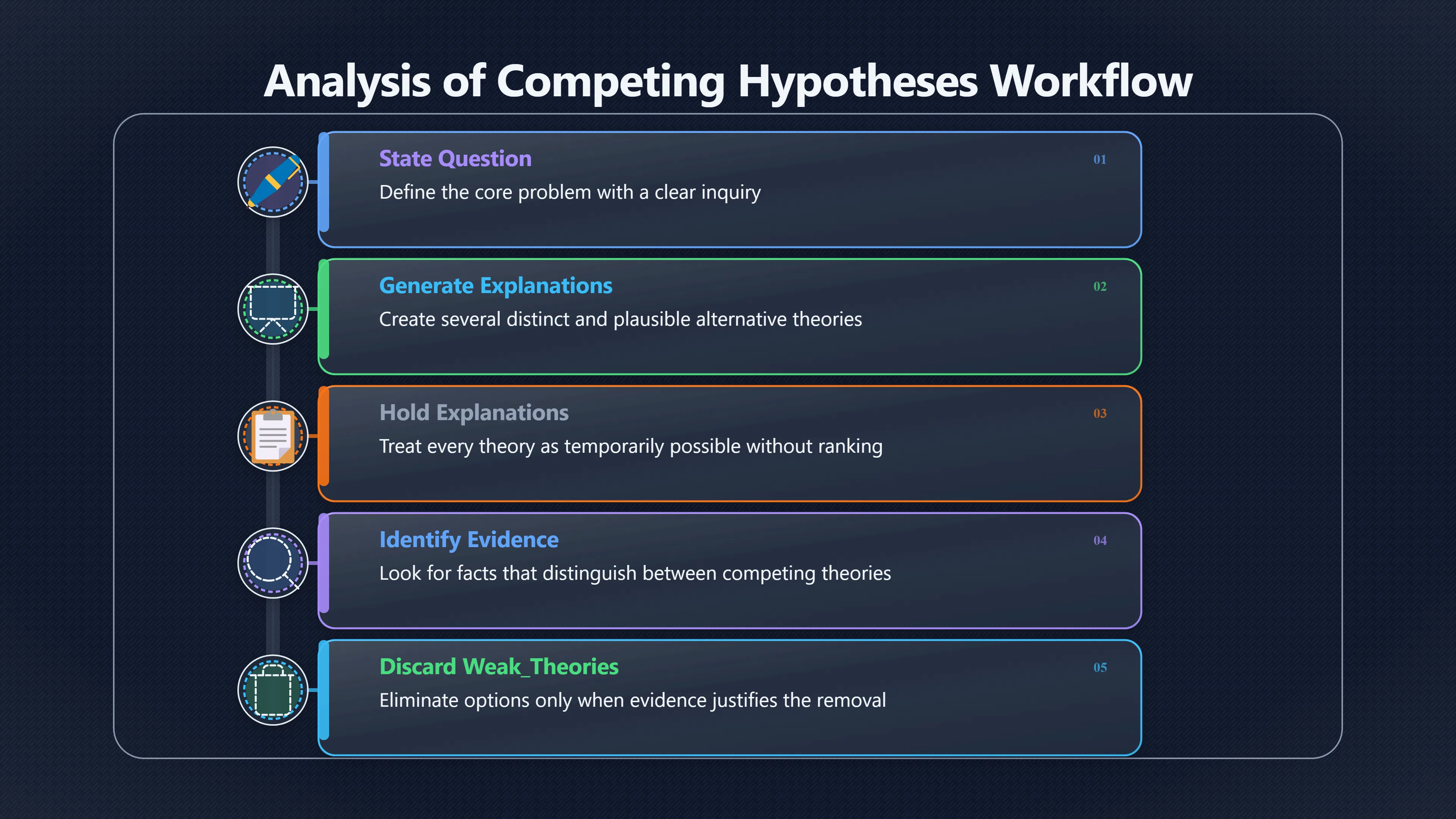
A useful sequence is:
- State the question clearly. For example: “Why has customer retention fallen?”
- Generate several distinct explanations. Avoid creating slight variations of the same idea.
- Treat each explanation as temporarily possible. Resist ranking them too early.
- Look for evidence that would favour one explanation over the others.
- Discard explanations only when the evidence justifies doing so.
The explanations should compete rather than overlap. For example, declining sales might be explained by:
- increased competition;
- product quality problems;
- pricing changes;
- changes in customer behaviour.
Each explanation predicts somewhat different evidence. That makes them useful analytical alternatives rather than multiple versions of the same story.
Intelligence analysts formalised this idea in the Analysis of Competing Hypotheses (ACH), a structured technique developed to reduce confirmation bias by requiring analysts to evaluate several plausible explanations simultaneously instead of building evidence around a single favourite. [Wikipedia]WikipediaAnalysis of competing hypothesesAnalysis of competing hypotheses
Looking for evidence that separates the options
Not all evidence is equally valuable. Some facts are compatible with nearly every explanation, while others strongly distinguish between them.
Suppose a manufacturing defect has increased customer complaints.
EvidenceHow useful is it?Complaints increased after launchLow. Nearly every explanation predicts this.Complaints come mainly from one production batchHigh. Strongly supports a manufacturing explanation over a marketing explanation.Competitor complaints also increasedHigh. Suggests an industry-wide issue rather than an internal defect.
Evidence becomes powerful when it changes the relative likelihood of competing explanations rather than merely fitting the preferred one.
One practical question helps identify diagnostic evidence:
“If this evidence turned out to be false, which explanation would become much weaker?”
If the answer is “none”, the evidence probably contributes little to distinguishing between alternatives.
Research on structured analytical techniques consistently emphasises that evidence which contradicts a hypothesis is often more informative than evidence that merely agrees with it. [Wikipedia]WikipediaAnalysis of competing hypothesesAnalysis of competing hypotheses
Avoid collecting only confirming evidence
Once a preferred explanation exists, it is remarkably easy to find supporting examples. A stronger analytical habit is deliberately searching for observations that should exist if another explanation were true.
For example, imagine employee turnover has risen.
If the preferred explanation is low pay, look for evidence that would favour competing explanations instead:
- Have resignations increased only in particular departments?
- Did turnover begin after management changes?
- Are exit interviews mentioning workload more often than salary?
- Are competitors experiencing similar patterns?
None of these questions attempts to disprove low pay unfairly. Instead, they ask whether another explanation predicts the evidence better.
Scientific reasoning often progresses by designing observations that could falsify a hypothesis rather than merely accumulating supporting examples. The same principle makes everyday decisions more reliable. [statmodeling.stat.columbia.edu]statmodeling.stat.columbia.eduConfirmationist and falsificationist paradigms of science5 Sept 2014 — In confirmationist reasoning, the research hypothesis of interest…
When competing explanations improve decisions
Comparing explanations is especially valuable when:
- several causes appear plausible;
- the available evidence is incomplete;
- decisions are expensive or difficult to reverse;
- people with different interests interpret the same facts differently;
- the preferred explanation conveniently supports an existing plan.
It is less useful for routine problems where the cause is already well established and the consequences of error are small. Analytical tools should match the complexity of the decision rather than becoming unnecessary procedure.
An important practical benefit is that competing explanations reveal uncertainty honestly. Instead of pretending certainty where none exists, they identify exactly what additional evidence would change the conclusion. That makes further investigation more focused and prevents unnecessary information gathering.
Competing explanations are a thinking discipline, not a guarantee
Maintaining alternative explanations is not a promise that the correct answer will always emerge. Studies evaluating the Analysis of Competing Hypotheses show that, although the method was designed to reduce confirmation bias, evidence for overall improvements in judgement quality is mixed. Some elements—particularly generating multiple hypotheses and focusing on disconfirming evidence—appear beneficial, while rigid application of the full technique may not consistently improve decisions. [Taylor & Francis Online]tandfonline.comIntelligence communities regularly produce important assessments that inform policymakers. The Analysis of Competing Hypotheses technique…
That finding reinforces an important lesson. Structured methods should support judgement rather than replace it. The real value lies in changing how people think: resisting the temptation to crown the first plausible story as the winner, actively searching for explanations that could also fit the facts, and allowing the evidence—not the initial narrative—to decide which explanation survives.
Amazon book picks
Further Reading
Books and field guides related to Do not stop at the first plausible story. Use these as the next step if you want deeper reading beyond the article.
Superforecasting
Emphasizes considering multiple hypotheses and updating beliefs as evidence changes.
The Scout Mindset
Focuses on evaluating competing explanations instead of defending an initial conclusion.
Thinking, Fast and Slow
Explains confirmation bias and other mental shortcuts that make first explanations feel compelling.
The Demon-Haunted World
Rating: 4.5/5 from 43 Google Books ratings
Promotes evidence-based thinking and resisting attractive but insufficiently tested stories.
eBay marketplace picks
Marketplace Samples
Live-tested eBay searches with available results related to this page.




Endnotes
-
Source: Wikipedia
Title: Analysis of competing hypotheses
Link: https://en.wikipedia.org/wiki/Analysis_of_competing_hypotheses -
Source: britannica.com
Title: confirmation bias
Link: https://www.britannica.com/science/confirmation-biasSource snippet
Encyclopedia BritannicaConfirmation bias | Definition, Examples, Psychology, & Facts11 Jun 2026 — Confirmation bias, people's tendency to...
-
Source: assets.publishing.service.gov.uk
Title: UK Forensic Science Regulator Guidance
Link: https://assets.publishing.service.gov.uk/media/5f4fc26ce90e074695f80977/217_FSR-G-217_Cognitive_bias_appendix_Issue_2.pdfSource snippet
Confirmation bias is closely related to expectation bias, whereby people test hypotheses by looking for confirming evidence rather than f...
-
Source: statmodeling.stat.columbia.edu
Link: https://statmodeling.stat.columbia.edu/2014/09/05/confirmationist-falsificationist-paradigms-science/Source snippet
Confirmationist and falsificationist paradigms of science5 Sept 2014 — In confirmationist reasoning, the research hypothesis of interest...
-
Source: Wikipedia
Link: https://en.wikipedia.org/wiki/AnalysisSource snippet
AnalysisAnalysis (pl.: analyses) is the process of breaking a complex topic or substance into smaller parts in order to gain a bette...
-
Source: Wikipedia
Title: Confirmation bias
Link: https://en.wikipedia.org/wiki/Confirmation_biasSource snippet
Confirmation biasConfirmation bias is the tendency to search for, interpret, favor and recall information in a way that confirms or su...
-
Source: youtube.com
Title: This CIA Manual Trains the World’s Sharpest Analytical Minds
Link: https://www.youtube.com/watch?v=NMElghTG_kISource snippet
Analysis of Competing Hypotheses...
-
Source: youtube.com
Title: Analysis of Competing Hypotheses
Link: https://www.youtube.com/watch?v=t6GEvRYMIxsSource snippet
(ACH): Finding Plausible Answers...
-
Source: tandfonline.com
Link: https://www.tandfonline.com/doi/abs/10.1080/02684527.2024.2304934Source snippet
Intelligence communities regularly produce important assessments that inform policymakers. The Analysis of Competing Hypotheses technique...
-
Source: academic.oup.com
Link: https://academic.oup.com/analysisSource snippet
Oxford AcademicAnalysis is the most established and esteemed forum in which to publish short discussions of topics in philosophy.Read more...
-
Source: tandfonline.com
Link: https://www.tandfonline.com/doi/abs/10.1080/02684527.2017.1395948Source snippet
Critical epistemology for Analysis of Competing Hypothesesby N Jones · 2018 · Cited by 27 — Acknowledging that subjective judgments of co...
-
Source: dictionary.cambridge.org
Link: https://dictionary.cambridge.org/dictionary/english/analysisSource snippet
English meaning - Cambridge Dictionarythe act of studying or examining something in detail, in order to discover or understand more abo...
-
Source: anticitizenone.medium.com
Title: analysis of competing hypotheses 176bd8147dbc
Link: https://anticitizenone.medium.com/analysis-of-competing-hypotheses-176bd8147dbcSource snippet
of Competing Hypotheses - Rodolfo Santos FlaboreaAnalysis of Competing Hypotheses (ACH) is a structured analytic technique that systemati...
Additional References
-
Source: merriam-webster.com
Link: https://www.merriam-webster.com/dictionary/analysisSource snippet
ANALYSIS Definition & MeaningThe meaning of <b>ANALYSIS</b> is a detailed examination of anything complex in order to understand its natu...
-
Source: collinsdictionary.com
Link: https://www.collinsdictionary.com/dictionary/english/analysisSource snippet
ANALYSIS definition and meaning | Collins English...Analysis is the process of considering something carefully or using statistical meth...
-
Source: futuribles.com
Link: https://www.futuribles.com/en/analysis-of-competing-hypotheses/Source snippet
Analysis of Competing HypothesesAnalysis of Competing Hypotheses (ACH) is an intelligence analysis method based on evaluating plausible a...
-
Source: futuribles.com
Link: https://www.futuribles.com/wp-content/uploads/related-documents/analysis-of-competing-hypotheses.pdf?postId=73706Source snippet
Analysis of Competing HypothesesAnalysis of Competing Hypotheses (ACH) is an intelligence analysis method based on evaluating plausible a...
-
Source: sosintel.co.uk
Link: https://sosintel.co.uk/mastering-the-analysis-of-competing-hypotheses-ach-a-practical-framework-for-clear-thinking/Source snippet
Mastering the Analysis of Competing Hypotheses (ACH)20 Jun 2025 — Rather than focusing on finding evidence that supports a single favoure...
-
Source: reddit.com
Link: https://www.reddit.com/r/IsItBullshit/comments/gobt3d/isitbullshit_the_most_probable_hypothesis_is/Source snippet
IsItBullshit: "The most probable hypothesis is usually...This came from a book (that you can find online as a pdf, by the way) that was...
-
Source: youtube.com
Link: https://www.youtube.com/watch?v=Y-J0FYOQRMYSource snippet
This CIA Manual Trains the World's Sharpest Analytical Minds is highly relevant because it covers Richard Heuer's formerly classified wor...
-
Source: youtube.com
Link: https://www.youtube.com/watch?v=7OI1b9PKTfsSource snippet
Analysis: Definition & ExamplesLearn what <b>analysis</b> is with a definition and examples. Discourse Analysis 101: What Is It & When To...
-
Source: strathprints.strath.ac.uk
Title: Dhami etal ACP 2019 The analysis of competing hypotheses in intelligence
Link: https://strathprints.strath.ac.uk/69049/1/Dhami_etal_ACP_2019_The_analysis_of_competing_hypotheses_in_intelligence.pdfSource snippet
“analysis of competing hypotheses” in intelligence analysisby MK Dhami · 2019 · Cited by 81 — It is designed to help analysts avoid “conf...
-
Source: strukturierteanalysedeutschland.de
Title: the structured analytic technique analysis of competing hypotheses ach
Link: https://strukturierteanalysedeutschland.de/2023/03/14/the-structured-analytic-technique-analysis-of-competing-hypotheses-ach/Source snippet
How to perform an Analysis of Competing Hypotheses?Mar 14, 2023 — In this blog post, you will learn how to apply an Analysis of Competing...
Topic Tree