Within Metacognition
Are You as Sure as You Think?
Being right matters, but good thinkers also learn whether their confidence reliably matches their actual accuracy.
On this page
- Accuracy versus calibration in everyday reasoning
- Confidence ratings and judgements of learning
- Simple ways to compare predictions with outcomes
Page outline Jump by section
Introduction
Self-assessment is only genuinely useful when it predicts reality. It is not enough to ask, “How well do I understand this?” or “How likely am I to be right?” The more important question is whether your confidence consistently matches your actual performance. This matching process is known as calibration. Someone who is well calibrated is not necessarily right all the time, but they know when to be confident and when to be cautious. That makes calibration one of the most practical forms of metacognition because it improves decisions about when to act, when to seek more evidence and when to keep learning.
 Research across psychology, education and decision science shows that people are often poor judges of the accuracy of their own knowledge. Fortunately, calibration can improve when confidence is measured, compared with outcomes and followed by timely feedback. Rather than treating confidence as a feeling, calibration treats it as a prediction that can be tested. [iipdm.haifa.ac.il+2ResearchGate]iipdm.haifa.ac.il2002 KorShefMaaJEPGO.. Nelson & Dunlosky, 1991) refers to the correspondence between mean JOL and mean recall and reflects the extent to…Read more…
Accuracy versus calibration in everyday reasoning
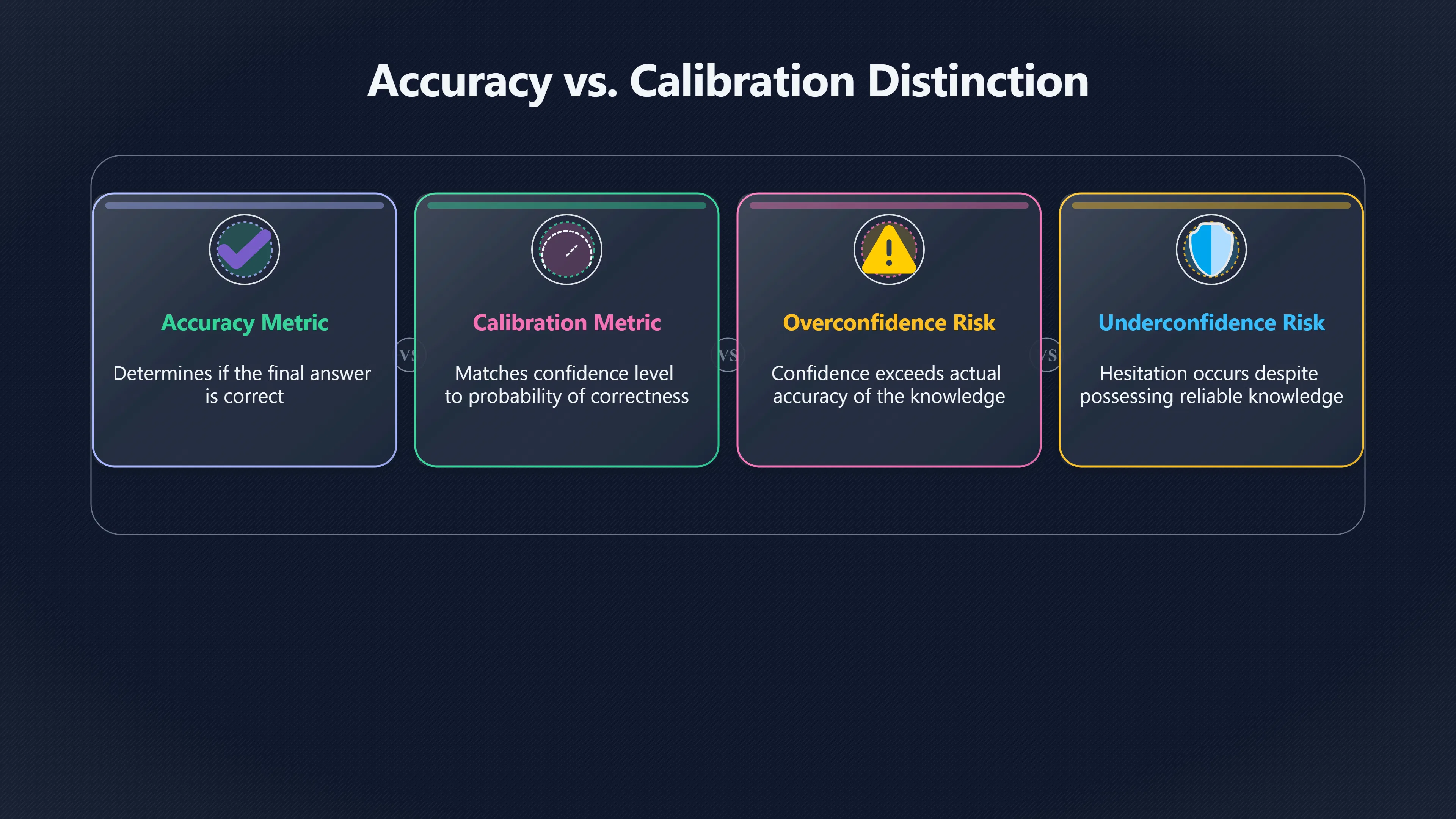
Being correct and being well calibrated are related but different qualities.
- Accuracy asks whether your answer is correct.
- Calibration asks whether your level of confidence reflects the probability that you are correct.
A person who answers ten questions correctly eight times while consistently saying they are “about 80% confident” is well calibrated. Someone who answers the same number correctly while claiming 100% certainty on every answer is equally accurate but poorly calibrated. Likewise, someone who is consistently unsure despite usually being correct is also poorly calibrated because they underestimate their own knowledge.
This distinction matters because decisions depend on confidence as much as correctness. In everyday life you rarely know immediately whether an answer is right. Instead, you decide whether to trust your judgement, double-check a source, ask for advice or postpone a decision. Calibration determines whether those choices are sensible.
Poor calibration creates two common problems:
- Overconfidence, where confidence exceeds actual accuracy. [mcm.uni-wuerzburg.de]mcm.uni-wuerzburg.deAccuracy of confidence judgmentsInstitut Mensch-Computer-MedienAccuracy of confidence judgments: Stability and generality…by C MENGELKAMP · 2010 · Cited by 98 — Accur…
- Underconfidence, where people hesitate even when they possess reliable knowledge.
Both reduce decision quality. Overconfidence encourages unnecessary risks and discourages checking assumptions, while underconfidence leads to excessive verification, missed opportunities and inefficient learning. [Zaguan+2PMC]zaguan.unizar.esConfidence–Accuracy Calibration with General Knowledge…January 29, 2025 — by K Luna · 2012 · Cited by 71 — Research on the confi…
An important insight from metacognition research is that confidence itself is not inherently informative. Confidence becomes useful only after repeated comparisons with objective outcomes reveal whether it deserves to be trusted.
Why confidence often feels more reliable than it really is
People rarely calculate confidence analytically. Instead, they rely on mental cues such as:
- how easily an answer comes to mind;
- how familiar information feels;
- how fluent reading or solving felt;
- previous successes on similar tasks;
- emotional certainty.
These cues are often helpful but are imperfect indicators of actual knowledge.
For example, rereading notes can create a feeling of familiarity that produces high confidence without improving later recall. Likewise, recognising terminology during a lecture may feel like understanding even when the underlying concepts remain unclear.
Research on confidence judgements has repeatedly shown that people often mistake these experiences for evidence of learning. The result is confidence that tracks subjective experience more closely than objective performance. [gmarks.org+2iipdm.haifa.ac.il]gmarks.orgwhen confidence is not a signal of knowingby B Finn · 2015 · Cited by 153 — The students who subscribed to the quick learning belief were more likely to have overconfident compreh…
Calibration therefore requires replacing intuition with measurement. Instead of asking “How confident do I feel?”, the better question becomes “When I have felt this confident before, how often was I actually right?”
Confidence ratings and judgements of learning
One of the most influential methods for studying calibration comes from research on judgements of learning (JOLs). After studying material, learners estimate the likelihood that they will remember it later before taking a test.
Researchers then compare predicted performance with actual performance.
This seemingly simple procedure reveals several important findings.
First, people can become better at predicting future performance, but improvement usually depends on receiving feedback rather than simply making predictions. Second, predictions made immediately after studying are often overly optimistic because the material is still fresh in working memory. Delaying the judgement even briefly generally produces more accurate estimates because learners rely less on short-term familiarity. Adam L Putnam+2iipdm.haifa.ac.il [adamlputnam.com]adamlputnam.computnam deng desoto 2022Adam L PutnamConfidence ratings are better predictors of future…by AL Putnam · 2022 · Cited by 13 — The intuitive answer is through ju…
Educational researchers distinguish between two aspects of monitoring accuracy:
- Calibration (absolute accuracy): whether average confidence matches average performance.
- Resolution (relative accuracy): whether confidence successfully distinguishes answers that will later be correct from those that will be wrong.
A learner may correctly identify which topics are stronger than others (good resolution) while still being systematically overconfident overall (poor calibration). These are different skills that develop differently and should not be confused. iipdm.haifa.ac.il+2Matti’s website [iipdm.haifa.ac.il]iipdm.haifa.ac.il2002 KorShefMaaJEPGO.. Nelson & Dunlosky, 1991) refers to the correspondence between mean JOL and mean recall and reflects the extent to…Read more…
This distinction explains why someone can correctly identify their weakest chapters before an examination while still substantially overestimating the final mark they will receive.
Simple ways to compare predictions with outcomes
Calibration improves most when confidence becomes something that can be tracked rather than remembered vaguely.
A practical approach is to make explicit predictions before outcomes are known.
For example:
Before outcomeAfter outcome”I am 90% confident this explanation is correct.”Correct or incorrect?”I expect to score 16 out of 20.”Actual score?”I think this forecast has a 70% chance.”Did it occur?
After collecting many observations, patterns become visible.
You may discover that:
- answers rated 90% confident are correct only about 65% of the time;
- predictions below 50% confidence are usually correct after all;
- certain types of problems consistently produce overconfidence;
- confidence is accurate in familiar domains but unreliable in unfamiliar ones.
These observations are far more informative than isolated successes or failures because calibration concerns long-run correspondence rather than individual cases.
Many educational interventions now ask students to provide confidence ratings alongside test answers. Studies suggest that repeated confidence assessment combined with feedback helps many learners improve calibration over successive assessments, although simply requesting confidence without meaningful feedback often produces much smaller gains. [Sage Journals+2ResearchGate]journals.sagepub.comSage JournalsChanges in students' confidence calibration across a…Nov 26, 2024 — Students broadly improved their calibration across th…
What good calibration changes in practice
Improved calibration affects behaviour in ways that extend beyond examinations.
A well-calibrated thinker is more likely to:
- stop searching once sufficient evidence exists;
- recognise when further checking is genuinely necessary;
- allocate study time towards genuinely weak areas instead of repeatedly reviewing familiar material;
- update beliefs more readily after contradictory evidence;
- distinguish uncertainty from ignorance.
Poor calibration produces the opposite pattern. Overconfident individuals often stop learning too early because they believe they already understand enough. Underconfident individuals may continue reviewing topics they have already mastered while neglecting weaker areas that need attention.
Research on classroom learning consistently finds that accurate monitoring helps learners regulate effort more effectively. Knowing what you do not know allows study time to be allocated where it produces the greatest benefit. [ResearchGate+2קרן טראמפ]researchgate.netResearchGate(PDF) Metacognitive monitoring accuracy and student…21 Mar 2016 — Having accurate metacognitive calibration is crucial, si…
Calibration is a skill, not a personality trait
People sometimes assume that confidence is simply part of personality. Calibration research suggests otherwise.
Confidence accuracy varies across tasks, domains and situations. Someone may be extremely well calibrated when estimating statistical problems but poorly calibrated when judging political knowledge, financial forecasts or their own comprehension of a complex article. Confidence therefore depends not only on the individual but also on the quality of feedback available and the characteristics of the task. [ResearchGate+2Institut Mensch-Computer-Medien]researchgate.netResearchGate(PDF) Confidence and Calibration of Comprehension in…24 Mar 2026 — Before and after taking 12 successive tests, 90 introdu…
The encouraging implication is that calibration can be improved.
Research points to several practices that consistently help:
- making explicit confidence estimates before receiving answers;
- obtaining prompt, objective feedback;
- repeating prediction–outcome comparisons over time;
- delaying self-evaluations until immediate familiarity has faded;
- reflecting on systematic patterns rather than isolated mistakes.
None of these techniques guarantees higher accuracy. Instead, they improve something equally valuable: awareness of when your own judgement is likely to be dependable.
Within metacognition, that awareness is often the missing ingredient. Improving analytical thinking is not only about reaching correct conclusions more often; it is about learning to assign confidence in proportion to the evidence. When confidence becomes calibrated rather than merely strong, self-assessment evolves from intuition into a measurable and continuously improvable skill.
Amazon book picks
Further Reading
Books and field guides related to Are You as Sure as You Think?. Use these as the next step if you want deeper reading beyond the article.
Superforecasting
Focuses on calibration, probabilistic thinking, feedback, and improving prediction accuracy.
The Scout Mindset
Encourages better self-assessment, updating beliefs, and matching confidence to evidence.
Thinking, Fast and Slow
Explains overconfidence, cognitive biases, and why confidence often diverges from accuracy.
Make It Stick
Covers judgments of learning, feedback, retrieval practice, and improving metacognitive accuracy.
eBay marketplace picks
Marketplace Samples
Live-tested eBay searches with available results related to this page.




Endnotes
-
Source: iipdm.haifa.ac.il
Title: 2002 KorShefMaaJEPG
Link: https://iipdm.haifa.ac.il/images/publications/Asher_Koriat/2002-KorShefMaaJEPG.pdfSource snippet
O.. Nelson & Dunlosky, 1991) refers to the correspondence between mean JOL and mean recall and reflects the extent to...Read more...
-
Source: researchgate.net
Link: https://www.researchgate.net/publication/284066045_Metacognitive_monitoring_accuracy_and_student_performance_in_the_postsecondary_classroomSource snippet
ResearchGate(PDF) Metacognitive monitoring accuracy and student...21 Mar 2016 — Having accurate metacognitive calibration is crucial, si...
-
Source: pmc.ncbi.nlm.nih.gov
Link: https://pmc.ncbi.nlm.nih.gov/articles/PMC12730000/Source snippet
Experimental Study of Overconfidence Biases in Young...by DG Gültekin · 2025 · Cited by 2 — This bias makes individuals overly confident...
-
Source: gmarks.org
Title: when confidence is not a signal of knowing
Link: https://gmarks.org/when_confidence_is_not_a_signal_of_knowing.pdfSource snippet
by B Finn · 2015 · Cited by 153 — The students who subscribed to the quick learning belief were more likely to have overconfident compreh...
-
Source: researchgate.net
Link: https://www.researchgate.net/publication/257936161_What_are_confidence_judgments_made_of_Students%27_explanations_for_their_confidence_ratings_and_what_that_means_for_calibrationSource snippet
study explored university students' justifications for making their judgments of learning in a developmental psychology...
-
Source: pmc.ncbi.nlm.nih.gov
Title: PMCJudgments of learning and improvement
Link: https://pmc.ncbi.nlm.nih.gov/articles/PMC3041918/Source snippet
of learning and improvement - PMC - NIHby CL Townsend · 2010 · Cited by 65 — The main result was that judgments of improvement were poorl...
-
Source: pmc.ncbi.nlm.nih.gov
Title: PMCRepeated Feedback Can Benefit Seven-Year-old’s
Link: https://pmc.ncbi.nlm.nih.gov/articles/PMC12122647/Source snippet
by FJ Buehler · 2025 · Cited by 4 — Four cornerstones of calibration research: Why understanding students' judgments can improve their...
-
Source: researchgate.net
Link: https://www.researchgate.net/publication/349179781_Calibrating_Calibration_A_Meta-Analysis_of_Learning_Strategy_Instruction_Interventions_to_Improve_Metacognitive_Monitoring_AccuracySource snippet
Research confirms...Read more...
-
Source: researchgate.net
Link: https://www.researchgate.net/publication/367575911_Confidence_and_Calibration_of_Comprehension_in_Adolescence_Are_They_Domain-General_or_Domain-SpecificSource snippet
ResearchGate(PDF) Confidence and Calibration of Comprehension in...24 Mar 2026 — Before and after taking 12 successive tests, 90 introdu...
-
Source: researchgate.net
Link: https://www.researchgate.net/publication/271749740_Students%27_confidence_in_their_performance_judgements_a_comparison_of_different_response_scalesSource snippet
Participating students were asked to judge their personal...Read more...
-
Source: researchgate.net
Link: https://www.researchgate.net/publication/377781931_Managing_Overconfidence_Bias_in_Decision_Making_A_Review_of_the_LiteratureSource snippet
(PDF) Managing Overconfidence Bias in Decision Making30 Jan 2024 — The current prevailing research has shown that overconfidence bias can...
-
Source: zaguan.unizar.es
Link: https://zaguan.unizar.es/record/150059/files/texto_completo.pdfSource snippet
Confidence–Accuracy Calibration with General Knowledge...January 29, 2025 — by K Luna · 2012 · Cited by 71 — Research on the confi...
Published: January 29, 2025
-
Source: adamlputnam.com
Title: putnam deng desoto 2022
Link: https://www.adamlputnam.com/uploads/8/3/5/6/83563830/putnam_deng___desoto_2022.pdfSource snippet
Adam L PutnamConfidence ratings are better predictors of future...by AL Putnam · 2022 · Cited by 13 — The intuitive answer is through ju...
-
Source: vuorre.com
Title: vuorre and metcalfe 2021 measures of relative metacognitive accur
Link: https://vuorre.com/bibliography/files/7NK7WAEM/vuorre-and-metcalfe_2021_measures-of-relative-metacognitive-accur.pdfSource snippet
Matti’s websiteMeasures of relative metacognitive accuracy are...by M Vuorre · 2021 · Cited by 59 — This article investigates the concer...
-
Source: journals.sagepub.com
Link: https://journals.sagepub.com/doi/10.1177/27527263241298968Source snippet
Sage JournalsChanges in students' confidence calibration across a...Nov 26, 2024 — Students broadly improved their calibration across th...
-
Source: mcm.uni-wuerzburg.de
Title: Accuracy of confidence judgments
Link: https://www.mcm.uni-wuerzburg.de/fileadmin/06110000/2026/Accuracy_of_confidence_judgments.pdfSource snippet
Institut Mensch-Computer-MedienAccuracy of confidence judgments: Stability and generality...by C MENGELKAMP · 2010 · Cited by 98 — Accur...
Additional References
-
Source: bi.team
Link: https://www.bi.team/wp-content/uploads/2024/08/WPS-7-1.pdfSource snippet
The UK is overconfidentOverconfident: average confidence scores at least 5pp higher than average correctness. Well-calibrated: average c...
-
Source: ejmste.com
Link: https://www.ejmste.com/download/whats-about-the-calibration-between-confidence-and-accuracy-findings-in-probabilistic-problems-from-7780.pdfSource snippet
What's about the Calibration between Confidence and...by M Agus · 2019 · Cited by 9 — According to Dunlosky and Thiede (2013), in genera...
-
Source: youtube.com
Title: Learn To Improve Your Decision Making
Link: http://www.youtube.com/watch?v=_NnA2Vi03IYSource snippet
Calibration metacognition confidence accuracy decision making What is metacognition? | Steve Fleming EXPeditions - The living library of...
-
Source: cris.maastrichtuniversity.nl
Title: merrienboer 2013 activation of inaccurate prior knowledge
Link: https://cris.maastrichtuniversity.nl/ws/files/73012654/merrienboer_2013_activation_of_inaccurate_prior_knowledge.pdfSource snippet
of inaccurate prior knowledge affects primary-...1 Apr 2013 — The cue utilization framework (Koriat, 1997) provides an explanation for l...
-
Source: cs.cornell.edu
Title: when confidence and competence collide
Link: https://www.cs.cornell.edu/~cristian/pdfs/when_confidence_and_competence_collide.pdfSource snippet
Confidence and Competence Collide: Effects on Online...by L Fu · Cited by 18 — We find that in task-oriented discussions, the more-confi...
-
Source: improvewithmetacognition.com
Title: metacognitive judgments of knowing
Link: https://www.improvewithmetacognition.com/metacognitive-judgments-of-knowing/Source snippet
02 Oct 2015 — JOLs are considered metacognitive judgments. They are judgments about what the person knows, often related to some future p...
-
Source: cambridge.org
Link: https://www.cambridge.org/core/journals/judgment-and-decision-making/article/when-deciding-creates-overconfidence/CFBE92B067A3DF55E5DB9A05CF497064Source snippet
When deciding creates overconfidence | Judgment and...by PJ Boyle · 2025 · Cited by 6 — We demonstrate how the distortion of information...
-
Source: onlinelibrary.wiley.com
Link: https://onlinelibrary.wiley.com/doi/full/10.1002/acp.4236Source snippet
effect of calibration training on...by MO Kelly · 2024 · Cited by 3 — Calibration is the degree to which confidence coincides with judgm...
-
Source: repository.isls.org
Link: https://repository.isls.org/bitstream/1/10262/1/ICLS2023_3-10.pdfSource snippet
Methodological Expansion and Empirical Applicationby S Tobler · 2023 · Cited by 1 — Confidence judgment indicates students' judgments of...
-
Source: youtube.com
Title: Stephen Fleming, “Know Thyself: The Science of Self-Awareness”
Link: http://www.youtube.com/watch?v=PmFGBeToa9kSource snippet
Learn To Improve Your Decision Making - Julia Galef | Modern Wisdom Podcast 332...
Topic Tree