Within Source Quality
When Anonymous Sources Deserve Trust
A named source is usually easier to hold accountable, but anonymous sourcing can be justified when access and public value are clear.
On this page
- Why newsrooms prefer named sources
- When anonymity can be justified
- Questions to ask before relying on unnamed claims
Page outline Jump by section
Introduction
When assessing news, the question is not simply whether a source is named or anonymous, but whether the newsroom has good reasons for granting anonymity and has done enough independent verification. Named sources are generally more reliable because they can be held publicly accountable for what they say. Anonymous sources remove that layer of accountability, making it harder for readers to judge credibility. However, anonymity can be essential for exposing wrongdoing, protecting whistleblowers, or reporting matters of significant public interest that would otherwise remain hidden. The key analytical skill is to distinguish justified confidentiality from unsupported anonymous claims. Rather than treating all unnamed sources as either trustworthy or suspect, evaluate the editorial safeguards surrounding their use.
Why newsrooms prefer named sources
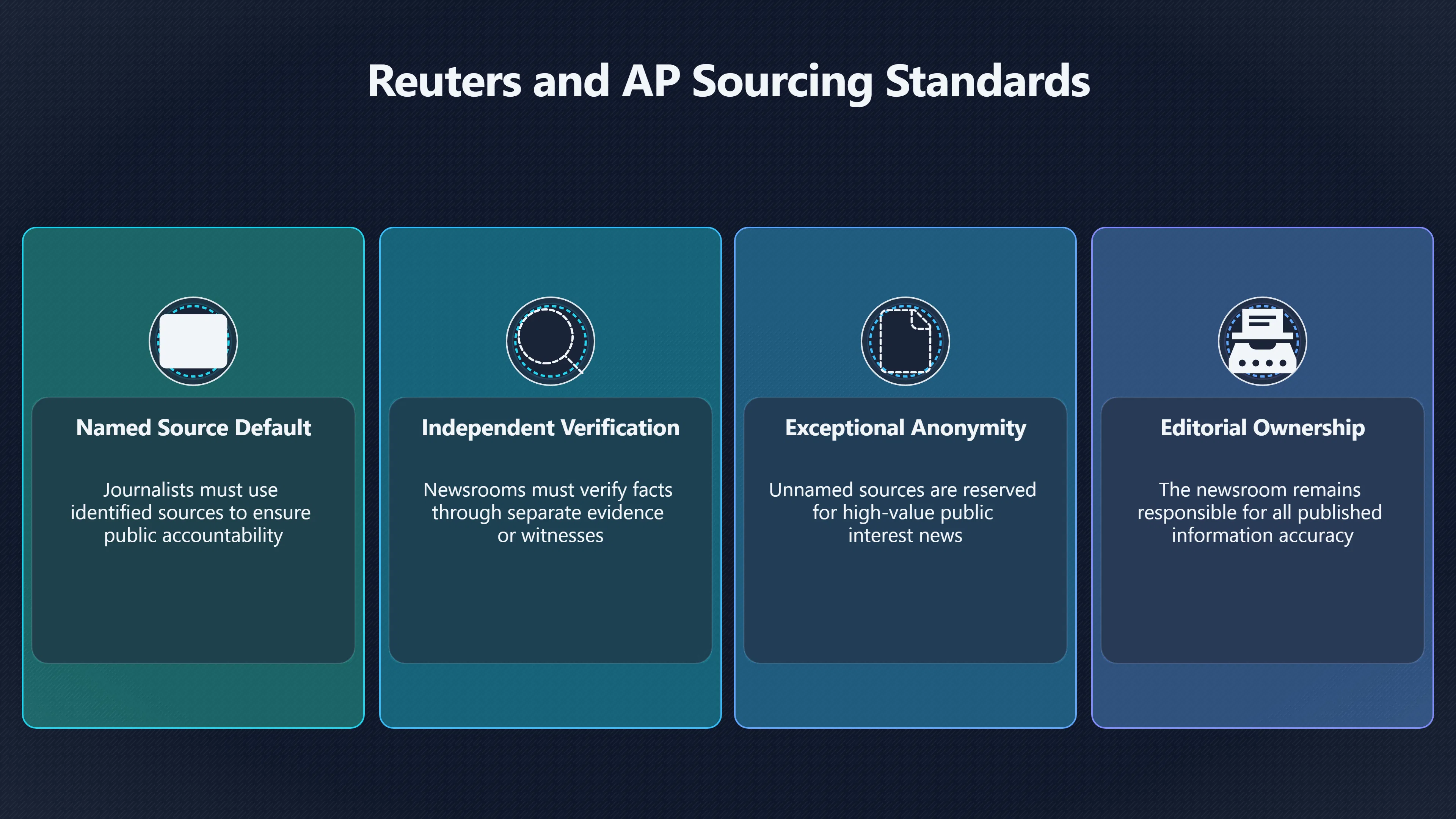
Professional news organisations overwhelmingly state that named sources should be the default. A person willing to attach their identity to a claim accepts reputational, professional and sometimes legal consequences if that claim proves false. Readers can also assess the source’s expertise, interests and possible biases.
This preference is reflected in editorial standards across major organisations:
- Reuters instructs journalists to use named sources wherever possible because they are accountable for the information they provide, while reminding reporters that the newsroom—not the source—remains responsible for accuracy. Anonymous sources should be exceptional rather than routine. [Reuters Agency]reutersagency.comReuters AgencyReuters Journalistic StandardsUse named sources wherever possible because they are responsible for the information they pro…
- The Associated Press requires attribution for disputable facts not independently observed or verified by its own reporting. Transparency about where information comes from is presented as a central way of maintaining public trust. [The Associated Press]ap.orgThe Associated Press When is it OK to use anonymous sources?The Associated PressWhen is it OK to use anonymous sources? - AP.org21 Jul 2017 — AP news reports must attribute any disputable facts tha…
- Professional ethics codes such as those of the Society of Professional Journalists similarly emphasise identifying sources whenever possible so that audiences can judge reliability and motivations for themselves. [Wikipedia]WikipediaCode of ethics in mediaCode of ethics in media
Named sourcing therefore improves accountability in two ways. It allows readers to evaluate the speaker, and it discourages casual or misleading claims because the speaker’s reputation is at stake.
When anonymity can be justified
Anonymous sourcing is not inherently unreliable. In some circumstances it is the only practical way to obtain information of substantial public value.
Examples include:
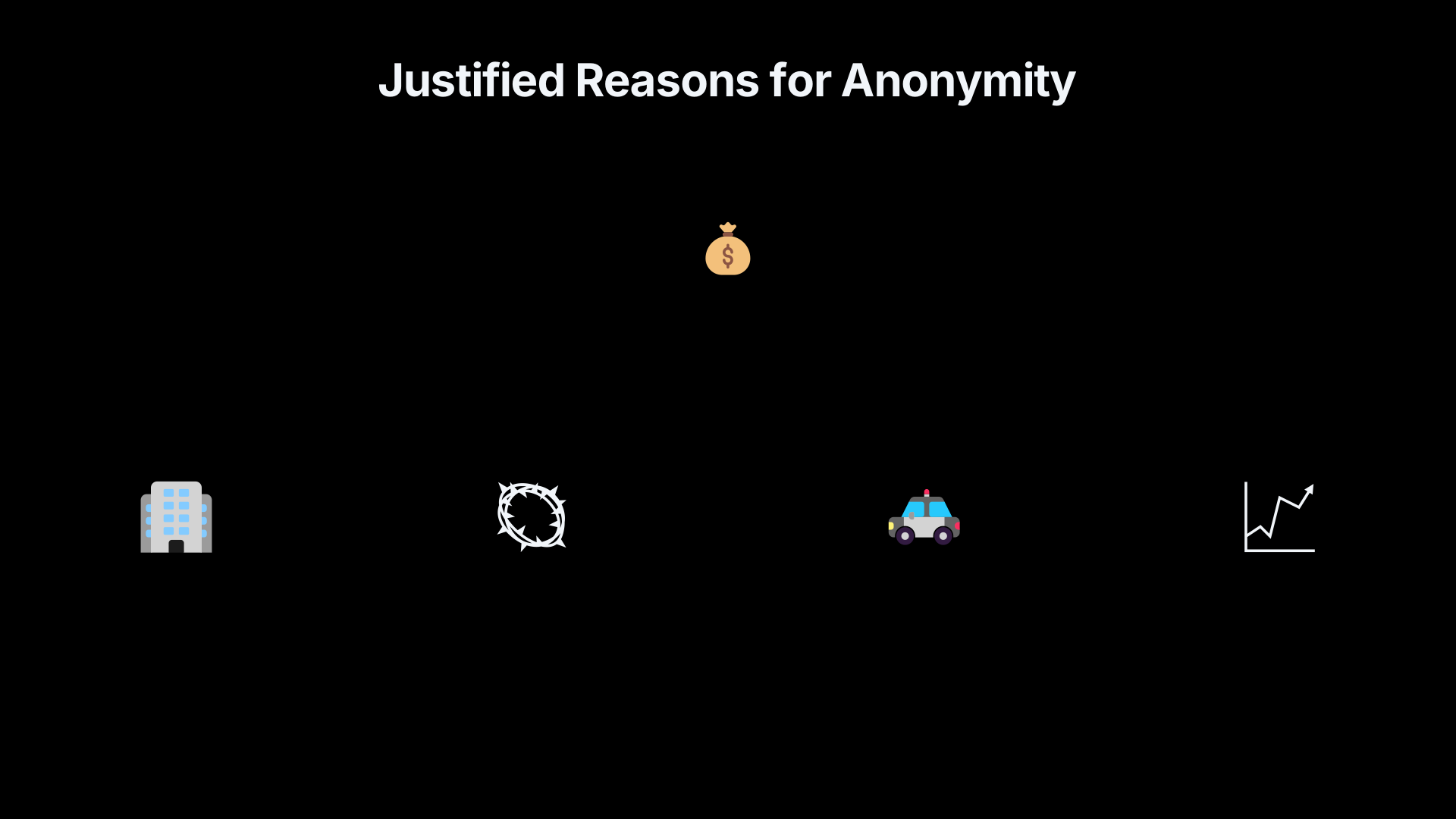
- Whistleblowers exposing corruption, fraud or threats to public safety.
- Civil servants or employees who risk dismissal for revealing misconduct.
- Sources living under authoritarian governments or facing credible threats of violence.
- Individuals reporting sexual abuse or organised crime where identification could lead to retaliation.
The important point is that anonymity protects the source—not the information itself. Responsible news organisations still expect the underlying facts to withstand verification.
Reuters, for example, states that unnamed sources may be used when they provide information of market or public interest unavailable on the record, but reporters should assess the source’s track record, position, motives and seek corroboration wherever possible. [Reuters Agency]reutersagency.comReuters AgencyReuters Journalistic StandardsUse named sources wherever possible because they are responsible for the information they pro…
Similarly, guidance discussed by journalism ethics organisations notes that anonymity should generally be reserved for information that is both newsworthy and unobtainable by other means. Readers should also receive as much contextual information as possible about why the source deserves confidence without revealing their identity. [Ethics and Journalism]ethicsandjournalism.orgEthics and JournalismBest Practices: Anonymous SourcesIn this post, we're exploring the best practices and ethical considerations when us…
What responsible anonymous sourcing looks like
A strong news report relying on unnamed sources usually contains visible signals that editors have imposed safeguards rather than simply accepting a secret claim.
Look for features such as:
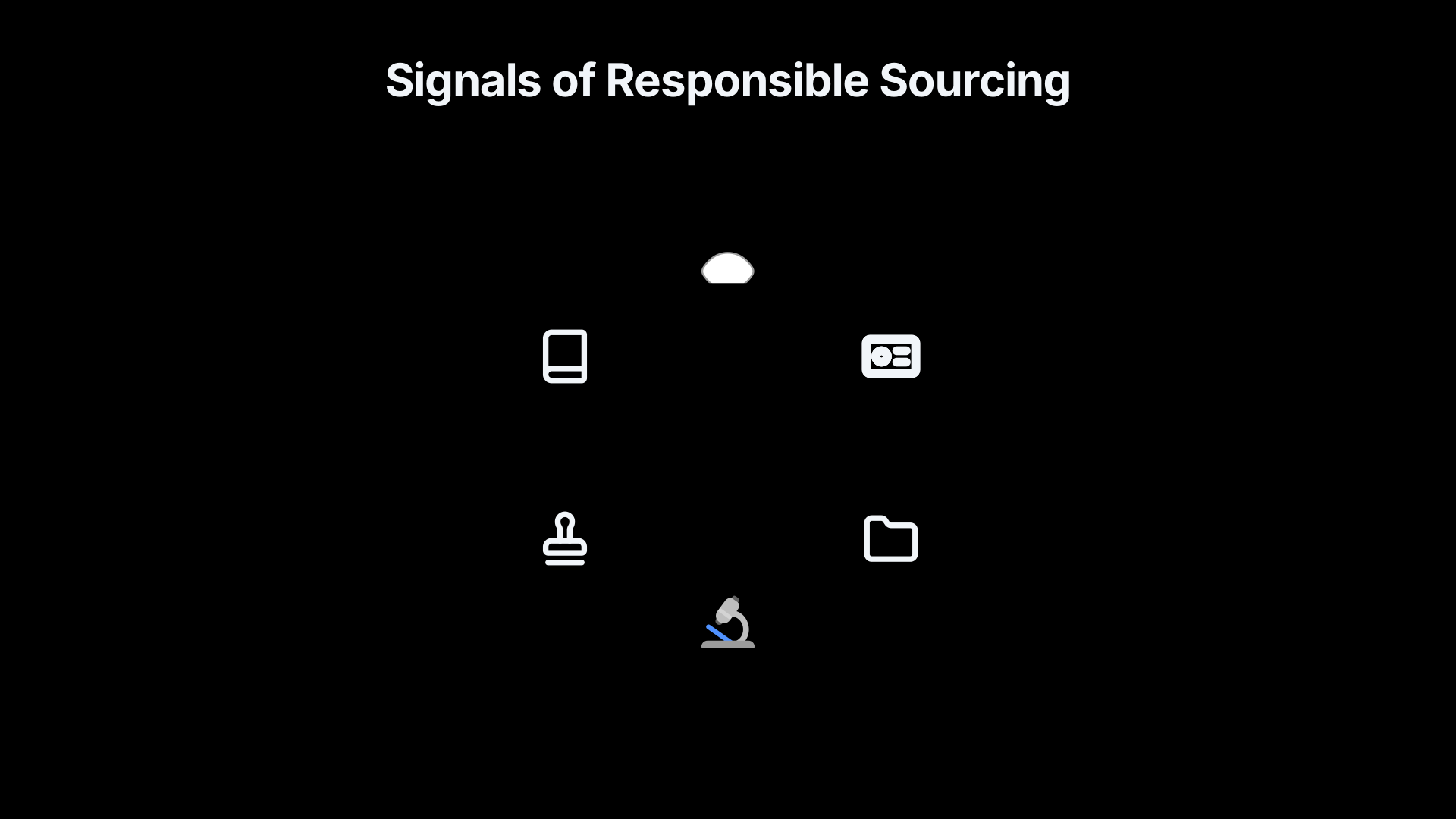
- A clear reason for anonymity. The article explains why the source cannot safely be identified.
- Meaningful description. Instead of “a source said”, the report identifies the person’s role, such as “a senior official directly involved in the negotiations.”
- Independent corroboration. Multiple sources or documentary evidence support the same factual claim.
- Editorial ownership. The newsroom explicitly indicates that it has verified the information rather than merely passing along an allegation.
- Limited scope. Anonymous sources are used primarily for factual reporting, not speculation or personal attacks.
These practices reduce—but do not eliminate—the uncertainty created by withholding a source’s identity.
Warning signs of weak anonymous claims
Anonymous sourcing deserves greater scrutiny when editorial safeguards are missing.
Questions that should increase scepticism include:
- Is the anonymous source making accusations without supporting evidence?
- Does the report fail to explain why anonymity was necessary?
- Is the source described so vaguely that readers cannot judge whether they would reasonably know the information?
- Does the story rely on a single unnamed source for an extraordinary claim?
- Is the anonymity protecting someone from embarrassment rather than genuine risk?
- Does the article contain speculation or opinion presented as insider knowledge?
These warning signs do not prove a report is false, but they reduce confidence because readers cannot independently assess the source’s credibility.
Questions to ask before relying on unnamed claims
When reading a report built partly on anonymous sources, ask a small set of practical questions rather than making an all-or-nothing judgement.
- Why was anonymity granted? Is there a credible risk of retaliation or another legitimate reason?
- How would this person know? Does the article establish the source’s access to the information?
- Has the newsroom corroborated the claim? Look for documents, additional reporting or multiple independent sources.
- Is the anonymous material central or supplementary? A report resting entirely on one unnamed source deserves more caution than one supported by records and named witnesses.
- Does the outlet have a reputation for corrections and editorial accountability? Strong editorial processes matter because readers cannot evaluate the anonymous individual directly.
These questions shift attention from the secrecy itself to the quality of the reporting surrounding it.
Why agreement alone is not enough
Within the broader topic of source quality versus source agreement, anonymous sourcing illustrates why repeated claims are not automatically stronger evidence.
Several outlets may publish apparently independent reports that all trace back to the same confidential briefing or single unnamed official. To a casual reader this can resemble broad confirmation, but it may represent only one underlying source repeated through multiple publications.
Conversely, one carefully reported investigation may rely on confidential sources whose information has been extensively corroborated through documents, interviews and editorial review. In that situation, the reporting may deserve more confidence than numerous outlets repeating an unverified anonymous rumour.
The important distinction is between multiple reports and multiple independent lines of evidence.
A balanced rule for critical readers
Named sources should generally be trusted more than anonymous ones because they provide public accountability and allow readers to evaluate credibility directly. Anonymous sourcing becomes persuasive not because secrecy itself signals insider knowledge, but because reputable news organisations compensate for the missing accountability through careful verification, corroboration and editorial responsibility.
A thoughtful reader therefore avoids two common mistakes: rejecting every anonymous source automatically, or accepting anonymous claims simply because they appear in several news reports. The stronger question is whether the newsroom has shown that the information is important, the source is genuinely positioned to know, and the reporting has been independently checked before publication.
Amazon book picks
Further Reading
Books and field guides related to When Anonymous Sources Deserve Trust. Use these as the next step if you want deeper reading beyond the article.
The Elements of Journalism
Explains sourcing, verification, attribution, and when confidential sources may be justified.
eBay marketplace picks
Marketplace Samples
Live-tested eBay searches with available results related to this page.

Endnotes
-
Source: reutersagency.com
Link: https://reutersagency.com/about/standards-values/Source snippet
Reuters AgencyReuters Journalistic StandardsUse named sources wherever possible because they are responsible for the information they pro...
-
Source: ap.org
Title: The Associated Press When is it OK to use anonymous sources?
Link: https://www.ap.org/the-definitive-source/behind-the-news/when-is-it-ok-to-use-anonymous-sources/Source snippet
The Associated PressWhen is it OK to use anonymous sources? - AP.org21 Jul 2017 — AP news reports must attribute any disputable facts tha...
-
Source: Wikipedia
Title: Code of ethics in media
Link: https://en.wikipedia.org/wiki/Code_of_ethics_in_media -
Source: ethicsandjournalism.org
Link: https://ethicsandjournalism.org/resources/best-practices/best-practices-anonymous-sources/Source snippet
Ethics and JournalismBest Practices: Anonymous SourcesIn this post, we're exploring the best practices and ethical considerations when us...
Additional References
-
Source: facebook.com
Link: https://www.facebook.com/groups/2755972544553553/posts/3441943479289786/Source snippet
Using anonymous sources in journalismAnonymous sources aren’t a free pass. Use them wisely — your credibility depends on it. Readers trus...
-
Source: researchgate.net
Link: https://www.researchgate.net/publication/312971942_Anonymous_Sources_Harm_Credibility_of_All_StoriesSource snippet
The author argues that reporters should give some information about the hierarchy of anonymous sources quoted in...
-
Source: spj.org
Title: Anonymity is the name of the Washington game. Anonymous
Link: https://www.spj.org/spj-ethics-committee-position-papers-anonymous-sources/Source snippet
SPJ Ethics Committee Position Papers: Anonymous SourcesFew ethical issues in journalism are more entangled with the law than the use of a...
-
Source: quillmag.com
Title: Guidelines on Anonymous Sources
Link: https://www.quillmag.com/2014/04/09/guidelines-on-anonymous-sources/Source snippet
Quill9 Apr 2014 — Reporters who intend to use material from anonymous sources must get approval from their news manager before sending th...
-
Source: pmc.ncbi.nlm.nih.gov
Link: https://pmc.ncbi.nlm.nih.gov/articles/PMC10731076/Source snippet
by AK Čelofiga · 2023 · Cited by 4 — We analyzed the relationship between the use of anonymous sources and various topics of the news...
-
Source: youtube.com
Title: Can you trust anonymous sources in journalism? | Jill Abramson | Big Think
Link: https://www.youtube.com/watch?v=7nVFla_qx1ISource snippet
2 Why do journalists keep sources anonymous?...
-
Source: youtube.com
Title: On the Record, Off the Record, Anonymous Sources: Best Practices
Link: https://www.youtube.com/watch?v=IqHgtwBnWWMSource snippet
5 Which News Sources Can Be Trusted? - BTN Media Literacy...
-
Source: youtube.com
Title: How the media handles anonymous sources
Link: https://www.youtube.com/watch?v=4XNdOEThM2YSource snippet
4 On the Record, Off the Record, Anonymous Sources: Best Practices...
-
Source: youtube.com
Title: Why do journalists keep sources anonymous?
Link: https://www.youtube.com/watch?v=-kWlaB2xS4sSource snippet
3 How the media handles anonymous sources...
-
Source: youtube.com
Title: Which News Sources Can Be Trusted?
Link: https://www.youtube.com/watch?v=SGVExHBXQBs
Topic Tree