Within Reasoning Chain
Write the Reason Before You Decide
Writing the reasoning before commitment makes it harder to retrofit a flattering explanation after the choice is made.
On this page
- The difference between explaining and justifying
- Why timing changes the value of the chain
- How to review the record later
Page outline Jump by section
Introduction
Writing down your reasoning before making a decision is one of the simplest ways to protect yourself from hindsight bias and self-serving revision. Once an outcome is known, people naturally reconstruct what they believed beforehand, often convincing themselves that they “knew it all along” or that their choice was obviously justified. A brief written reasoning chain preserves what you actually knew, what you assumed, and what you were uncertain about at the moment of commitment. Research on hindsight bias has repeatedly shown that outcome knowledge distorts memory of prior beliefs, making contemporaneous records far more reliable than later recollections. [PMC]pmc.ncbi.nlm.nih.govPMCHindsight Bias and Developing Theories of Mindby DM Bernstein · 2007 · Cited by 106 — The concepts of hindsight bias and ToM are related: both involve perspective taking and the mi…
 Within the broader practice of making reasoning visible, the distinctive value of a pre-decision chain is timing. It is created before success or failure can colour judgement, turning it into a fair record for later learning rather than a polished story about why the result was inevitable.
The difference between explaining and justifying
After an outcome is known, explanations often become justifications.
An explanation aims to reconstruct what information was available at the time and how it led to a decision. A justification, by contrast, selectively arranges facts so the decision appears more reasonable in light of what happened afterwards. The two can sound almost identical, yet they serve different purposes.
Suppose a product launch succeeds. Weeks later, the team may sincerely remember having been highly confident because customer demand “was obvious”. If the launch fails, the same people may remember that they always expected difficulties. Neither account necessarily reflects what they actually believed before the launch. Instead, current knowledge quietly reshapes memory. Experimental research beginning with the classic work of Baruch Fischhoff and continuing over several decades demonstrates that outcome knowledge consistently influences how people recall their earlier expectations. [Wikipedia]WikipediaHindsight biasHindsight bias
A written reasoning chain interrupts this process. Rather than asking, “Why did I make this decision?”, it preserves the more valuable question:
- What evidence did I have?
- Which assumptions was I relying on?
- Which alternatives did I seriously consider?
- What level of confidence did I actually have?
- What did I identify as the largest uncertainty?
Those questions are difficult to answer accurately from memory after events unfold. They are straightforward when answered immediately beforehand.
Why timing changes the value of the chain
The usefulness of a reasoning chain depends less on its length than on when it is written.
A note created after commitment cannot distinguish original reasoning from reconstructed reasoning. By contrast, a note written beforehand becomes an external reference point that resists later memory distortion.
This matters because hindsight bias has several related components. Researchers distinguish between:
- Memory distortion, where people misremember their original judgement.
- A sense of inevitability, where outcomes appear as though they had to happen.
- A sense of foreseeability, where people believe they personally could have predicted the outcome. [Wikipedia]WikipediaHindsight biasHindsight bias
A pre-decision record weakens all three. Instead of relying on memory, you can compare today’s interpretation against yesterday’s written evidence.
For important decisions, even five minutes of documentation can create a far more trustworthy baseline than retrospective reflection conducted weeks or months later.
What belongs in a pre-decision reasoning chain
The objective is not to document every thought. The record should be concise enough that it is practical while still capturing the critical elements that hindsight tends to rewrite.
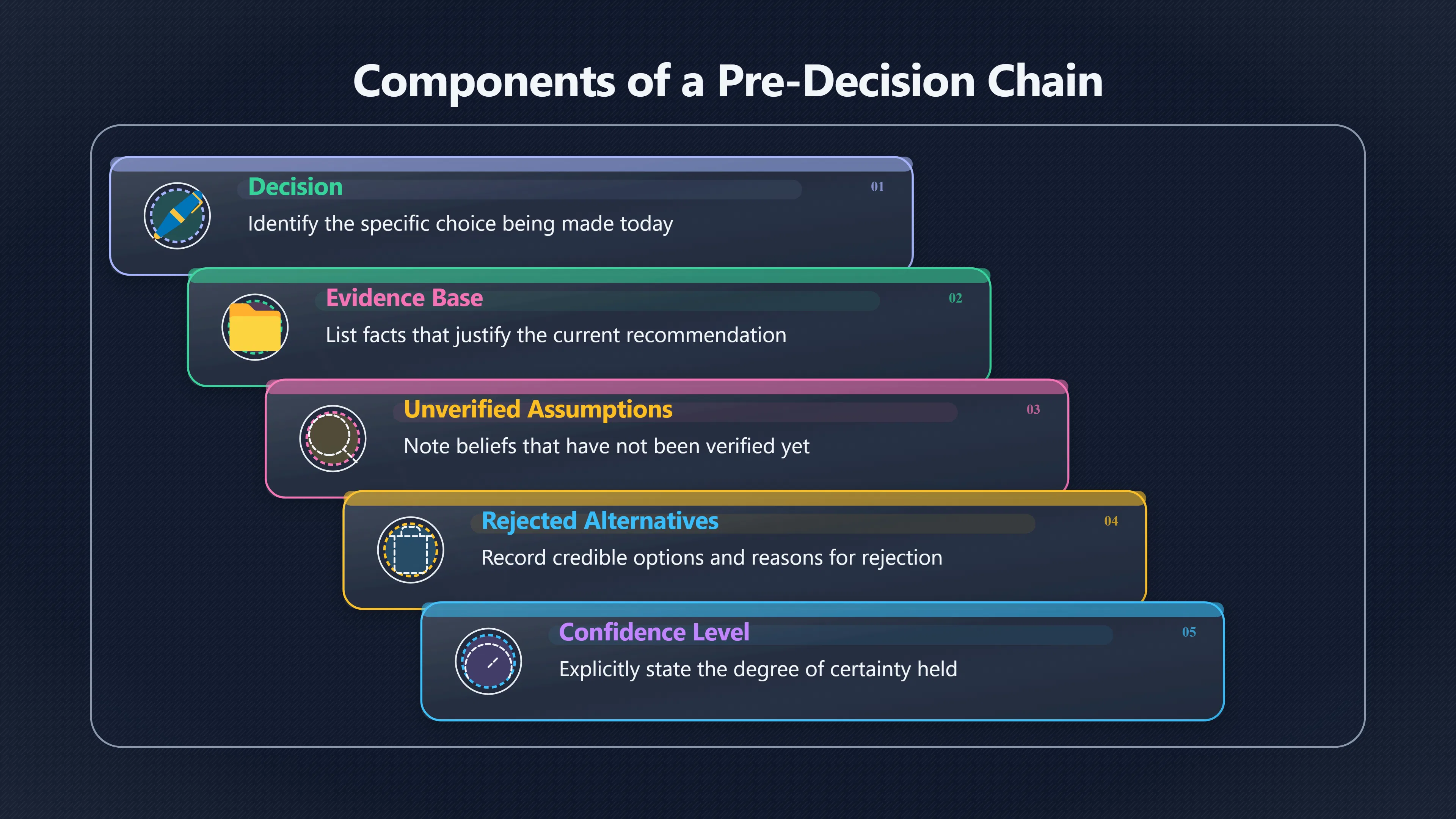
A useful chain typically includes:
- The decision. What exactly is being chosen?
- The current recommendation. Which option is preferred?
- Supporting evidence. What facts justify that recommendation today?
- Major assumptions. Which beliefs have not yet been verified?
- Alternative options. What credible alternatives were rejected, and why?
- Expected outcomes. What do you think is most likely to happen?
- Confidence level. How certain are you, expressed explicitly rather than implied.
- Conditions for changing your mind. What new evidence would reverse the decision?
The final item is particularly valuable because it distinguishes flexible reasoning from simple commitment. Recording in advance what evidence would change your conclusion reduces the temptation to reinterpret contradictory evidence later.

How pre-decision records improve later reviews
The purpose of preserving reasoning is not to discover whether the decision succeeded. It is to evaluate whether the decision process was sound given the available information.
This distinction is important because a good process sometimes produces a poor outcome through chance, while a poor process occasionally produces success through luck. Evaluating decisions only by results encourages outcome bias—the tendency to judge decision quality by what happened rather than by what could reasonably have been known beforehand. [Wikipedia]WikipediaOutcome biasOutcome bias
When reviewing a written chain later, useful questions include:
- Which assumptions turned out to be correct?
- Which uncertainties mattered most?
- Did new evidence emerge that could not reasonably have been anticipated?
- Did I ignore warning signs that were already available?
- Was my confidence level appropriate?
Notice that none of these questions asks whether the outcome was good. They ask whether the reasoning matched the information available at the time.
That difference makes post-decision learning substantially more accurate.
A practical example
Imagine choosing between two suppliers.
Without a written record, six months later the review might become:
“Supplier A was clearly the better choice. The warning signs about Supplier B were obvious.”
The contemporary reasoning chain might instead read:
“Supplier A is preferred because it has completed three comparable projects on schedule. Supplier B offers a lower price but has limited experience at this scale. Our biggest uncertainty is Supplier A’s capacity during peak demand. If the reference checks reveal recurring delays, we will reconsider.”
If Supplier A later performs badly because of an unexpected factory closure, the written chain shows that the failure resulted from genuinely unforeseen circumstances rather than poor reasoning. Conversely, if the reference checks had already revealed repeated delays and were ignored, the record exposes a real process failure.
The written chain therefore protects against two opposite mistakes:
- claiming to have foreseen events that were genuinely unpredictable; and
- overlooking weaknesses that were already visible before the decision.
Limits of written reasoning
A pre-decision chain is not a guarantee of better decisions.
People can still omit inconvenient evidence, write vague justifications, or become committed to an initial position despite changing circumstances. The record is only as useful as its honesty and specificity.
It should also avoid becoming excessively detailed. Very long documents are often revised after the fact or become too burdensome to maintain consistently. Short, concrete records are usually more valuable because they are easier to create before every important decision.
Written reasoning is best viewed as a debiasing aid rather than a complete solution. Research on debiasing suggests that interventions are generally more effective when they change how decisions are made before commitment instead of relying solely on retrospective reflection. [Wikipedia]WikipediaOpen source on wikipedia.org.
Before choice, not after
The central advantage of writing reasoning chains before deciding is not that they improve memory. It is that they preserve intellectual honesty across time.
When outcomes become known, memory naturally drifts towards coherence, certainty and flattering explanations. A contemporaneous reasoning chain fixes the decision in its original context, recording the evidence, assumptions and uncertainty that genuinely existed. Later reviews can therefore distinguish bad luck from poor judgement, identify real weaknesses in reasoning, and support learning that is based on what was actually known rather than what only seems obvious in hindsight. [Wikipedia+2PMC]WikipediaHindsight biasHindsight bias
Amazon book picks
Further Reading
Books and field guides related to Write the Reason Before You Decide. Use these as the next step if you want deeper reading beyond the article.
Superforecasting
Emphasizes tracking predictions and reasoning before outcomes to improve judgment over time.
The Scout Mindset
Focuses on recording beliefs honestly and resisting motivated reasoning and post hoc justification.
Decisive
Provides practical methods for improving decisions, including reducing bias and reviewing reasoning.
How to Measure Anything
Encourages explicit assumptions and documented reasoning before decisions under uncertainty.
eBay marketplace picks
Marketplace Samples
Live-tested eBay searches with available results related to this page.


Endnotes
-
Source: pmc.ncbi.nlm.nih.gov
Title: PMCHindsight Bias and Developing Theories of Mind
Link: https://pmc.ncbi.nlm.nih.gov/articles/PMC3649066/Source snippet
by DM Bernstein · 2007 · Cited by 106 — The concepts of hindsight bias and ToM are related: both involve perspective taking and the mi...
-
Source: Wikipedia
Title: Hindsight bias
Link: https://en.wikipedia.org/wiki/Hindsight_bias -
Source: Wikipedia
Title: Outcome bias
Link: https://en.wikipedia.org/wiki/Outcome_bias -
Source: Wikipedia
Link: https://en.wikipedia.org/wiki/Debiasing -
Source: youtube.com
Title: Behavioural Biases: Hindsight Bias
Link: https://www.youtube.com/watch?v=bQv4l9S6jokSource snippet
Hindsight Bias...
-
Source: pmc.ncbi.nlm.nih.gov
Link: https://pmc.ncbi.nlm.nih.gov/articles/PMC3170528/Source snippet
determinants of affective forecasting errors - PMCby M Hoerger · 2010 · Cited by 106 — Additionally, an experimental manipulation effecti...
-
Source: pmc.ncbi.nlm.nih.gov
Link: https://pmc.ncbi.nlm.nih.gov/articles/PMC11734358/Source snippet
by J Axt · 2024 · Cited by 9 — We review several instances where debiasing principles have been successfully applied toward reducing i...
Additional References
-
Source: nature.com
Link: https://www.nature.com/research-intelligence/nri-topic-summaries/hindsight-bias-and-its-implications-in-decision-making-micro-180822Source snippet
Hindsight Bias and Its Implications in Decision MakingHindsight bias is a well‐documented cognitive phenomenon whereby individuals percei...
-
Source: researchgate.net
Link: https://www.researchgate.net/publication/264486494_Hindsight_Bias_A_Primer_for_Motivational_ResearchersSource snippet
(PDF) Hindsight Bias: A Primer for Motivational ResearchersIn this article, I introduce the reader to the basic designs used to study the...
-
Source: thedecisionlab.com
Link: https://thedecisionlab.com/reference-guide/psychology/precommitmentSource snippet
PrecommitmentPrecommitment is a strategy to ensure we reach the goals we set out for ourselves. It is employed by various businesses to e...
-
Source: bmt.org
Link: https://www.bmt.org/insights/hindsight-bias-its-effects-on-decision-making-and-implications-for-project-management/Source snippet
Hindsight Bias: its effects on decision making and...29 Aug 2024 — Hindsight bias can have severe implications for project management, i...
-
Source: annualreviews.org
Link: https://www.annualreviews.org/content/journals/10.1146/annurev-psych-091924-040158?crawler=true&mimetype=application%2FpdfSource snippet
m various domains, including behavioral eco- nomics, psychology, and health, to explore six time-related biases...Read mor...
-
Source: researchgate.net
Link: https://www.researchgate.net/publication/288172670_Investors%27_Short_Term_Decision_Making_and_Review_of_the_Hindsight_Bias_EffectSource snippet
multi-year management forecasts before an investment decision...
-
Source: mdpi.com
Link: https://www.mdpi.com/2076-3387/15/6/227Source snippet
Cognitive Biases in Strategic Decision-Makingby K Midtgård · 2025 · Cited by 15 — Our main goal is to investigate the extent to which cog...
-
Source: journals.sagepub.com
Link: https://journals.sagepub.com/doi/10.1177/01492063241287188Source snippet
Sage JournalsMitigating Cognitive Bias to Improve Organizational...by B Fasolo · 2025 · Cited by 65 — Observing a lack of comparative st...
-
Source: academic.oup.com
Link: https://academic.oup.com/rof/article/29/5/1587/8195745Source snippet
more tomorrow, today: experimental evidence on the...by CE Freeman · 2025 — We study the causal effects of precommitment [framing]({{ 'framing/' | relative_url }}), motiva...
-
Source: thedecisionlab.com
Link: https://thedecisionlab.com/biases/hindsight-bias
Topic Tree