Within Source Quality
When Many Sources Are Really One
Repeated claims are only useful when they trace back to independent evidence rather than the same copied origin.
On this page
- How duplication creates false confidence
- Tracing a claim back to its origin
- When repetition becomes real corroboration
Page outline Jump by section
Introduction
When several websites, social media posts or news articles all make the same claim, it is tempting to treat that agreement as proof. In reality, repeated claims only become genuine corroboration when they come from independent evidence, not when they all trace back to the same original source. This distinction sits at the heart of evaluating source quality versus source agreement. A hundred copies of one unsupported claim still amount to one piece of evidence, while two independent investigations reaching the same conclusion may provide much stronger grounds for confidence.
 The modern information environment makes this distinction especially important. Online publishing allows claims to spread within minutes, often through copying, summarising or republishing. The apparent weight of agreement can therefore be an illusion created by duplication rather than independent verification. Recognising this mechanism helps you avoid mistaking popularity for reliability.
How duplication creates false confidence
Repeated information feels more believable. Psychologists have consistently found that repetition alone increases people’s confidence that a statement is true, even when no new evidence has been added. This effect arises because familiar statements are easier for the brain to process, and that ease is often mistaken for accuracy. [PubMed]pubmed.ncbi.nlm.nih.govRepetition, not number of sources, increases both…by JL Foster · 2012 · Cited by 143 — Repetition, not number of sources, increa…
The internet amplifies this tendency. A claim may appear in:
- a social media post; [eerstekamer.nl]eerstekamer.nl311-327). Routledge… at its core misinformation once worthy of removal and later demotion now…Read more…
- several blogs;
- a news aggregation site;
- multiple AI-generated summaries;
- discussion forums; and
- videos quoting one another.
To a casual reader these appear to be many independent voices. In reality they may all rely on a single tweet, press release, anonymous forum post or misinterpreted document.
This is sometimes described as an information cascade. Once a claim begins circulating, later writers often cite previous reports instead of locating the underlying evidence themselves. Every additional repetition increases the appearance of consensus without increasing the amount of actual evidence.
The problem is not simply deliberate misinformation. Time pressure, search-engine optimisation, syndicated news feeds, copied press releases and automated content generation can all produce large numbers of near-identical claims with little independent checking. UNESCO’s guidance on misinformation warns that journalists and readers alike should distinguish between repeated reporting and verified information, because unchecked material can spread rapidly through the wider information ecosystem. [UNESCO]unesco.orgJOURNALISM, 'FAKE NEWS' & DISINFORMATIONAugust 31, 2018 — 2018 · Cited by 1178 — Likewise, the issues of migration, climate change…
Tracing a claim back to its origin
One of the most useful habits in critical thinking is asking a simple question: [youtube.com]youtube.comCritical Thinking: Information Sources5 Ever Wonder: How Can You Tell If A Source Is Credible?…
Where did this information first come from?
Rather than counting how many websites repeat a claim, work backwards until you find the earliest available source.
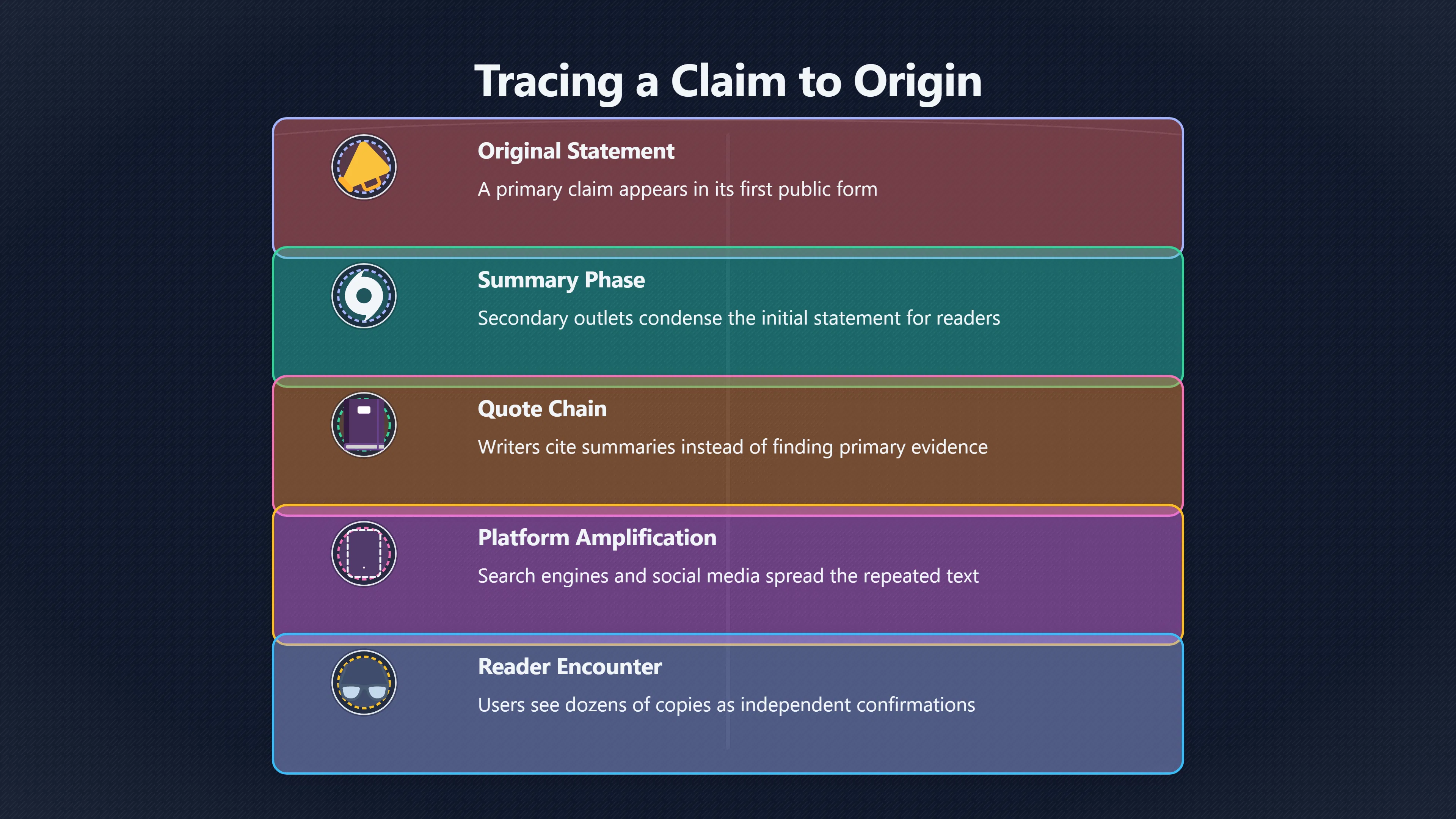
Often the chain looks something like this:
- An original statement appears.
- Another outlet summarises it.
- Other writers quote the summary.
- Search engines and social platforms amplify the repeated versions.
- Readers encounter dozens of apparently independent confirmations.
The evidence has not multiplied. Only the copies have.
Several warning signs suggest that multiple reports may have a common origin:
- every article uses nearly identical wording;
- all reports cite the same unnamed source;
- every article links to the same press release or interview;
- none provides additional documents, witnesses or original reporting;
- later articles merely quote earlier articles rather than primary evidence.
The goal is not necessarily to reach the very first person who mentioned a claim. Rather, it is to identify the closest available source to the evidence itself. That may be an official document, court filing, research paper, recorded interview, government announcement, dataset or direct eyewitness account.
This approach mirrors the “lateral reading” techniques widely recommended in information literacy. Instead of staying inside one article, readers quickly investigate where the information originated and whether independent sources have verified it. [library.thechicagoschool.edu]library.thechicagoschool.eduLateral Reading: Be a Pro Fact Checker - Navigating…12 Jun 2026 — Navigating Misinformation and Disinformation…
When repetition becomes real corroboration
Repetition becomes meaningful only when different sources have reached the same conclusion through genuinely separate routes.
Consider two contrasting situations.
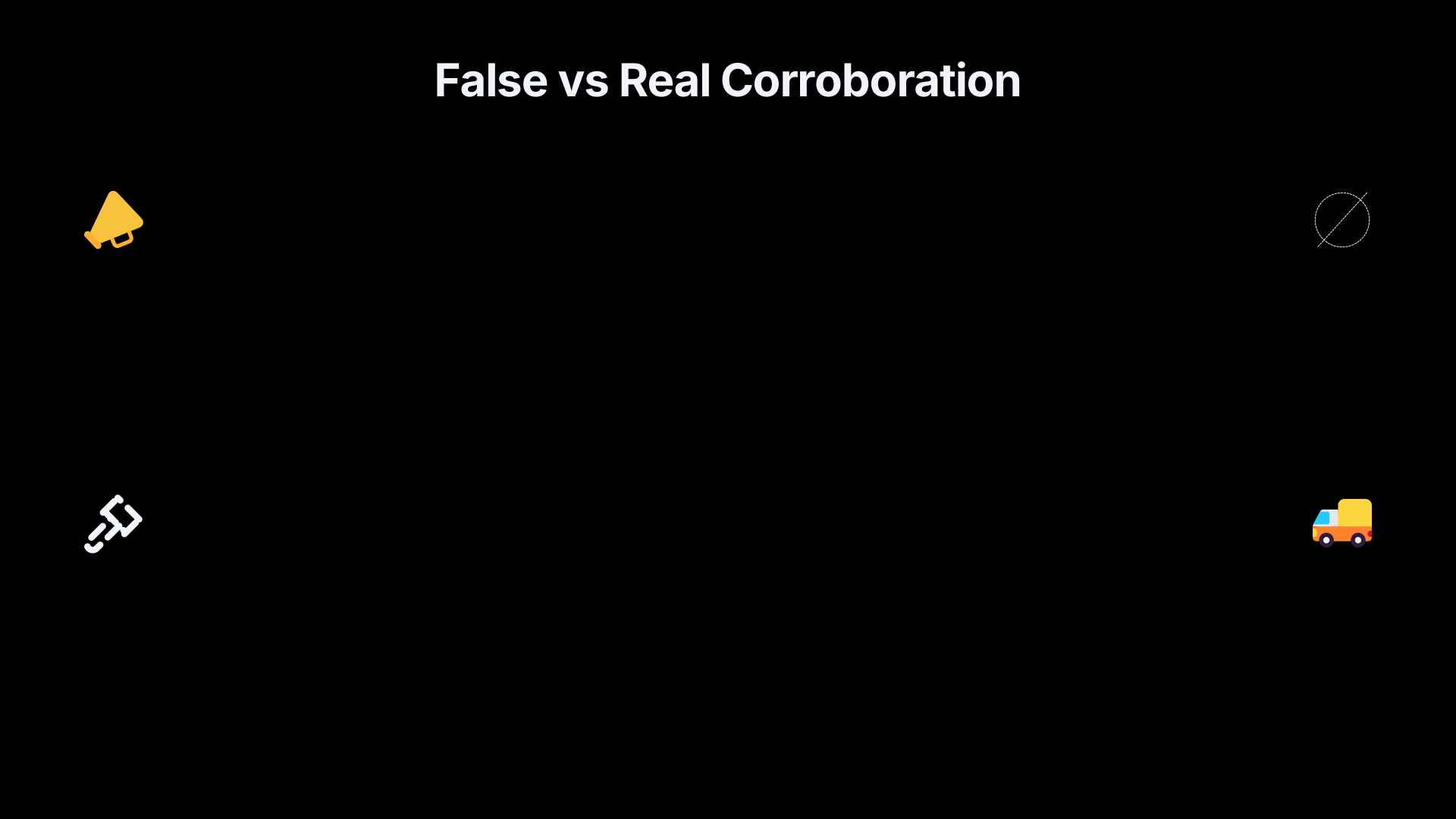
False corroboration
- Five websites repeat that a company is facing bankruptcy.
- Every story ultimately cites one anonymous social media account.
- No financial filings, company statements or independent reporting are provided.
Although there are five articles, there is effectively only one evidential pathway.
Real corroboration
- A company’s regulatory filing shows financial problems.
- Independent journalists examine court records.
- Credit rating agencies publish separate analyses.
- Company executives acknowledge the situation in interviews.
- Suppliers independently report payment delays.
Here the agreement comes from multiple forms of evidence collected independently. Even if each source has limitations, together they create much stronger support because they do not depend entirely on one original claim.
The key question shifts from:
“How many people are saying this?”
to:
“How many independent ways do we know this?”
Why copied claims are so persuasive
Several psychological and practical factors combine to make duplicated information especially convincing.
Familiarity feels like truth. Repeated exposure makes information easier to process, and people often interpret that familiarity as evidence of accuracy. [PubMed]pubmed.ncbi.nlm.nih.govRepetition, not number of sources, increases both…by JL Foster · 2012 · Cited by 143 — Repetition, not number of sources, increa…
Search results reward popularity. Search engines often display many pages discussing the same topic. Unless you inspect the sourcing, it is easy to mistake ranking and volume for independent confirmation.
Modern publishing is highly interconnected. News organisations legitimately share wire services, press releases and official announcements. Blogs frequently summarise one another. AI systems may also generate summaries from already duplicated material. None of this automatically reduces quality, but it does mean that apparent agreement can mask a shared origin.
Social proof influences judgement. Humans naturally infer that widespread agreement signals reliability. That shortcut often works in everyday life but performs poorly when many people rely on the same underlying information.
Practical ways to avoid being misled
When you encounter a widely repeated claim, slow down before treating repetition as evidence.
Ask yourself:
- Can I identify the original source?
- Does any report provide documents or direct evidence?
- Are different organisations independently verifying the claim?
- Do later reports add genuinely new information, or simply repeat earlier wording?
- Would the claim still stand if every copied article disappeared except the original evidence?
One practical technique is to ignore the later summaries initially and read the earliest accessible source directly. If the original evidence is weak, vague or unavailable, then hundreds of later repetitions do little to strengthen the claim.
Another useful habit is to value independent diversity over simple quantity. One scientific study, one official record and one independent investigative report that all converge may be more informative than fifty articles repeating the same press release.

The central lesson
The appearance of agreement is not the same as corroboration. Information can spread far more quickly than evidence, especially online, creating the illusion that many independent sources support a claim when they are all echoing the same origin.
Strong analytical thinking therefore treats repeated claims as a prompt for investigation rather than a reason to stop investigating. Genuine corroboration is created not by the number of voices repeating a statement, but by the number of independent paths leading to the same conclusion.
Amazon book picks
Further Reading
Books and field guides related to When Many Sources Are Really One. Use these as the next step if you want deeper reading beyond the article.
Calling Bullshit
Shows how claims can look authoritative while being unsupported, copied, or statistically misleading.
The Demon-Haunted World
Rating: 4.5/5 from 43 Google Books ratings
Emphasises independent evidence, sceptical inquiry, and not mistaking repeated assertion for proof.
Factfulness
Encourages checking claims against actual data rather than impressions produced by repetition.
The Skeptics' Guide to the Universe
Teaches tools for evaluating claims, spotting misinformation, and avoiding false confidence.
eBay marketplace picks
Marketplace Samples
Live-tested eBay searches with available results related to this page.



Endnotes
-
Source: unesco.org
Link: https://unesco.org/sites/default/files/journalism_fake_news_disinformation_print_friendly_0.pdfSource snippet
JOURNALISM, 'FAKE NEWS' & DISINFORMATIONAugust 31, 2018 — 2018 · Cited by 1178 — Likewise, the issues of migration, climate change...
Published: August 31, 2018
-
Source: library.thechicagoschool.edu
Link: https://library.thechicagoschool.edu/c.php?g=1425760&p=10608575Source snippet
Lateral Reading: Be a Pro Fact Checker - Navigating...12 Jun 2026 — Navigating Misinformation and Disinformation...
-
Source: pubmed.ncbi.nlm.nih.gov
Link: https://pubmed.ncbi.nlm.nih.gov/22257711/Source snippet
Repetition, not number of sources, increases both...by JL Foster · 2012 · Cited by 143 — Repetition, not number of sources, increa...
Additional References
-
Source: eerstekamer.nl
Link: https://www.eerstekamer.nl/overig/20251209/content_moderation_across_social/document3/f%3D/vmu1nf1chfy6_opgemaakt.pdfSource snippet
311-327). Routledge... at its core misinformation once worthy of removal and later demotion now...Read more...
-
Source: maderacenter.libguides.com
Link: https://maderacenter.libguides.com/c.php?g=1376039Source snippet
Evaluating Sources: SIFT method and Lateral Reading7 Apr 2026 — Evaluating Sources: SIFT method and Lateral Reading: Overview...
-
Source: cjr.org
Title: craig silverman lies damn lies viral content
Link: https://www.cjr.org/tow_center_reports/craig_silverman_lies_damn_lies_viral_content.php/Source snippet
Lies, Damn Lies, and Viral Content10 Feb 2015 — For now, it's important to understand what we're up against. Below is a look at seven phe...
-
Source: facebook.com
Link: https://www.facebook.com/AHCFiji/posts/false-and-misleading-information-is-spreading-faster-and-becoming-harder-to-iden/1392206829604342/Source snippet
False and misleading information is spreading faster and...Combating the spread of fake news, misinformation and disinformation is a res...
-
Source: researchguides.austincc.edu
Link: https://researchguides.austincc.edu/c.php?g=612891&p=9815507Source snippet
SIFT Method - Fake News and Alternative Facts27 Mar 2026 — This guide for students, faculty and staff investigates the phenomenon of fake...
-
Source: youtube.com
Title: How to Spot Misinformation Without Losing Your Mind
Link: https://www.youtube.com/watch?v=97JbluMfNngSource snippet
3 The power of the illusory truth effect...
-
Source: youtube.com
Title: [Critical Thinking]({{ ‘critical-skills/’ | relative_url }}): Information Sources
Link: https://www.youtube.com/watch?v=5-WzokT5d80Source snippet
5 Ever Wonder: How Can You Tell If A Source Is Credible?...
-
Source: youtube.com
Title: How false news can spread
Link: https://www.youtube.com/watch?v=cSKGa_7XJkgSource snippet
2 How to Spot Misinformation Without Losing Your Mind...
-
Source: youtube.com
Title: The power of the illusory truth effect
Link: https://www.youtube.com/watch?v=G0nJbZJeLV0Source snippet
4 Critical Thinking: Information Sources...
-
Source: youtube.com
Title: Ever Wonder: How Can You Tell If A Source Is Credible?
Link: https://www.youtube.com/watch?v=8AgCPuUh78s
Topic Tree