Within Practice Tests
Why Rereading Feels Better but Teaches Less
The harder feeling of self-testing often signals the useful work that rereading can hide.
On this page
- The familiarity trap in passive review
- What retrieval adds that rereading does not
- How to tell whether you can use an idea
Page outline Jump by section
Introduction
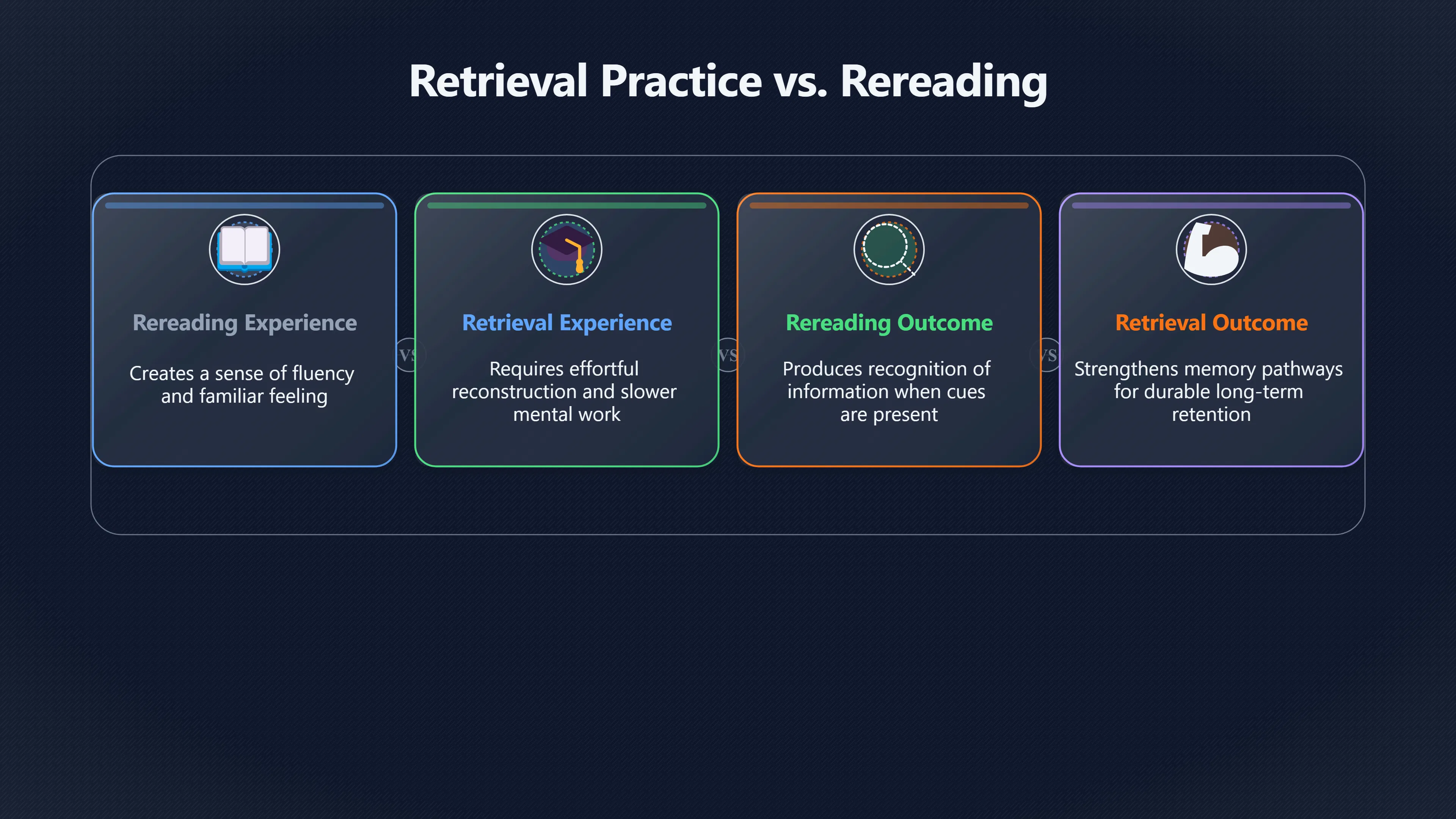
Practice testing improves learning not because it feels easier, but because it demands the mental work that durable understanding requires. Rereading creates a sense of fluency: the material looks familiar, key ideas seem obvious, and confidence rises. Yet familiarity is often mistaken for genuine understanding. By contrast, trying to recall an idea without looking at the answer is slower, more effortful, and frequently uncomfortable—but that very effort strengthens later memory and makes knowledge more usable in real situations. Decades of cognitive psychology research consistently show that successful retrieval practice produces better long-term retention than repeated rereading, even when rereading feels more effective at the time. [PsychNet]psychnet.wustl.eduRoediger Karpicke 2006 PPSThe Power of Testing Memoryby HL Roediger III · Cited by 3306 — Agarwal, P.K., Karpicke, J.D., Kang, S.H.K., Roediger, H.L., III, &…
 Within the broader practice of testing yourself to learn, the key mechanism is simple: retrieval changes memory, whereas rereading mostly changes your feeling of familiarity. Understanding that difference helps explain why difficult recall is often a sign of productive learning rather than poor learning.
The familiarity trap in passive review
One of the biggest obstacles to effective learning is confusing recognition with recall.
When you reread notes or a textbook chapter, every sentence acts as a cue. Seeing the words again makes them easier to process, creating a feeling known as processing fluency. Because the material is easy to follow, many people conclude that they know it well. In reality, they may only recognise the information when it is presented.
This becomes obvious when the cues disappear. A learner who has reread an explanation of confirmation bias several times may immediately recognise the correct definition on the page, yet struggle to explain it from memory or identify it in a real discussion. The knowledge is familiar, but it is not readily accessible.
Research on students’ study habits shows that many learners rely heavily on rereading despite its relatively modest long-term benefits. They often judge it to be effective precisely because it produces this comforting feeling of familiarity, creating an illusion of competence rather than reliable recall. [Cognition and Learning Lab]learninglab.psych.purdue.edu2009 Karpicke Butler RoedigerCognition and Learning LabDo students practise retrieval when they study on their own?1 May 2009 — We propose that many students experien…
This illusion matters because analytical thinking depends on retrieving ideas independently. When evaluating an argument, solving a problem, or making a decision, there is no textbook providing hints. The relevant concepts must come to mind without external support.
What retrieval adds that rereading does not
Retrieval practice asks your memory to reconstruct knowledge instead of merely recognising it. That reconstruction changes learning in several important ways.
First, retrieval strengthens the pathways that make future access easier. Rather than simply exposing the learner to information again, each successful retrieval becomes another opportunity to rebuild the memory, making later retrieval faster and more reliable. This is one of the central explanations for the testing effect. [PsychNet]psychnet.wustl.eduRoediger Karpicke 2006 PPSThe Power of Testing Memoryby HL Roediger III · Cited by 3306 — Agarwal, P.K., Karpicke, J.D., Kang, S.H.K., Roediger, H.L., III, &…
Second, retrieval encourages richer connections between ideas. To answer a question from memory, learners often have to reconstruct relationships, organise concepts, and connect new information with existing knowledge. Experimental work suggests that these more elaborate retrieval processes are an important reason testing improves later learning. Studies have found that when the mental effort involved in retrieval is statistically accounted for, much of the testing advantage disappears, supporting the idea that effortful retrieval—not merely taking a test—is the active ingredient. [PMC]pmc.ncbi.nlm.nih.govPMCMechanisms behind the testing effect: an empiricalby T Endres · 2015 · Cited by 121 — These findings indicate that testing helps learning when learners must invest substantial mental e…
Third, retrieval exposes weaknesses immediately. Passive review rarely reveals missing links because the correct information is always visible. An unsuccessful retrieval attempt, however, identifies exactly where understanding breaks down. Even an incomplete answer provides useful diagnostic information that guides later study.
Finally, retrieval better matches the demands of real-world thinking. Outside the classroom, useful knowledge must usually be produced rather than recognised. Whether explaining evidence during a meeting or evaluating competing explanations in an article, people must generate ideas from memory instead of selecting them from a page.
Why harder often means better learning
One of the most counter-intuitive findings in learning science is that immediate performance and long-term learning are not the same thing.
Repeated rereading often produces excellent short-term performance. Immediately after studying, learners can recognise information quickly and answer straightforward questions accurately. This creates the impression that learning has been successful.
Retrieval practice usually feels different. It is slower, involves hesitation, and frequently includes mistakes. During practice, performance may appear worse than with rereading. Yet after days or weeks, the pattern often reverses.
This apparent paradox fits the idea of “desirable difficulties”: learning conditions that reduce short-term fluency while improving long-term retention and transfer. Retrieval becomes especially beneficial when recalling requires genuine mental effort but remains achievable. If retrieval is impossibly difficult, little learning occurs; if it is effortless because the answer is almost obvious, the additional benefit is smaller. The most productive learning often sits between these extremes. [bjorklab.psych.ucla.edu+2PMC]bjorklab.psych.ucla.eduEBjork RBjork 2011Creating Desirable Difficulties to Enhance Learningby EL Bjork · Cited by 2230 — repeated study opportunities appear, in the short term…
The important lesson is that subjective experience can be misleading. Feeling that learning is easy is not reliable evidence that learning is lasting.
How to tell whether you can use an idea
The most reliable test of understanding is not whether something looks familiar but whether you can produce and use it without assistance.
Useful questions include:
- Can you explain the idea in your own words without looking at your notes?
- Can you apply it to an unfamiliar example rather than the one used during study?
- Can you distinguish it from similar concepts?
- Can you recognise when it is relevant during a real problem rather than after someone points it out?
- Can you identify the limits of the idea and situations where it does not apply?
Each of these requires retrieval rather than recognition. They reveal whether knowledge is organised well enough to support reasoning instead of merely supporting recognition.
For example, recognising the definition of “base rate neglect” while rereading is different from spontaneously asking, during a discussion of medical screening or financial forecasting, whether base rates have been ignored. The second situation demonstrates usable understanding because the concept has become available when it is actually needed.
Why rereading still has a place
None of this means rereading is useless.
Initial reading is essential for building the first representation of new material, and rereading can help clarify confusing passages or refresh forgotten details before attempting retrieval. Problems arise only when rereading becomes the primary learning strategy.
A practical sequence is often more effective:
- Read to understand the material.
- Close the source and retrieve what you remember.
- Compare your answer with the original.
- Fill the gaps.
- Repeat retrieval after some delay.
In this sequence, rereading supports retrieval instead of replacing it. The difficult part—the attempt to reconstruct knowledge—is what transforms familiarity into durable understanding.

The key insight
Rereading improves access to information that is already visible. Retrieval improves access to information when it is absent.
That distinction explains why rereading feels smoother while recall feels harder. Recognition benefits from external cues; analytical thinking rarely has those cues available. By repeatedly practising the act of bringing ideas back into mind, learners develop knowledge that is not only remembered for longer but is also more likely to appear when solving problems, evaluating evidence, or making decisions. The discomfort of effortful recall is therefore often a sign that learning is happening at exactly the level where it becomes most useful. [PsychNet+2bjorklab.psych.ucla.edu]psychnet.wustl.eduRoediger Karpicke 2006 PPSThe Power of Testing Memoryby HL Roediger III · Cited by 3306 — Agarwal, P.K., Karpicke, J.D., Kang, S.H.K., Roediger, H.L., III, &…
eBay marketplace picks
Marketplace Samples
Live-tested eBay searches with available results related to this page.




Endnotes
-
Source: pmc.ncbi.nlm.nih.gov
Title: PMCMechanisms behind the testing effect: an empirical
Link: https://pmc.ncbi.nlm.nih.gov/articles/PMC4513285/Source snippet
by T Endres · 2015 · Cited by 121 — These findings indicate that testing helps learning when learners must invest substantial mental e...
-
Source: bjorklab.psych.ucla.edu
Title: EBjork RBjork 2011
Link: https://bjorklab.psych.ucla.edu/wp-content/uploads/sites/13/2016/04/EBjork_RBjork_2011.pdfSource snippet
Creating Desirable Difficulties to Enhance Learningby EL Bjork · Cited by 2230 — repeated study opportunities appear, in the short term...
-
Source: pmc.ncbi.nlm.nih.gov
Link: https://pmc.ncbi.nlm.nih.gov/articles/PMC4480221/Source snippet
Practice and [Spacing]({{ 'spacing/' | relative_url }}) Effects in Young and Older...by GB Maddox · 2015 · Cited by 53 — Based on Bjork's concept of desirable difficulty...
-
Source: psychnet.wustl.edu
Title: Roediger Karpicke 2006 PPSSource snippet
The Power of Testing Memoryby HL Roediger III · Cited by 3306 — Agarwal, P.K., Karpicke, J.D., Kang, S.H.K., Roediger, H.L., III, &...
-
Source: learninglab.psych.purdue.edu
Title: 2009 Karpicke Butler Roediger
Link: https://learninglab.psych.purdue.edu/downloads/2009/2009_Karpicke_Butler_Roediger.pdfSource snippet
Cognition and Learning LabDo students practise retrieval when they study on their own?1 May 2009 — We propose that many students experien...
Published: May 2009
-
Source: education-ni.gov.uk
Link: https://www.education-ni.gov.uk/sites/default/files/2025-04/May%20Newsletter%20-%20Retrieval%20Practice%20%20What%20it%20is%2C%20Why%20it%20Works%20and%20How%20to%20Do%20It%20Better.PDFSource snippet
Department of EducationRetrieval Practice:Karpicke and Roediger (2008) noted that students who repeatedly re-read texts may develop an “i...
-
Source: pmc.ncbi.nlm.nih.gov
Link: https://pmc.ncbi.nlm.nih.gov/articles/PMC12292765/Source snippet
Use of Retrieval Practice in the Health Professions - PMCby MJ Serra · 2025 · Cited by 15 — Retrieval practice, or the active recall of i...
-
Source: newsletter.jamieleeclark.com
Title: retrieval practice
Link: https://newsletter.jamieleeclark.com/p/retrieval-practiceSource snippet
Practice: Why Thinking Hard Improves...1 Jan 2026 — Studies consistently show that retrieving information leads to better long-term rete...
-
Source: mindomax.com
Title: desirable difficulties
Link: https://www.mindomax.com/desirable-difficultiesSource snippet
2011. Karpicke and Blunt publish retrieval practice study in Science. 2019. Brunmair...Read more...
Additional References
-
Source: researchgate.net
Link: https://www.researchgate.net/publication/399606964Why_Desirable_Difficulties%27Work%27_A_Review_of_the_Evidence_From_Cognitive_and_Educational_Psychology_and_Some_Caveats_for_the_Health_Professions_Education_FieldSource snippet
Why Desirable Difficulties 'Work': A Review of the Evidence...9 Jan 2026 — Aim In this paper, I review the evidence from the cognitive p...
-
Source: merriam-webster.com
Link: https://www.merriam-webster.com/dictionary/retrievalSource snippet
RETRIEVAL Definition & Meaning3 days ago — 1. an act or process of retrieving 2. possibility of being retrieved or of recovering beyond r...
-
Source: researchgate.net
Link: https://www.researchgate.net/publication/364586997Desirable_Difficulties_in_Applied_Learning_Settings[MechanismsSource snippet
(PDF) Desirable Difficulties in Applied Learning Settings21 Oct 2022 — practicing test questions has been found to outperform restudy ret...
-
Source: yukaichou.com
Title: The testing effect, explained, with the Octalysis crosswalk
Link: https://yukaichou.com/gamification-analysis/retrieval-practice-testing-effect-roediger-karpicke-learning/Source snippet
Retrieval Practice: The Testing Effect & Behavioral DesignRetrieval practice beats rereading 61% to 40% one week out, yet courses still q...
-
Source: iatrox.com
Title: Retrieval Practice, Desirable Difficulty, and Why the Best
Link: https://www.iatrox.com/blog/retrieval-practice-desirable-difficulty-revision-scienceSource snippet
Bjork and Bjork's "desirable difficulty" framework (2011) explains why this happens at a deeper theoretical level.Read more...
-
Source: structural-learning.com
Link: https://www.structural-learning.com/post/desirable-difficultiesSource snippet
Desirable Difficulties: Bjork's 5 Principles29 Aug 2025 — Roediger and Karpicke (2006) found retrieval improves recall by 50%...
-
Source: notes.andymatuschak.org
Link: https://notes.andymatuschak.org/zYB7kwEFRu8QALcbzbcoy9TSource snippet
difficulties, after BjorkExperimental study demonstrating Desirable difficulties, after Bjork in the context of Retrieval practice. Roedi...
-
Source: structural-learning.com
Title: testing effect retrieval practice
Link: https://www.structural-learning.com/post/testing-effect-retrieval-practiceSource snippet
The Testing Effect: Why Retrieval Practice Works29 Dec 2025 — Testing helps learners recall facts, according to Bjork (1994)...
-
Source: structural-learning.com
Title: robert bjork teachers guide desirable
Link: https://www.structural-learning.com/post/robert-bjork-teachers-guide-desirableSource snippet
Roediger and Karpicke (2006) found recall beats re-reading for learning. This "testing effect" shows retrieval...
-
Source: youtube.com
Title: Henry Roediger
Link: https://www.youtube.com/watch?v=oqae85jbfbESource snippet
How to Study Effectively #3: Active Retrieval & Desirable Difficulties...
Topic Tree