Within Framing
The question optimistic teams forget to ask
Reference classes help teams replace flattering internal stories with evidence from similar projects and their real outcomes.
On this page
- Why the inside view feels persuasive
- How reference classes change forecasts
- Common mistakes when comparing projects
Page outline Jump by section
Introduction
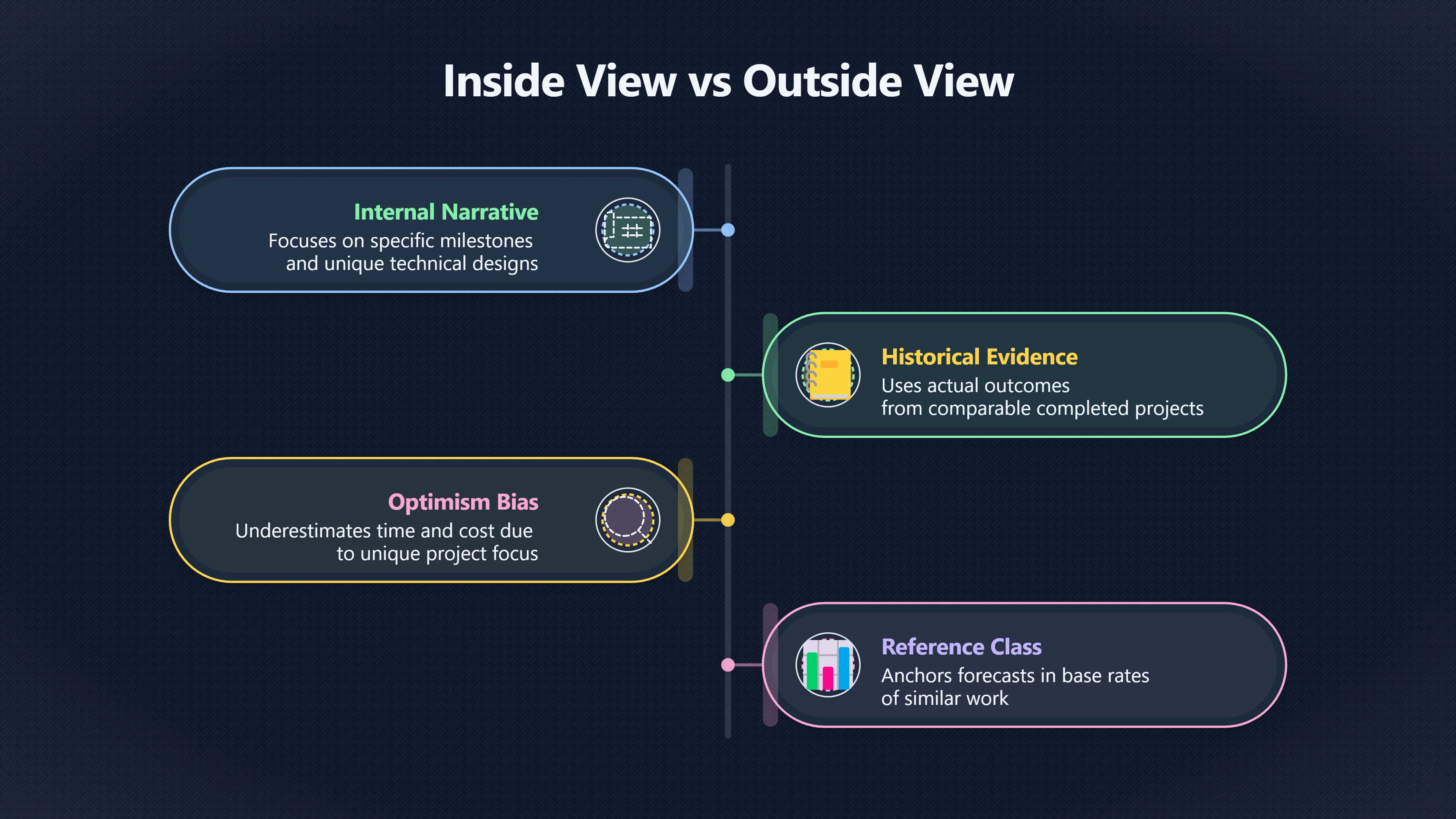
Project teams often become convinced that this project will avoid the delays, budget overruns and technical setbacks that affected similar efforts. This “inside view” feels persuasive because it is built from detailed knowledge of the current plan, talented people and intended solutions. Yet research in behavioural decision-making consistently shows that forecasts improve when teams deliberately adopt an “outside view”: instead of asking why their own plan should succeed, they compare it with the actual outcomes of comparable completed projects. This approach, known as reference class forecasting, is one of the most practical ways to reduce excessive optimism and make better project decisions. [arXiv]arxiv.orgarXiv From Nobel Prize to Project Management: Getting RisksFrom Nobel Prize to Project Management: Getting Risks…February 14, 2013 — by B Flyvbjerg · 2013 · Cited by 826 — The first instan…
 Rather than replacing expert judgement, the outside view acts as a disciplined reality check. It asks whether the proposed timetable, budget or expected benefits are plausible when viewed against historical evidence rather than the project’s own narrative.
Why the inside view feels persuasive
The inside view starts with the specifics of the current project. Teams analyse milestones, staffing plans, technical designs and identified risks, then build a forecast from those details. This process is valuable, but it encourages people to imagine how the plan will unfold if everything broadly works as intended.
Behavioural researchers Daniel Kahneman and Amos Tversky argued that this perspective encourages the planning fallacy—the tendency to underestimate the time, cost and difficulty of future work even when similar past projects have exceeded expectations. The problem is not simply optimism. It is that people focus on the uniqueness of the current situation while neglecting statistical information about comparable cases. [The Decision Lab]thedecisionlab.comThe Decision LabPlanning fallacyPlanning Fallacy is the tendency to be too optimistic about one's estimates. As a result, the time needed…
Several psychological forces reinforce the inside view:
- Teams possess rich information about today’s project but only vague memories of previous ones.
- Success stories are easier to imagine than routine failures and cumulative delays.
- Commitment to a chosen strategy encourages people to defend rather than test assumptions.
- Stakeholders often reward ambitious forecasts more than cautious ones, creating pressure to present attractive plans. [Sage Journals]journals.sagepub.comSage JournalsTop Ten Behavioral Biases in Project Managementby B Flyvbjerg · 2021 · Cited by 379 — I developed this into a practical tool…
Because the inside view is based on detailed reasoning, it often feels more rigorous than simple historical comparisons. Ironically, that confidence can make forecasts less accurate.

How reference classes change forecasts
Reference class forecasting replaces “How will our plan unfold?” with a different question:
How have projects genuinely similar to ours actually turned out?
Instead of constructing a forecast solely from project-specific assumptions, the method begins with a reference class—a collection of comparable completed projects. The team then examines the distribution of actual outcomes, including costs, schedules and realised benefits, before positioning the current project within that distribution. [arXiv]arxiv.orgarXiv From Nobel Prize to Project Management: Getting RisksFrom Nobel Prize to Project Management: Getting Risks…February 14, 2013 — by B Flyvbjerg · 2013 · Cited by 826 — The first instan…
The process generally involves three stages:
- Identify an appropriate reference class. Select projects that are genuinely comparable in size, complexity, technology, regulatory environment or organisational setting.
- Measure historical outcomes. Build a distribution of actual completion times, costs or performance rather than relying on averages alone.

- Adjust the current forecast. If similar projects routinely finished 25% over budget or six months late, treat that evidence as the starting point rather than the exception. Project Management Institute
This shifts attention from compelling stories to observable evidence. A software development team, for example, may believe its experienced engineers and improved tools justify an aggressive schedule. An outside view asks whether previous projects using similarly experienced teams actually achieved comparable timelines. If not, the burden of proof shifts to demonstrating why this case is genuinely different.
Importantly, reference class forecasting does not assume every project is identical. Instead, it recognises that forecasts become more reliable when anchored in base rates before incorporating project-specific adjustments.
A practical example
Imagine a company planning a major customer platform.
The inside view identifies:
- an experienced development team;
- improved cloud infrastructure;
- lessons learned from earlier releases;
- confidence that identified risks have mitigation plans.
The resulting forecast predicts delivery in twelve months.
The outside view examines twenty comparable platform projects completed over the previous decade. It finds:
- the median delivery time was sixteen months;
- only three projects finished within twelve months;
- most delays arose from integration work that planners had recognised but underestimated.
The historical evidence does not prove the new project will require sixteen months. It does show that a twelve-month forecast should now be treated as an unusually optimistic outcome requiring strong evidence rather than as the default expectation.
Common mistakes when comparing projects
Using an outside view is powerful, but only if applied carefully. Several recurring errors reduce its value.
Choosing comparisons that are too flattering
Teams naturally prefer examples that support existing expectations. Selecting unusually successful projects creates an unrealistic benchmark.
A stronger reference class includes both successful and unsuccessful outcomes so that forecasts reflect the full distribution rather than exceptional cases. APM
Assuming every project is completely unique
Most projects contain genuinely distinctive features. However, treating uniqueness as a reason to ignore historical evidence is itself a recognised source of forecasting error.
Recent research identifies uniqueness bias as a tendency for managers to overestimate how exceptional their own projects are, leading them to discount useful comparisons and produce less accurate forecasts. Decision hygiene practices such as reference class forecasting help counter this tendency. arXiv
Comparing only averages
An average completion time hides important variation.
Suppose comparable projects average fifteen months but range from ten to twenty-four months. Decision-makers need the full distribution because contingency planning depends on understanding uncertainty, not merely the central estimate.
Ignoring changing conditions
Reference classes should be updated when technology, regulation or delivery methods change substantially. Historical evidence remains valuable, but the comparison must remain genuinely relevant rather than mechanically copying outdated experience. Recent reviews of reference class forecasting emphasise that selecting and maintaining appropriate comparison groups is one of the method’s most important implementation challenges. Tandfonline
Making the outside view part of project decisions
The outside view is most effective when introduced before major commitments become politically difficult to reverse.
Useful implementation practices include:
- requiring every business case to include evidence from comparable completed projects;
- documenting why the chosen reference class is appropriate;
- distinguishing between the most likely outcome and the optimistic target;
- updating forecasts as more comparable projects become available;
- using historical distributions to inform contingency budgets instead of treating contingency as an arbitrary percentage.
Some governments and major infrastructure organisations have incorporated reference class forecasting into project assurance because repeated experience showed that conventional forecasting systematically underestimated costs and schedules. Practical applications in transport planning and public investment demonstrate that historical comparison can improve resource allocation by exposing optimism before commitments become irreversible. arXiv+2arXiv
What the outside view changes
The greatest value of the outside view is not that it eliminates uncertainty. Instead, it changes the standard of evidence.
Rather than asking teams to justify why their project will succeed, it asks them to explain why their project should perform substantially better than a well-defined group of comparable projects. That subtle change in framing makes optimism compete with evidence instead of replacing it. Within broader efforts to improve thinking and analytical skills, this is one of the most practical ways to counter persuasive internal stories with measurable experience, leading to forecasts that are typically more realistic, transparent and useful for decision-making.
Amazon book picks
Further Reading
Books and field guides related to The question optimistic teams forget to ask. Use these as the next step if you want deeper reading beyond the article.
Superforecasting
Teaches base rates, outside-view thinking, and disciplined forecasting habits.
How Big Things Get Done
Reference class forecasting and the outside view are core practical ideas in the book.
The Signal and the Noise
Explores why forecasts fail and how evidence, probabilities, and model limits should shape predictions.
Risk Savvy
Helps readers reason with uncertainty, base rates, and realistic evidence rather than intuitive optimism.
eBay marketplace picks
Marketplace Samples
Topic-anchored marketplace searches for visual, collectible, or second-hand items related to this page.



Endnotes
-
Source: arxiv.org
Title: arXiv From Nobel Prize to Project Management: Getting Risks
Link: https://arxiv.org/pdf/1302.3642Source snippet
From Nobel Prize to Project Management: Getting Risks...February 14, 2013 — by B Flyvbjerg · 2013 · Cited by 826 — The first instan...
Published: February 14, 2013
-
Source: apm.org.uk
Link: https://www.apm.org.uk/news/reference-class-forecasting-useful-method-or-random-number-generator-webinar/Source snippet
Reference Class Forecasting - useful method, or random...11 Oct 2023 — The method is used to make explicit, empirically based adjustm...
-
Source: arxiv.org
Title: arXiv Uniqueness Bias: Why It Matters, How to Curb It
Link: https://arxiv.org/abs/2408.07710Source snippet
Uniqueness Bias: Why It Matters, How to Curb ItAugust 13, 2024...
Published: August 13, 2024
-
Source: tandfonline.com
Link: https://www.tandfonline.com/doi/full/10.1080/09537287.2025.2578708Source snippet
Reference class forecasting: promises, problems, and a...by CC Cantarelli · 2025 · Cited by 7 — Kahneman and Tversky (Citatio...
-
Source: arxiv.org
Link: https://arxiv.org/pdf/1710.09419Source snippet
Bent Flyvbjerg, Chi-keung Hon, and Wing Huen Fok, 2016by B Flyvbjerg · 2017 · Cited by 78 — Reference Class Forecasting (RCF) is a m...
-
Source: thedecisionlab.com
Link: https://thedecisionlab.com/biases/planning-fallacySource snippet
The Decision LabPlanning fallacyPlanning Fallacy is the tendency to be too optimistic about one's estimates. As a result, the time needed...
-
Source: journals.sagepub.com
Link: https://journals.sagepub.com/doi/10.1177/87569728211049046Source snippet
Sage JournalsTop Ten Behavioral Biases in Project Managementby B Flyvbjerg · 2021 · Cited by 379 — I developed this into a practical tool...
-
Source: projectmanagement.com
Title: reference class forecasting depends on how you define similar
Link: https://www.projectmanagement.com/blog-post/79682/reference-class-forecasting-depends-on-how-you-define–similar-Source snippet
Reference Class Forecasting Depends on How You Define...6 May 2026 — Reference Class Forecasting (RCF), popularized by Bent Flyvbjerg, i...
Published: May 2026
-
Source: managementplatform.nl
Title: Reference Class Forecasting
Link: https://managementplatform.nl/reference-class-forecasting/08/02/2026Source snippet
Management Platform8 Feb 2026 — Reference Class Forecasting (RCF) betreft een methode voor het corrigeren van voorspellingen met betrekki...
-
Source: Wikipedia
Title: Reference class forecasting
Link: https://en.wikipedia.org/wiki/Reference_class_forecastingSource snippet
Reference class forecastingReference class forecasting or comparison class forecasting is a method of predicting the future by looking...
Additional References
-
Source: linkedin.com
Link: https://www.linkedin.com/posts/flyvbjerg_reducing-risks-in-megaprojects-the-potential-activity-7132215991085756416-VeprSource snippet
Prof. Bent Flyvbjerg's PostThe first full literature review of reference class forecasting is now available: "Reducing risks in megaproje...
-
Source: corporate.jasoncollins.blog
Link: https://corporate.jasoncollins.blog/outside-viewSource snippet
jasoncollins.blog23 The outside view – Course notes...The planning fallacy is the tendency of people to underestimate the completion tim...
-
Source: linkedin.com
Link: https://www.linkedin.com/pulse/fallacy-planning-glen-alleman -
Source: committees.parliament.uk
Link: https://committees.parliament.uk/writtenevidence/100937/html/Source snippet
2008. 'Curbing optimism bias and strategic misrepresentation in planning: Reference class forecasting in practice', European Planning Stu...
-
Source: researchgate.net
Link: https://www.researchgate.net/publication/233258056_Curbing_Optimism_Bias_and_Strategic_Misrepresentation_in_Planning_Reference_Class_Forecasting_in_PracticeSource snippet
lass forecasting in planning practice.Read more...
-
Source: dspace.lib.cranfield.ac.uk
Link: https://dspace.lib.cranfield.ac.uk/server/api/core/bitstreams/076d9c29-659d-4bfd-9b1b-e0019ea9ad20/contentSource snippet
class forecasting: promises, problems, and a...by CC Cantarelli · Cited by 7 — Reference Class Forecasting (RCF) has emerged as a promin...
-
Source: youtube.com
Title: The Planning Fallacy: Why You Always Underestimate How Long Everything Takes
Link: https://www.youtube.com/watch?v=6bvtMRHlJN8Source snippet
Reference Class Forecasting in 90 Seconds, with Professor Bent Flyvbjerg...
-
Source: youtube.com
Title: How Big Things Get Done
Link: https://www.youtube.com/watch?v=20EGz2SxdpMSource snippet
The Effect of Optimism Bias on Investing...
-
Source: youtube.com
Title: 3 Reasons Your Schedule Always Slips
Link: https://www.youtube.com/watch?v=kAl7vCspNlcSource snippet
How Big Things Get Done - The Surprising Factors Behind Every Successful Project (Bent Flyvbjerg)...
-
Source: ideas.repec.org
Title: v16y2006i1p3 21
Link: https://ideas.repec.org/a/taf/eurpls/v16y2006i1p3-21.htmlSource snippet
IDEAS/RePEcCurbing Optimism Bias and Strategic Misrepresentation in...by B Flyvbjerg · 2006 · Cited by 705 — The American Planning Assoc...
Topic Tree