Within Tradeoffs
When Decision Scores Mislead
Scoring options can clarify judgement, but the numbers should not pretend uncertain values are exact.
On this page
- Why structured comparisons can help
- Weights, scores and the illusion of certainty
- How to use scoring as a conversation, not a verdict
Page outline Jump by section
Introduction
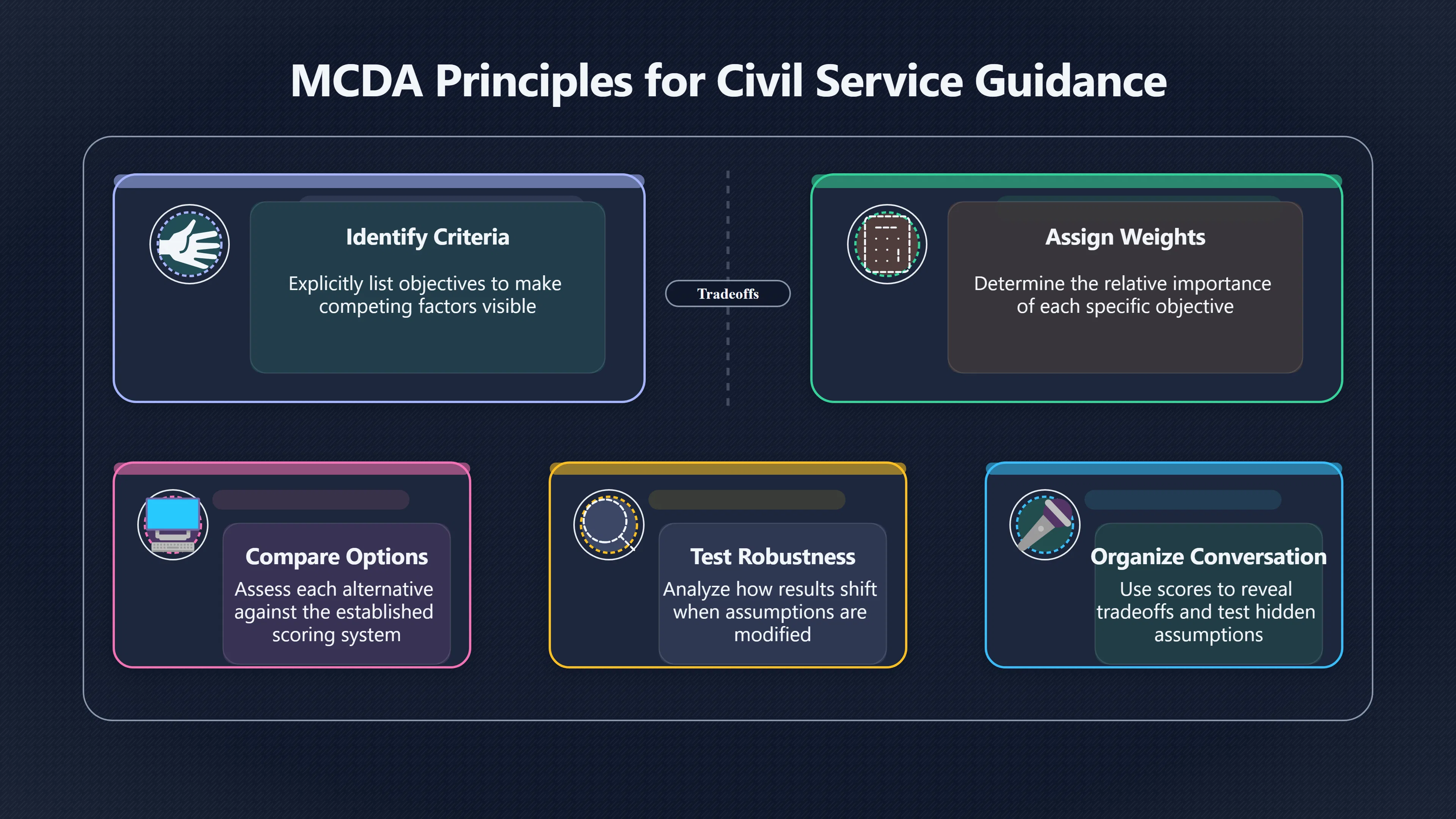
When a decision involves several competing objectives, a structured scoring system can be far better than relying on instinct alone. Listing criteria, assigning weights and comparing options helps people explain their reasoning, expose hidden assumptions and make disagreements more productive. The danger begins when the resulting numbers are treated as though they represent objective truth. A final score of 78.4 versus 76.9 can create an illusion of precision even when the underlying judgements are uncertain, incomplete or subjective. Multi-criteria decision analysis (MCDA) is designed to support judgement, not replace it. Good decision-makers use scores to organise conversations, test assumptions and reveal tradeoffs rather than to claim mathematical certainty where none exists. [analysisfunction.civilservice.gov.uk]analysisfunction.civilservice.gov.ukan introductory guide to mcdaAn Introductory Guide to Multi-Criteria Decision Analysis…1 May 2024 — MCDA is a way of helping decision-makers rationally choose betw…

Why structured comparisons can help
Many important choices involve objectives that cannot be reduced to a single measure. A local authority might balance environmental impact, cost, accessibility and public acceptance. A business may compare reliability, implementation time, cybersecurity and price when selecting software. An individual choosing between jobs may care about salary, flexibility, career development and family life.
Without structure, these considerations often become inconsistent. People naturally give excessive attention to whichever factor is discussed most recently or most vividly. A structured comparison encourages decision-makers to identify the criteria explicitly, assess each option against them and explain why one objective matters more than another in that particular context. The UK’s guidance on MCDA recommends such approaches precisely because they make competing objectives visible when neither purely financial analysis nor a single performance measure is sufficient. [analysisfunction.civilservice.gov.uk]analysisfunction.civilservice.gov.ukan introductory guide to mcdaAn Introductory Guide to Multi-Criteria Decision Analysis…1 May 2024 — MCDA is a way of helping decision-makers rationally choose betw…
The important benefit is not the arithmetic itself. It is the discipline of asking questions such as:
- Have we included every important objective?
- Are we counting the same benefit twice under different names?
- Which criteria are genuinely essential rather than merely desirable?
- Where do stakeholders disagree, and why?
These questions often improve the decision even if the final numerical ranking changes later.
Weights, scores and the illusion of certainty
Numbers can look more certain than the evidence
Once weights and scores are multiplied together, the result often appears authoritative. A spreadsheet may produce rankings to several decimal places, encouraging readers to believe the difference between alternatives is larger or more meaningful than it really is.
In reality, many inputs are judgements rather than measurements. Assigning “8 out of 10” for usability or giving environmental impact a weight of 22% instead of 20% does not transform uncertain human preferences into precise facts. Government guidance on MCDA repeatedly emphasises that the method supports judgement rather than replacing it. [analysisfunction.civilservice.gov.uk]analysisfunction.civilservice.gov.ukan introductory guide to mcdaAn Introductory Guide to Multi-Criteria Decision Analysis…1 May 2024 — MCDA is a way of helping decision-makers rationally choose betw…
A useful question is not whether an option scores 82.3 instead of 81.7, but whether anyone could reasonably defend different scores using the available evidence.
Small numerical differences rarely deserve strong conclusions
Suppose two policy options receive weighted totals of 74 and 75.
If changing one criterion’s weight slightly reverses the ranking, the conclusion is fragile rather than decisive. The apparent winner depends more on modelling choices than on substantial differences between the alternatives.
Conversely, if one option remains ahead despite substantial changes in assumptions, confidence in the decision increases. Modern MCDA literature therefore places considerable emphasis on robustness and sensitivity analysis rather than on the headline score alone. [Wiley Online Library]onlinelibrary.wiley.comInternal uncertaintiesWiley Online LibrarySensitivity and Robustness Analyses in Social Multi‐…by I Azzini · 2025 · Cited by 14 — In Multiple Criteria Decis…
Precision should match evidence quality
A practical rule is to avoid expressing more numerical precision than the evidence can justify.
For example:
- Use broad scoring scales when evidence is qualitative rather than inventing fine distinctions.
- Avoid decimal-point weights unless there is genuine evidence supporting that level of discrimination.
- Treat similar overall scores as indicating comparable options rather than declaring a narrow winner.
This approach makes uncertainty visible instead of hiding it behind arithmetic.
How to use scoring as a conversation, not a verdict
A well-designed scoring exercise should improve discussion before it determines outcomes.
Instead of asking, “Which option has the highest total?”, ask questions such as:
- Which criterion drives this result?
- Which assumptions matter most?
- Which scores are based on evidence and which rely mainly on judgement?
- Where would additional information actually change the decision?
These questions shift attention from defending a spreadsheet towards understanding the decision itself.
An especially useful exercise is to ask different participants to score the options independently before comparing results. Differences often reveal disagreements about objectives or evidence rather than calculation errors. Those conversations are usually more valuable than producing a single “correct” ranking.
Test robustness instead of chasing exact answers
Sensitivity analysis asks what happens if reasonable assumptions change.
Examples include:
- increasing or decreasing criterion weights;
- adjusting uncertain scores;
- considering optimistic and pessimistic scenarios;
- removing one criterion entirely to see whether conclusions depend disproportionately upon it.
If the preferred option remains strongest across many plausible assumptions, the decision is more robust. If rankings change repeatedly after small adjustments, decision-makers should acknowledge that several options are effectively tied and that judgement must play a larger role. Research on uncertainty in MCDA consistently identifies sensitivity and robustness analysis as essential safeguards against overconfidence. [Wiley Online Library+2PMC]onlinelibrary.wiley.comInternal uncertaintiesWiley Online LibrarySensitivity and Robustness Analyses in Social Multi‐…by I Azzini · 2025 · Cited by 14 — In Multiple Criteria Decis…
Importantly, a sensitivity analysis is not a sign that the model has failed. It is evidence that the decision-makers recognise uncertainty rather than concealing it.

Common mistakes that create false precision
Several habits make structured decisions appear more scientific than they really are:
- Overweighting arbitrary numbers. Assigning precise percentages without explaining why they reflect stakeholder priorities.
- Scoring beyond available evidence. Distinguishing between values such as 7.4 and 7.7 when no reliable information supports that difference.
- Ignoring uncertainty. Presenting one ranking without testing alternative assumptions.
- Treating the spreadsheet as objective. Forgetting that people selected the criteria, weights and scoring rules.
- Confusing consistency with correctness. A perfectly consistent model can still be built upon poor assumptions.
These problems arise not because scoring systems are flawed, but because people often mistake a formal process for certainty.
A practical mindset for realistic decisions
Multi-criteria scoring works best when viewed as a structured aid to reasoning rather than a machine that produces objectively correct answers. The numbers help organise complex tradeoffs, reveal priorities and make assumptions explicit. They do not eliminate uncertainty or replace judgement.
A useful decision process therefore asks two questions rather than one. First, which option scores well under our current assumptions? Second, how confident are we that those assumptions are reasonable? When both questions receive careful attention, scoring systems become valuable tools for clearer thinking instead of sources of false precision.
Amazon book picks
Further Reading
Books and field guides related to When Decision Scores Mislead. Use these as the next step if you want deeper reading beyond the article.
How to Measure Anything
Shows how uncertainty and measurement should inform decisions.
eBay marketplace picks
Marketplace Samples
Topic-anchored marketplace searches for visual, collectible, or second-hand items related to this page.


Endnotes
-
Source: analysisfunction.civilservice.gov.uk
Title: an introductory guide to mcda
Link: https://analysisfunction.civilservice.gov.uk/policy-store/an-introductory-guide-to-mcda/Source snippet
An Introductory Guide to Multi-Criteria Decision Analysis...1 May 2024 — MCDA is a way of helping decision-makers rationally choose betw...
Published: May 2024
-
Source: GOV.UK
Title: use of multi criteria decision analysis in options appraisal of economic cases
Link: https://www.gov.uk/government/publications/green-book-supplementary-guidance-multi-criteria-decision-analysis/use-of-multi-criteria-decision-analysis-in-options-appraisal-of-economic-casesSource snippet
of Multi-Criteria Decision Analysis in options appraisal...16 May 2024 — MCDA is a technique that helps decision-makers make rational ch...
Published: May 2024
-
Source: onlinelibrary.wiley.com
Title: Internal uncertainties
Link: https://onlinelibrary.wiley.com/doi/full/10.1002/mcda.70006Source snippet
Wiley Online LibrarySensitivity and Robustness Analyses in Social Multi‐...by I Azzini · 2025 · Cited by 14 — In Multiple Criteria Decis...
-
Source: assets.publishing.service.gov.uk
Link: https://assets.publishing.service.gov.uk/media/5a78e47ded915d07d35b3403/pb13695-paper5-socialimpacts-wellbeing.pdfSource snippet
5 Social Impacts and Wellbeing: multi-criteria...decision-making criteria, identifying appropriate weights, and in scoring options again...
Additional References
-
Source: researchgate.net
Link: https://www.researchgate.net/publication/393630075_Comparison_of_Multi-Criteria_Decision_Analysis_methods_under_comprehensive_sensitivity_analysisSource snippet
Comparison of Multi-Criteria Decision Analysis Methods...30 May 2026 — The analysis employs the Comprehensive Sensitivity Analysis Metho...
Published: May 2026
-
Source: researchgate.net
Link: https://www.researchgate.net/post/How_many_implementations_of_sensitivity_analysis_regarding_multiple_criteria_decision_making_MCDM_methodsSource snippet
How many implementations of sensitivity analysis...10 Jul 2021 — I want to know which ways are common sensitivity analysis that are perf...
-
Source: innovationvalueinitiative.github.io
Link: https://innovationvalueinitiative.github.io/IVI-NSCLC/reference/mcda.htmlSource snippet
Multi criteria decision analysis — mcda • iviNSCLCIf an element is "low", then lower performance on that criterion is better, and, if an...
-
Source: ideaclouds.net
Link: https://www.ideaclouds.net/resources/workshop-methods/multi-criteria-decision-making-product-prioritization-guide/Source snippet
Multi-Criteria Decision Making Product PrioritizationFalse precision illusion: Final 2D positions appear mathematically precise but repre...
-
Source: wrc.org.za
Link: https://www.wrc.org.za/wp-content/uploads/mdocs/512-1-97.pdfSource snippet
Water Research CommissionMultiple Criteria Decision Analysis: Procedures for...by TJ Stewart · Cited by 21 — Uncertainty as to values (p...
-
Source: publications.jrc.ec.europa.eu
Link: https://publications.jrc.ec.europa.eu/repository/handle/JRC138872Source snippet
and Robustness Analyses in Social Multi-Criteria...by I AZZINI · Cited by 14 — In this article, we propose the following improvements of...
-
Source: pmc.ncbi.nlm.nih.gov
Title: PMCA Review and Classification of Approaches for Dealing
Link: https://pmc.ncbi.nlm.nih.gov/articles/PMC4544539/Source snippet
by H Broekhuizen · 2015 · Cited by 175 — This review identified five commonly used approaches to quantify and incorporate uncertainty...
-
Source: research.utwente.nl
Title: a review and classification of approaches for dealing with uncert
Link: https://research.utwente.nl/en/publications/a-review-and-classification-of-approaches-for-dealing-with-uncert/Source snippet
Review and Classification of Approaches for Dealing...by H Broekhuizen · 2015 · Cited by 176 — Multi-criteria decision analysis (MCDA) i...
-
Source: researchgate.net
Title: 358131153 A Practical Guide to Multi Criteria Analysis
Link: https://www.researchgate.net/publication/358131153_A_Practical_Guide_to_Multi-Criteria_AnalysisSource snippet
A Practical Guide to Multi-Criteria Analysis26 Jan 2022 — The paper also offers practical guidance regarding the fundamental tasks requir...
-
Source: consensus.app
Link: https://consensus.app/search/sensitivity-analysis-techniques-in-multi-criteria-/Xlqw-sP3SFSwFUdgNngmAg/Source snippet
MCDM) to assess how changes in input data, such as criteria weights or performance...
Topic Tree