Within Tradeoffs
Why More Choice Can Feel Worse
Too many options can make decisions harder because each extra feature creates more sacrifices to compare.
On this page
- Option count versus comparison difficulty
- Preference uncertainty and complex feature tradeoffs
- How to shrink a crowded choice set without guessing
Page outline Jump by section
Introduction
More options do not automatically produce better decisions. In many real-world situations, the difficulty comes not from the number of alternatives alone but from the growing number of tradeoffs that must be compared. Every extra option can introduce a new combination of strengths and weaknesses, forcing people to weigh price against quality, convenience against performance, or short-term gains against long-term benefits. As these comparisons multiply, people often hesitate, postpone the decision or become less confident that they chose well. Research supports this pattern, but it also shows that “choice overload” is not inevitable. It is most likely when people lack clear preferences, must compare many competing attributes and cannot easily eliminate inferior options. [PMC]nih.govPMC11111947PMCfuture research directions in choice overload and its moderatorsby R Misuraca · 2024 · Cited by 40 — A famous field study conducted by…

Option count versus comparison difficulty
One common misunderstanding is that choice overload is simply about having a large menu. Evidence suggests that comparison difficulty is usually the more important factor.
Imagine choosing between three laptops. Even if there are only three, the decision can become demanding if one has the best battery life, another has the fastest processor and the third offers the lowest price. None dominates the others, so every comparison requires balancing competing objectives.
Now imagine twenty laptops that are clearly divided into entry-level, mid-range and premium groups with consistent specifications. Although there are more products overall, the structure makes comparison easier because many options can be dismissed quickly.
Research increasingly distinguishes these situations. The psychological burden grows when:
- options differ across several important dimensions;
- no option is clearly superior;
- the decision-maker lacks a clear ranking of priorities; and
- each additional option creates new pairwise comparisons rather than simply adding a similar alternative. [PMC]nih.govPMC11111947PMCfuture research directions in choice overload and its moderatorsby R Misuraca · 2024 · Cited by 40 — A famous field study conducted by…
For improving analytical thinking, this distinction matters. The real challenge is often not “too many choices” but “too many meaningful tradeoffs”.
Preference uncertainty makes tradeoffs harder
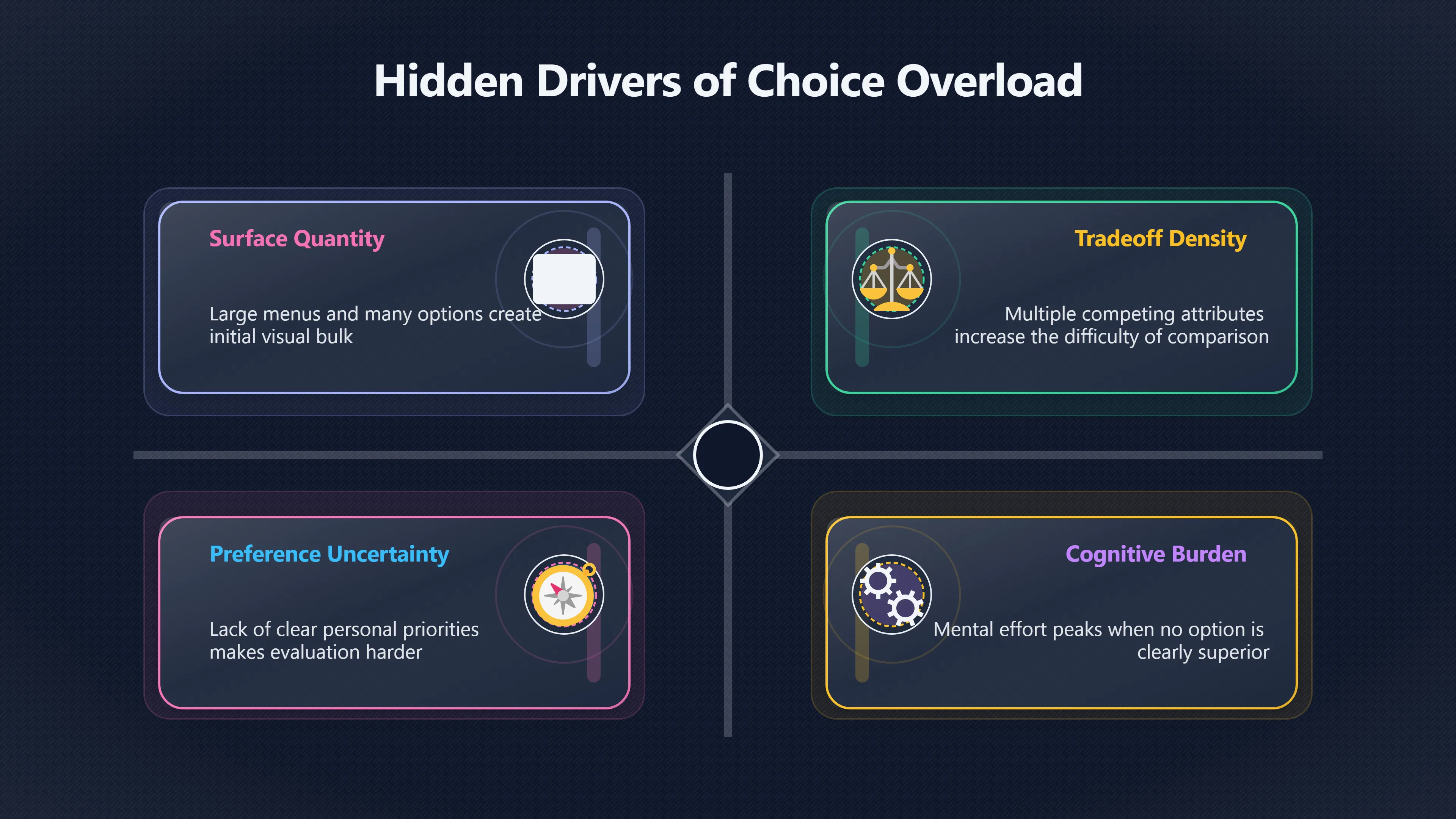
Choice overload becomes much more likely when people are uncertain about what they value most.
Studies reviewed across two decades consistently show that people with established preferences are less vulnerable to overload. Someone who already knows they want the lightest bicycle or the cheapest flight can ignore many irrelevant attributes and eliminate large numbers of options quickly. By contrast, people who are exploring an unfamiliar category must evaluate nearly every feature, making comparison substantially more demanding. [scheibehenne.com]scheibehenne.comCan There Ever Be Too Many Options?A Meta-Analytic…by B SCHEIBEHENNE · Cited by 1730 — The choice overload hypothesis states that an increase in the number of options to…
This explains why buying a first home, selecting a pension plan or choosing a university course often feels more exhausting than making routine supermarket purchases. The decision is not merely larger—it requires discovering personal priorities while simultaneously evaluating alternatives.
Researchers have also identified several conditions that increase overload:
- unfamiliar products or domains;
- absence of a clearly dominant option;
- many attractive alternatives with different strengths;
- poorly defined personal preferences; and
- decisions requiring simultaneous comparison across numerous attributes. [scheibehenne.com]scheibehenne.comCan There Ever Be Too Many Options?A Meta-Analytic…by B SCHEIBEHENNE · Cited by 1730 — The choice overload hypothesis states that an increase in the number of options to…
These findings fit naturally with tradeoff thinking. When values are unclear, every additional feature becomes another sacrifice to evaluate.
The evidence is more nuanced than “more choice is always worse”
The popular idea of the “paradox of choice” was strongly influenced by the famous jam tasting experiment by Sheena Iyengar and Mark Lepper. Shoppers were more likely to stop at a display with twenty-four jams than one with six, but purchases were reportedly higher from the smaller assortment. The study became an influential illustration that extensive choice could reduce commitment. [UW Faculty]faculty.washington.eduUW FacultyWhen Choice is Demotivating: Can One Desire Too Much…August 30, 2001 — by SS Iyengar · 2000 · Cited by 6949 — Current psycho…
However, later evidence paints a more complicated picture.
A major meta-analysis combining results from dozens of experiments found that the average overall effect of choice overload was close to zero. Rather than concluding that the phenomenon does not exist, the authors argued that its effects depend heavily on context. Some situations reliably produce overload, while others show neutral or even positive effects from larger assortments. [scheibehenne.com]scheibehenne.comCan There Ever Be Too Many Options?A Meta-Analytic…by B SCHEIBEHENNE · Cited by 1730 — The choice overload hypothesis states that an increase in the number of options to…
Subsequent conceptual reviews reached a similar conclusion. Larger assortments can be valuable because they improve the chance of finding a better match, satisfy diverse preferences and increase perceived freedom. Negative outcomes become more likely only when comparison becomes cognitively demanding relative to the decision-maker’s knowledge and goals. [Semantic Scholar]semanticscholar.orgSemantic ScholarChoice overload: A conceptual review and meta-analysis1 Apr 2015 — On the advantages and disadvantages of choice: future…
For analytical thinking, this is an important correction. Simply reducing the number of options is not automatically beneficial. Reducing unnecessary comparison effort is usually the more useful objective.
How multiplying tradeoffs changes decision quality
When tradeoffs become increasingly difficult to compare, several predictable behaviours emerge.
People may delay choosing because they anticipate the effort required to evaluate every possibility. They may also experience greater regret, since more alternatives make it easier to imagine that another option would have been slightly better.
Another common response is simplifying the decision by relying on shortcuts rather than deliberate comparison. Examples include choosing the default option, selecting the most familiar brand or focusing on a single attribute while ignoring others. These strategies reduce cognitive effort but can also overlook important tradeoffs. [scheibehenne.com]scheibehenne.comCan There Ever Be Too Many Options?A Meta-Analytic…by B SCHEIBEHENNE · Cited by 1730 — The choice overload hypothesis states that an increase in the number of options to…
From the perspective of analytical skill, the problem is therefore not merely slower decisions. It is that excessive comparison complexity can shift people away from reasoned evaluation towards convenient heuristics.
How to shrink a crowded choice set without guessing
The goal is not to pretend fewer tradeoffs exist but to remove options that are irrelevant before making detailed comparisons.
Several practical approaches help:
- Define non-negotiable requirements first. Eliminate alternatives that fail essential criteria before comparing finer differences.
- Rank objectives before reviewing options. Deciding that reliability matters more than appearance, or flexibility more than cost, greatly reduces later comparison effort.
- Compare a small shortlist. After screening, analyse perhaps three to five serious candidates rather than repeatedly returning to dozens.
- Ignore features that will not affect the final decision. Not every specification deserves equal attention.
- Accept that perfect optimisation is rarely possible. When several options satisfy the important objectives, searching indefinitely often produces diminishing returns rather than better decisions. PMC
These methods improve thinking because they simplify the comparison process without pretending the underlying tradeoffs disappear.
What this means for better tradeoff thinking
Choice overload is best understood as a problem of comparison rather than abundance. A larger set of options becomes difficult when each alternative introduces new sacrifices that must be weighed against different benefits, especially when personal priorities are uncertain.
For realistic decision-making, the most valuable analytical habit is therefore not asking, “How can I consider every possibility?” Instead, it is asking, “Which tradeoffs actually matter for this decision?” Once those priorities are explicit, even a large choice set becomes more manageable, while many apparently difficult decisions shrink into a comparison of only a few meaningful alternatives.
Amazon book picks
Further Reading
Books and field guides related to Why More Choice Can Feel Worse. Use these as the next step if you want deeper reading beyond the article.
The Paradox of Choice
Directly addresses why more options can reduce satisfaction and confidence.
Thinking in Bets
Encourages better decisions despite uncertainty and competing tradeoffs.
eBay marketplace picks
Marketplace Samples
Live-tested eBay searches with available results related to this page.



Endnotes
-
Source: scheibehenne.com
Title: Can There Ever Be Too Many Options?
Link: https://scheibehenne.com/ScheibehenneGreifenederTodd2010.pdfSource snippet
A Meta-Analytic...by B SCHEIBEHENNE · Cited by 1730 — The choice overload hypothesis states that an increase in the number of options to...
-
Source: faculty.washington.edu
Link: https://faculty.washington.edu/jdb/345/345%20Articles/Iyengar%20%26%20Lepper%20%282000%29.pdfSource snippet
UW FacultyWhen Choice is Demotivating: Can One Desire Too Much...August 30, 2001 — by SS Iyengar · 2000 · Cited by 6949 — Current psycho...
Published: August 30, 2001
-
Source: semanticscholar.org
Link: https://www.semanticscholar.org/paper/Choice-overload%3A-A-conceptual-review-and-Chernev-B%C3%B6ckenholt/48a0eba4bb1df2c391844aae409873942275ba09Source snippet
Semantic ScholarChoice overload: A conceptual review and meta-analysis1 Apr 2015 — On the advantages and disadvantages of choice: future...
Additional References
-
Source: researchgate.net
Link: https://www.researchgate.net/publication/48210291_Can_There_Ever_be_Too_Many_Options_A_Meta-analytic_Review_of_Choice_OverloadSource snippet
Can There Ever be Too Many Options? A Meta-analytic...The choice overload hypothesis states that an increase in the number of options to...
-
Source: thedecisionlab.com
Link: https://thedecisionlab.com/biases/choice-overload-biasSource snippet
Choice Overload BiasChoice overload, or "overchoice", is a phenomena stating our tendency to have difficulty making a choice if presented...
-
Source: behavioralscientist.org
Link: https://behavioralscientist.org/is-having-too-many-choices-versus-too-few-really-the-greater-problem-for-consumers/Source snippet
ere the number of options participants reporting having was larger than the number of...Read more...
-
Source: papers.ssrn.com
Title: SSRN ID4434106 code1410331
Link: https://papers.ssrn.com/sol3/Delivery.cfm/SSRN_ID4434106_code1410331.pdf?abstractid=4434106&mirid=1Source snippet
Overload: A Systematic Literature ReviewSome academics have acknowledged that decision complexity resulting from a large number of option...
-
Source: youtube.com
Link: https://www.youtube.com/watch?v=mgC3Lk42VocSource snippet
Why Too Many Choices Makes Us Miserable | Shrink Space E.70...
-
Source: youtube.com
Title: Information Overload Explained: How Netflix Tries to Help Users
Link: https://www.youtube.com/watch?v=IJXb4DOfvRISource snippet
Multi-Criteria Decision Analysis (MCDA): The Method for High-Impact Complex Decisions...
-
Source: youtube.com
Title: The Overchoice Paradox: Why More Options Make You Miserable
Link: https://www.youtube.com/watch?v=AaXi1ELlG60Source snippet
Information Overload Explained: How Netflix Tries to Help Users...
-
Source: youtube.com
Title: The paradox of choice | Barry Schwartz | TED
Link: https://www.youtube.com/watch?v=VO6XEQIsCoMSource snippet
The Overchoice Paradox: Why More Options Make You Miserable...
-
Source: youtube.com
Title: Why Too Many Choices Makes Us Miserable | Shrink Space E.70
Link: https://www.youtube.com/watch?v=p1V7prl0l34
Topic Tree