Within Spacing
Let forgetting show what needs repair
Forgetting is useful when a spaced session reveals which definition, step or assumption has not survived.
On this page
- Why partial forgetting is a diagnostic signal
- Finding failed steps in explanations and procedures
- Turning mistakes into the next review target
Page outline Jump by section
Introduction
Forgetting can be useful when it exposes the part of an idea that has not survived the gap between study sessions. In distributed practice, the point is not to wait until everything has vanished, but to return after enough time has passed that definitions, steps and assumptions must be rebuilt from memory. The weak link is often not the whole topic. It may be one missing condition in a definition, one skipped step in a procedure, or one assumption that felt obvious during study but disappears when the learner has to reason independently.
 This matters for analytical skill because reasoning fails at its weakest dependency. A person may remember the name of a concept yet forget the condition that makes it apply; remember a formula yet forget why a term belongs in it; or remember a conclusion yet forget the evidence that justified it. Spaced review turns those memory gaps into useful evidence about what needs repair before the knowledge is trusted in real thinking. Research on desirable difficulties, retrieval practice, feedback and metacognitive monitoring supports this basic mechanism: delayed recall is harder, but that difficulty can reveal what familiarity hides. Bjork Learning and Forgetting Lab+2PDF Retrieval Practice [bjorklab.psych.ucla.edu]bjorklab.psych.ucla.eduBjork Learning and Forgetting LabCreating Desirable Difficulties to Enhance LearningDecember 17, 2010 — by EL Bjork · Cited by 2237 — At…
Why partial forgetting is a diagnostic signal
Immediately after studying, it is easy to mistake fluency for understanding. Notes look familiar, examples feel obvious, and the learner can often recognise the right answer without being able to reconstruct it. That is a poor test of analytical readiness. Reasoning usually happens later, in a different setting, without the textbook, teacher, worked example or recent memory trace doing half the work.
The useful feature of a spaced session is that it lowers this false comfort. Bjork and Bjork’s distinction between “storage strength” and “retrieval strength” helps explain why: something may be well established in memory yet temporarily hard to access, while something recently seen may feel accessible without being deeply learned. Spacing lets the learner discover which ideas are merely familiar and which can actually be retrieved and used. [Bjork Learning and Forgetting Lab]bjorklab.psych.ucla.eduBjork Learning and Forgetting LabCreating Desirable Difficulties to Enhance LearningDecember 17, 2010 — by EL Bjork · Cited by 2237 — At…
Delayed judgements of learning are also more informative than immediate ones. Research on metacognitive monitoring finds that people’s predictions about later recall tend to become more accurate when made after a delay, partly because the learner is no longer relying on short-lived cues from recent exposure. In practical terms, “I know this because I just read it” is less useful than “I can still explain this after a gap.” [MDPI]mdpi.comWhen Memory and Metamemory Align: How Processes at…by GI Hughes · 2022 · Cited by 6 — Judgments of learning are most accurate when…
For reasoning, the signal is most valuable when the recall attempt is specific. A vague feeling of forgetting says little. A failed attempt to state the difference between correlation and causation, explain why a base rate matters, or reproduce the logic of a proof gives a much sharper diagnosis. The gap points to a repair target.
Finding failed steps in explanations and procedures
Weak links often appear when the learner tries to explain a process without looking. In a worked example, every step is visible, so the reasoning can seem smoother than it really is. MIT’s Teaching and Learning Lab describes worked examples as step-by-step illustrations of how to solve a task, but notes that learners benefit when they self-explain the procedures and principles rather than merely inspect them. [Teaching + Learning Lab]tll.mit.eduTeaching + Learning Lab Worked Examples | Teaching + Learning LabTeaching + Learning LabWorked Examples | Teaching + Learning Lab - MITWorked examples are step-by-step illustrations of the process requi…
A spaced session can turn that into a diagnostic exercise. Instead of rereading the example, the learner tries to rebuild the explanation:
- What is the problem asking?
- Which principle applies, and why?
- What is the first step?
- What assumption allows that step?
- What would make this method inappropriate?
- Where does the conclusion come from?
The failed answer is the important part. If the learner remembers the calculation but not the condition under which it is valid, the weak link is conceptual. If they remember the conclusion but not the evidence, the weak link is evidential. If they remember each step separately but cannot explain why the steps occur in that order, the weak link is procedural structure.
Self-explanation research is relevant here because it shows why simply seeing a correct solution is not enough. Reviews of worked-example research report that examples are most useful when learners actively explain the rationale behind solution steps, connect them to principles, and resolve mismatches between their own understanding and the expert model. [Evaluation and Assessment]assess.ucr.eduOpen source on ucr.edu.
The same logic applies outside maths and science. In critical reading, the weak link might be a missing warrant between evidence and claim. In decision-making, it might be an unstated assumption about incentives or probabilities. In philosophy or law, it might be a definition that changes the whole argument. Forgetting exposes these points because the learner can no longer glide along on the surface of the original explanation.

Mistakes become review targets, not signs to stop
A failed retrieval attempt is not wasted. Studies on pretesting and unsuccessful retrieval suggest that trying to answer before seeing feedback can improve later learning, especially when corrective feedback follows. Kornell, Hays and Bjork found that unsuccessful retrieval attempts could enhance subsequent learning, and later reviews describe errorful generation as useful when it prepares the learner to process the correction more deeply. [ResearchGate]researchgate.netResearch Gate Unsuccessful Retrieval Attempts Enhance SubsequentResearch Gate Unsuccessful Retrieval Attempts Enhance Subsequent
That does not mean errors are automatically good. They become useful when the learner checks them, explains them and updates the next practice target. A wrong answer left uncorrected can strengthen confusion; a wrong answer followed by clear feedback can mark the boundary between what seemed known and what was actually usable. Recent work on the pretesting effect also emphasises the role of feedback timing, finding benefits for pretesting compared with read-only learning while showing that feedback conditions matter. [Journal of Cognition]journalofcognition.orgJournal of Cognition Exploring the Impact of Feedback and Final Test TimingJournal of Cognition Exploring the Impact of Feedback and Final Test Timing
A good spaced review therefore treats mistakes as data. The learner should record not just “wrong”, but the type of failure:
- Missing definition: the term was remembered, but its necessary condition was not.
- Broken sequence: the steps were known individually, but their order or dependency failed.
- Hidden assumption: the conclusion was remembered, but the assumption supporting it vanished.
- False familiarity: the idea felt known until it had to be produced without prompts.
- Transfer failure: the learner could use the idea in the original example but not in a new case.
This classification matters because each failure calls for a different repair. A missing definition needs precise restatement and contrast with near-neighbours. A broken sequence needs a rebuilt procedure. A hidden assumption needs explanation prompts. A transfer failure needs varied examples, not more repetition of the same one.
Let forgetting show what needs repair
The practical rule is to design spaced sessions so that forgetting has somewhere to show itself. Rereading hides weak links; recall exposes them. The session should begin with an attempt, not a review: explain the idea, solve a problem, reconstruct the argument, list the assumptions, or compare two cases before opening the source.
Then the repair should be narrow. If only one step failed, do not restudy the whole chapter as if everything were equally weak. Fix the exact dependency that broke, then test it again later in a slightly different form. This keeps distributed practice from becoming passive repetition and turns it into maintenance for reasoning.
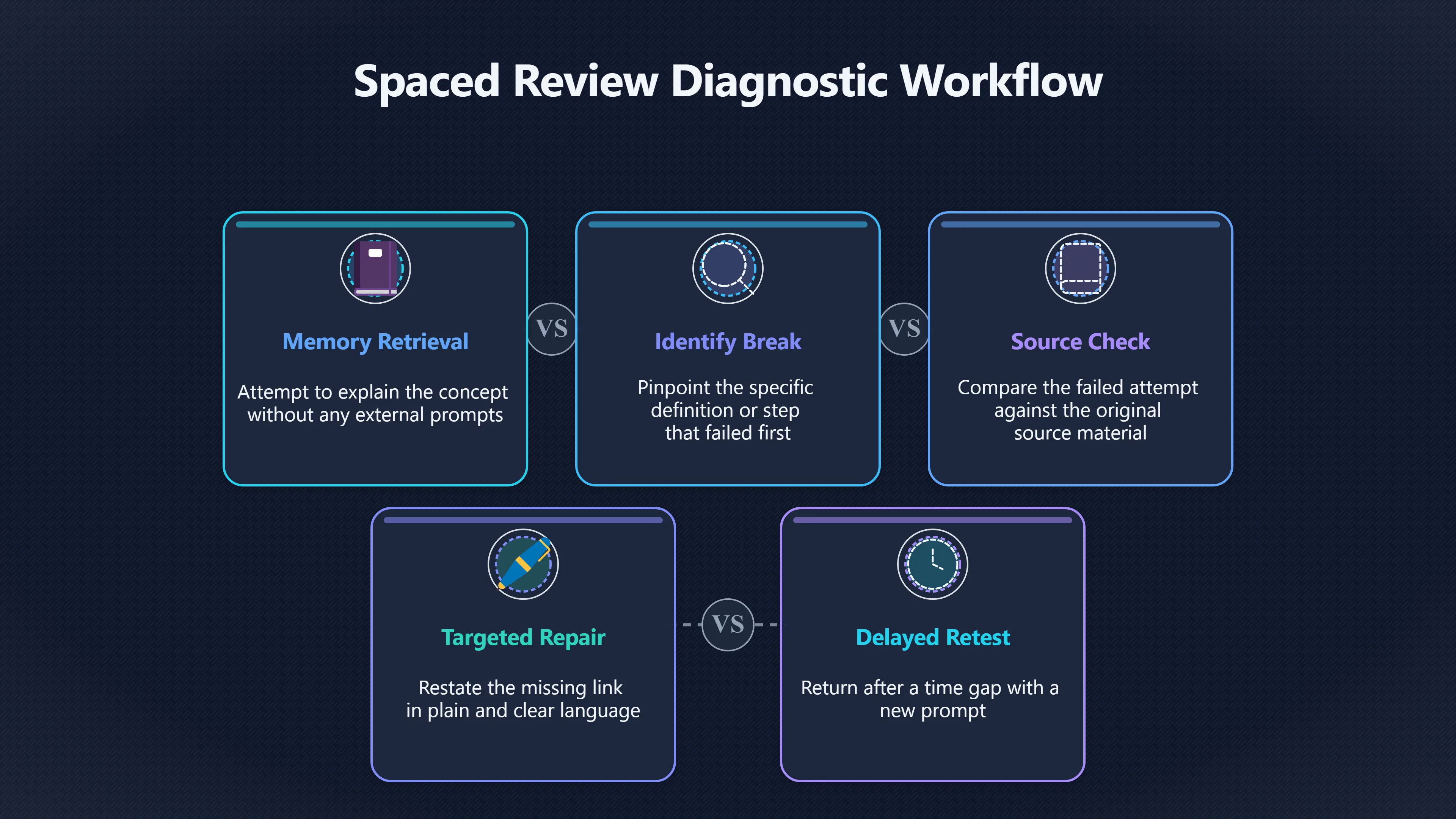
A useful pattern is:
- Retrieve first: write or say the explanation from memory.
- Mark the break: identify the first definition, step or assumption that failed.
- Check the source: compare the attempt with the original explanation or worked solution.
- Repair the link: restate the missing part in plain language and connect it to the next step.
- Retest later: return after another delay with a new prompt or example.
This is why forgetting belongs inside a strategy for improving thinking rather than being treated only as a memory problem. Analytical skill depends on chains of knowledge that hold under pressure. Spaced sessions reveal which links in those chains still break when the surrounding cues are gone.
Amazon book picks
Further Reading
Books and field guides related to Let forgetting show what needs repair. Use these as the next step if you want deeper reading beyond the article.
How We Learn
Covers spacing, forgetting, retrieval, and practical methods for improving long-term learning.
Make It Stick
Explains retrieval practice, spaced learning, desirable difficulties, and using forgetting to strengthen memory.
Small Teaching
Shows how retrieval, feedback, and incremental review expose weak understanding and improve retention.
Ultralearning
Emphasizes active recall, feedback, and identifying weaknesses through challenging practice.
eBay marketplace picks
Marketplace Samples
Live-tested eBay searches with available results related to this page.



Endnotes
-
Source: mdpi.com
Link: https://www.mdpi.com/2079-3200/10/4/101Source snippet
When Memory and Metamemory Align: How Processes at...by GI Hughes · 2022 · Cited by 6 — Judgments of learning are most accurate when...
-
Source: tll.mit.edu
Title: Teaching + Learning Lab Worked Examples | Teaching + Learning Lab
Link: https://tll.mit.edu/teaching-resources/how-people-learn/worked-examples/Source snippet
Teaching + Learning LabWorked Examples | Teaching + Learning Lab - MITWorked examples are step-by-step illustrations of the process requi...
-
Source: researchgate.net
Link: https://www.researchgate.net/profile/Alexander_Renkl/publication/250616461_Learning_by_Solved_Example_Problems_Instructional_Explanations_Reduce_Self-Explanation_Activity/links/0c96053bbcc1c68e1b000000.pdf -
Source: researchgate.net
Title: Research Gate Unsuccessful Retrieval Attempts Enhance Subsequent
Link: https://www.researchgate.net/publication/26655655_Unsuccessful_Retrieval_Attempts_Enhance_Subsequent_Learning -
Source: researchgate.net
Link: https://www.researchgate.net/publication/284097727_Making_things_hard_on_yourself_but_in_a_good_way_Creating_desirable_difficulties_to_enhance_learning -
Source: researchgate.net
Link: https://www.researchgate.net/publication/383111781_Responsible_remembering_The_role_of_metacognition_forgetting_attention_and_retrieval_in_adaptive_memory -
Source: researchgate.net
Link: https://www.researchgate.net/publication/24268097_Metacognitive_strategies_in_student_learning_Do_students_practise_retrieval_when_they_study_on_their_own -
Source: youtube.com
Title: robert bjork
Link: https://www.youtube.com/watch?v=1FQoGUCgb5wSource snippet
Bjork Learning and Forgetting Lab...
-
Source: bjorklab.psych.ucla.edu
Link: https://bjorklab.psych.ucla.edu/wp-content/uploads/sites/13/2016/04/EBjork_RBjork_2011.pdfSource snippet
Bjork Learning and Forgetting LabCreating Desirable Difficulties to Enhance LearningDecember 17, 2010 — by EL Bjork · Cited by 2237 — At...
Published: December 17, 2010
-
Source: pdf.retrievalpractice.org
Link: https://pdf.retrievalpractice.org/RetrievalPracticeGuide.pdfSource snippet
PDF Retrieval PracticeHOW TO USE RETRIEVAL PRACTICE TO IMPROVE...by PK Agarwal · 2020 · Cited by 93 — As an additional benefit, retrieva...
-
Source: pdf.retrievalpractice.org
Title: 5 Metcalfe Finn 2008
Link: https://pdf.retrievalpractice.org/metacognition/5_Metcalfe_Finn_2008.pdfSource snippet
Dunlosky (1991) said, “The accuracy of JOLs (judgments of learning) is critical because if the JOLs are inaccurate, the allocation of su...
-
Source: assess.ucr.edu
Link: https://assess.ucr.edu/sites/default/files/2019-02/atkinsonderryrenklwortham_2000.pdf -
Source: journalofcognition.org
Title: Journal of Cognition Exploring the Impact of Feedback and Final Test Timing
Link: https://journalofcognition.org/articles/455/files/687f6aa6dcf5d.pdf -
Source: bjorklab.psych.ucla.edu
Link: https://bjorklab.psych.ucla.edu/wp-content/uploads/sites/13/2016/11/RABjork_JacobyFestschriftChapterFigsEmbedded052014.pdf -
Source: bjorklab.psych.ucla.edu
Title: Koriat Bjork 2006 JEP LMC
Link: https://bjorklab.psych.ucla.edu/wp-content/uploads/sites/13/2016/07/Koriat_Bjork_2006_JEP-LMC.pdf -
Source: learninglab.uchicago.edu
Title: Richland Kornell Kao
Link: https://learninglab.uchicago.edu/Pre-Testing_files/RichlandKornellKao.pdf -
Source: sheffieldscitt.org.uk
Title: retrieval practice
Link: https://www.sheffieldscitt.org.uk/research/retrieval-practice -
Source: learninglab.psych.purdue.edu
Title: 2009 Karpicke JEPGeneral
Link: https://learninglab.psych.purdue.edu/downloads/2009/2009_Karpicke_JEPGeneral.pdf -
Source: learninglab.psych.purdue.edu
Title: 2009 Karpicke Butler Roediger
Link: https://learninglab.psych.purdue.edu/downloads/2009/2009_Karpicke_Butler_Roediger.pdf
Additional References
-
Source: youtube.com
Link: https://www.youtube.com/watch?v=gkJz0PpvGf4Source snippet
Desirable Difficulties: If Studying Feels Easy, You're Doing It Wrong...
-
Source: columbia.edu
Link: https://www.columbia.edu/cu/psychology/metcalfe/PDFs/Metcalfe-BjorkVolSubmitFeb14Final.pdf -
Source: waddesdonschool.com
Link: https://www.waddesdonschool.com/wp-content/uploads/2021/02/Desriable-Difficulties-in-theory-and-practice-Bjork-Bjork-2020.pdf -
Source: mrbartonmaths.com
Link: https://mrbartonmaths.com/resourcesnew/8.%20Research/Explicit%20Instruction/Worked%20examples%20with%20mistakes.pdf -
Source: thirdspacelearning.com
Link: https://thirdspacelearning.com/blog/retrieval-practice/ -
Source: nko.nl
Link: https://www.nko.nl/sites/nro/files/migrate/411-10-910-010-Proefschrift_Reijners.pdf -
Source: teachertoolkit.co.uk
Link: https://www.teachertoolkit.co.uk/wp-content/uploads/2024/10/2009-14440-005.pdf -
Source: documents.manchester.ac.uk
Link: https://documents.manchester.ac.uk/display.aspx?DocID=54513 -
Source: osf.io
Link: https://osf.io/download/un87v -
Source: my.chartered.college
Title: does question difficulty impact the effect of retrieval [practice testing]({{ ‘practice-tests/’ | relative_url }}) effect
Link: https://my.chartered.college/impact_article/does-question-difficulty-impact-the-effect-of-retrieval-practice-testing-effect/
Topic Tree