Within Practice Tests
Why Wrong Answers Make Better Thinkers
Checking answers quickly stops errors from becoming habits and turns failed recall into useful information.
On this page
- What a failed retrieval reveals
- When feedback should happen
- How to correct without overloading review time
Page outline Jump by section
Introduction
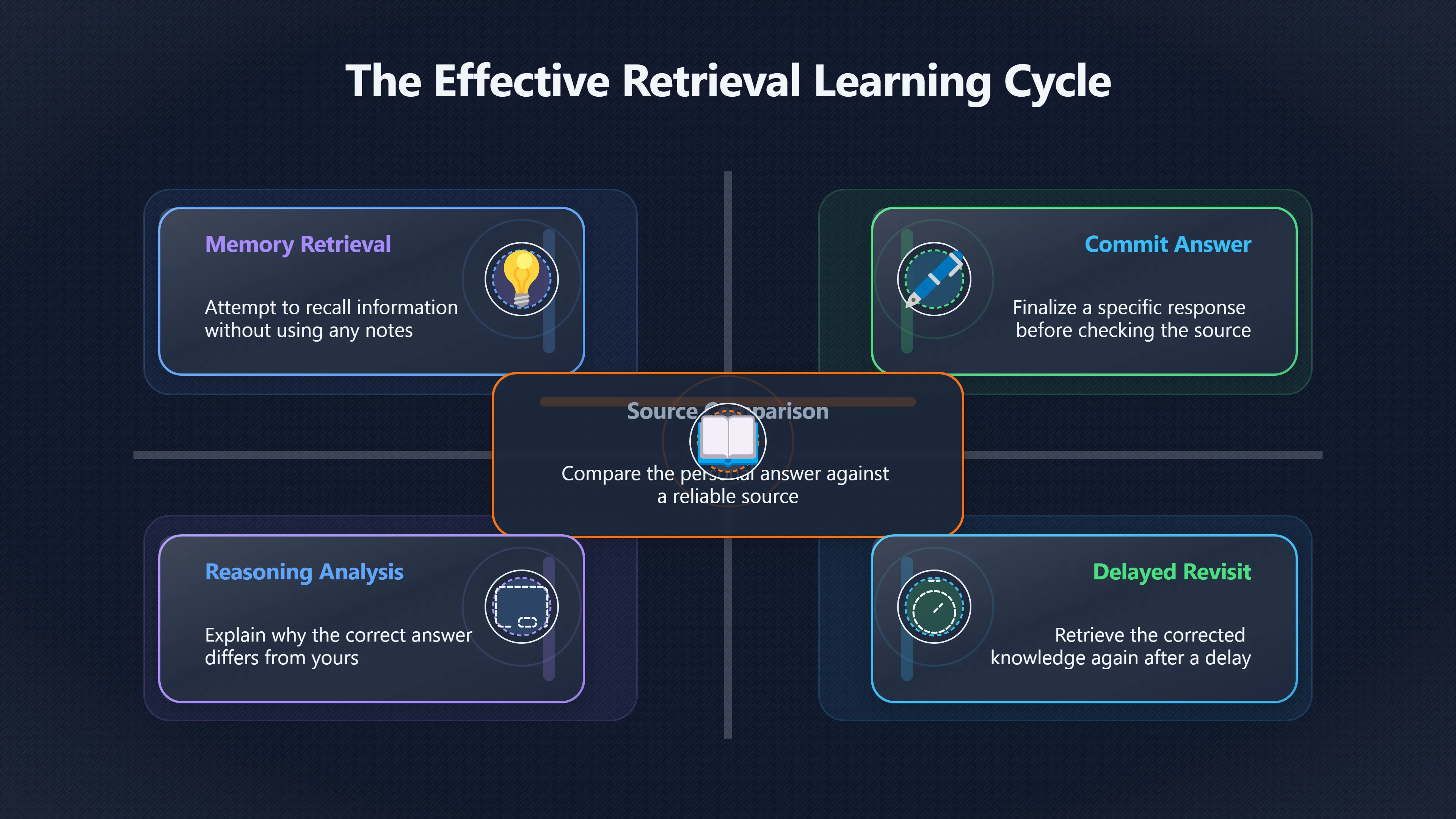
Practice testing only improves judgement if it closes the loop between an attempted answer and an accurate correction. Retrieving an answer from memory exposes what you genuinely know, but feedback determines whether that retrieval strengthens correct understanding or reinforces an error. The most effective learning cycle is therefore not simply test yourself, but test, compare, correct, and revisit. When done well, every wrong answer becomes diagnostic evidence: it reveals the precise misconception, overconfidence, or missing connection that needs attention. Research on retrieval practice consistently shows that corrective feedback strengthens the long-term benefits of testing while reducing the risk that learners retain false information or misplaced confidence.[PsychNet+2PubMed]psychnet.wustl.eduRoediger Butler 2011 TCSAlthough retrieval practice promotes superior long-term retention in the absence of feedback (Figure 1), providing the…Read more…
 For improving thinking and analytical skills, this matters because good judgement depends not only on remembering facts but also on recognising when your reasoning has failed. Feedback transforms errors from signs of failure into opportunities to refine the mental models that guide future decisions.
What a failed retrieval reveals
A failed retrieval is informative in several different ways, and each type of failure calls for a different response.
The simplest failure is forgetting. You cannot recall a definition, principle, or example that you believed you knew. This indicates that the memory trace is weak or insufficiently practised.
A more valuable failure is the confident mistake. Here, you retrieve an answer quickly and with certainty, yet it is wrong. This exposes a misconception rather than mere forgetting. Because the incorrect idea is already well established, passive rereading may never reveal the problem. Only comparing your answer against reliable feedback exposes the gap between confidence and correctness. Research on retrieval practice shows that feedback is particularly important when learners generate incorrect responses, because it helps replace rather than reinforce those errors.[PsychNet+2PMC]psychnet.wustl.eduRoediger Butler 2011 TCSAlthough retrieval practice promotes superior long-term retention in the absence of feedback (Figure 1), providing the…Read more…
A third failure is incomplete reasoning. You may remember isolated facts but fail to connect them into a coherent explanation or apply them to a new situation. For analytical thinking, this is often the most important signal. The issue is not missing information but an incomplete mental model.
Rather than treating all wrong answers as equal, effective learners ask:
- Was the mistake caused by forgetting?
- Did I misunderstand the concept?
- Did I apply the right idea in the wrong situation?
- Was I overconfident about weak knowledge?
Those questions shift attention from simply correcting answers to improving judgement.
Why feedback matters more than another guess
Retrieval itself strengthens learning, but feedback determines whether that strengthening points in the right direction.
Without feedback, repeated self-testing can sometimes preserve incorrect beliefs, especially when an error is recalled repeatedly with high confidence. Corrective feedback interrupts this cycle by replacing inaccurate retrieval with the correct representation before the mistake becomes more deeply embedded. Reviews of the testing effect consistently conclude that retrieval practice remains effective on its own but becomes even more beneficial when accurate feedback is added.[PsychNet+2PubMed]psychnet.wustl.eduRoediger Butler 2011 TCSAlthough retrieval practice promotes superior long-term retention in the absence of feedback (Figure 1), providing the…Read more…
Feedback also improves metacognition—the ability to judge what you actually know. Studies of classroom practice tests have found that learners receiving corrective feedback not only performed better but also developed more accurate judgements about their own level of understanding. In other words, feedback improves both knowledge and self-awareness.[ResearchGate]researchgate.netResearch Gate(PDF) Testing pays off twice: Potentials of practice testsTwo studies investigated the testing effects on performance and on metacognitive judgment accuracy in authentic learning settings.Read more…
This distinction matters because analytical mistakes often begin with inaccurate self-assessment rather than missing information. People rarely investigate assumptions they believe are already correct.
When feedback should happen
The best timing depends on the goal, but for most independent learners, feedback should follow soon after the retrieval attempt.
Immediate correction prevents incorrect answers from becoming familiar through repetition and allows the learner to compare their own reasoning with the correct explanation while the original thought process is still accessible. This comparison helps identify why the mistake occurred rather than simply replacing one answer with another. Research across laboratory and classroom settings generally finds positive effects from incorporating feedback into retrieval practice, although the exact timing can vary depending on task complexity and learning goals.[Nature+2Perspectives on Medical Education]nature.comTiming of feedback and retrieval practice: a laboratory…by S Aljabri · 2024 · Cited by 6 — The majority of previous studies have…
However, “immediate” should not mean interrupting retrieval before genuine effort. Looking up the answer after only a few seconds removes the desirable difficulty that makes retrieval effective. Productive learning requires attempting the answer first, then checking.
A practical sequence is:
- Retrieve from memory without notes.
- Commit to an answer before checking.
- Compare against a reliable source.
- Explain why the correct answer differs from yours.
- Return to the same question after a delay.
The final step is essential because corrected knowledge is strongest when it is retrieved again later rather than merely reread.
Correct the reasoning, not only the answer
The fastest way to waste feedback is to replace a wrong answer without examining the reasoning that produced it.
Suppose someone incorrectly concludes that two events are causally related simply because they occurred together. Writing down the correct answer—”correlation does not imply causation“—addresses the symptom but not the underlying habit of reasoning.
A more useful correction asks:
- Which assumption led me astray?
- Which evidence did I ignore?
- Which alternative explanation should I have considered?
- What cue should alert me to this mistake next time?
This turns feedback into a change in decision-making rather than a change in memory alone.
Research on explanatory feedback supports this distinction. Feedback that explains why an answer is correct often produces better transfer to new problems than feedback consisting only of the correct answer, particularly when learners must apply concepts rather than memorise facts.[PDF Retrieval Practice]pdf.retrievalpractice.orgC., Karpicke, J. D., & Roediger, H. L., III. (2008). Correcting a meta-cognitive error: Feedback enhances retention of low confidence cor…
How to correct without overloading review time
Review sessions become inefficient when every mistake receives equal attention. A simple triage approach makes feedback more useful.
Correct immediately: factual errors, incorrect definitions, or computational mistakes that have clear right answers.
Investigate briefly: mistakes caused by flawed reasoning, missing assumptions, or poor interpretation. These deserve a few minutes of reflection because they are more likely to recur.
Retest later: once corrected, place the question back into future retrieval practice instead of assuming it has been learned.
Keeping a short error log can also help. Rather than recording every incorrect answer, record recurring patterns, such as:
- “I ignore base rates.”
- “I confuse evidence with opinion.”
- “I stop checking alternative explanations once I find one plausible answer.”
- “I answer too quickly when a question feels familiar.”
These patterns often reveal stable thinking habits that influence many future decisions.
Why wrong answers often become the most valuable learning moments
Correct answers confirm what already works. Wrong answers reveal what needs rebuilding.
The benefit does not come from making mistakes alone. Errors become valuable only when they are followed by accurate feedback, reflection on the underlying reasoning, and another opportunity to retrieve the corrected knowledge. This cycle explains why difficult self-testing frequently produces stronger long-term understanding than comfortable review. The temporary discomfort of discovering an error becomes the mechanism through which judgement becomes more accurate, confidence becomes better calibrated, and analytical thinking grows more reliable over time.[waddesdonschool.com+2bjorklab.psych.ucla.edu]waddesdonschool.comn general, learners feel they are learning less well when faced with desirable difficulties, how…
Amazon book picks
Further Reading
Books and field guides related to Why Wrong Answers Make Better Thinkers. Use these as the next step if you want deeper reading beyond the article.
eBay marketplace picks
Marketplace Samples
Live-tested eBay searches with available results related to this page.




Endnotes
1.
Source: pmc.ncbi.nlm.nih.gov
Link:https://pmc.ncbi.nlm.nih.gov/articles/PMC9293038/
Source snippet
of feedback type on enhancing subsequent memoryby L Wang · 2021 · Cited by 8 — Compared to the condition of no feedback, giving feedback...
2.
Source: researchgate.net
Link:https://www.researchgate.net/publication/5359941_Feedback_enhances_the_positive_effects_and_reduces_the_negative_effect_of_multiple-choice_testing
Source snippet
(PDF) Feedback enhances the positive effects and reduces...The present research investigated whether feedback could be used to boost the...
3.
Source: researchgate.net
Title: Research Gate(PDF) Testing pays off twice: Potentials of practice tests
Link:https://www.researchgate.net/publication/359335875_Testing_pays_off_twice_Potentials_of_practice_tests_and_feedback_regarding_exam_performance_and_judgment_accuracy
Source snippet
Two studies investigated the testing effects on performance and on metacognitive judgment accuracy in authentic learning settings.Read more...
4.
Source: nature.com
Link:https://www.nature.com/articles/s41599-024-03983-6
Source snippet
Timing of feedback and retrieval practice: a laboratory...by S Aljabri · 2024 · Cited by 6 — The majority of previous studies have...
5.
Source: pmc.ncbi.nlm.nih.gov
Link:https://pmc.ncbi.nlm.nih.gov/articles/PMC5183614/
Source snippet
Testing Effect and Far Transfer: The Role of Exposure to...by GG van Eersel · 2016 · Cited by 32 — Butler (2010: Experiment 3) showed th...
6.
Source: waddesdonschool.com
Link:https://www.waddesdonschool.com/wp-content/uploads/2021/02/Desriable-Difficulties-in-theory-and-practice-Bjork-Bjork-2020.pdf
Source snippet
n general, learners feel they are learning less well when faced with desirable difficulties, how...
7.
Source: bjorklab.psych.ucla.edu
Title: EBjork RBjork 2011
Link:https://bjorklab.psych.ucla.edu/wp-content/uploads/sites/13/2016/04/EBjork_RBjork_2011.pdf
Source snippet
Creating Desirable Difficulties to Enhance Learningby EL Bjork · Cited by 2226 — Bjork: My interests in optimizing learning were triggere...
8.
Source: researchgate.net
Link:https://www.researchgate.net/publication/284097727_Making_things_hard_on_yourself_but_in_a_good_way_Creating_desirable_difficulties_to_enhance_learning
Source snippet
(PDF) Making things hard on yourself, but in a good wayBjork and Bjork (2011) argued that some learning conditions that slow immediate pe...
9.
Source: researchgate.net
Link:https://www.researchgate.net/publication/5246898_Correcting_a_Metacognitive_Error_Feedback_Increases_Retention_of_Low-Confidence_Correct_Responses
Source snippet
ck serves to correct this initial metacognitive error, enhancing retention.Read more...
10.
Source: researchgate.net
Title: 347931447 Desirable Difficulties in Theory and Practice
Link:https://www.researchgate.net/publication/347931447_Desirable_Difficulties_in_Theory_and_Practice
Source snippet
(PDF) Desirable Difficulties in Theory and Practice3 Jan 2021 — Rationale: Learning is most effective when it involves "desirable difficu...
11.
Source: researchgate.net
Link:https://www.researchgate.net/publication/5574966_The_Critical_Importance_of_Retrieval_for_Learning
Source snippet
(PDF) The Critical Importance of Retrieval for LearningClassroombased research has demonstrated that retrieval practice following lecture...
12.
Source: researchgate.net
Link:https://www.researchgate.net/publication/47448936_The_critical_role_of_retrieval_practice_in_long-term_retention
Source snippet
The critical role of retrieval practice in long-term retentionAccording to Roediger and Butler [51], retrieval practice such as recallin...
13.
Source: researchgate.net
Link:https://www.researchgate.net/publication/399606964Why_Desirable_Difficulties%27Work%27_A_Review_of_the_Evidence_From_Cognitive_and_Educational_Psychology_and_Some_Caveats_for_the_Health_Professions_Education_Field
Source snippet
Why Desirable Difficulties 'Work': A Review of the Evidence...Jan 9, 2026 — Aim In this paper, I review the evidence from the cognitive...
14.
Source: bjorklab.psych.ucla.edu
Link:https://bjorklab.psych.ucla.edu/research/
Source snippet
(1994) dubbed these difficult but effective training conditions desirable difficulties. Other examples of desirable difficulties varying...
15.
Source: psychnet.wustl.edu
Title: Roediger Butler 2011 TCS
Link:https://psychnet.wustl.edu/memory/wp-content/uploads/2018/04/Roediger-Butler-2011_TCS.pdf
Source snippet
Although retrieval practice promotes superior long-term retention in the absence of feedback (Figure 1), providing the...Read more...
16.
Source: pubmed.ncbi.nlm.nih.gov
Link:https://pubmed.ncbi.nlm.nih.gov/20951630/
Source snippet
critical role of retrieval practice in long-term retentionby HL Roediger 3rd · 2011 · Cited by 2726 — Retrieval practice is actually a po...
17.
Source: pmejournal.org
Link:https://pmejournal.org/articles/10.1007/S40037-020-00606-Z
Source snippet
Perspectives on Medical EducationMore effective feedback for formative multiple-choice testsby A Ryan · 2020 · Cited by 35 — This study i...
18.
Source: pdf.retrievalpractice.org
Link:https://pdf.retrievalpractice.org/transfer/Butler_etal_2013.pdf
Source snippet
C., Karpicke, J. D., & Roediger, H. L., III. (2008). Correcting a meta-cognitive error: Feedback enhances retention of low confidence cor...
19.
Source: dictionary.cambridge.org
Link:https://dictionary.cambridge.org/dictionary/english/retrieval
Source snippet
English meaning - Cambridge Dictionarythe process of finding and bringing back something: the storage and retrieval of information. The...
20.
Source: dictionary.cambridge.org
Link:https://dictionary.cambridge.org/dictionary/english/feedback
Source snippet
English meaning - Cambridge Dictionary3 days ago — information about something such as a new product or someone's work, that provides a...
21.
Source: Wikipedia
Title: Desirable difficulty
Link:https://en.wikipedia.org/wiki/Desirable_difficulty
Source snippet
Desirable difficultyA desirable difficulty is a learning task that requires a considerable but desirable amount of effort, thereby imp...
22.
Source: cirl.etoncollege.com
Title: desirable difficulties
Link:https://cirl.etoncollege.com/desirable-difficulties/
Source snippet
Difficulties - CIRL - Eton College1 Dec 2020 — Spaced practice and interleaving support this process: 'when you let the memory recede a l...
Additional References
23.
Source: davidsondavie.edu
Link:https://www.davidsondavie.edu/desirable-difficulty/
Source snippet
Desirable DifficultyRetrieval Practice – This is the practice of having students recall previously learned content on a regular basis. By...
24.
Source: merriam-webster.com
Link:https://www.merriam-webster.com/dictionary/feedback
Source snippet
FEEDBACK Definition & Meaning6 days ago — The meaning of FEEDBACK is the transmission of evaluative or corrective information about an ac...
25.
Source: medium.com
Link:https://medium.com/age-of-awareness/a-deep-dive-into-desirable-difficulties-41dbd17e9b9e
26.
Source: kirschnered.nl
Link:https://www.kirschnered.nl/2025/01/02/desirable-difficulties-and-cognitive-load-three-authors-solve-a-non-existent-problem/
Source snippet
Bjork[4], suggests that creating certain types of difficulty during learning can enhance long-term memory. It emphasises that tasks...Re...
27.
Source: mike-taylor.org
Link:https://mike-taylor.org/2025/12/01/the-testing-effect-why-retrieval-practice-is-your-most-powerful-learning-tool/
Source snippet
It exposes the gap between what you think you know and what you can actually recall. This is a metacognitive...Read more...
28.
Source: ssoar.info
Title: ssoar frontpsychol 2021 ruth et al The Effects of Different Feedback
Link:https://www.ssoar.info/ssoar/bitstream/document/85357/1/ssoar-frontpsychol-2021-ruth_et_al-The_Effects_of_Different_Feedback.pdf
Source snippet
The Effects of Different Feedback Types on Learning With...31 May 2021 — In two experimental studies, we examined the effects of two fee...
Published: May 2021
29.
Source: studocu.com
Link:https://www.studocu.com/ja/document/poole-gakuin-university/psychology/critical-role-of-retrieval-practice-in-retention/33101964
Source snippet
tter recall than did immediate feedback (given after each question was answered).Read more...
30.
Source: academia.edu
Link:https://www.academia.edu/83864006/Correcting_a_metacognitive_error_Feedback_increases_retention_of_low_confidence_correct_responses
Source snippet
feedback serves to correct this initial metacognitive error, enhancing...Read more...
31.
Source: structural-learning.com
Link:https://www.structural-learning.com/post/desirable-difficulties
Source snippet
rieval practice, generation, and elaboration, into one powerful...
32.
Source: formative-action.com
Title: desirable difficulties no pain no gain
Link:https://formative-action.com/desirable-difficulties-no-pain-no-gain/
Source snippet
No pain, no gain – on desirable difficulties13 May 2024 — Desirable difficulties are learning techniques that are not necessarily comfort...
Published: May 2024
Topic Tree