Within Weakest Link
Why Supportive Evidence Can Hide the Weakest Link
Confirmation bias makes friendly assumptions feel obvious while objections are held to a stricter standard.
On this page
- Selective standards in evaluating evidence
- Support checks versus break checks
- How mixed evidence can harden prior beliefs
Page outline Jump by section
Introduction
Confirmation bias does not merely make people notice evidence that supports their conclusions. It also changes how they judge evidence. Supportive information is often accepted with relatively little scrutiny, while contradictory information is examined for flaws, alternative explanations or methodological weaknesses. The result is that the weakest premise in an argument can remain almost invisible because it is protected by unequal standards of evaluation rather than by strong evidence. [Sage Journals]journals.sagepub.comOpen source on sagepub.com.
 Within weakest-link thinking, this matters because a conclusion often depends on one critical assumption. If confirmation bias shields that assumption from serious testing, an otherwise careful thinker may spend time strengthening already-solid parts of an argument while leaving its most fragile component untouched.
Selective standards in evaluating evidence
The defining feature is not simply favouring agreeable information. It is applying different standards depending on whether evidence supports or threatens an existing conclusion.
A person may ask of supportive evidence:
- “Does this generally fit what I expected?”
- “Is this another reason to believe the conclusion?”
Yet ask of contradictory evidence:
- “Was the sample large enough?”
- “Could there be another explanation?”
- “Are these researchers trustworthy?”
- “Does this really apply to this situation?”
These critical questions are legitimate. The problem arises when they are asked only of inconvenient evidence. The preferred conclusion is effectively given a lower burden of proof than competing explanations. Raymond Nickerson’s influential review describes confirmation bias as encompassing both the search for evidence and its interpretation in ways that favour existing beliefs. [Sage Journals]journals.sagepub.comOpen source on sagepub.com.
This asymmetry can hide the weakest premise because the premise never faces the same level of examination as competing claims.
Support checks versus break checks
Weakest-link thinking distinguishes between two different styles of testing.
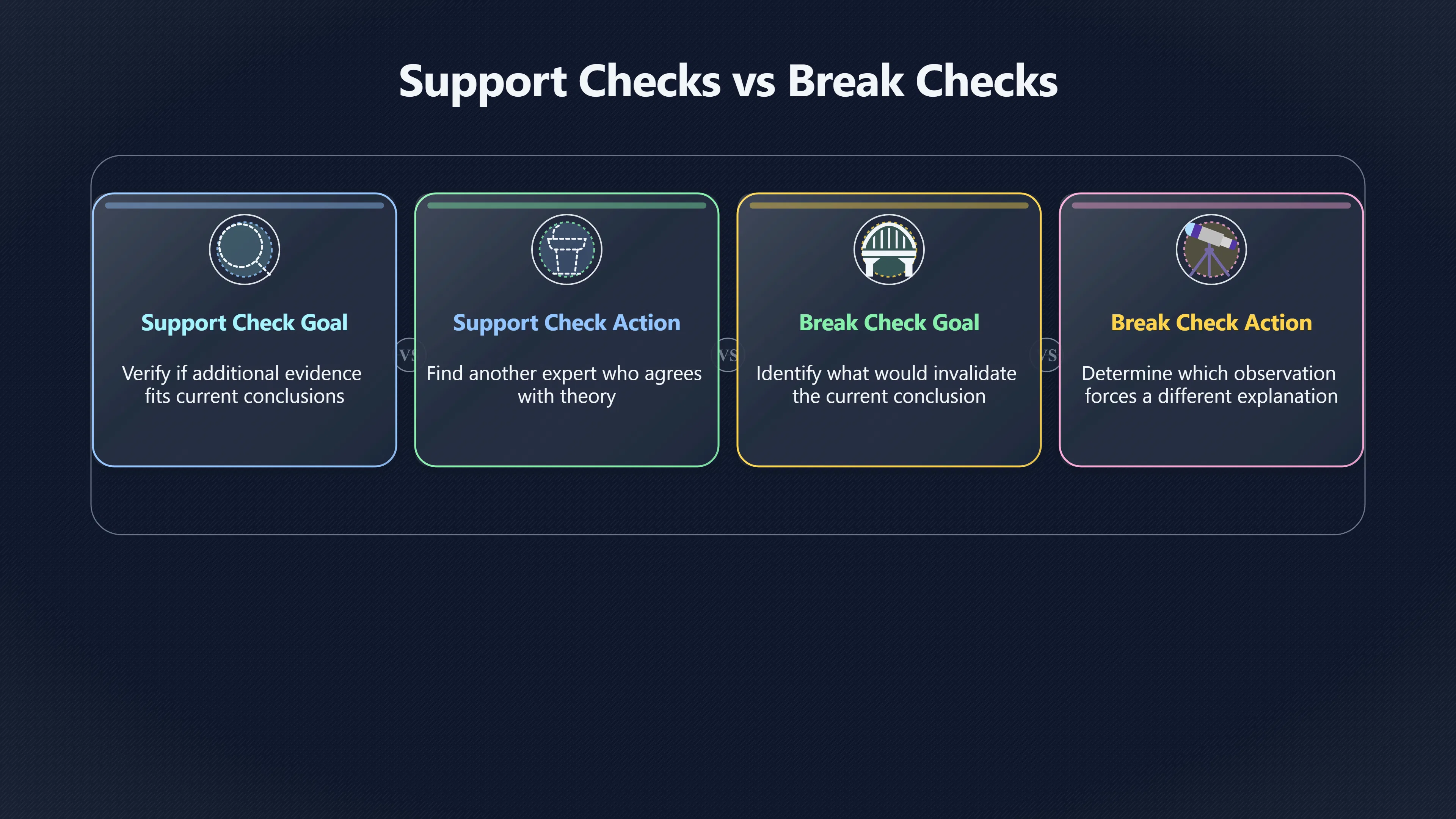
Support checks ask whether additional evidence is consistent with the current conclusion.
Examples include:
- finding another example that fits the theory;
- locating another expert who agrees;
- identifying another successful case.
These activities can strengthen confidence, but they rarely identify the assumption most likely to fail.
Break checks ask what would invalidate the conclusion.
Typical questions include:
- Which assumption would overturn the conclusion if false?
- What evidence would genuinely surprise me?
- Which observation would force a different explanation?
- If my preferred interpretation were wrong, what would I expect to see instead?
Confirmation bias naturally favours support checks because they are psychologically comfortable. Break checks deliberately expose the argument’s weakest bridge rather than reinforcing its strongest pillars. This distinction reflects the broader scientific emphasis on testing whether hypotheses can survive attempts at falsification rather than merely collecting confirming examples. [Sage Journals]journals.sagepub.comOpen source on sagepub.com.
How mixed evidence can harden prior beliefs
One of the most striking demonstrations of this mechanism came from classic research by Charles G. Lord, Lee Ross and Mark R. Lepper.
Participants who strongly supported or opposed capital punishment read the same mixed body of research, containing evidence both for and against its deterrent effect. Rather than moving towards a common position, each group judged studies supporting its prior belief as more convincing while finding methodological flaws primarily in studies that challenged it. Many participants consequently became more confident in their original views after reading exactly the same evidence. [Frank Baumgartner]fbaum.unc.edujpsp 1979 Lord Ross LepperLepper, & Hubbard, 1975). Our thesis is that belief polarization will increase, rather than decrease or remain unchanged, when mixed or i…
The important lesson is not simply that people disagreed. It is that identical evidence was filtered through unequal standards of evaluation.
This illustrates how the weakest premise remains hidden:
- A preferred conclusion identifies which evidence feels trustworthy.
- Friendly evidence is accepted with relatively little resistance.
- Challenging evidence receives intensive criticism.
- The conclusion appears increasingly well supported.
- The central assumption escapes meaningful testing.
In other words, confidence grows without necessarily improving the quality of the underlying reasoning.
Why the weakest premise often feels obvious
Load-bearing assumptions frequently become psychologically invisible because they are treated as background facts instead of hypotheses.
For example:
- A business forecast assumes customer demand will remain stable.
- A hiring decision assumes interview performance predicts future work quality.
- A medical explanation assumes one diagnosis best accounts for all symptoms.
- A policy proposal assumes people’s behaviour will change in the intended direction.
Once these assumptions become part of a preferred story, confirmation bias encourages attention towards evidence that elaborates the story rather than evidence that questions its foundation.
Ironically, the more coherent the overall narrative becomes, the easier it is to overlook the single premise on which everything depends.
Recognising unequal scrutiny
Several warning signs suggest confirmation bias may be protecting the weakest premise: [Wikipedia]WikipediaConfirmation biasConfirmation biasConfirmation bias is the tendency to search for, interpret, favor and recall information in a way that confirms or su…
- You can list many supporting examples but struggle to identify what would falsify the conclusion.
- Objections are answered by raising methodological standards that were never applied to supporting evidence.
- New favourable evidence produces immediate confidence, while unfavourable evidence is dismissed as exceptional.
- Most discussion concerns defending the conclusion rather than examining its key assumptions.
- Confidence increases faster than the quality or independence of the supporting evidence.
None of these proves confirmation bias is operating, but together they indicate that an argument may be receiving uneven evaluation.
Practical ways to expose the hidden weak link
The goal is not to eliminate confirmation bias completely, which is unrealistic, but to compensate for it deliberately.
Useful techniques include:
- Reverse the burden of proof. Apply the same critical questions to evidence supporting your conclusion as you apply to evidence against it.
- Identify the indispensable assumption. Ask which single premise, if false, would most damage the conclusion.
- Search for diagnostic evidence. Prefer evidence capable of distinguishing between competing explanations rather than evidence compatible with many possibilities.
- Separate confidence from consistency. A coherent story is not necessarily a well-tested one.
- Perform a deliberate break check. Before strengthening your preferred argument further, spend time trying to discover how it could fail.
Research on active evidence sampling also suggests that people preferentially seek information confirming previous choices, but prompting them to consider alternatives or counterexamples can reduce this tendency and improve hypothesis testing. [PMC]pmc.ncbi.nlm.nih.govHumans actively sample evidence to support prior beliefs - PMCby P Kaanders · 2022 · Cited by 68 — Previous research has shown that pa…
Why this matters for weakest-link thinking
Weakest-link thinking is effective only if every premise is exposed to comparable scrutiny. Confirmation bias undermines that goal by quietly protecting the assumptions that matter most. Instead of revealing the fragile bridge supporting a conclusion, it reinforces confidence that the bridge must already be sound.
The practical discipline is therefore not to become more sceptical of everything, but to become equally demanding of the assumptions that favour your preferred conclusion as you are of those that threaten it. When supportive evidence and contradictory evidence must meet the same standards, the weakest premise becomes much easier to identify before it becomes the source of a costly mistake.
Amazon book picks
Further Reading
Books and field guides related to Why Supportive Evidence Can Hide the Weakest Link. Use these as the next step if you want deeper reading beyond the article.
The Scout Mindset
Focuses on testing beliefs fairly rather than defending existing conclusions.
Mistakes Were Made (but Not by Me)
Explains self-justification and confirmation processes that protect weak beliefs from scrutiny.
Super Thinking
Provides structured approaches for identifying weak assumptions and evaluating arguments.
The Demon-Haunted World
Rating: 4.5/5 from 43 Google Books ratings
Promotes skeptical evaluation of evidence and equal standards for competing claims.
eBay marketplace picks
Marketplace Samples
Live-tested eBay searches with available results related to this page.


Endnotes
-
Source: journals.sagepub.com
Link: https://journals.sagepub.com/doi/10.1037/1089-2680.2.2.175 -
Source: Wikipedia
Title: Confirmation bias
Link: https://en.wikipedia.org/wiki/Confirmation_biasSource snippet
Confirmation biasConfirmation bias is the tendency to search for, interpret, favor and recall information in a way that confirms or su...
-
Source: fbaum.unc.edu
Title: jpsp 1979 Lord Ross Lepper
Link: https://fbaum.unc.edu/teaching/articles/jpsp-1979-Lord-Ross-Lepper.pdfSource snippet
Lepper, & Hubbard, 1975). Our thesis is that belief polarization will increase, rather than decrease or remain unchanged, when mixed or i...
-
Source: pmc.ncbi.nlm.nih.gov
Link: https://pmc.ncbi.nlm.nih.gov/articles/PMC9038198/Source snippet
Humans actively sample evidence to support prior beliefs - PMCby P Kaanders · 2022 · Cited by 68 — Previous research has shown that pa...
-
Source: bvanudgeconsulting.com
Title: confirmation bias
Link: https://www.bvanudgeconsulting.com/bias-of-the-week/confirmation-bias/Source snippet
Lord, C. G., Ross, L., & Lepper, M. R. (1979). [Biased assimilation]({{ 'mixed-evidence-accf68/' | relative_url }}) and attitude polarization: The effects of prior theories on subseq...
-
Source: britannica.com
Title: confirmation bias
Link: https://www.britannica.com/science/confirmation-biasSource snippet
Definition, Examples, Psychology, & Facts11 Jun 2026 — Confirmation bias, people's tendency to process information by looking for, or int...
-
Source: reachlink.com
Title: confirmation bias
Link: https://www.reachlink.com/advice/general/confirmation-bias/Source snippet
Why You Only See What You Already...10 Apr 2026 — Confirmation bias operates invisibly, filtering information to protect your existing b...
-
Source: studocu.com
Title: jpsp 1979 lord ross lepper
Link: https://www.studocu.com/en-gb/document/university-college-london/introduction-to-psychology/jpsp-1979-lord-ross-lepper/21807450Source snippet
Prior Theories on Subsequently Considered Evidence. Charles G. Lord, Lee Ross, and Mark R. Lepper.Read more...
-
Source: www2.um.edu.uy
Title: um.edu.uy When do populations polarize?
Link: https://www2.um.edu.uy/fcee_papers/2018/when_do_populations_polarize_an_explanation.pdfSource snippet
An explanation.∗by JP Benoît · Cited by 10 — In Lord, Ross and Lepper's (1979) capital punishment experiment, subjects are presented...
-
Source: youtube.com
Link: https://www.youtube.com/watch?v=d2r7Bk1NlgUSource snippet
Confirmation Bias | Ethics Defined...
-
Source: youtube.com
Title: Confirmation Bias | Ethics Defined
Link: https://www.youtube.com/watch?v=7zoWTb3KP-kSource snippet
[Critical Thinking]({{ 'critical-skills/' | relative_url }}): Confirmation Bias and Building the Whole Picture - YouTube Critical Thinking: Confirmation Bias and Building the Whole...
Additional References
-
Source: populismstudies.org
Link: https://www.populismstudies.org/Vocabulary/confirmation-bias/Source snippet
Confirmation BiasA tendency to gather evidence that confirms preexisting expectations, typically by emphasizing or pursuing supporting ev...
-
Source: thedecisionlab.com
Link: https://thedecisionlab.com/biases/confirmation-biasSource snippet
Confirmation BiasConfirmation bias describes our underlying tendency to notice, focus on, and provide greater credence to evidence that f...
-
Source: catalogofbias.org
Link: https://catalogofbias.org/biases/confirmation-bias/Source snippet
Confirmation biasBackground. Confirmation bias occurs when an individual looks for and uses the information to support their own ideas or...
-
Source: researchgate.net
Title: 277479091 Reflections on Biased Assimilation and Belief Polarization
Link: https://www.researchgate.net/publication/277479091_Reflections_on_Biased_Assimilation_and_Belief_PolarizationSource snippet
Reflections on Biased Assimilation and Belief Polarization20 Sept 2012 — Where Taber and Lodge view belief polarization to indicate a "pa...
-
Source: researchgate.net
Title: 340798496 What Is the Function of Confirmation Bias
Link: https://www.researchgate.net/publication/340798496_What_Is_the_Function_of_Confirmation_BiasSource snippet
(PDF) What Is the Function of Confirmation Bias?20 May 2026 — Confirmation bias evolved because it helps us influence people and social s...
Published: May 2026
-
Source: charleskemp.com
Link: https://charleskemp.com/papers/jernck_beliefpolarizationisnotalwaysirrational.pdfSource snippet
fs both strengthen their beliefs after observing the same data.Read more...
-
Source: kilthub.cmu.edu
Title: Belief polarization is not always irrational
Link: https://kilthub.cmu.edu/articles/journal_contribution/Belief_polarization_is_not_always_irrational_/6613703Source snippet
polarization is not always irrational.Belief polarization occurs when 2 people with opposing prior beliefs both strengthen their beliefs...
-
Source: researchgate.net
Link: https://www.researchgate.net/publication/232555483_Biased_assimilation_and_attitude_polarization_The_effects_of_prior_theories_on_subsequently_considered_evidenceSource snippet
xamine relevant empirical evidence in a biased manner.Read more...
-
Source: phenomenalworld.org
Link: https://www.phenomenalworld.org/analysis/why-rational-people-polarize/Source snippet
r, Mark R., 1979. 'Biased assimilation and...Read more...
-
Source: mpra.ub.uni-muenchen.de
Title: de When do populations polarize?
Link: https://mpra.ub.uni-muenchen.de/86173/Source snippet
An explanation.27 Sept 2019 — For instance, Lord, Ross & Lepper presented subjects with the same mixed... Kemp (2014) "Belief polarizati...
Topic Tree