Within Decision Routines
What will this decision really cost?
Big choices look safer when the visible price is separated from time, stress, opportunity cost, reversal cost and who bears the downside.
On this page
- Visible costs versus delayed costs
- Opportunity cost and reversal cost
- Who carries the downside if it fails
Page outline Jump by section
Introduction
The biggest cost of a high-stakes decision is often not the price you approve on the day you make it. It is the collection of delayed costs that emerge later: months of staff time, mounting stress, foregone opportunities, expensive reversals, damaged relationships, or the burden shifted onto people who never approved the decision. A good cost check is therefore not an accounting exercise. It is a way of exposing losses that are real but easy to ignore before commitment.
 Research on behavioural decision-making repeatedly shows that people systematically underestimate future costs, overestimate their ability to deliver difficult plans, and continue investing in failing choices because they focus on what has already been spent rather than what remains to be gained.[GOV.UK+2PMC]assets.publishing.service.gov.ukUK A review of optimism bias, planning fallacy, sunk costreview of optimism bias, planning fallacy, sunk cost…July 12, 2017 — This literature review provides an overview of three common cogni… The purpose of a cost check is to make those hidden losses visible before they become unavoidable.
Visible costs versus delayed costs
Many decisions receive careful scrutiny for their immediate financial cost while receiving almost none for their long-term consequences. This creates a distorted comparison in which one option appears cheaper simply because many of its costs arrive later.
A useful cost check separates expenses into at least two categories.
- Visible costs: purchase price, contract value, salaries, equipment, legal fees or other expenses that appear in budgets immediately.
- Delayed costs: implementation time, training, maintenance, operational disruption, management attention, stress, technical debt, political friction, reputational damage and ongoing support.
The distinction matters because delayed costs frequently determine whether a decision succeeds. Large infrastructure projects, technology programmes and organisational change initiatives often exceed their original estimates because planners underestimate delivery complexity, risks and implementation effort while overestimating benefits. Studies of public projects consistently find cost overruns and benefit shortfalls to be common rather than exceptional, largely because of optimism bias and inaccurate forecasting.[arXiv+2arXiv]arxiv.orgThe Cost-Benefit Fallacy: Why Cost-Benefit Analysis Is Broken and How to Fix ItOctober 12, 2021…
A practical question is therefore:
If the purchase were free, what would still be expensive?
The answer often reveals the real constraint. A software platform may cost relatively little to licence but require years of migration work. A new strategy may need no capital investment yet consume hundreds of hours of executive attention. A career move may increase salary while imposing substantial commuting time or family disruption.
Opportunity cost and reversal cost
The most important costs are often the ones that never appear on an invoice.
Opportunity cost: what must be given up?
Every major commitment excludes alternatives. Time, capital and attention cannot be spent twice.
[Opportunity cost asks:(#endnote-6 "Endnote 6")]WikipediaOpportunity costOpportunity cost
- What worthwhile option becomes impossible if this proceeds?
- Which projects will receive less attention?
- What skills or relationships will not be developed?
- If resources become constrained, what will we stop doing?
This question is especially valuable because people naturally compare a proposal with doing nothing instead of comparing it with the best realistic alternative. Economics treats opportunity cost as the value of the next-best forgone option, not merely money spent.[Wikipedia]WikipediaOpportunity costOpportunity cost
For example:
- Hiring one senior specialist may prevent hiring two junior staff with broader capacity.
- Buying a house in one location may eliminate future career flexibility.
- Pursuing one major product launch may delay several smaller improvements with higher combined returns.
Ignoring opportunity cost makes almost every proposal appear more attractive than it really is.
Reversal cost: how expensive is it to change your mind?
Some decisions are easy to reverse. Others create lasting commitments.
A reversal-cost check asks:
- How difficult is it to undo this?
- What financial penalties exist?
- How much reputation would be lost?
- Would reversing require rebuilding trust?
- Would switching later be substantially more expensive than waiting now?
The more expensive reversal becomes, the stronger the case for slower initial commitment.
This explains why experienced organisations often favour staged implementation, pilot programmes and incremental commitments before making irreversible investments. A small early cost that preserves flexibility may be far cheaper than a large later correction.
Who carries the downside if it fails?
Hidden costs are frequently hidden because somebody else pays them.
Decision-makers may enjoy the benefits of approval while frontline staff absorb implementation pressure, customers experience service failures or future leaders inherit maintenance burdens.
A useful cost check therefore maps consequences by stakeholder rather than by accounting category.
Ask:
- Who loses time?
- Who experiences additional workload?
- Who bears financial losses?
- Who carries legal or regulatory exposure?
- Who faces reputational damage?
- Who must explain failure publicly?
This changes the discussion from “What does this cost?” to “Who actually pays?”
For example:
- A procurement decision that lowers purchasing costs may substantially increase maintenance work.
- A management restructuring that improves short-term financial metrics may increase burnout among remaining staff.
- A political commitment may produce immediate electoral gains while shifting long-term financial obligations to future administrations.
Costs distributed across many people often receive less attention than costs concentrated in one budget, even when the total burden is much larger.
Hidden losses that are easiest to miss
Several recurring categories deserve explicit checking because they are routinely underestimated.
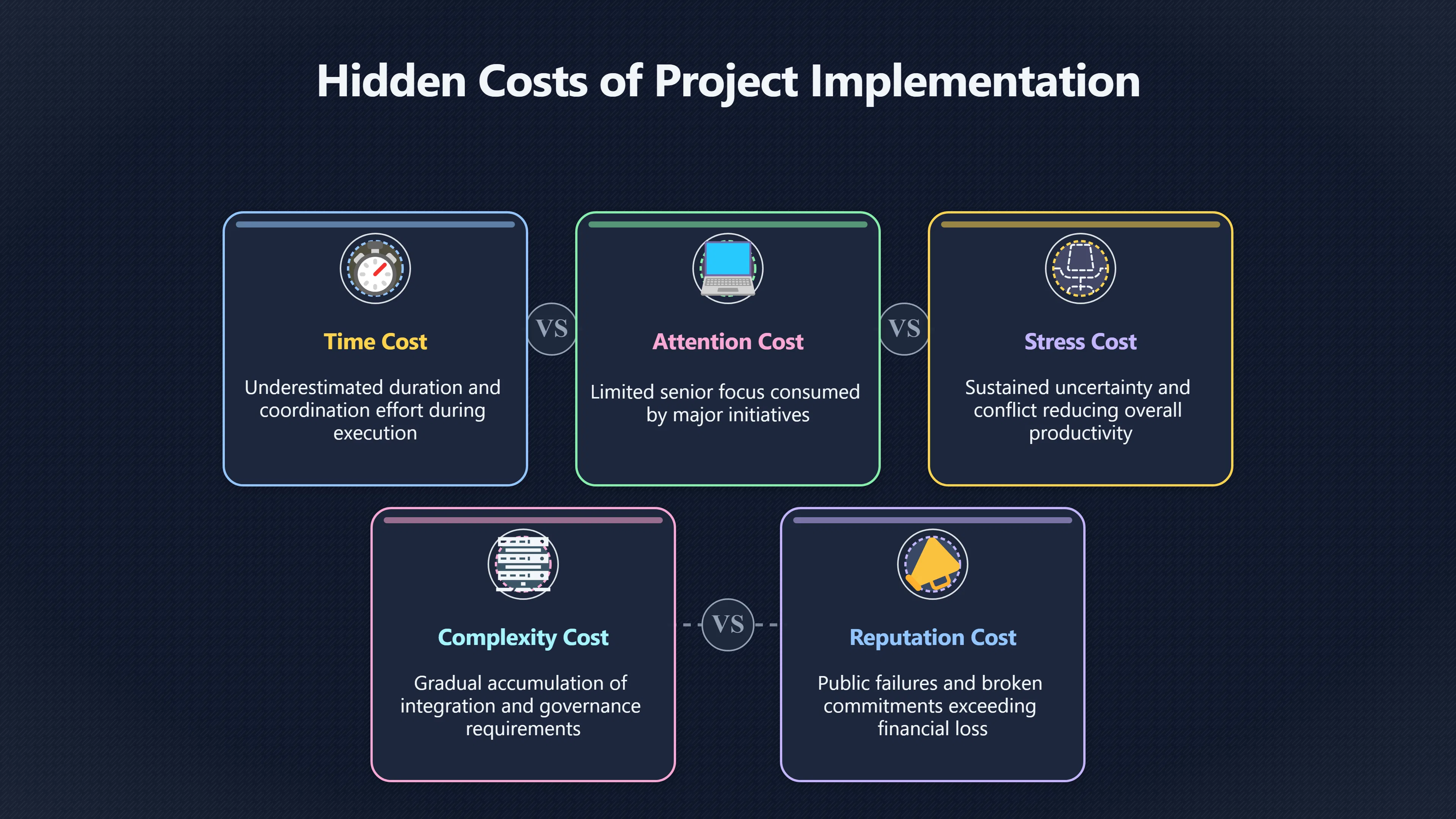
Time cost. People usually underestimate implementation duration, coordination effort and delays. The planning fallacy causes individuals and organisations to predict shorter completion times and lower delivery costs than experience justifies.[Wikipedia]WikipediaPlanning fallacyPlanning fallacy
Attention cost. Leadership attention is limited. A major initiative often succeeds or fails according to how much senior focus it consumes rather than its financial budget.
Stress cost. Decisions that appear economically efficient may create sustained uncertainty, conflict or overload that reduces productivity elsewhere.
Complexity cost. New systems often increase integration, maintenance and governance requirements that accumulate gradually.
Reputation cost. Public failures, customer dissatisfaction or broken commitments may create losses that far exceed the original financial investment.
These costs rarely disappear because they were omitted from the original business case.[pmc.ncbi.nlm.nih.gov]pmc.ncbi.nlm.nih.govPMCWhat Were They Thinking?Reducing Sunk-Cost Bias in a Life…by JN Strough · 2016 · Cited by 40 — We tested interventions to reduce “sunk-cost bias,” the tendenc…
The trap of sunk costs
One of the most damaging hidden decision losses occurs after commitment rather than before it.
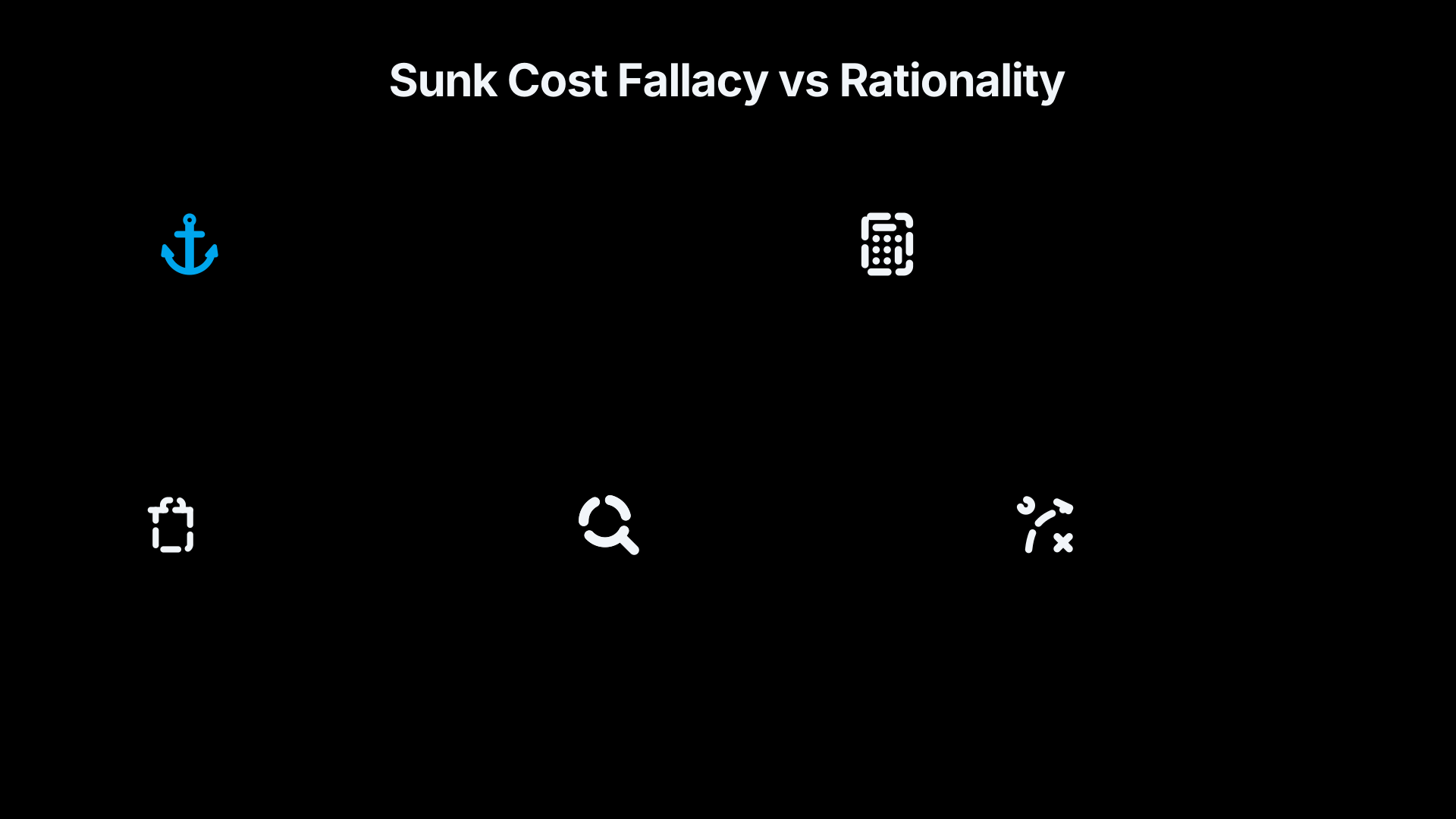
Once people have invested money, effort or reputation, they often continue investing because abandoning the project feels like admitting the original investment was wasted. Behavioural research calls this the sunk-cost fallacy or escalation of commitment. Instead of asking whether future investment still makes sense, people become influenced by irrecoverable past expenditure.[PMC+2The Decision Lab]pmc.ncbi.nlm.nih.govPMCWhat Were They Thinking?Reducing Sunk-Cost Bias in a Life…by JN Strough · 2016 · Cited by 40 — We tested interventions to reduce “sunk-cost bias,” the tendenc…
This bias can produce a second layer of hidden costs:
- additional spending on weak projects;
- lost opportunities because resources remain tied up;
- delayed recognition of failure;
- increased organisational disruption.
The critical question changes from:
“Have we already invested too much to stop?”
to:
“Knowing what we know today, would we begin this project now?”
If the answer is no, previous expenditure should not justify further commitment. That principle is central to economic decision-making and is supported by decades of behavioural research.[Wikipedia]WikipediaOpportunity costOpportunity cost
A practical cost check before committing
A short set of questions often reveals losses that conventional budgeting overlooks.
- What is the visible financial cost?
- What ongoing costs will appear after implementation?
- What valuable alternative will this prevent?
- How difficult and expensive would reversal be?
- Who carries the downside if expectations are wrong?
- If we had not already invested anything, would we still choose this option today?
None of these questions predicts the future perfectly. Their value lies in widening the frame before commitment. High-stakes decisions become safer not because every risk disappears, but because important costs are recognised while they are still choices rather than consequences.
Amazon book picks
Further Reading
Books and field guides related to What will this decision really cost?. Use these as the next step if you want deeper reading beyond the article.
Thinking in Bets
Helps readers separate decision quality from outcomes and think more clearly about downside, odds, and uncertainty.
Decisive
Covers hidden costs, narrow framing, opportunity costs, and reality-testing before irreversible commitments.
Predictably Irrational, Revised and Expanded Edition
Rating: 4.0/5 from 15 Google Books ratings
Explains how people misjudge costs, value, incentives, and trade-offs in ways that can distort major choices.
The Art of Thinking Clearly
Includes concise discussions of sunk cost, opportunity cost, overconfidence, and other traps behind hidden decision costs.
eBay marketplace picks
Marketplace Samples
Live-tested eBay searches with available results related to this page.


Endnotes
1.
Source: assets.publishing.service.gov.uk
Title: UK A review of optimism bias, planning fallacy, sunk cost
Link:https://assets.publishing.service.gov.uk/media/5a821602ed915d74e3401a64/lit-review-exploration-of-behavioural-biases.pdf
Source snippet
review of optimism bias, planning fallacy, sunk cost...July 12, 2017 — This literature review provides an overview of three common cogni...
Published: July 12, 2017
2.
Source: pmc.ncbi.nlm.nih.gov
Title: PMCWhat Were They Thinking?
Link:https://pmc.ncbi.nlm.nih.gov/articles/PMC5125514/
Source snippet
Reducing Sunk-Cost Bias in a Life...by JN Strough · 2016 · Cited by 40 — We tested interventions to reduce “sunk-cost bias,” the tendenc...
3.
Source: Wikipedia
Title: Planning fallacy
Link:https://en.wikipedia.org/wiki/Planning_fallacy
4.
Source: arxiv.org
Link:https://arxiv.org/abs/2112.03171
Source snippet
The Cost-Benefit Fallacy: Why Cost-Benefit Analysis Is Broken and How to Fix ItOctober 12, 2021...
Published: October 12, 2021
5.
Source: arxiv.org
Title: arXiv Planning Fallacy or Hiding Hand: Which Is the Better Explanation?
Link:https://arxiv.org/abs/1802.09999
6.
Source: Wikipedia
Title: Opportunity cost
Link:https://en.wikipedia.org/wiki/Opportunity_cost
7.
Source: Wikipedia
Title: Escalation of commitment
Link:https://en.wikipedia.org/wiki/Escalation_of_commitment
8.
Source: Wikipedia
Title: Sunk cost
Link:https://en.wikipedia.org/wiki/Sunk_cost
Source snippet
Sunk costIn economics and business decision-making, a sunk cost (also known as retrospective cost) is a cost that has already been inc...
9.
Source: thedecisionlab.com
Link:https://thedecisionlab.com/biases/the-sunk-cost-fallacy
Source snippet
The Sunk Cost FallacyThe sunk cost fallacy is our tendency to follow through with something that we've already invested heavily in (be it...
Additional References
10.
Source: facebook.com
Link:https://www.facebook.com/iamshjay/posts/caught-in-the-trap-of-[sunk-costs
Source snippet
Caught in the trap of sunk costs? Sunk-Cost FallacyThe sunk cost fallacy is a cognitive bias that influences decision-making, where indiv...
11.
Source: warwick.ac.uk
Link:https://warwick.ac.uk/fac/soc/economics/staff/dsgroi/evaluating_the_sunk_cost_effect.pdf
Source snippet
Evaluating the Sunk Cost EffectThe sunk cost effect is one of the most well-known biases in decision making. Our work ad- vances the iden...
12.
Source: researchgate.net
Link:https://www.researchgate.net/publication/364368242_Sunk_Cost_Bias_in_Decision_Making_Empirical_Evidence_on_Capital_Expenditure_in_Mergers_and_Acquisitions_Deals
Source snippet
Sunk Cost Bias in Decision Making: Empirical Evidence on...19 Oct 2022 — We do not find a standard sunk cost bias, but observe a robust...
13.
Source: youtube.com
Title: How Sunk Cost Bias & Behavior Finance Biases Sabotage Smart Decision Making
Link:https://www.youtube.com/watch?v=zGwEw8nR8CQ
Source snippet
Hidden costs decision making optimism bias cost overruns Execution Doesn’t Kill Projects. Early Decisions Do...
14.
Source: leadershipiq.com
Title: the sunk cost fallacy
Link:https://www.leadershipiq.com/blogs/leadershipiq/the-sunk-cost-fallacy
Source snippet
11 Dec 2025 — The fallacy lies in allowing irrecoverable past investments to influence decisions about future [outcomes]({{ 'outcomes/' | relative_url }}), when rational dec...
15.
Source: asana.com
Link:https://asana.com/resources/sunk-cost-fallacy
Source snippet
Sunk Cost Fallacy: Definition, Examples, How to Avoid [2025]The sunk cost fallacy is our tendency to continue with something we've invest...
16.
Source: youtube.com
Title: Sunk Cost Fallacy: Not Knowing When It’s Time to Stop
Link:https://www.youtube.com/watch?v=jJajz9n9Oi4
Source snippet
How Sunk Cost Bias & Behavior Finance Biases Sabotage Smart Decision Making...
17.
Source: youtube.com
Title: Execution Doesn’t Kill Projects. Early Decisions Do
Link:https://www.youtube.com/watch?v=TL-XWz3s9pg
Source snippet
Opportunity Cost: The Hidden Cost of Everything...
18.
Source: youtube.com
Title: How Big Things Get Done with Prof Bent Flyvbjerg
Link:https://www.youtube.com/watch?v=yUEycqrCuIY
Source snippet
Execution Doesn’t Kill Projects. Early Decisions Do...
19.
Source: youtube.com
Title: Opportunity Cost: The Hidden Cost of Everything
Link:https://www.youtube.com/watch?v=BQQ1HFobVPQ
Source snippet
Sunk Cost Fallacy: Not Knowing When It’s Time to Stop...
Topic Tree