Within Sharper Thinking
Can Critical Thinking Really Be Taught?
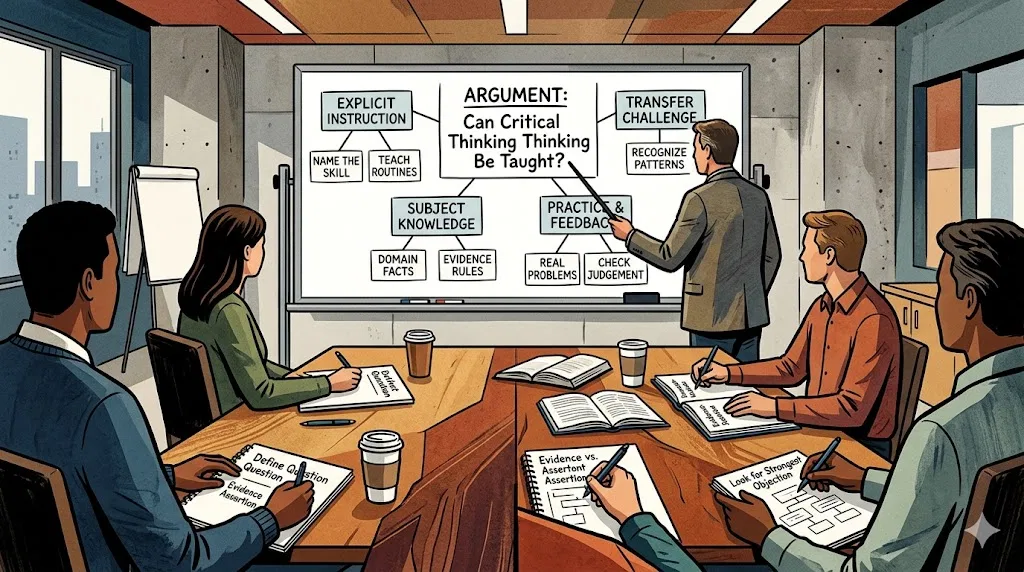
Critical thinking improves most when it is taught explicitly, practised repeatedly, and checked against real feedback.
On this page
- What critical thinking means in practice
- Why explicit instruction beats vague advice
- How to practise it outside school
Page outline Jump by section
Introduction
Critical thinking can be taught, but it does not transfer beyond school simply because someone has been told to “think critically”. The best evidence points to a more specific answer: people improve when critical thinking is named explicitly, practised on real problems, connected to subject knowledge, and checked against feedback. That matters because the adult uses of critical thinking are rarely exam-shaped. They include judging a health claim, comparing financial options, challenging a weak workplace proposal, reading political information carefully, or deciding whether a confident explanation is actually supported by evidence.
The transferable part is not a magic all-purpose mental muscle. It is a set of habits and routines: define the question, separate evidence from assertion, compare alternative explanations, look for the strongest objection, notice uncertainty, and revise when feedback shows the first judgement was wrong. Research on critical-thinking instruction is cautiously encouraging, but it also warns against vague “skills” programmes that are detached from knowledge and practice. Meta-analyses find positive effects from instruction, while cognitive-science accounts stress that transfer is hard unless learners are taught when and how to use the skill in new settings. [Sage Journals+2NSW Education]journals.sagepub.comFirst, the evidence on…Read more…
What critical thinking means in practice
Critical thinking is often described as if it were a personality trait: some people are “critical thinkers” and others are not. In practice, it is better understood as a disciplined way of handling claims, reasons and uncertainty. A widely used research definition describes it as purposeful, self-regulatory judgement involving interpretation, analysis, evaluation and inference, together with the ability to explain the reasoning behind a conclusion. [Sage Journals]journals.sagepub.comFirst, the evidence on…Read more…
That definition becomes more useful when translated into everyday actions. A person thinking critically about a claim does not merely ask, “Do I agree?” They ask:
- What exactly is being claimed? A precise claim is easier to test than a broad impression.
- What evidence would support or weaken it? This keeps judgement from becoming a search for confirmation.
- What else could explain the same facts? Many poor decisions come from comparing one favoured explanation with no alternative.
- How reliable is the source, method or measurement? Evidence is not all equal.
- What would change my mind? This makes confidence accountable.
- What happens if I am wrong? Practical judgement includes consequences, not just logic.
These moves are useful beyond school because they match the structure of real decisions. In a workplace meeting, critical thinking may mean asking whether a projected saving depends on unrealistic customer behaviour. In personal life, it may mean comparing a medical headline with the actual study design. In civic life, it may mean distinguishing a vivid anecdote from population-level evidence. The common thread is not the topic; it is the habit of making reasoning visible enough to inspect.
Why transfer is difficult, not automatic
The appealing myth is that critical thinking is like learning to ride a bicycle: once acquired, it can be used anywhere. The research picture is more complicated. Daniel Willingham’s review for the New South Wales Department of Education argues that transfer to new problems is “decidedly mixed” and that thinking processes are strongly intertwined with background knowledge. A student may learn how to evaluate an argument in newspaper editorials, but that does not guarantee they will evaluate a scientific paper, a budget forecast or a legal claim equally well. [NSW Education]education.nsw.gov.auNSW EducationHow to Teach Critical Thinkingby DT Willingham · Cited by 153 — This aspect of critical thinking is called transfer, and the…
The reason is simple but important: critical thinking needs material to think with. Someone cannot weigh competing explanations in climate science, mortgage terms or employment law without enough knowledge to recognise what counts as a meaningful fact, a dubious assumption or a relevant comparison. Generic prompts help, but they do not replace domain knowledge.
This does not mean transfer is impossible. It means transfer needs design. Diane Halpern’s influential model for teaching critical thinking across domains includes four parts: a disposition to engage in effortful thinking, explicit instruction in thinking skills, training in the structure of problems and arguments, and metacognitive monitoring, meaning checking one’s own progress and accuracy. [PubMed]pubmed.ncbi.nlm.nih.govPub Med Teaching Critical Thinking for Transfer Across Domainsby DF Halpern · 1998 · Cited by 3555 — Teaching Critical Thinking for Transfer Across Domains. Dispositions, Skills, Structure Training…
The practical lesson is that transferable critical thinking sits between two extremes. It is not a free-floating skill that works without knowledge, but it is also not locked inside one school subject. People can learn reusable reasoning patterns, especially when they practise recognising the same underlying structure across different contexts.

Why explicit instruction beats vague advice
“Think harder” is not a teaching method. Nor is “be sceptical”, if scepticism simply means doubting whatever feels unfamiliar. Critical thinking improves most reliably when learners are shown the move they are meant to make, see examples, practise it, and receive feedback on whether they used it well.
A major meta-analysis in the Review of Educational Research found that instructional interventions can improve critical-thinking skills and dispositions, with stronger results when critical thinking is taught explicitly rather than left implicit inside ordinary coursework. [Sage Journals]journals.sagepub.comFirst, the evidence on…Read more… Another study with economics students found that explicit critical-thinking instruction combined with practice was required to improve performance; implicit exposure and practice alone were not enough. [RePub]repub.eur.nlOpen source on eur.nl.
This evidence matters because many schools, universities and workplaces say they value critical thinking while teaching it indirectly. A course may assign essays, debates or projects and assume that the thinking skill will emerge. Sometimes it does. Often it does not, because learners may focus on producing the required answer rather than noticing the reasoning pattern they are supposed to transfer.
Explicit instruction makes the invisible move visible. For example, instead of asking students to “analyse this article”, a teacher or trainer can teach a repeatable routine:
- Identify the main claim.
- List the reasons offered for it.
- Separate direct evidence from interpretation.
- Name one plausible alternative explanation.
- Decide what additional evidence would matter most.
- State a confidence level and the reason for it.
The routine is not a substitute for knowledge. It is a scaffold. Over time, the scaffold should be used across enough topics that the learner starts to recognise when a new situation has the same reasoning structure.
The skills most likely to travel beyond school
Not every classroom exercise has equal value outside school. The most transferable critical-thinking skills are those that map onto common adult judgement problems: evidence quality, causal claims, trade-offs, uncertainty and self-correction.
Evaluating evidence. This is the ability to ask whether a claim rests on measurement, expert consensus, a controlled comparison, a single example, a sales pitch or hearsay. It is essential in health information, consumer choices, journalism, workplace data and public policy.
Distinguishing correlation from causation. Many real-world errors come from seeing two things move together and assuming one caused the other. A school science or statistics lesson becomes transferable when learners practise asking about comparison groups, confounders, base rates and alternative explanations.
Recognising argument structure. Arguments in school essays, board papers and opinion columns often share the same skeleton: claim, reason, evidence, assumption, conclusion. Training people to see that structure helps them respond to the reasoning rather than merely to the topic.
Calibrating confidence. Good thinkers are not always less confident; they are better at matching confidence to evidence. This includes saying “I do not know”, “this is plausible but weakly supported”, or “my conclusion depends on this assumption”.
Using metacognition. Metacognition means monitoring one’s own thinking. The Education Endowment Foundation’s guidance on metacognition and self-regulated learning emphasises that pupils benefit when teachers explicitly model planning, monitoring and evaluation rather than assuming learners already know how to manage their thinking. [EEF]educationendowmentfoundation.org.ukOpen source on educationendowmentfoundation.org.uk.
These skills transfer best when they are attached to realistic cues. A learner should not only know the phrase “alternative explanation”; they should recognise the moment when one is needed: a surprising trend, a persuasive anecdote, a confident recommendation, or a decision with high cost if wrong.
Feedback is what turns a thinking habit into a skill
Critical thinking is not improved by reflection alone. People need feedback that shows whether their judgement worked and why. Without feedback, a person can become more fluent in rational-sounding language while still making the same mistakes.
A useful example comes from physics education. Researchers redesigned an introductory physics laboratory course so that students repeatedly made quantitative comparisons between datasets and models, then received practice and feedback. Later, after the prompts had been removed, students in the experimental condition were far more likely than a control group to improve their experimental methods spontaneously and to identify limitations in a physical model using their data. The researchers also reported that these differences persisted into a later course. [arXiv]arxiv.orgarXiv Teaching Critical ThinkingarXiv Teaching Critical Thinking
The wider lesson is not that everyone needs physics labs. It is that transferable thinking improves when practice includes three ingredients:
- A real judgement. The learner must decide, not merely repeat.
- A visible standard. There must be a way to tell whether the reasoning was good.
- A feedback loop. The learner must compare their first judgement with evidence, expert modelling, peer critique or later outcomes.
Outside school, this can be built into ordinary life. A manager can keep a decision log and review which assumptions proved wrong. A patient comparing treatments can write down what evidence would change their mind before reading more. A citizen reading a policy claim can compare the headline with the underlying data source. The key is to make the test of reasoning external, not just internal.

How to practise critical thinking outside school
The best practice is not a generic brain-training game. It is repeated work on real claims and decisions, using a small set of routines until they become familiar.
Use a claim-evidence-alternative routine
For any important claim, write three short lines:
- Claim: What is being asserted?
- Evidence: What supports it, and how strong is that support?
- Alternative: What else might explain the same facts?
This routine works because it interrupts the common jump from “this sounds plausible” to “this is true”. It is especially useful for news stories, workplace proposals, online advice and personal decisions where the evidence is incomplete.
For example, a company might say a new software tool improved productivity by 20%. Critical thinking asks whether productivity was measured before and after, whether the same team was compared with a similar team not using the tool, whether other changes happened at the same time, and whether the improvement lasted. The point is not to reject the claim. It is to avoid accepting a causal story before the evidence can bear it.
Practise near transfer before expecting far transfer
Transfer is easier when the new situation resembles the old one. A person who learns to evaluate evidence in biology may transfer that skill more readily to health reporting than to financial forecasting. This is called near transfer. Far transfer, where a skill moves to a very different context, is harder and usually needs explicit comparison across examples. Willingham’s account of transfer stresses that teachers should identify the critical-thinking skill within a subject, ensure enough background knowledge, and revisit the skill across time and contexts. [NSW Education]education.nsw.gov.auNSW EducationHow to Teach Critical Thinkingby DT Willingham · Cited by 153 — This aspect of critical thinking is called transfer, and the…
A practical sequence is:
- Practise the skill in one familiar context.
- Practise it in a similar context.
- Compare the two examples and name the shared structure.
- Practise it in a less familiar context.
- Reflect on what changed and what stayed the same.
For instance, someone learning to detect weak causal claims might start with a simple classroom example, then a health headline, then a workplace performance claim, then a political argument. The transferable element becomes clearer when the examples are compared, not merely completed one after another.

Keep a decision record
A decision record is a simple way to train judgement outside formal education. Before making a meaningful decision, write down the question, the options, the evidence, the main assumption, the risk, and the confidence level. Later, review what happened.
This does two things. First, it prevents hindsight bias: the tendency to remember past judgement as more accurate than it was. Second, it improves calibration. Over time, people can see whether their “very likely” predictions really come true more often than their “maybe” predictions.
The record does not need to be elaborate. Its value lies in forcing a conclusion to become inspectable. A private feeling becomes a claim that can later be checked.
What schools, universities and employers should actually change
If the goal is transfer beyond school, the intervention should not be a one-off “critical thinking week”. It should be a designed sequence of explicit instruction, repeated application and feedback across subjects or workplace tasks.
For schools and universities, this means teaching both knowledge and thinking moves. A history course can teach sourcing, corroboration and contextualisation. A science course can teach uncertainty, measurement and model testing. A statistics course can teach base rates, sampling and causal inference. The common routines can be named across subjects so learners recognise the family resemblance between them.
For employers, it means building critical thinking into work processes rather than treating it as a workshop slogan. A project review can require teams to state assumptions, alternatives and disconfirming evidence. A hiring process can test how candidates handle ambiguous information, not only whether they have the right credential. The OECD has noted a growing shift towards skills-first labour markets, where competencies are increasingly used alongside or instead of traditional qualifications, but implementation remains challenging. [OECD]oecd.orgOpen source on oecd.org.
Adult-skill evidence also shows why this matters beyond formal education. The OECD’s 2023 Survey of Adult Skills assessed adults across literacy, numeracy and adaptive problem solving; its summary reports that, on average across participating OECD countries, 18% of adults lacked the most basic level of proficiency in any of the assessed domains. [OECD]oecd.orgdo adults have the skills they need to thrive in a changing world 4396f1f1do adults have the skills they need to thrive in a changing world 4396f1f1 Critical thinking is not identical to those measures, but it depends heavily on the same foundations: reading accurately, reasoning with numbers, adapting to new information and solving unfamiliar problems.
The policy implication is modest but important. Institutions should not promise instant “future-ready” thinking through generic activities. They should design repeated opportunities to interpret evidence, compare explanations, justify decisions and receive feedback in increasingly varied contexts.
The common mistakes that stop critical thinking from transferring
The first mistake is teaching critical thinking as a list of inspirational words: curiosity, creativity, resilience, independence. These qualities may matter, but they do not tell a learner what to do when faced with a misleading graph or a weak argument.
The second mistake is teaching it as pure scepticism. A critical thinker is not someone who doubts everything. Blanket doubt can become as lazy as blind acceptance. The better standard is proportionate belief: stronger confidence for stronger evidence, weaker confidence for weaker evidence, and active updating when new information arrives.
The third mistake is separating thinking from knowledge. A person cannot critically evaluate a subject they barely understand. They may still ask useful questions about source, evidence and uncertainty, but deep evaluation requires enough background to know what is normal, what is surprising and what expertise is relevant.
The fourth mistake is failing to assess transfer. A student may perform well when the teacher announces, “Now use critical thinking,” but fail to use the same skill when the cue disappears. Research on obstacles to critical-thinking transfer has examined whether learners fail because they do not recognise the opportunity, cannot recall the taught principle, or cannot apply it in the new case. That distinction matters: each failure needs a different fix. [Taylor & Francis Online]tandfonline.comOpen source on tandfonline.com.
A good programme therefore tests not only whether learners can use a skill immediately after instruction, but whether they notice when to use it later, in messier settings, without being prompted.
A realistic answer to “Can critical thinking really be taught?”
Yes, but only in the disciplined sense. Critical thinking is teachable when it is treated as a set of explicit, practised, feedback-rich reasoning habits supported by knowledge. It is not reliably taught by vague exhortation, isolated puzzles, or the hope that difficult assignments automatically produce better judgement.
The most useful transferable skills are practical: clarify the question, inspect the evidence, compare alternatives, identify assumptions, monitor confidence and learn from feedback. These skills travel beyond school when learners practise them across enough real contexts to recognise the same reasoning problem in a new disguise.
That is why the best answer is neither “critical thinking is fully general” nor “critical thinking cannot transfer at all”. The evidence supports a middle position: transfer is possible, valuable and worth teaching, but it has to be deliberately built.
Amazon book picks
Further Reading
Books and field guides related to Can Critical Thinking Really Be Taught?. Use these as the next step if you want deeper reading beyond the article.
The Demon-Haunted World
Rating: 4.5/5 from 43 Google Books ratings
Demonstrates practical critical thinking, evaluating evidence and questioning unsupported claims.
Critical Thinking
Focuses directly on developing and applying critical-thinking skills in everyday life.
Super Thinking
Introduces practical mental models that help readers evaluate problems, evidence and decisions more effectively.
How to Read a Book
Teaches disciplined reading, questioning and analysis that support transferable critical-thinking habits.
eBay marketplace picks
Marketplace Samples
Live-tested eBay searches with available results related to this page.




Endnotes
-
Source: educationendowmentfoundation.org.uk
Link: https://educationendowmentfoundation.org.uk/education-evidence/guidance-reports/metacognition -
Source: arxiv.org
Title: arXiv Teaching Critical Thinking
Link: https://arxiv.org/abs/1508.04870 -
Source: oecd.org
Link: https://www.oecd.org/en/publications/empowering-the-workforce-in-the-context-of-a-skills-first-approach_345b6528-en/full-report/skills-first-in-oecd-countries-concepts-trends-and-implications-for-the-labour-market_0d6ba66f.html -
Source: oecd.org
Title: do adults have the skills they need to thrive in a changing world 4396f1f1
Link: https://www.oecd.org/en/publications/2024/12/do-adults-have-the-skills-they-need-to-thrive-in-a-changing-world_4396f1f1.html -
Source: oecd.org
Link: https://www.oecd.org/en/about/projects/teaching-learning-and-assessing-creative-and-critical-thinking-skills.html -
Source: oecd.org
Link: https://www.oecd.org/en/publications/the-[assessment -
Source: oecd.org
Title: skills that matter for success and well being in adulthood 6e318286 en
Link: https://www.oecd.org/en/publications/skills-that-matter-for-success-and-well-being-in-adulthood_6e318286-en.html -
Source: oecd.org
Title: future of education and skills 2030
Link: https://www.oecd.org/en/about/projects/future-of-education-and-skills-2030.html -
Source: journals.sagepub.com
Link: https://journals.sagepub.com/doi/10.3102/0034654314551063Source snippet
First, the evidence on...Read more...
-
Source: education.nsw.gov.au
Link: https://education.nsw.gov.au/content/dam/main-education/teaching-and-learning/education-for-a-changing-world/media/documents/How-to-teach-critical-thinking-Willingham.pdfSource snippet
NSW EducationHow to Teach Critical Thinkingby DT Willingham · Cited by 153 — This aspect of critical thinking is called transfer, and the...
-
Source: pubmed.ncbi.nlm.nih.gov
Title: Pub Med Teaching Critical Thinking for Transfer Across Domains
Link: https://pubmed.ncbi.nlm.nih.gov/9572008/Source snippet
by DF Halpern · 1998 · Cited by 3555 — Teaching Critical Thinking for Transfer Across Domains. Dispositions, Skills, Structure Training...
-
Source: journals.sagepub.com
Link: https://journals.sagepub.com/doi/abs/10.3102/0034654308326084 -
Source: repub.eur.nl
Link: https://repub.eur.nl/pub/59456/ -
Source: tandfonline.com
Link: https://www.tandfonline.com/doi/full/10.1080/20445911.2021.1990302 -
Source: repub.eur.nl
Title: Cultivating critical thinking Anita Heijltjes
Link: https://repub.eur.nl/pub/50418/Cultivating-critical-thinking-Anita-Heijltjes.pdf -
Source: dspace.library.uu.nl
Link: https://dspace.library.uu.nl/server/api/core/bitstreams/999a2aae-6b7f-41f4-b568-70c7dba94b87/content -
Source: frontiersin.org
Link: https://www.frontiersin.org/journals/education/articles/10.3389/feduc.2026.1689765/full -
Source: frontiersin.org
Link: https://www.frontiersin.org/journals/education/articles/10.3389/feduc.2023.1141686/full -
Source: assets.publishing.service.gov.uk
Title: 21st century
Link: https://assets.publishing.service.gov.uk/media/5d71187ce5274a097c07b985/21st_century.pdf -
Source: structural-learning.com
Title: explicit instruction
Link: https://www.structural-learning.com/post/explicit-instruction -
Source: pmc.ncbi.nlm.nih.gov
Link: https://pmc.ncbi.nlm.nih.gov/articles/PMC10054602/ -
Source: pmc.ncbi.nlm.nih.gov
Link: https://pmc.ncbi.nlm.nih.gov/articles/PMC8476672/ -
Source: pmc.ncbi.nlm.nih.gov
Link: https://pmc.ncbi.nlm.nih.gov/articles/PMC8476665/ -
Source: pmc.ncbi.nlm.nih.gov
Link: https://pmc.ncbi.nlm.nih.gov/articles/PMC9004595/ -
Source: pmc.ncbi.nlm.nih.gov
Link: https://pmc.ncbi.nlm.nih.gov/articles/PMC12022541/ -
Source: education.vic.gov.au
Title: HIG H IMPACT TEACHING STRATEGIES
Link: https://www.education.vic.gov.au/Documents/school/teachers/management/highimpactteachingstrat.pdf -
Source: tandfonline.com
Link: https://www.tandfonline.com/doi/full/10.1080/03323315.2023.2258497
Additional References
-
Source: people.bath.ac.uk
Link: https://people.bath.ac.uk/edspd/Weblinks/MA_ULL/Resources/Learning%20to%20Learn/Willingham%202008%20AEPR.pdfSource snippet
University of Bath Personal HomepagesCritical Thinking: Why Is It So Hard to Teach?7 Aug 2010 — Research from cognitive science shows tha...
-
Source: youtube.com
Title: Encourage critical thinking with 3 questions | Brian Oshiro | TEDx Xiguan
Link: https://www.youtube.com/watch?v=0hoE8mtUS1ESource snippet
5 Essential Critical Thinking Skills For Making Good Decisions...
-
Source: youtube.com
Title: 5 tips to improve your critical thinking
Link: https://www.youtube.com/watch?v=MGq7fvQzzz4Source snippet
This tool will help improve your critical thinking - Erick Wilberding...
-
Source: academia.edu
Link: https://www.academia.edu/102389093/Transfer_of_Critical_Thinking_Skills_Across_Domains_Implicit_or_Explicit_Instructional_Approaches -
Source: researchgate.net
Link: https://www.researchgate.net/publication/249797930_Instructional_Interventions_Affecting_Critical_Thinking_Skills_and_Dispositions_A_Stage_1_Meta-Analysis -
Source: scirp.org
Link: https://www.scirp.org/reference/referencespapers?referenceid=2778998 -
Source: aft.org
Link: https://www.aft.org/ae/fall2020/willingham -
Source: winchester.ac.uk
Link: https://www.winchester.ac.uk/research/Our-impactful-research/Research-in-Education-and-the-Arts/Research-projects/Building-Creative-and-Critical-Thinking-Skills-in-Higher-Education-Project/ -
Source: facebook.com
Link: https://www.facebook.com/groups/48984828263/posts/10155048174808264/ -
Source: instagram.com
Link: https://www.instagram.com/estherabrami/?hl=en
Topic Tree