Within Decision Journal
What did you choose against?
Recording the options not chosen prevents a later comparison between the real outcome and an imaginary perfect path.
On this page
- Why rejected options belong in the entry
- How alternatives improve later comparison
- Common review mistakes when options are missing
Page outline Jump by section
Introduction
A decision journal is most useful when it records not only what you chose, but also what you deliberately chose against. Listing the rejected alternatives anchors a decision in the realistic set of options that actually existed at the time. Without that record, later reviews easily drift into comparing reality with an imaginary “perfect” option that was never seriously available, creating unfair self-criticism or misplaced confidence. Recording rejected alternatives helps preserve the original decision context, reduces hindsight distortion, and makes it possible to judge whether the reasoning was sound rather than whether fortune happened to be favourable. Research on hindsight bias and outcome bias consistently shows that knowledge of the result changes how people remember both the options and the quality of the decision process. [PubMed+2The Decision Lab]pubmed.ncbi.nlm.nih.govHindsight bias, outcome knowledge and adaptive learningby K Henriksen · 2003 · Cited by 279 — This paper examines the influence of…
What did you choose against?
Every meaningful decision is a comparison, not an isolated choice. Accepting one job usually means declining another. Launching one product feature means postponing others. Investing in one project means tying up resources that cannot be spent elsewhere.
Months later, memory often compresses this comparison into a much simpler story. The option chosen remains vivid because it became reality, while rejected options fade or become distorted. As a result, reviews frequently compare the actual outcome with an idealised alternative that may never have been practical.
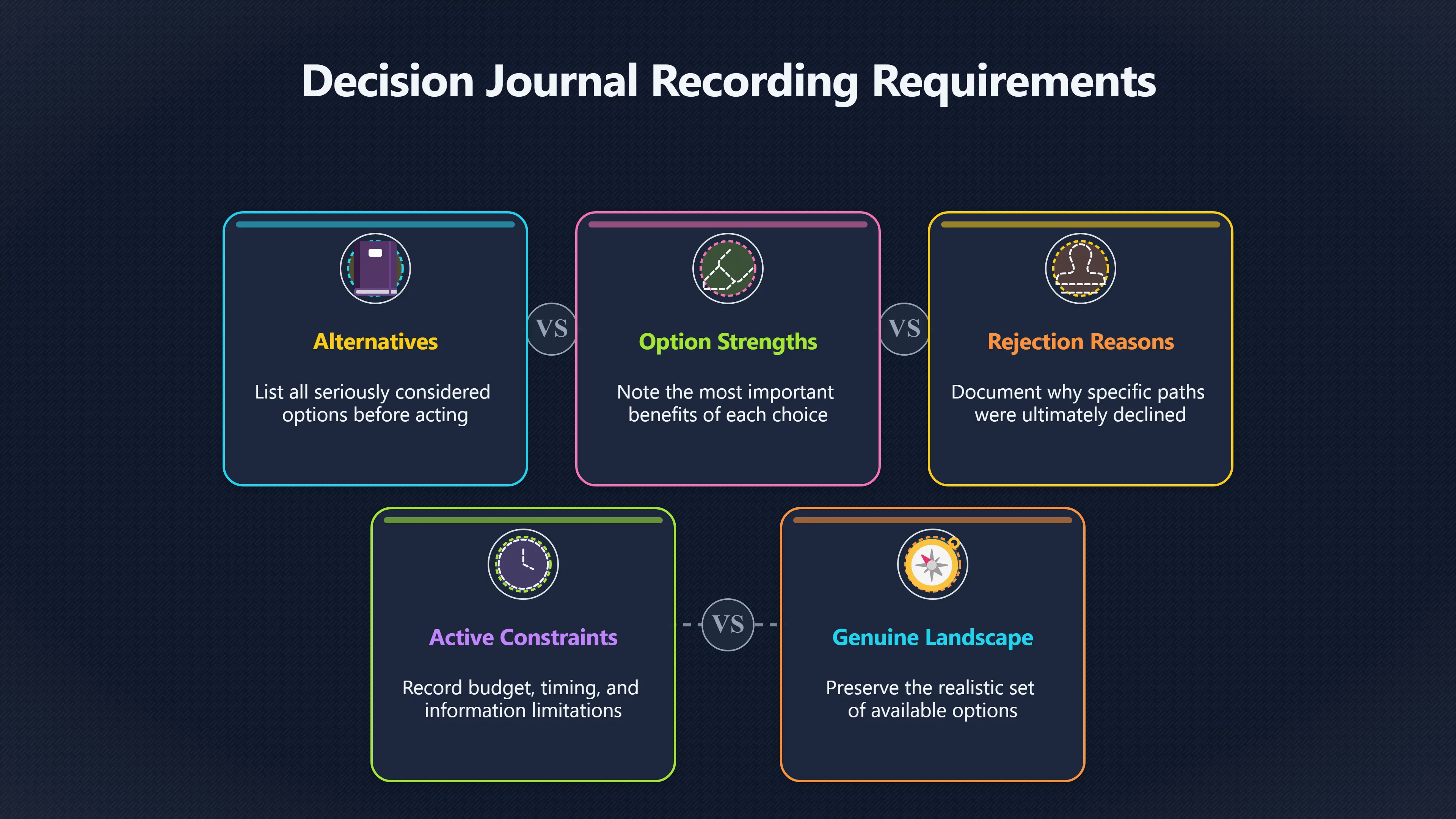
A useful decision journal avoids this by recording, before acting:
- the main alternatives that were seriously considered;
- the most important strengths of each alternative;
- the reasons each option was rejected;
- any constraints that made some options unrealistic, such as budget, timing or available information.
This turns a later review into a comparison with the genuine decision landscape rather than with an imagined one.
Why rejected options belong in the entry
Recording rejected alternatives serves several distinct purposes that cannot be reconstructed reliably afterwards.
First, it preserves the decision-maker’s opportunity set. Circumstances change rapidly. Information becomes available, markets move, and new technologies emerge. A review conducted six months later should judge the choice against what was genuinely available then, not against options that only became obvious later.
Second, it exposes trade-offs. Many decisions involve sacrificing one desirable feature to gain another. Writing down these trade-offs prevents later reviewers from acting as though a solution offering every benefit without every cost was available all along.
Third, it separates deliberate rejection from accidental omission. During a review, it is valuable to distinguish between:
- options that were examined and consciously rejected;
- options that were overlooked entirely.
The first may reflect sound judgement. The second may reveal a genuine gap in the decision process that deserves attention.
Finally, documenting rejected alternatives encourages active consideration of multiple possibilities, a practice that can reduce overconfidence and improve judgement by making assumptions more explicit. Reviews of debiasing interventions consistently identify structured consideration of alternatives as one practical way to improve decision quality, although effectiveness varies with context. [Sage Journals]journals.sagepub.comSage JournalsMitigating Cognitive Bias to Improve Organizational…by B Fasolo · 2025 · Cited by 80 — The detrimental influence of cogni…
How alternatives improve later comparison
The greatest value appears during the review rather than during the original decision.
Suppose someone chose Supplier A instead of Supplier B because A offered greater reliability while B was cheaper but had an inconsistent delivery record.
A year later, Supplier A experiences one major delay. Without a record, the reviewer may conclude:
“We should obviously have picked Supplier B.”
The original journal may instead show:
- Supplier B had already missed delivery targets several times.
- Reliability was identified as the primary decision criterion.
- Cost savings from B were acknowledged but judged less important.
- Both suppliers carried recognised risks.
The review then becomes much more informative. Instead of asking whether the chosen supplier eventually disappointed, it asks whether the original weighting of reliability against price was sensible given what was known.
This distinction protects against outcome bias, in which identical decisions are judged differently solely because their outcomes differ. Experimental research has repeatedly shown that people rate the quality of a decision more harshly after learning of a poor outcome, even when the decision-maker had exactly the same information beforehand. [The Decision Lab+2Wikipedia]thedecisionlab.comThe Decision LabOutcome bias: Why we blame bad results, not bad reasoningOutcome bias is a cognitive bias where we evaluate decisions pri…
Preventing comparisons with imaginary histories
One of the biggest dangers in reviewing decisions is comparing reality with a counterfactual world that never truly existed.
Examples include:
- comparing an investment with the single stock that happened to perform best;
- comparing a hiring decision with the perfect candidate who was unavailable;
- comparing a project plan with a schedule that ignored real resource limits.
These comparisons feel persuasive because hindsight makes successful paths appear more obvious than they were. Research on hindsight bias shows that outcome knowledge systematically changes people’s memory of what seemed likely beforehand and makes actual events appear more predictable than they really were. [PubMed+2The Decision Lab]pubmed.ncbi.nlm.nih.govHindsight bias, outcome knowledge and adaptive learningby K Henriksen · 2003 · Cited by 279 — This paper examines the influence of…
Recording rejected alternatives helps establish a fairer benchmark:
- “What were the genuine options?”
- “What evidence supported each one?”
- “Why was this alternative declined?”
- “Would those reasons still have been reasonable before the outcome was known?”
Those questions focus attention on the quality of reasoning instead of retrospective storytelling.
Common review mistakes when options are missing
When rejected alternatives are absent from the original record, several predictable errors become more likely.
Inventing better choices after the fact. Reviewers unconsciously construct options that combine the advantages of several real alternatives while ignoring the constraints that prevented such combinations.
Remembering only weaknesses in the chosen option. Once an outcome disappoints, people often forget why the selected option originally looked attractive.
Forgetting why rejected options seemed risky. Poor outcomes make previously rejected alternatives appear safer than they actually were at the time.
Judging with new information. Reviews quietly incorporate facts learned months later while pretending those facts were available from the beginning.
Ignoring opportunity costs selectively. The benefits forgone by rejecting alternatives disappear from memory, leaving only the costs of the chosen path.
Each of these mistakes reduces the usefulness of the review because the comparison shifts away from the real decision environment toward an idealised reconstruction.

A practical way to record alternatives
The record does not need to be lengthy. For many decisions, a simple table is enough.
AlternativeMain advantageMain concernWhy rejectedChosen optionBest overall fitHigher costSelectedAlternative ALower costGreater operational riskRisk judged unacceptableAlternative BFaster implementationLimited long-term valueDid not meet strategic objective
When reviewing the decision later, revisit each row before looking at the outcome. This simple discipline helps preserve the original frame of reference and makes it much easier to ask the central learning question:
Given the realistic alternatives available at the time, was this a well-reasoned choice?
That question is usually far more valuable than asking whether events happened to reward or punish the decision.
Amazon book picks
Further Reading
Books and field guides related to What did you choose against?. Use these as the next step if you want deeper reading beyond the article.
How to Decide
Directly addresses comparing options, uncertainty, and improving decision quality.
Superforecasting
Encourages disciplined reasoning, tracking predictions, and learning from past decisions.
The Decision Book
Provides practical frameworks for comparing alternatives and documenting structured choices.
eBay marketplace picks
Marketplace Samples
Live-tested eBay searches with available results related to this page.
Endnotes
-
Source: pubmed.ncbi.nlm.nih.gov
Link: https://pubmed.ncbi.nlm.nih.gov/14645895/Source snippet
Hindsight bias, outcome knowledge and adaptive learningby K Henriksen · 2003 · Cited by 279 — This paper examines the influence of...
-
Source: thedecisionlab.com
Link: https://thedecisionlab.com/biases/outcome-biasSource snippet
The Decision LabOutcome bias: Why we blame bad results, not bad reasoningOutcome bias is a cognitive bias where we evaluate decisions pri...
-
Source: journals.sagepub.com
Link: https://journals.sagepub.com/doi/10.1177/01492063241287188Source snippet
Sage JournalsMitigating Cognitive Bias to Improve Organizational...by B Fasolo · 2025 · Cited by 80 — The detrimental influence of cogni...
-
Source: pmc.ncbi.nlm.nih.gov
Link: https://pmc.ncbi.nlm.nih.gov/articles/PMC8763848/Source snippet
The Impact of Cognitive Biases on Professionals' Decision...by V Berthet · 2022 · Cited by 306 — First, the literature reviewed shows...
-
Source: Wikipedia
Title: Outcome bias
Link: https://en.wikipedia.org/wiki/Outcome_biasSource snippet
Outcome biasThe outcome bias is an error made in evaluating the quality of a decision when the outcome of that decision is already known...
-
Source: thedecisionlab.com
Link: https://thedecisionlab.com/biases/hindsight-biasSource snippet
Hindsight BiasHindsight bias, or the knew-it-all-along, is the tendency to claim currents events were to happen even though it was comple...
Additional References
-
Source: scholarlypublications.universiteitleiden.nl
Link: https://scholarlypublications.universiteitleiden.nl/access/item%3A3160833/downloadSource snippet
bias and outcome bias in judging directors'...by N Strohmaier · Cited by 29 — Although very similar to hindsight bias in that outcome in...
-
Source: bmt.org
Link: https://www.bmt.org/insights/hindsight-bias-its-effects-on-decision-making-and-implications-for-project-management/Source snippet
Hindsight Bias: its effects on decision making and...29 Aug 2024 — Hindsight bias can have severe implications for project management, i...
-
Source: youtube.com
Link: https://www.youtube.com/watch?v=o_rW4jCOB4cSource snippet
results, instead of looking at the process itself...
-
Source: youtube.com
Link: https://www.youtube.com/watch?v=00KD0tyvgcYSource snippet
656 - How to Make ANY Decision with Annie Duke...
-
Source: link.springer.com
Link: https://link.springer.com/article/10.1007/s13164-023-00672-2Source snippet
the Evidence for Outcome Bias and Hindsight Bias31 Jan 2023 — Outcome bias and hindsight bias are important in philosophical debates and...
-
Source: cmu.edu
Title: Outcome Feedback
Link: https://www.cmu.edu/dietrich/sds/docs/loewenstein/OutcomeFeedback.pdfSource snippet
Carnegie Mellon UniversityOutcome Feedback: Hindsight and Informationby SJ Hoch · 1989 · Cited by 247 — Although "hindsight bias" researc...
-
Source: academicworks.cuny.edu
Link: https://academicworks.cuny.edu/cgi/viewcontent.cgi?article=1005&context=jj_etdsSource snippet
Bias in Clinical Decision Makingby A Beltrani · 2017 · Cited by 4 — The aim of this study was to extend the current body of literature on...
-
Source: youtube.com
Link: https://www.youtube.com/watch?v=ZOl8z30k2PgSource snippet
How to Decide: Better Choices, Better Life with Annie Duke...
-
Source: youtube.com
Title: What is hindsight bias?
Link: https://www.youtube.com/watch?v=OkrKOdWn3oASource snippet
Psychological Research: Crash Course Psychology #2...
-
Source: youtube.com
Title: How to Decide: Better Choices, Better Life with Annie Duke
Link: https://www.youtube.com/watch?v=ynFWVeRDoQsSource snippet
What is hindsight bias?...
Topic Tree