Within Lateral Reading
Why polished websites can fool careful readers
Professional design and official-sounding language can make weak or biased sources look more trustworthy than they are.
On this page
- The limits of judging a page by appearance
- How templates, logos and mission statements create false authority
- What lateral reading checks before trusting the design
Page outline Jump by section
Introduction
A polished website is not the same thing as a trustworthy source. Modern publishing tools make it inexpensive to create pages that look as professional as those of universities, charities, government agencies or established news organisations. Clean layouts, sophisticated branding and confident writing can create an immediate impression of competence, even when the underlying evidence is weak, selective or misleading.
 This matters because people naturally use visual cues to make quick judgements. Those cues are useful for deciding whether a page is readable or easy to navigate, but they are poor indicators of whether its claims are accurate. Lateral reading addresses this weakness by shifting attention away from appearance and towards the source itself: who created it, what incentives they have, and how independent sources describe them. Research comparing professional fact-checkers with historians and university students found that even highly educated readers could be misled by polished websites when they stayed on the page instead of checking the broader web. [Sage Journals+2SSRN]journals.sagepub.comhistorians, 10 professional fact checkers, and 25 Stanford University undergraduates. Analysis focused…Read more…
The limits of judging a page by appearance
People often rely on what psychologists call heuristics: mental shortcuts that help us make rapid decisions. Online, these shortcuts include assumptions such as:
- Professional design suggests professionalism.
- Careful grammar suggests careful research.
- A formal tone suggests neutrality.
- References and footnotes suggest rigorous evidence.
- Familiar visual elements such as logos, navigation menus and contact pages suggest legitimacy.
These signals are not meaningless. Genuine organisations often invest in good design because it improves usability and public trust. The problem is that none of these features are difficult to imitate. A misleading organisation can purchase the same website template, stock photographs and branding package as a reputable institution for relatively little cost.
Research into website credibility has shown that design elements such as logos, visual consistency and professional presentation significantly increase users’ perceptions of trustworthiness and expertise, particularly during the first moments of visiting a site. That makes these elements valuable for honest organisations—but equally useful for deceptive ones. [ResearchGate]researchgate.netResearch Gate Source Credibility Theory Applied to Logo and WebsiteSource Credibility Theory Applied to Logo and Website…January 2, 2014 — We present a strategy for building credibility der…
The result is a common error: confusing presentation quality with evidence quality. A website may communicate authority extremely effectively while providing little independent support for its central claims.
How templates, logos and mission statements create false authority
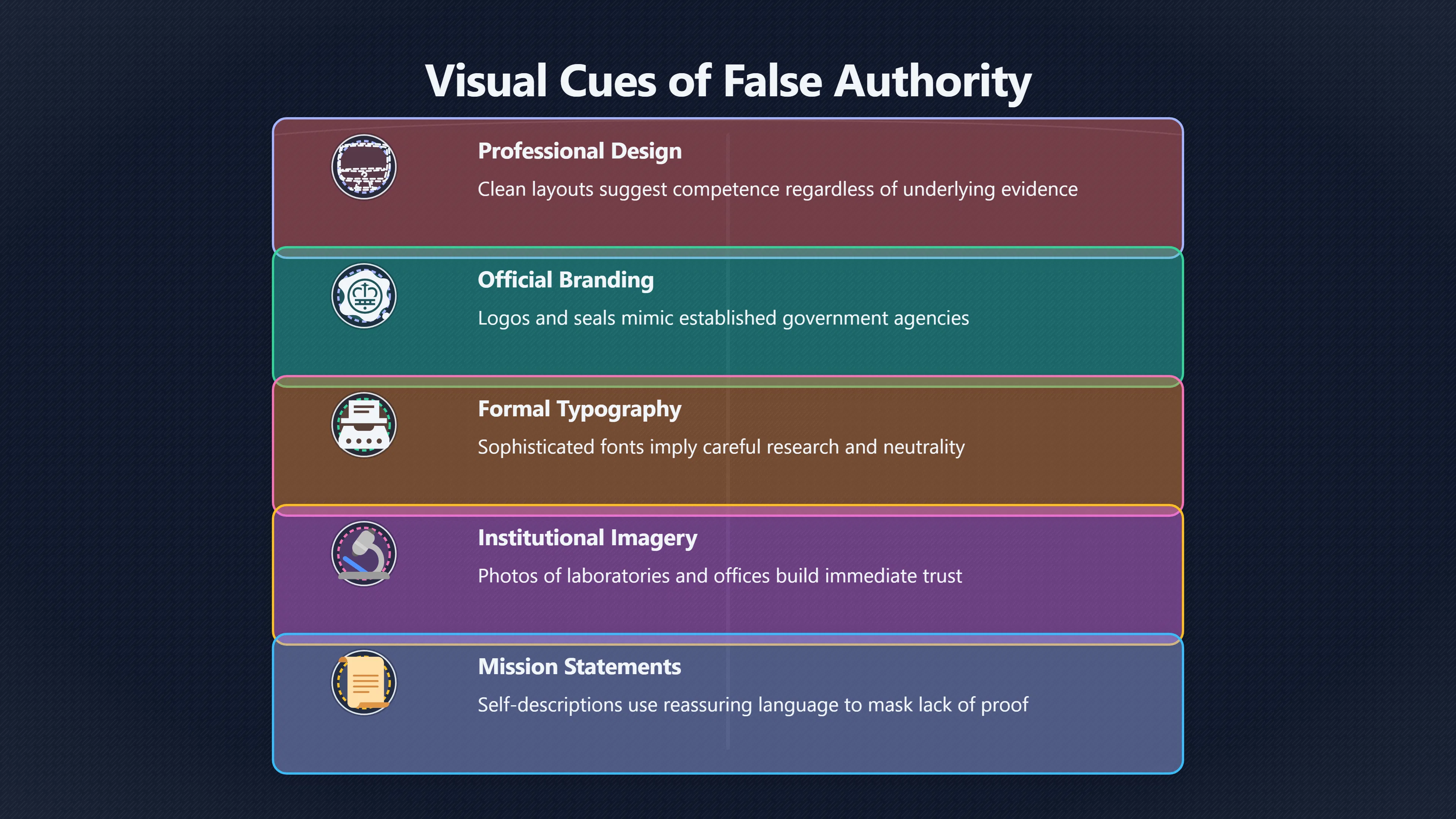
Professional websites often share a familiar visual language. Readers have learned to associate this style with established organisations, which means the style itself begins to signal credibility.
Professional design borrows institutional cues
Many sites intentionally resemble respected institutions by using:
- restrained colour palettes
- formal typography
- photographs of laboratories, offices or experts
- official-looking seals or badges
- organisational charts
- detailed “About us” pages
- extensive policy documents
None of these features proves expertise. They mainly demonstrate that someone invested time in presentation.
Some misleading organisations deliberately adopt names that sound like research institutes, public interest groups or independent foundations. When combined with polished branding, the overall impression can encourage readers to assume independence before asking who actually funds or controls the organisation.

Mission statements sound trustworthy even when they reveal little
Mission statements are another powerful credibility cue. Phrases such as “committed to evidence”, “independent research”, “public education” or “advancing informed debate” sound reassuring because they resemble the language used by legitimate organisations.
However, mission statements are self-descriptions rather than independent verification. Almost any organisation can claim to value transparency or objectivity. Those claims become meaningful only when supported by observable behaviour, transparent governance, identifiable experts and reliable evidence.
This is one reason lateral reading recommends leaving the site early. Instead of asking whether the organisation describes itself positively, ask whether independent reporting describes it in the same way. [UK Parliament Committees]committees.parliament.ukUK Parliament CommitteesStanford History Education Group – written evidence…Our approach, in contrast, is based on research we've done…
Why careful readers can still be fooled
Being intelligent or knowledgeable does not automatically protect someone from persuasive presentation.
One influential Stanford study observed professional fact-checkers, PhD historians and university students as they evaluated unfamiliar websites. Surprisingly, the historians—experts in analysing historical documents—often spent considerable time inspecting the page itself. Professional fact-checkers behaved differently. After only a brief look, they left the page to investigate the organisation elsewhere.
The difference was not intelligence but strategy. Historians applied methods suited to analysing primary documents whose authenticity was already established. Online, however, the first question is often whether the source deserves attention at all. Fact-checkers recognised that question immediately and sought outside evidence before investing time in the site’s own presentation. [Sage Journals+2SSRN]journals.sagepub.comhistorians, 10 professional fact checkers, and 25 Stanford University undergraduates. Analysis focused…Read more…
The research demonstrates an important lesson for analytical thinking: expertise developed in one context does not automatically transfer to evaluating unfamiliar websites.
What lateral reading checks before trusting the design
Lateral reading treats the website as a starting point rather than the final source of information.
Instead of examining every feature on the page, it asks questions that the page cannot answer about itself.
Who runs the organisation? Search for independent descriptions of the publisher, including ownership, funding, leadership and history.
What reputation does it have? Look for reporting from established news organisations, academic institutions, professional associations or recognised fact-checking organisations.
Do experts cite it? Credible organisations are usually discussed, criticised or referenced by others working in the same field. An apparent research institute that exists almost entirely on its own website deserves additional scrutiny.
What is the original source? Many polished websites simply repeat claims made elsewhere. Trace quotations, statistics and studies back to their original publication instead of relying on how they are presented.
Is the site’s self-description confirmed independently? Claims such as “award-winning”, “non-partisan”, “independent” or “leading authority” should be verifiable outside the organisation’s own pages.
Professional fact-checkers consistently use these habits because they reduce the influence of carefully designed presentation. Educational resources based on this research now teach students to investigate unfamiliar sources by opening new tabs rather than remaining inside the site’s own narrative. [Stanford Education+3Inquiry Group+3Inquiry Group]cor.inquirygroup.orgInquiry GroupIntro to Lateral Reading | Civic Online ReasoningSort Fact from Fiction Online with Lateral Reading. Lateral reading is a po…

A practical way to separate appearance from credibility
A useful mental shift is to treat design as evidence of publishing effort, not of truth.
A clean website may indicate that someone invested money, technical skill or marketing expertise. It does not indicate whether the claims are accurate, whether contrary evidence has been omitted, or whether the organisation has relevant expertise.
When encountering an unfamiliar source, avoid asking, “Does this look trustworthy?” Instead ask, “What would convince an independent observer that this source deserves trust?” The answer rarely lies in logos, typography or mission statements. It lies in transparent authorship, accountable institutions, reliable evidence and independent corroboration.
Seen this way, polished presentation becomes neither a reason to trust nor a reason to distrust. It becomes something largely neutral—a feature that may improve readability but should never substitute for checking who is behind the information and what the wider web says about them. [Boosting+2The Chicago School Library]scienceofboosting.orgBoosting Lateral ReadingBoostingLateral Reading - Boosting4 May 2023 — Lateral reading is a simple heuristic for online fact-checking: Open multiple tabs in your…
eBay marketplace picks
Marketplace Samples
Live-tested eBay searches with available results related to this page.

Endnotes
-
Source: papers.ssrn.com
Link: https://papers.ssrn.com/sol3/papers.cfm?abstract_id=3048994Source snippet
Less and Learning More When Evaluating Digital...by S Wineburg · 2019 · Cited by 81 — Fact checkers read laterally, leaving a site after...
-
Source: stacks.stanford.edu
Title: Wineburg Mc Grew Lateral Reading and the Nature of Expertise
Link: https://stacks.stanford.edu/file/druid%3Ayk133ht8603/Wineburg%20McGrew_Lateral%20Reading%20and%20the%20Nature%20of%20Expertise.pdfSource snippet
Reading and the Nature of Expertise - Stacks28 Jul 2018 — This study compares how professional fact checkers, historians, and first year...
-
Source: researchgate.net
Title: Research Gate Source Credibility Theory Applied to Logo and Website
Link: https://www.researchgate.net/publication/251232741_A_Picture_is_Worth_a_Thousand_Words_Source_Credibility_Theory_Applied_to_Logo_and_Website_Design_for_Heightened_Credibility_and_Consumer_TrustSource snippet
Source Credibility Theory Applied to Logo and Website...January 2, 2014 — We present a strategy for building credibility der...
Published: January 2, 2014
-
Source: committees.parliament.uk
Link: https://committees.parliament.uk/writtenevidence/448/html/Source snippet
UK Parliament CommitteesStanford History Education Group – written evidence...Our approach, in contrast, is based on research we've done...
-
Source: ed.stanford.edu
Title: it doesn t take long learn how spot misinformation online stanford study finds
Link: https://ed.stanford.edu/news/it-doesn-t-take-long-learn-how-spot-misinformation-online-stanford-study-findsSource snippet
Stanford EducationIt doesn't take long to learn how to spot misinformation online...19 Apr 2022 — Research from the Stanford History Edu...
-
Source: researchgate.net
Title: (PDF) Lateral reading: College students learn to critically
Link: https://www.researchgate.net/publication/349535570_Lateral_reading_College_students_learn_to_critically_evaluate_internet_sources_in_an_online_courseSource snippet
civic online reasoning: A national portrait. Stanford... students were taught online evaluation strategies drawn from research with prof...
-
Source: journals.sagepub.com
Link: https://journals.sagepub.com/doi/10.1177/016146811912101102Source snippet
historians, 10 professional fact checkers, and 25 Stanford University undergraduates. Analysis focused...Read more...
-
Source: cor.inquirygroup.org
Title: Inquiry Group Teaching Lateral Reading
Link: https://cor.inquirygroup.org/curriculum/collections/teaching-lateral-reading/Source snippet
Lateral Reading - Civic Online ReasoningThese lessons also introduce students to resources they can use when laterally reading: Wikipedia...
-
Source: cor.inquirygroup.org
Link: https://cor.inquirygroup.org/curriculum/lessons/intro-to-lateral-reading/Source snippet
Inquiry GroupIntro to Lateral Reading | Civic Online ReasoningSort Fact from Fiction Online with Lateral Reading. Lateral reading is a po...
-
Source: cor.inquirygroup.org
Title: Watch the video.Read more
Link: https://cor.inquirygroup.org/curriculum/lessons/lateral-reading-resources-practice/?cuid=teaching-lateral-readingSource snippet
Inquiry GroupLateral Reading Resources & Practice | Civic Online ReasoningIn this video, host John Green teaches you how to read laterall...
-
Source: scienceofboosting.org
Title: Boosting Lateral Reading
Link: https://www.scienceofboosting.org/project/lateral-reading/Source snippet
BoostingLateral Reading - Boosting4 May 2023 — Lateral reading is a simple heuristic for online fact-checking: Open multiple tabs in your...
Published: May 2023
-
Source: library.thechicagoschool.edu
Title: The Chicago School Library Lateral Reading: Be a Pro Fact Checker
Link: https://library.thechicagoschool.edu/c.php?g=1425760&p=10608575Source snippet
The Chicago School LibraryLateral Reading: Be a Pro Fact Checker - Navigating...12 Jun 2026 — Lateral reading is a strategy for investig...
Additional References
-
Source: misinforeview.hks.harvard.edu
Link: https://misinforeview.hks.harvard.edu/article/lateral-reading-college-students-learn-to-critically-evaluate-internet-sources-in-an-online-course/Source snippet
Misinformation ReviewLateral reading: College students learn to critically...23 Feb 2021 — We based our intervention on strategies culle...
-
Source: linkedin.com
Link: https://www.linkedin.com/posts/nacke_reading-less-can-lead-you-to-learn-more-activity-7467536616853491712-PChe -
Source: youtube.com
Link: https://www.youtube.com/watch?v=SHNprb2hgzUSource snippet
Sort Fact from Fiction Online with Lateral ReadingBased on research with professional fact checkers, the Civic Online Reasoning curriculu...
-
Source: tandfonline.com
Title: cities, more credibility and legitimacy logos and symbols of official
Link: https://www.tandfonline.com/doi/full/10.1080/01900692.2024.2311385Source snippet
Full article: Public Branding in the Digital Age: An Empirical...by AP Manoharan · 2025 · Cited by 17 — This study investigates the use...
-
Source: hendrix.edu
Link: https://www.hendrix.edu/uploadedFiles/Academics/Faculty_Resources/Teaching_and_Learning/EvaluatingDigitalInformation.pdfSource snippet
In contrast, fact checkers read laterally, leaving a site after a quick scan and...Read more...
-
Source: guides.lib.uiowa.edu
Link: https://guides.lib.uiowa.edu/c.php?g=849536&p=6077640Source snippet
Evaluating Online Information: Lateral Reading - Guides24 Nov 2025 — Good lateral readers use the simple techniques of the fact-checkers...
-
Source: researchportal.scu.edu.au
Title: How and why credibility based company logos
Link: https://researchportal.scu.edu.au/esploro/outputs/doctoral/How-and-why-credibility-based-company-logos/991012821272202368Source snippet
Research PortalHow and why credibility-based company logos are effective in...by W Haig · 2007 · Cited by 12 — This thesis explores the...
-
Source: fabrikbrands.com
Link: https://fabrikbrands.com/branding-matters/brand-strategy/your-mission-statement-is-a-lie/Source snippet
nticity—and how to create one your stakeholders believe...
-
Source: thecrashcourse.com
Title: Check Yourself with Lateral Reading
Link: https://thecrashcourse.com/courses/check-yourself-with-lateral-reading-crash-course-navigating-digital-information-3/Source snippet
Crash CourseJohn Green is going to teach you how to read laterally, using multiple tabs in your browser to look stuff up and fact-check a...
-
Source: openlearninglibrary.mit.edu
Link: https://openlearninglibrary.mit.edu/courses/course-v1%3AMITx%2B0.504x%2B3T2020/aboutSource snippet
Truth From Fiction: Civic Online ReasoningThe Stanford History Education Group has distilled these practices from observations with profe...
Topic Tree