Within Problem Parts
Is it a cause or a constraint?
Missed deadlines become easier to fix when you separate what caused the delay from what limits the solution.
On this page
- Why causes and constraints get confused
- Project delay examples where the distinction matters
- How the distinction changes realistic options
Page outline Jump by section
Introduction
When a project slips, the first conversation often mixes together two very different questions: why did the delay happen? and what limits our response? Treating these as the same problem leads teams to spend time on actions that cannot remove the real cause, or to debate explanations when they should be negotiating practical trade-offs.
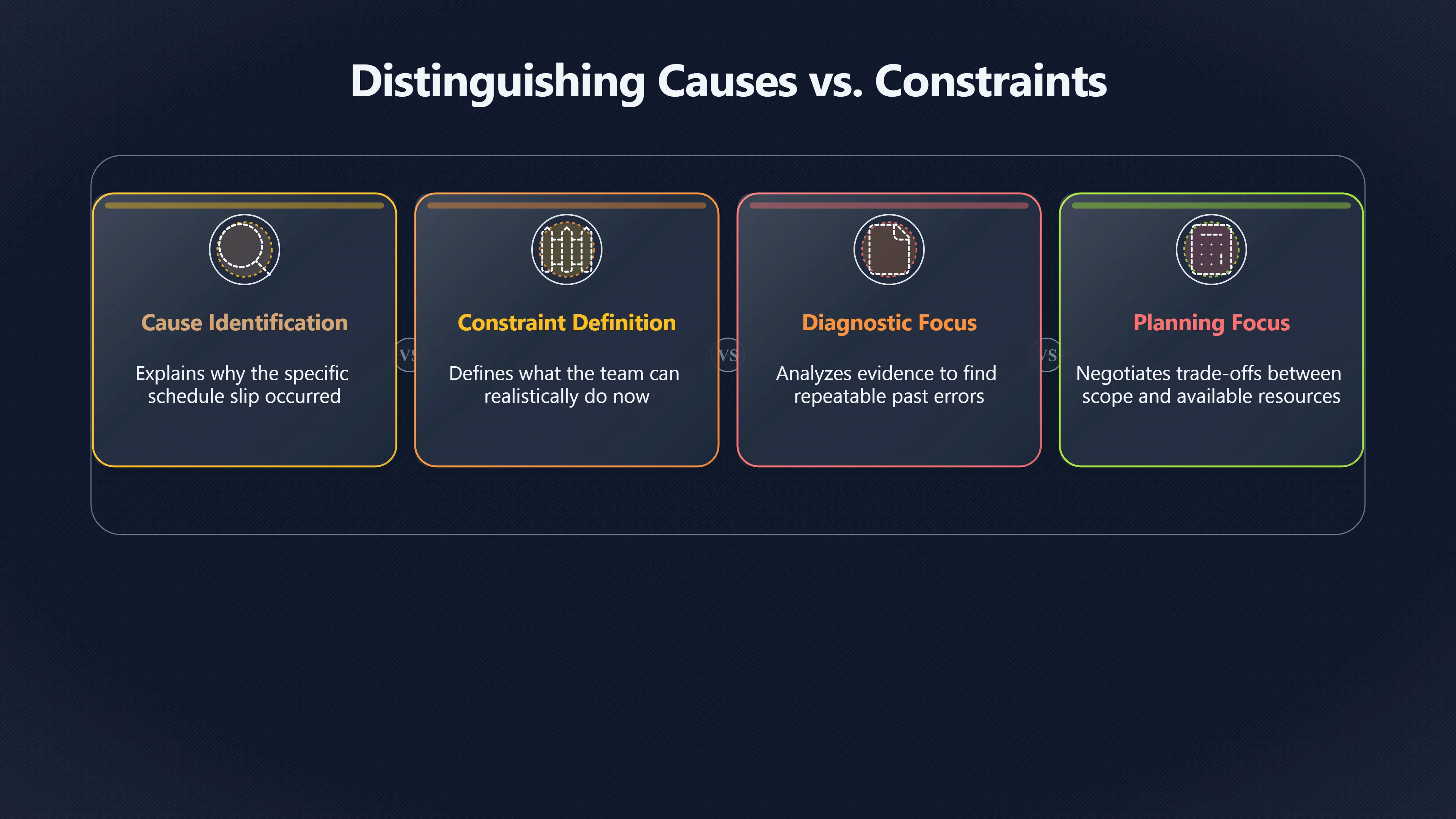
 Analytical thinking improves when causes and constraints are separated before solutions are discussed. A cause explains why the schedule slipped. A constraint defines what the team can realistically do next. The distinction changes the options available, the evidence that matters, and the decisions that follow.
Why causes and constraints get confused
Project discussions naturally drift towards whichever issue feels most urgent. A fixed launch date, for example, dominates attention even though it may not explain the delay. Equally, discovering a software defect explains why work stopped but says nothing about whether the deadline can still be met.
Several factors encourage this confusion:
- Symptoms are mistaken for causes. “We are two weeks late” is the outcome, not the explanation.
- Constraints sound like explanations. Statements such as “we only have three developers” describe a limitation, not necessarily the reason work slipped.
- Root causes and bottlenecks overlap in everyday language. A bottleneck may currently restrict progress, while the original cause of the delay may have occurred weeks earlier.
- Teams focus on what they can see. Schedule pressure is highly visible, whereas planning assumptions, hidden dependencies or decision delays are often less obvious.
Root-cause analysis methods such as the Ishikawa (fishbone) diagram exist precisely because multiple plausible explanations usually compete until evidence separates them. They encourage teams to organise possible causes rather than accepting the first convincing story. [Wikipedia]WikipediaIshikawa diagramIshikawa diagram
Project delay examples where the distinction matters
The difference becomes clearer when examining common project situations.
SituationCauseConstraintTesting finishes lateCritical defects required unexpected reworkProduct launch date is fixed by regulationConstruction project slipsMaterials arrived weeks behind scheduleBudget cannot fund additional crewsSoftware release stallsKey technical dependency failedCustomer contract limits changes to scopeMarketing campaign misses milestonesApproval process created repeated waiting timeAdvertising slots have already been purchased
Notice that removing the cause does not necessarily remove the constraint.
If late supplier deliveries caused a delay, changing suppliers may prevent future problems. However, if the customer has already committed to a public launch date, that deadline remains a constraint. The recovery discussion therefore becomes different from the diagnostic discussion.
Likewise, discovering that poor requirements caused repeated redesign explains the past. It does not eliminate limits on available staff, contractual obligations or regulatory approval windows.
How to tell whether something is a cause or a constraint
A useful analytical test is to ask two questions.
Question 1: Does this explain why the delay happened?
If removing the factor would probably have prevented the delay, it is likely to be a cause.
Examples include:
- inaccurate effort estimates
- late stakeholder decisions
- equipment failures
- poor dependency management
- incomplete requirements
Question 2: Does this limit what we can do now?
If the factor restricts available solutions regardless of how the delay occurred, it is likely to be a constraint.
Examples include:
- fixed legal deadlines
- available budget
- contractual commitments
- limited specialist staff
- safety or compliance requirements
Some factors can legitimately be both, but only in different contexts. A shortage of skilled engineers may have contributed to delays and may also restrict recovery options. The important step is to separate those roles instead of assuming they are identical.
How the distinction changes realistic options
Separating causes from constraints improves decision quality because each requires different reasoning.
When investigating causes, the team asks:
- What evidence supports this explanation?
- Which events happened before the delay?
- Which explanation best fits the available facts?
- Which causes are repeatable across projects?
When managing constraints, the questions become:
- Which limits cannot realistically change?
- Which constraints are negotiable?
- What trade-offs between scope, cost, schedule and quality are acceptable?
- Which options remain feasible?
This shift prevents unrealistic recovery plans. For example, identifying that unrealistic original estimates caused a delay does not justify promising an even shorter remaining schedule unless additional resources, reduced scope or another genuine change makes that possible.
Project management guidance consistently treats constraints as boundaries within which delivery decisions must be made. Modern practice commonly extends beyond the traditional time-cost-scope triangle to include quality, resources and risk because these factors often define what recovery strategies are actually possible. [SAVIOM+2Atlassian]saviom.com6 Project Constraints: Ways to Manage Them Effectively6 Project Constraints: Ways to Manage Them EffectivelyJune 5, 2026 — Project constraints are limitations or restrictions that can i…
A practical way to separate the discussion
A simple meeting structure helps avoid mixing diagnosis with planning.
- List every observed problem without proposing solutions.
- Identify evidence-backed causes for each delay.
- List constraints separately, including deadlines, budgets, contractual obligations and resource limits.
- Design recovery options that address causes while respecting constraints.
- Challenge assumptions by asking whether a stated “constraint” is genuinely fixed or merely an accepted practice.
Many apparent constraints turn out to be negotiable. A milestone may be movable after stakeholder discussion, while a legal compliance date is not. Distinguishing fixed constraints from assumed ones often creates more practical options than repeatedly debating causes.
Why this distinction improves analytical thinking
Breaking project delays into causes and constraints demonstrates a broader analytical habit: different parts of a problem perform different functions. Explanations answer why something happened. Constraints answer what remains possible. Treating both as a single category leads to confused diagnosis, unrealistic plans and wasted effort.
By deliberately sorting these two types of information before choosing a response, teams are more likely to identify genuine root causes, recognise unavoidable limits and select recovery actions that have a realistic chance of succeeding.

Amazon book picks
Further Reading
Books and field guides related to Is it a cause or a constraint?. Use these as the next step if you want deeper reading beyond the article.
The Goal
Directly helps readers distinguish system constraints from underlying causes and choose effective responses.
The Five Dysfunctions of a Team
Shows how better team discussions improve diagnosis, decision-making, and problem solving.
Critical Thinking
Supports the analytical habits needed to separate evidence, causes, assumptions, and practical constraints.
Root Cause Analysis, Second Edition
Focuses on identifying genuine causes rather than treating symptoms or constraints as explanations.
eBay marketplace picks
Marketplace Samples
Live-tested eBay searches with available results related to this page.




Endnotes
-
Source: Wikipedia
Title: Ishikawa diagram
Link: https://en.wikipedia.org/wiki/Ishikawa_diagram -
Source: Wikipedia
Title: Current reality tree (theory of constraints)
Link: https://en.wikipedia.org/wiki/Current_reality_tree_%28theory_of_constraints%29 -
Source: saviom.com
Title: 6 Project Constraints: Ways to Manage Them Effectively
Link: https://www.saviom.com/resources/project-management/articles/project-constraints/Source snippet
6 Project Constraints: Ways to Manage Them EffectivelyJune 5, 2026 — Project constraints are limitations or restrictions that can i...
Published: June 5, 2026
-
Source: atlassian.com
Link: https://www.atlassian.com/work-management/project-management/triple-constraintsSource snippet
ationships, and practical strategies for managing them effectively.Read more...
-
Source: gridfox.com
Link: https://gridfox.com/blog/constraints-of-the-project/Source snippet
Constraints of the Project: Key Limitations and Boundaries...7 Aug 2025 — Project constraints are the boundaries you must work within, U...
-
Source: galorath.com
Link: https://galorath.com/project/constraints/Source snippet
Project Constraints: Definition, Examples, and Why They...15 Apr 2025 — Project constraints are the boundaries that define what is possi...
Additional References
-
Source: pmi.org
Link: https://www.pmi.org/learning/library/triple-constraint-erroneous-useless-value-8024 -
Source: projectmanager.com
Title: triple constraint project management time scope cost
Link: https://www.projectmanager.com/blog/triple-constraint-project-management-time-scope-costSource snippet
The Triple Constraint in Project Management: Time, Scope...2 Apr 2025 — The triple constraint states that the success of the project is...
-
Source: youtube.com
Title: Delay Analysis for Beginners: As Planned vs As Built Comparison
Link: https://www.youtube.com/watch?v=KRKHracW-BYSource snippet
How Smart Project Managers Handle Schedule Slips Without Losing Trust provides a direct framework for navigating schedule slips, differen...
-
Source: researchgate.net
Link: https://www.researchgate.net/publication/377051498_The_impact_of_triple_constraints_on_the_project_success_a_moderating_role_of_organizational_supportSource snippet
time, cost, and quality on construction projects.Read more...
-
Source: pmcerts.com.my
Link: https://pmcerts.com.my/project-management/6-project-constraints/Source snippet
6 Project Constraints: Tackle Challenges in Management Today12 Dec 2023 — Project constraints in project management is something that lim...
-
Source: youtube.com
Title: How to Make a Fishbone Diagram (Ishikawa Diagram)
Link: https://www.youtube.com/watch?v=dPenE6NzrCMSource snippet
Stop Project Delays: The Resource Constrained Scheduling Method (part 2)...
-
Source: youtube.com
Title: Stop Project Delays: The Resource Constrained Scheduling Method (part 2)
Link: https://www.youtube.com/watch?v=FuLcFXL7ZBgSource snippet
Delay Analysis for Beginners: As Planned vs As Built Comparison...
-
Source: youtube.com
Title: How Smart Project Managers Handle Schedule Slips Without Losing Trust
Link: https://www.youtube.com/watch?v=eOM3NSIGwo8Source snippet
Fishbone Diagram & 5 Whys for Root Cause Analysis | PM Expert...
-
Source: youtube.com
Title: Fishbone Diagram & 5 Whys for Root Cause Analysis | PM Expert
Link: https://www.youtube.com/watch?v=JnE3h740Z7sSource snippet
How to Make a Fishbone Diagram (Ishikawa Diagram) - Root Cause Analysis...
-
Source: pressbooks.ulib.csuohio.edu
Link: https://pressbooks.ulib.csuohio.edu/projectmanagement2ndedition/chapter/1-3-project-constraints/Source snippet
Pressbooks@MSL1.3 Project Constraints – Project Management, 2nd EditionThree main constraints (i.e., triple or iron triangle constraints)...
Topic Tree