Within Lateral Reading
Who is really behind this website?
A few targeted searches can reveal the people, funding, ownership and incentives behind a source before its claims get your attention.
On this page
- Search the organisation before reading deeply
- Look for funding, ownership and incentives
- Compare self description with independent descriptions
Page outline Jump by section
Introduction
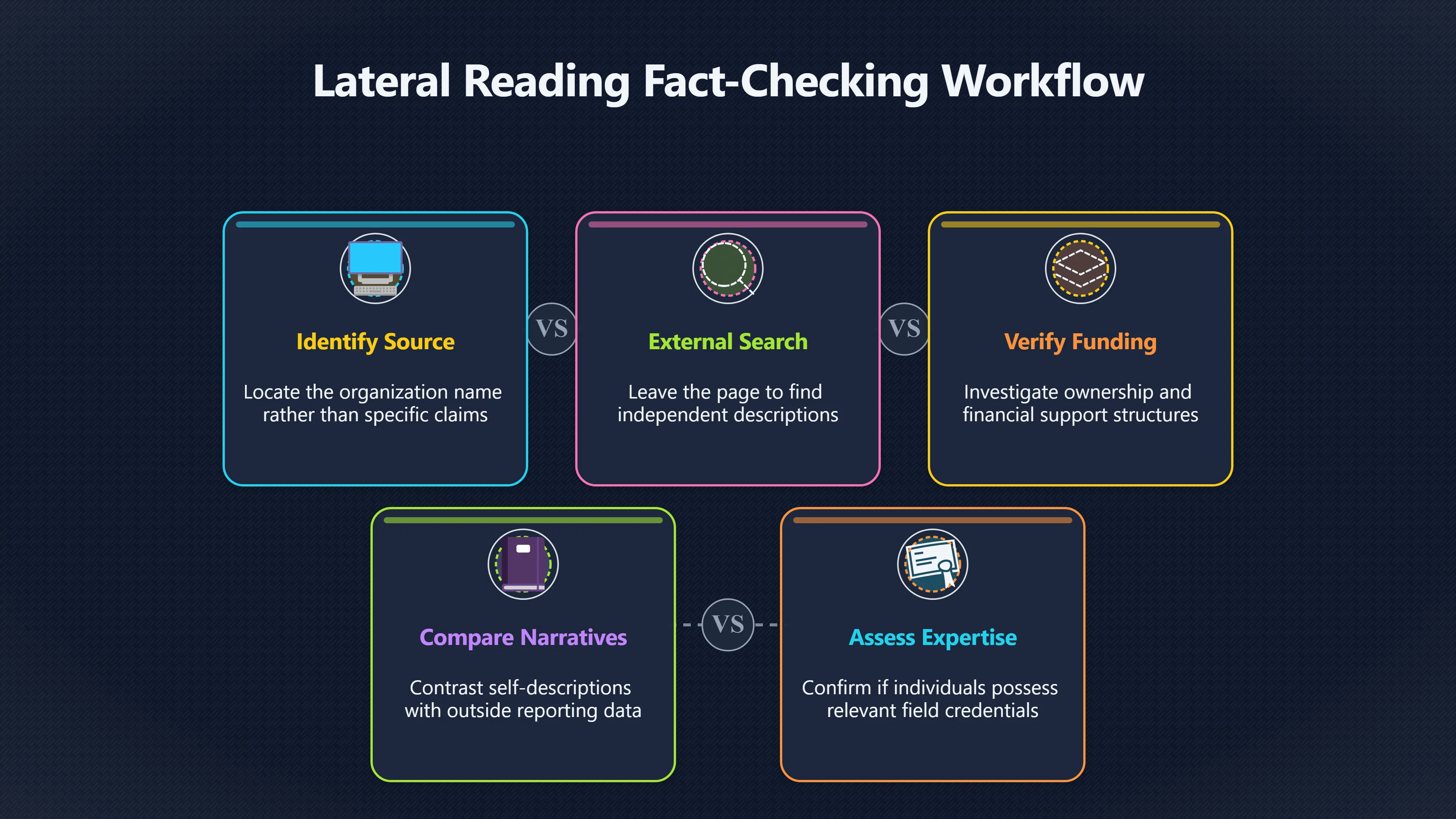
When you land on an unfamiliar website, one of the fastest ways to judge its credibility is not to read more of what it says, but to find out who is behind it. A polished design, impressive logo or authoritative tone tells you very little about whether the organisation is knowledgeable, independent or trustworthy. Instead, spend a few minutes identifying the people, organisation, funding and incentives that sit behind the site before investing attention in its claims. This is a core part of lateral reading: leaving the page to investigate the source itself rather than accepting its self-description. Research on professional fact-checkers consistently shows that this approach is more effective than evaluating a website only by its appearance or internal content.[Boosting]scienceofboosting.orgBoosting Lateral ReadingBoostingLateral Reading - BoostingMay 4, 2023 — 4 May 2023 — Lateral reading is a simple heuristic for online fact-checking: Open multipl…
Search the organisation before reading deeply
The first search should usually be for the organisation’s name rather than the article or claim that brought you there. Your goal is to discover whether independent sources describe the organisation in the same way that it describes itself.
Useful searches include:
- Organisation name
- Organisation name + funding
- Organisation name + ownership
- Organisation name + about
- Organisation name + controversy
- Organisation name + criticism
- Organisation name + Wikipedia (where available, as a starting point rather than a final authority)
Resist the temptation to spend several minutes studying the website’s own “About Us” page before doing this. That page is valuable for gathering names, dates and stated affiliations, but every organisation presents itself in the most favourable light. Those details become useful only after they have been checked elsewhere. Professional fact-checkers typically leave unfamiliar sites almost immediately and search for outside information instead.[libguides.csun.edu]libguides.csun.edureading laterally fact checkingCommunication Studies: Reading Laterally for Fact Checking15 Jun 2026 — Fact checkers at news organizations use lateral reading - "hoppin…
Independent descriptions often reveal information that is absent from the site itself, such as previous names, ownership changes, political affiliations, commercial interests or a history of publishing unreliable material.
Look for funding, ownership and incentives
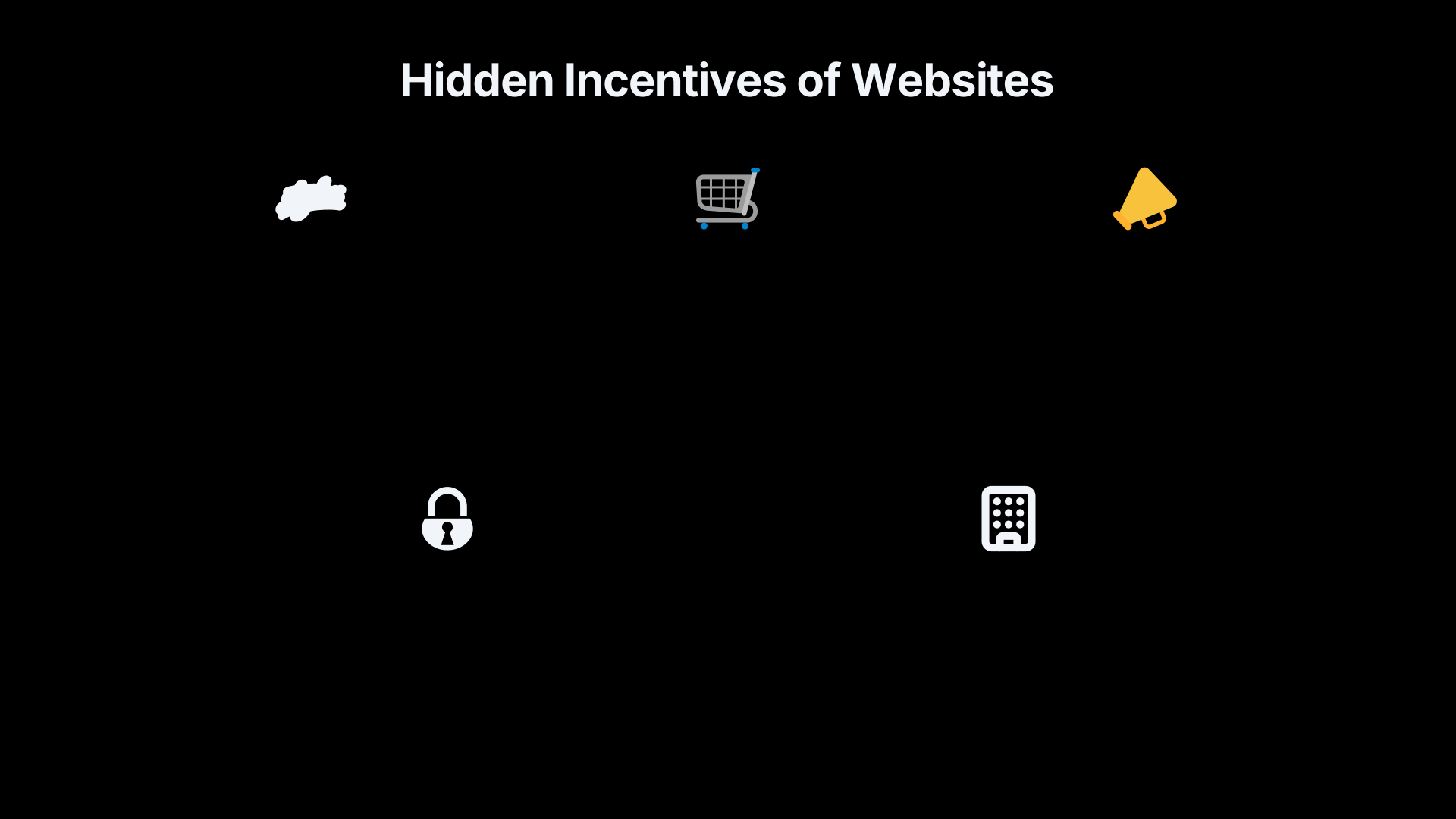
Knowing who pays for a website often explains why it exists. Funding does not automatically make a source unreliable, but undisclosed financial or ideological interests should make you more cautious.
Ask questions such as:
- Is the website operated by a company, charity, university, government agency or individual?
- Who owns the domain or publication?
- Who provides financial support?
- Does it sell products, subscriptions or consulting services related to its content?
- Does it openly disclose sponsorship or partnerships?
- Does it advocate for particular political, commercial or ideological goals?
For example, a health website that recommends supplements while selling those same products has a different incentive structure from an independent medical institution. Likewise, an organisation funded by an industry group may provide useful information but should be read with an awareness of its interests.
Transparency itself is informative. Credible organisations generally make it straightforward to identify their leadership, governance, contact details and funding arrangements. When ownership is deliberately obscured or difficult to discover, that lack of transparency becomes part of the credibility assessment rather than proof of wrongdoing.
Compare the website’s own story with independent descriptions
Every organisation tells a story about itself. The important question is whether that story survives comparison with independent reporting.
Suppose a website describes itself as “an independent research institute”. That statement should prompt further questions:
- Is it recognised by universities or researchers in the field?
- Do reputable news organisations describe it similarly?
- Does it publish original research that is cited elsewhere?
- Are its experts recognised outside the organisation?
- Do independent profiles mention significant funding sources or affiliations that the site omits?
Differences do not necessarily indicate deception. A charity may legitimately describe itself differently from a government register, and a news organisation may simplify another group’s mission. However, substantial gaps between self-description and outside reporting deserve attention.
The aim is not to find criticism at all costs. Nearly every established organisation attracts critics. Instead, look for recurring factual information across independent sources, especially regarding ownership, governance, funding and reputation.
Identify the people, not just the brand
Many websites appear institutional but are effectively the work of a small group or even a single individual.
Look beyond the homepage to identify:
- Named editors
- Authors
- Directors
- Trustees
- Executive leadership
- Editorial boards
- Scientific or advisory panels
Once you have names, search them independently. Questions worth asking include:
- What relevant expertise do they have?
- What other organisations are they connected to?
- Have they published work in this field?
- Are they primarily advocates, campaigners or commercial operators?
- Do multiple leadership figures share the same undisclosed affiliations?
Expertise is contextual. A respected engineer is not automatically an authority on public health, and a qualified doctor is not automatically an expert in climate science. Credibility depends partly on whether the people behind a site possess expertise relevant to the specific claims being made.
Pay attention to what is missing
Sometimes the absence of information is as revealing as what is present.
Warning signs include:
- No identifiable organisation.
- No named authors or editors.
- No physical address or meaningful contact details.
- Vague claims of expertise without supporting evidence.
- No explanation of funding.
- Generic or unverifiable biographies.
- Claims of independence without describing governance.
None of these alone proves that a website is unreliable. Small community organisations, personal blogs and new projects may genuinely have limited resources. However, when several warning signs appear together, extra verification becomes important before relying on the site’s claims.
Use official records when appropriate
For organisations making significant public claims, independent records often provide stronger evidence than the website itself.
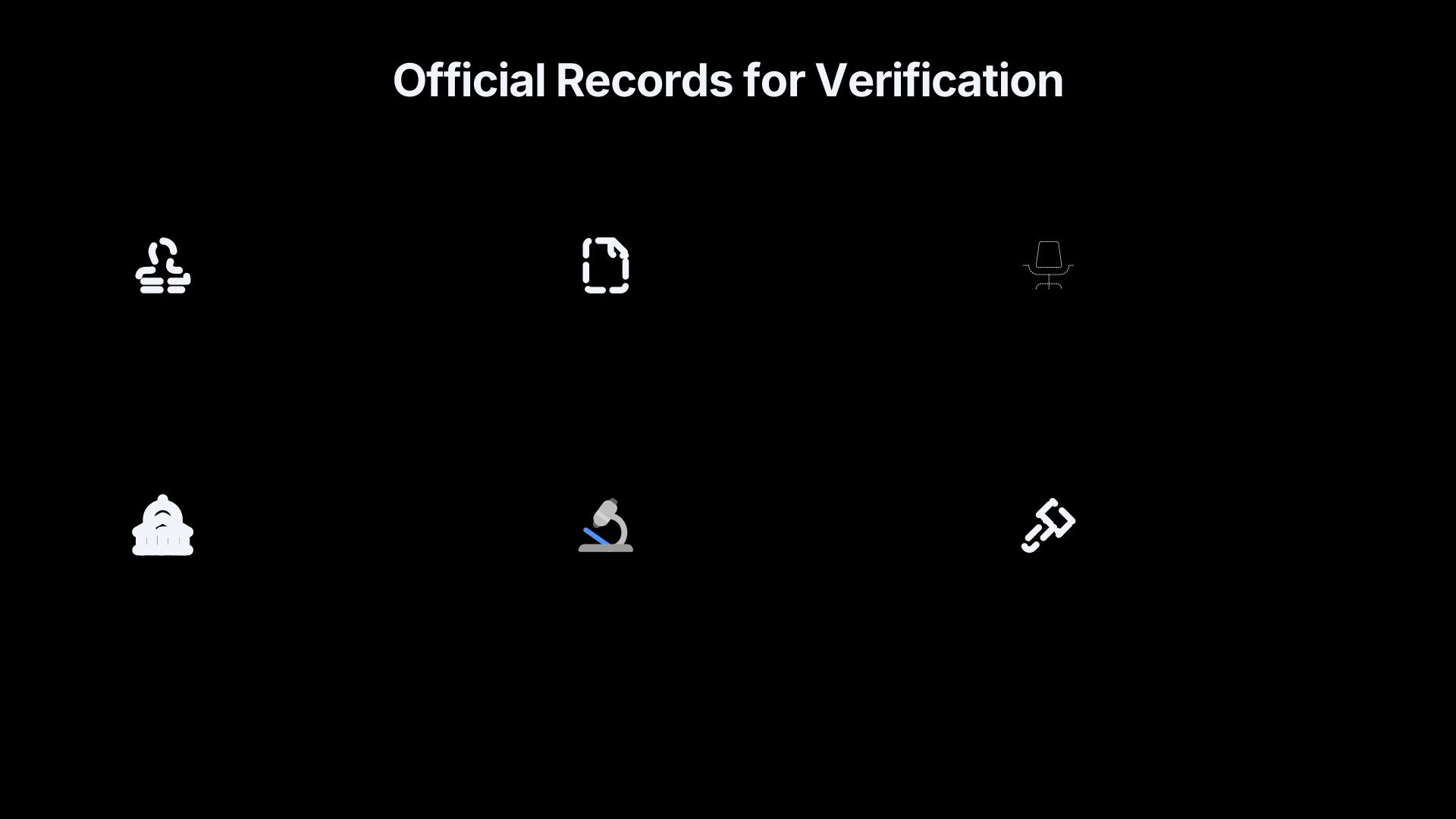
Depending on the country and organisation type, useful sources may include:
- Company registers for corporate ownership.
- Charity registers for trustees and financial filings.
- Government databases.
- University staff directories.
- Academic publication databases.
- Regulatory filings.
- Court records where relevant.
These records are particularly useful because they are created independently of the organisation’s own marketing materials.
A practical example
Imagine you encounter a website presenting environmental research.
Instead of reading twenty pages of articles, you might spend five minutes answering these questions:
- Who owns the organisation?
- Who funds it?
- Who leads it?
- How do independent sources describe it?
- Are its reports cited by recognised experts?
- Does it disclose its methods and evidence?
If those answers point towards transparent governance, identifiable expertise and a reputation supported by independent sources, the site’s content deserves more attention. If the searches instead reveal hidden ownership, undisclosed lobbying interests or repeated concerns about accuracy, you have learned something important before investing time in evaluating individual claims.
Why this habit improves analytical thinking
Checking who is behind a website changes the sequence of evaluation. Instead of asking whether the article sounds convincing, you first ask whether the source has earned the right to be persuasive.
That small change reduces the influence of professional design, emotional language and confident presentation. It also shifts attention towards evidence that is harder to manipulate: documented ownership, transparent funding, identifiable expertise and independent reputation.
This habit does not require cynicism or distrust. It simply recognises that understanding a source’s incentives is often one of the quickest ways to judge how much weight its claims deserve. As research on lateral reading shows, professional fact-checkers spend remarkably little time examining unfamiliar pages in isolation. They learn more by looking outward than by reading deeper.[Boosting+2libguides.csun.edu]scienceofboosting.orgBoosting Lateral ReadingBoostingLateral Reading - BoostingMay 4, 2023 — 4 May 2023 — Lateral reading is a simple heuristic for online fact-checking: Open multipl…
eBay marketplace picks
Marketplace Samples
Live-tested eBay searches with available results related to this page.


Endnotes
1.
Source: libguides.csun.edu
Title: reading laterally fact checking
Link:https://libguides.csun.edu/coms-research/reading-laterally-fact-checking
Source snippet
Communication Studies: Reading Laterally for Fact Checking15 Jun 2026 — Fact checkers at news organizations use lateral reading - "hoppin...
2.
Source: uscupstate.libguides.com
Title: Lateral Reading
Link:https://uscupstate.libguides.com/LateralReading
Source snippet
Checking, Information Evaluation, & Lateral Reading29 Jul 2025 — Using lateral reading you should go broad, not deep, and see what many o...
3.
Source: scienceofboosting.org
Title: Boosting Lateral Reading
Link:https://www.scienceofboosting.org/project/lateral-reading/
Source snippet
BoostingLateral Reading - BoostingMay 4, 2023 — 4 May 2023 — Lateral reading is a simple heuristic for online fact-checking: Open multipl...
Published: May 4, 2023
Additional References
4.
Source: guides.lib.uiowa.edu
Link:https://guides.lib.uiowa.edu/c.php?g=849536&p=6077640
Source snippet
Online Information: Lateral Reading - Guides24 Nov 2025 — Good lateral readers use the simple techniques of the fact-checkers in the Stan...
5.
Source: mediahelpingmedia.org
Title: quick guide lateral reading for fact checking
Link:https://mediahelpingmedia.org/quick-guides/quick-guide-lateral-reading-for-fact-checking/
Source snippet
Quick Guide: Lateral reading for fact-checking30 Mar 2026 — Journalists use lateral reading to fact-check by broadening their knowledge...
6.
Source: library.thechicagoschool.edu
Title: Lateral Reading: Be a Pro Fact Checker
Link:https://library.thechicagoschool.edu/c.php?g=1425760&p=10608575
Source snippet
Navigating...12 Jun 2026 — Lateral reading is a strategy for investigating who's behind an unfamiliar online source by leaving the webpa...
7.
Source: matthewfacciani.substack.com
Link:https://matthewfacciani.substack.com/p/quick-tips-to-fact-check-like-a-pro
Source snippet
Tips to Fact-Check Like a Pro - Matthew Facciani, PhDUse Fact-Checking Sites: Websites like PolitiFact & FactCheck.org can help verify or...
8.
Source: libguides.calstatela.edu
Link:https://libguides.calstatela.edu/c.php?g=1450827&p=10783864
Source snippet
Reading and Fact-Checking - LibGuides - Cal State LA14 Oct 2025 — Lateral reading is: a powerful digital literacy strategy used by fact-c...
9.
Source: youtube.com
Title: Intro to Lateral Reading
Link:http://www.youtube.com/watch?v=as1IzVljNAw
Source snippet
Check Yourself with Lateral Reading: Crash Course Navigating Digital Information #3 CrashCourse · 1.1M views...
10.
Source: youtube.com
Title: The Facts about Fact Checking: Crash Course Navigating Digital Information #2
Link:http://www.youtube.com/watch?v=EZsaA0w_0z0
Source snippet
Evaluating Sources & Fact Checking: Crash Course Scientific Thinking #6...
11.
Source: youtube.com
Link:http://www.youtube.com/watch?v=GoQG6Tin-1E
Source snippet
Sort Fact from Fiction Online with Lateral Reading...
12.
Source: youtube.com
Title: Evaluating Sources & Fact Checking: Crash Course Scientific Thinking #6
Link:http://www.youtube.com/watch?v=Fm0MpfKIs5w
Source snippet
Intro to Lateral Reading - Teaching Online Fact-Checking...
13.
Source: youtube.com
Title: Sort Fact from Fiction Online with Lateral Reading
Link:http://www.youtube.com/watch?v=SHNprb2hgzU
Source snippet
The Facts about Fact Checking: Crash Course Navigating Digital Information #2...
Topic Tree