Within Cause Check
Why Random Assignment Changes the Question
Randomisation helps separate treatment effects from pre-existing differences, but it still needs bias checks and careful interpretation.
On this page
- What randomisation makes comparable
- When trials still go wrong
- Lessons for non experimental decisions
Page outline Jump by section
Introduction
When trying to decide whether one thing caused another, the hardest question is usually not what happened, but what would have happened otherwise. Randomised trials improve our answer to that question by creating comparison groups that are similar before the intervention begins. Instead of allowing people, doctors, teachers or policymakers to choose who receives a treatment, participants are assigned by chance. This reduces the risk that pre-existing differences, rather than the intervention itself, explain the result. Randomised trials are therefore one of the strongest tools for estimating causal effects, but their strength comes from improving the comparison—not from eliminating every possible source of error. Even a well-randomised study can produce misleading conclusions if it suffers from poor implementation, missing data, biased outcome measurement or selective reporting. [PMC+2PMC]pmc.ncbi.nlm.nih.govCONSORT 2010, 15. Baseline data. [Retrieved November…Read more…

What randomisation makes comparable
Imagine evaluating a new reading programme in schools. If teachers choose which pupils receive it, they may give it to children who are already highly motivated or to those who are struggling most. Either way, the treatment and comparison groups differ before the programme even starts.
Random assignment changes this process. Because allocation is determined by chance rather than judgement, participants in each group should, on average, have similar mixes of characteristics that influence the outcome. This includes both measured factors, such as age or previous performance, and many unmeasured factors that researchers may never observe. Differences that remain after randomisation are expected to be due mainly to chance rather than systematic selection. [PMC]pmc.ncbi.nlm.nih.govRandomization in clinical studies - PMC - NIHby CY Lim · 2019 · Cited by 424 — CONSORT, a set of guidelines proposed to improve comple…
The key point is that randomisation does not guarantee that every individual characteristic is perfectly balanced. Small studies can still end up with noticeable differences simply through luck. Instead, it guarantees that the allocation process itself is unbiased, allowing statistical methods to quantify the uncertainty that remains. Larger trials generally achieve better balance because chance imbalances become smaller relative to the sample size. [PMC]pmc.ncbi.nlm.nih.govRandomisation to protect against selection bias in healthcare trialsThis review compares random allocation (allocated to treatment usi…
This is why randomised trials are so valuable in messy real-world settings. They create a credible estimate of the missing comparison: what outcomes would probably have looked like without the intervention.
Why random assignment is different from simply comparing groups
Many observational comparisons appear convincing because one group performs better than another. The difficulty is knowing whether the intervention caused the difference or whether the groups were already different in important ways.
Randomisation removes one major source of uncertainty: selection into treatment. Participants cannot systematically sort themselves into one group because of motivation, wealth, illness severity or other factors if assignment is genuinely random and properly concealed.
For example:
- Patients receiving a new medicine are no longer automatically healthier, wealthier or more motivated than those receiving standard care.
- Schools receiving a new teaching method are not selected because they already have particularly enthusiastic staff.
- Communities receiving a policy intervention are not simply those already on an improving trend.
Because the comparison begins from a fairer starting point, later differences are much easier to interpret as effects of the intervention rather than pre-existing differences. This is the central causal advantage of randomisation. [PMC]pmc.ncbi.nlm.nih.govCONSORT 2010, 15. Baseline data. [Retrieved November…Read more…
When trials still go wrong
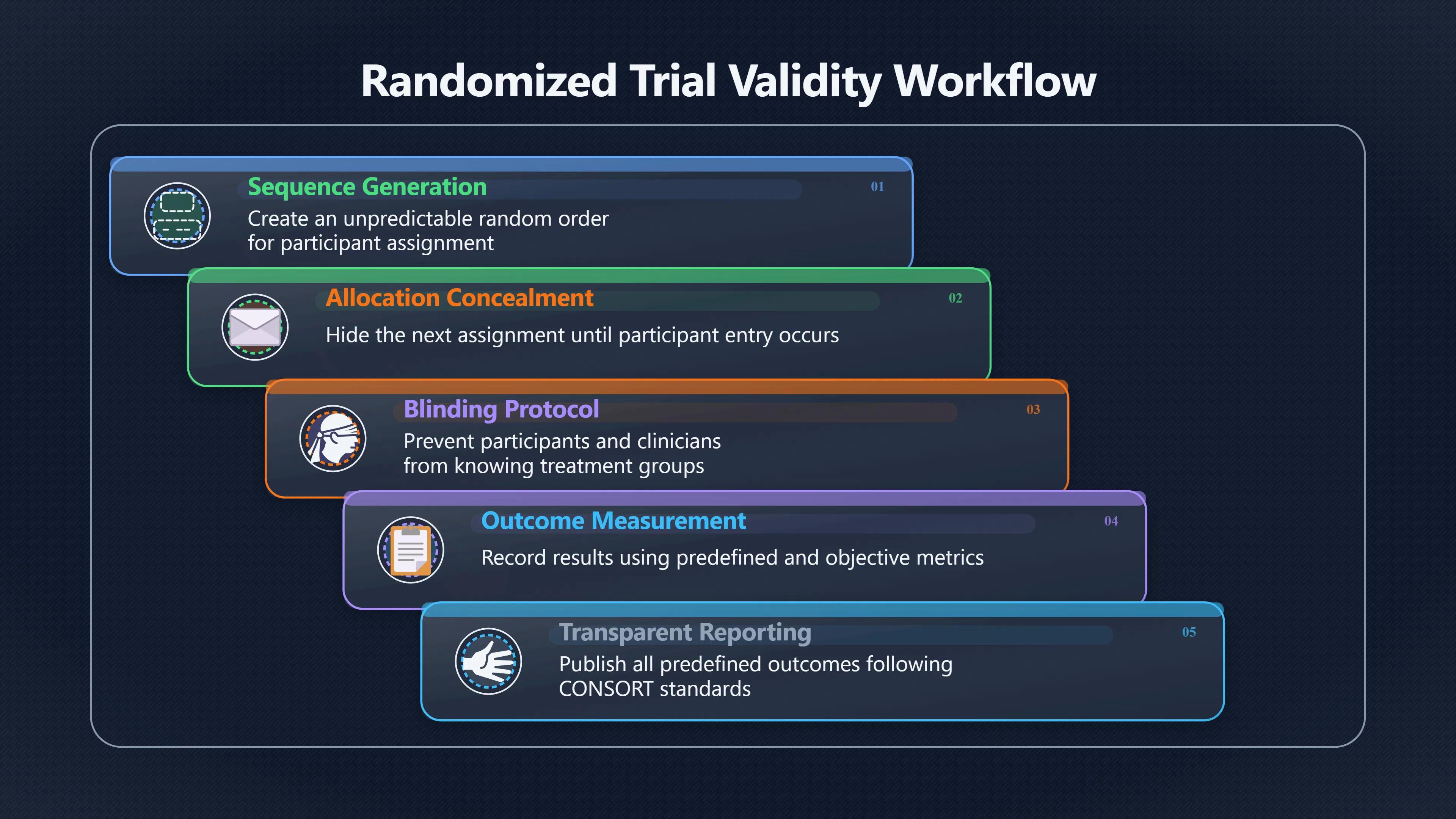
Random assignment improves internal validity, but it does not make a study automatically trustworthy. Several important sources of bias can still distort the results.
Poor allocation procedures
The random sequence must remain unpredictable until participants enter the study. If researchers can guess the next assignment—for example through poorly concealed envelopes or predictable alternation—they may consciously or unconsciously influence who enters each group. This reintroduces selection bias despite nominal randomisation. Allocation concealment is therefore distinct from random sequence generation and is considered essential. [PMC+2PMC]pmc.ncbi.nlm.nih.govRandomisation to protect against selection bias in healthcare trialsThis review compares random allocation (allocated to treatment usi…
Lack of blinding
If participants, clinicians or outcome assessors know which treatment was received, expectations can influence behaviour or measurement. For subjective outcomes such as pain or wellbeing, this can substantially affect results. Some interventions cannot realistically be blinded, making careful outcome measurement especially important. [BMJ]bmj.comCONSORT 2010 Explanation and Elaborationby D Moher · 2010 · Cited by 12645 — A group of scientists and editors developed the CONSORT (…

Missing participants and incomplete follow-up
If many participants leave one group but not the other, the remaining comparison may no longer represent the original random assignment. Researchers therefore pay close attention to attrition, reasons for withdrawal and analyses that preserve the benefits of randomisation wherever appropriate. [BMJ]bmj.comCONSORT 2010 Explanation and Elaborationby D Moher · 2010 · Cited by 12645 — A group of scientists and editors developed the CONSORT (…
Selective reporting
Researchers may measure many outcomes but publish only favourable ones. Reporting standards such as CONSORT encourage transparent reporting of trial methods, participant flow and predefined outcomes so readers can judge the reliability of the evidence. [BMJ]bmj.comCONSORT 2010 Explanation and Elaborationby D Moher · 2010 · Cited by 12645 — A group of scientists and editors developed the CONSORT (…
Why one good trial is rarely the final answer
Randomised trials estimate the effect within the population actually studied. Participants may differ from the wider population in age, health, geography or willingness to volunteer.
For example, a trial conducted in specialist hospitals may not perfectly predict what happens in routine primary care. Likewise, a successful education programme tested in a small group of motivated schools may perform differently when introduced nationally.
This distinction explains why systematic reviews often combine evidence from multiple trials conducted in different settings. Repeated findings across diverse populations provide stronger evidence than a single positive study, however well designed. At the same time, observational studies can complement trials by examining effectiveness in broader populations once an intervention is in widespread use. [PMC+2PMC]pmc.ncbi.nlm.nih.govCONSORT (CONsolidated Standards Of Reporting Trials) 18, Aims “to alleviate the problems…Read more…
Lessons for non-experimental decisions
Most important decisions in everyday life cannot be randomised. You cannot randomly assign families to different parenting styles or cities to decades of economic history simply to answer a question.
Nevertheless, randomised trials teach useful habits of thought:
- Ask what comparison would make the claim fair.
- Look for differences that existed before the intervention.
- Be cautious about before-and-after comparisons without a control group.
- Distinguish evidence that comes from deliberate comparison from evidence based only on observation.
- Remember that uncertainty remains even when the comparison is strong.
These habits help avoid confusing correlation with causation outside formal experiments.
The central insight
Randomised trials are powerful because they improve the comparison that underlies a causal claim. By using chance rather than judgement to assign interventions, they greatly reduce the influence of pre-existing differences between groups. That makes later outcome differences more credible as estimates of treatment effects.
However, randomisation is not a guarantee of truth. A convincing trial still depends on sound design, adequate follow-up, careful measurement, transparent reporting and thoughtful interpretation. The most reliable conclusions come not from assuming that randomisation solves every problem, but from recognising exactly which problem it solves—and which ones remain. [PMC+2BMJ]pmc.ncbi.nlm.nih.govCONSORT 2010, 15. Baseline data. [Retrieved November…Read more…
Amazon book picks
Further Reading
Books and field guides related to Why Random Assignment Changes the Question. Use these as the next step if you want deeper reading beyond the article.
The Book of Why
Explains causation, counterfactuals, and why experimental designs such as randomised trials matter.
Bad Science
Uses randomised trials and flawed studies to explain how to evaluate scientific claims.
How to Lie with Statistics
Helps readers understand misleading statistical claims and why robust comparisons matter in causal reasoning.
Causal Inference
Covers random assignment, causal identification, and strengths and limits of experimental methods.
eBay marketplace picks
Marketplace Samples
Live-tested eBay searches with available results related to this page.


Endnotes
-
Source: pmc.ncbi.nlm.nih.gov
Link: https://pmc.ncbi.nlm.nih.gov/articles/PMC6019115/Source snippet
CONSORT 2010, 15. Baseline data. [Retrieved November...Read more...
-
Source: pmc.ncbi.nlm.nih.gov
Link: https://pmc.ncbi.nlm.nih.gov/articles/PMC6547231/Source snippet
Randomization in clinical studies - PMC - NIHby CY Lim · 2019 · Cited by 424 — CONSORT, a set of guidelines proposed to improve comple...
-
Source: bmj.com
Link: https://www.bmj.com/content/340/bmj.c869Source snippet
CONSORT 2010 Explanation and Elaborationby D Moher · 2010 · Cited by 12645 — A group of scientists and editors developed the CONSORT (...
-
Source: pmc.ncbi.nlm.nih.gov
Link: https://pmc.ncbi.nlm.nih.gov/articles/PMC7150228/Source snippet
Randomisation to protect against selection bias in healthcare trialsThis review compares random allocation (allocated to treatment usi...
-
Source: pmc.ncbi.nlm.nih.gov
Link: https://pmc.ncbi.nlm.nih.gov/articles/PMC6710512/Source snippet
CONSORT (CONsolidated Standards Of Reporting Trials) 18, Aims “to alleviate the problems...Read more...
-
Source: pmc.ncbi.nlm.nih.gov
Link: https://pmc.ncbi.nlm.nih.gov/articles/PMC5130591/Source snippet
in randomized trials: a conversation between trialists and...We use causal [diagrams]({{ 'diagrams/' | relative_url }}) to represent the structure of biases, as described b...
-
Source: pmc.ncbi.nlm.nih.gov
Link: https://pmc.ncbi.nlm.nih.gov/articles/PMC12499922/Source snippet
Inference Methods for Combining Randomized Trials...by B Colnet · 2024 · Cited by 298 — In this paper, we review the growing literature...
-
Source: pmc.ncbi.nlm.nih.gov
Link: https://pmc.ncbi.nlm.nih.gov/articles/PMC10753608/Source snippet
CONSORT = Consolidated Standards of Reporting Trials. RCT = randomized controlled trial. Formulating the...Rea...
-
Source: pmc.ncbi.nlm.nih.gov
Link: https://pmc.ncbi.nlm.nih.gov/articles/PMC4910682/Source snippet
controlled trials – a matter of design - PMCby PM Spieth · 2016 · Cited by 548 — Notes: According to the CONSORT statement, the different...
Additional References
-
Source: nature.com
Link: https://www.nature.com/articles/s43856-026-01721-4Source snippet
(STROBE) statement: guidelines for reporting observational studies... randomized trials: extension of the CONSORT 2010 statement. JAMA 3...
-
Source: cochrane.org
Link: https://www.cochrane.org/authors/handbooks-and-manuals/handbook/current/chapter-25Source snippet
Chapter 25: Assessing risk of bias in a non-randomized studySelection bias occurs when some eligible participants, or some follow-up time...
-
Source: researchgate.net
Link: https://www.researchgate.net/publication/345970702_Causal_inference_methods_for_combining_randomized_trials_and_observational_studies_a_reviewSource snippet
Causal inference methods for combining randomized trials...16 Nov 2020 — In this paper, we review the growing literature on methods for...
-
Source: nature.com
Link: https://www.nature.com/articles/s41366-021-00909-zSource snippet
July 29, 2021 — Randomization is an important tool used to establish causal inferences in studies designed to further our understan...
Published: July 29, 2021
-
Source: researchgate.net
Title: The unpredictability of the process, if not subverted,
Link: https://www.researchgate.net/publication/51049758_Randomisation_to_protect_against_selection_bias_in_healthcare_trialsSource snippet
Randomisation to protect against selection bias in healthcare trialsBackground: Randomised trials use the play of chance to assign partic...
-
Source: researchgate.net
Link: https://www.researchgate.net/publication/271329607_Testing_for_baseline_differences_in_randomized_controlled_trials_An_unhealthy_research_behavior_that_is_hard_to_eradicateSource snippet
differences in randomized controlled trials should not be performed.Read more...
-
Source: facebook.com
Link: https://www.facebook.com/groups/853552931365745/posts/1878694608851567/Source snippet
r. Just go through it and if items can't be checked...Read more...
-
Source: dokumen.pub
Link: https://dokumen.pub/the-doctors-guide-to-critical-appraisal-4nbsped-9781905635979.htmlSource snippet
The Doctor's Guide to Critical Appraisal [4 Reporting of noninferiority and equivalence randomized trials: An extension of the CONSOR...
-
Source: Wikipedia
Title: Randomized controlled trial
Link: https://en.wikipedia.org/wiki/Randomized_controlled_trialSource snippet
Randomized controlled trial... RCT. For other RCT study designs, "CONSORT extensions" have been published, some examples are: Consort...
-
Source: researchgate.net
Title: Randomized Clinical Trials
Link: https://www.researchgate.net/topic/Randomized-Clinical-Trials/2Source snippet
Randomization prevents confounding (makes the baseline prognostic factors equal...Read more...
Topic Tree