Within Decision Journal
Did the promotion fail, or the support plan?
A promotion review becomes sharper when it separates the person's outcome from the risks, support plan, and evidence known upfront.
On this page
- The promotion entry before the decision
- How to review stress, support, and team outcomes
- What the case teaches about process versus result
Page outline Jump by section
Introduction
Promotion decisions are among the most valuable entries in a decision journal because they combine high stakes with slow, ambiguous feedback. A newly promoted employee may thrive, struggle, or leave months later, but none of those outcomes alone proves whether the original decision was good. Team changes, inadequate onboarding, shifting business priorities, poor manager support, or simple bad luck can all influence what happens after promotion. A well-designed journal entry preserves what was known before the decision, making it possible to distinguish flaws in judgement from problems in execution. Research on hindsight bias and outcome bias shows that once results are known, people systematically overestimate how predictable they were and tend to judge decisions by outcomes rather than by the quality of the reasoning available at the time.[PMC]pmc.ncbi.nlm.nih.govThe Impact of Cognitive Biases on Professionals' Decision…by V Berthet · 2022 · Cited by 306 — The author reviewed the research on…
The promotion entry before the decision
A promotion case should record the reasoning before anyone knows whether the promotion will succeed. The goal is not to predict everything correctly but to create an honest record that later prevents memory from being rewritten.
A useful promotion journal typically captures:
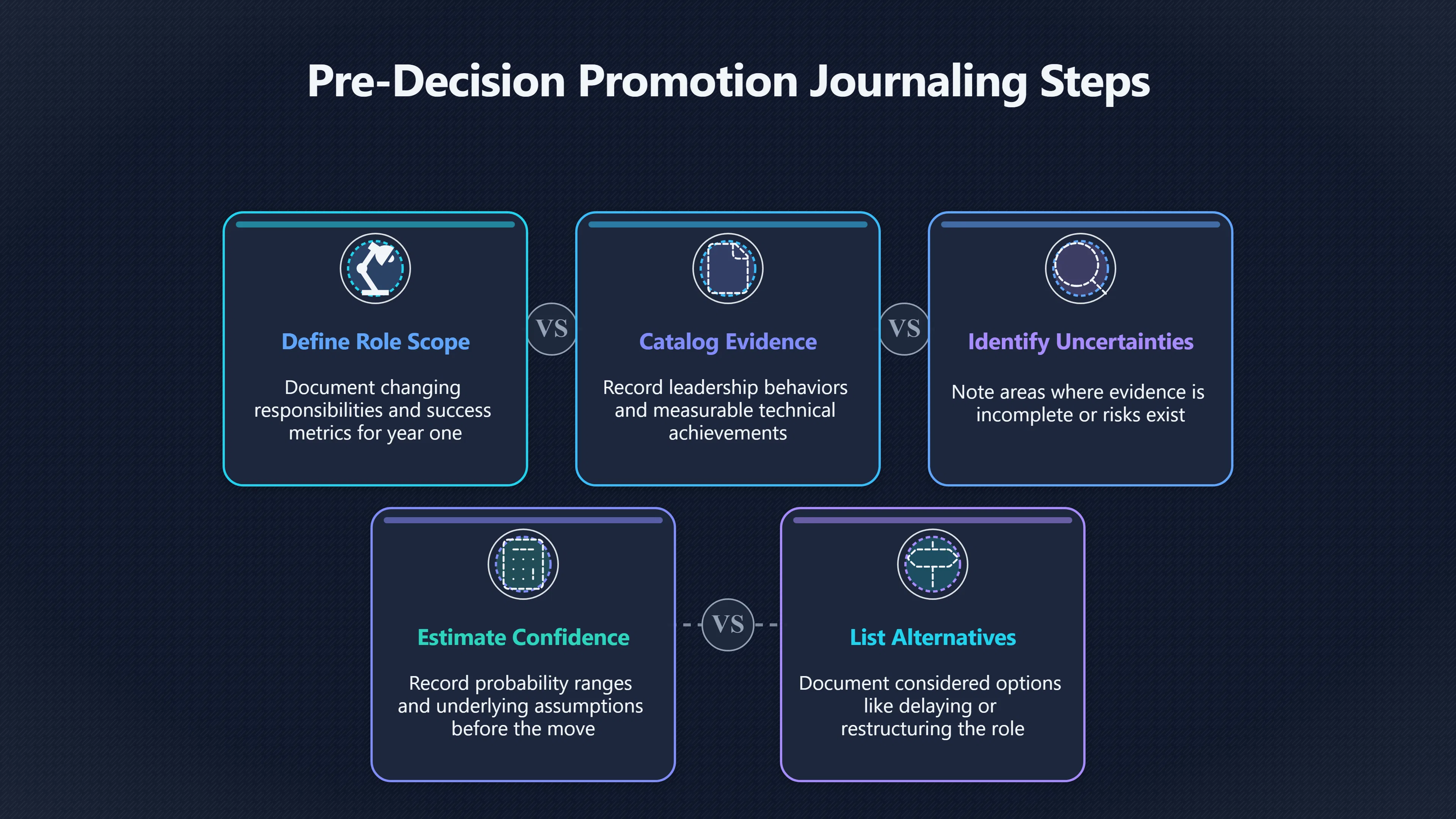
- The role being filled. What responsibilities are changing, and what success looks like after six or twelve months.
- Evidence supporting promotion. Documented performance, leadership behaviours, technical capability, peer feedback, customer impact, or measurable achievements.
- Known uncertainties. Areas where evidence is incomplete, such as managing larger teams, strategic planning, stakeholder communication, or budget responsibility.
- Alternative options considered. Delaying promotion, providing additional development, appointing another candidate, or restructuring the role.
- Expected risks. Loss of technical contribution, overload, political resistance, or insufficient experience.
- Confidence estimates. Rather than writing “this will succeed”, record a probability or confidence range together with the assumptions behind it.
Writing these factors before making the decision forces reviewers to separate observed evidence from assumptions and makes later reviews substantially fairer. This approach is consistent with evidence that structured decision processes help reduce the influence of cognitive biases in organisational judgement.[Sage Journals]journals.sagepub.comSage JournalsMitigating Cognitive Bias to Improve Organizational…by B Fasolo · 2025 · Cited by 80 — The detrimental influence of cogni…
Did the promotion fail, or the support plan?
One of the most common review mistakes is assuming that unsuccessful performance proves the promotion itself was wrong.
A decision journal instead asks whether the organisation delivered the conditions it assumed would exist when the promotion was approved.
Questions worth reviewing include:
- Was the employee given the coaching originally planned?
- Did workload expand beyond what decision-makers expected?
- Were key team members lost after the promotion?
- Did organisational priorities change?
- Did the manager provide the promised feedback and mentoring?
- Were performance expectations clearly defined?
Imagine a promotion journal stating:
“Candidate has excellent technical judgement but limited experience managing cross-functional teams. Weekly coaching for three months and leadership training are expected to reduce this risk.”
Six months later, suppose the employee struggles and receives poor evaluations. Before judging the promotion as a mistake, reviewers check the journal and discover that the coaching never occurred because the department was reorganised.
The review now becomes much more informative. The promotion decision may still have been wrong, but the evidence first points towards a failed implementation of the support plan rather than a flawed assessment of potential.
This distinction matters because organisations often improve learning far more by fixing onboarding and managerial support than by becoming increasingly conservative about promotions.
How to review stress, support, and team outcomes
Promotion reviews become more accurate when they examine multiple dimensions instead of asking only whether the promoted employee succeeded.
Individual adaptation
Review how the employee responded to increased responsibility.
Look for evidence rather than impressions:
- decision quality
- delegation
- communication
- prioritisation
- willingness to seek help
- learning over time
Early struggles may simply reflect a normal learning curve rather than poor promotion judgement.
Organisational support
Many promotions assume resources that never materialise.
Compare what the journal predicted with reality:
Journal assumptionWhat actually happenedMentor assignedMentor unavailable after restructuringLeadership course completedCourse cancelledStable teamTwo experienced staff resignedMonthly feedback sessionsOnly one meeting occurred
Differences like these help explain outcomes without rewriting history.
Team effects
Promotion success extends beyond the promoted individual.
Review:
- employee retention
- team morale
- delivery quality
- customer outcomes
- collaboration across departments
- succession effects created by filling the previous role
A technically excellent individual contributor promoted into management may temporarily reduce team productivity while developing leadership capability. That short-term outcome does not automatically invalidate the original decision if the expected transition costs were already recognised.
A comparative promotion case
[Consider two promotion decisions.]scholarship.claremont.eduThese biases seemed to have the most tangible effect on employers' hiring and promotion decisions.Read more…
Case A
The promoted manager exceeds targets after one year. Reviewing the journal shows that several risks were ignored, little evidence supported readiness, and success depended heavily on unexpected market growth.
This represents a good outcome produced by a weak decision process.
Case B
Another promoted employee struggles initially. However, the journal shows strong evidence supporting readiness, clearly identified risks, realistic expectations of a difficult transition, and a documented support programme that was only partially delivered.
This represents a disappointing outcome but potentially a sound decision process.
Without a decision journal, organisations often praise Case A while criticising Case B. Research on outcome bias demonstrates why this happens: knowledge of the result influences evaluations of the original decision even when the available information before the decision was identical.[The Decision Lab]thedecisionlab.comLearn how it differs from hindsight bias, why it distortsThe Decision LabOutcome bias: Why we blame bad results, not bad reasoningOutcome bias leads us to judge decisions by how they turned out…

What the case teaches about process versus result
Promotion journals encourage a historical perspective by reconstructing the actual decision environment rather than judging it through today’s knowledge.
When reviewing promotion cases, distinguish between four possibilities:
Decision processOutcomeInterpretationStrongStrongGood evidence and favourable execution.StrongWeakInvestigate execution, changing circumstances, or unavoidable uncertainty before criticising judgement.WeakStrongAvoid celebrating luck as evidence of good promotion practice.WeakWeakImprove both evaluation criteria and implementation.
This framework prevents organisations from learning the wrong lesson from isolated successes or failures.
Building better promotion case studies over time
As promotion journal entries accumulate, they become an organisational learning resource rather than isolated personnel records.
Patterns begin to emerge:
- Which indicators consistently predicted successful transitions?
- Which warning signs turned out to matter less than expected?
- Which support interventions produced the largest improvements?
- Which assumptions repeatedly proved false?
- Which managers consistently made well-calibrated promotion decisions?
Rather than relying on memorable success stories or disappointing failures, decision-makers build evidence from comparable cases reviewed using the same framework.
Research on workplace decision-making consistently finds that cognitive biases influence professional judgement, while structured evaluation methods and transparent promotion processes help reduce those biases. A promotion journal complements these practices by preserving the reasoning behind each decision, making later reviews less vulnerable to hindsight and more useful for improving future judgement.[PMC+2scholarship.claremont.edu]pmc.ncbi.nlm.nih.govThe Impact of Cognitive Biases on Professionals' Decision…by V Berthet · 2022 · Cited by 306 — The author reviewed the research on…
Amazon book picks
Further Reading
Books and field guides related to Did the promotion fail, or the support plan?. Use these as the next step if you want deeper reading beyond the article.
Decisive
Provides practical frameworks for improving important workplace decisions such as promotions.
Thinking, Fast and Slow
Explains hindsight bias, outcome bias, and decision quality versus results, all central to promotion decision reviews.
The Coaching Habit
Helps managers provide the support and coaching that often determines whether a promotion succeeds.
The Making of a Manager
Covers onboarding, leadership development, and evaluating management performance beyond outcomes.
eBay marketplace picks
Marketplace Samples
Example marketplace items related to this page. Use the search link to explore similar finds on eBay.




Endnotes
1.
Source: pmc.ncbi.nlm.nih.gov
Link:https://pmc.ncbi.nlm.nih.gov/articles/PMC8763848/
Source snippet
The Impact of Cognitive Biases on Professionals' Decision...by V Berthet · 2022 · Cited by 306 — The author reviewed the research on...
2.
Source: scholarship.claremont.edu
Link:https://scholarship.claremont.edu/cgi/viewcontent.cgi?article=4220&context=cmc_theses
Source snippet
These biases seemed to have the most tangible effect on employers' hiring and promotion decisions.Read more...
3.
Source: thedecisionlab.com
Title: Learn how it differs from hindsight bias, why it distorts
Link:https://thedecisionlab.com/biases/outcome-bias
Source snippet
The Decision LabOutcome bias: Why we blame bad results, not bad reasoningOutcome bias leads us to judge decisions by how they turned out...
4.
Source: journals.sagepub.com
Link:https://journals.sagepub.com/doi/10.1177/01492063241287188
Source snippet
Sage JournalsMitigating Cognitive Bias to Improve Organizational...by B Fasolo · 2025 · Cited by 80 — The detrimental influence of cogni...
Additional References
5.
Source: pulsely.io
Link:https://pulsely.io/dei-initiatives/de-bias-promotion-processes
Source snippet
De-Bias Promotion ProcessesUnconscious biases can lead managers and leaders to make certain predictable errors when selecting employees f...
6.
Source: inclusionhub.com
Title: how to design bias free review and promotion processes
Link:https://www.inclusionhub.com/articles/how-to-design-bias-free-review-and-promotion-processes
Source snippet
How to Design Bias-Free Review and Promotion Processes29 Feb 2024 — Discover key strategies for creating bias-free review and promotion p...
7.
Source: bytespark.ai
Link:https://bytespark.ai/resources/ai-powered-psychometrics/promotion-decision-ai-psychometrics-case-study/
Source snippet
ion between two equally strong internal candidates...
8.
Source: youtube.com
Title: Corporate Finance Explained | The Psychology of Financial Decision Making
Link:https://www.youtube.com/watch?v=ZY619RbWe38
Source snippet
What are the Benefits of a Decision Journal? | Shane Parrish...
9.
Source: youtube.com
Title: What are the Benefits of a Decision Journal? | Shane Parrish
Link:https://www.youtube.com/watch?v=CDgfvQtnrUU
Source snippet
How Decision Journals Can Transform Product Owner Behavior | Florian Georgescu...
10.
Source: repository.rit.edu
Link:https://repository.rit.edu/cgi/viewcontent.cgi?article=13598&context=theses
Source snippet
Promotions Using Data Analyticsby MKAM ABDULRAHIM · 2025 — The primary aim of the research is to create, test and analyze a highly visibl...
11.
Source: youtube.com
Title: How To Use A Decision Making Journal
Link:https://www.youtube.com/watch?v=iYNV01S9wTg
Source snippet
"Decision journal" farnam street The Ultimate Guide to Using a Decision Journal Farnam Street...
12.
Source: youtube.com
Title: The Ultimate Guide to Using a Decision Journal
Link:https://www.youtube.com/watch?v=ReetUAwTDKk
Source snippet
Corporate Finance Explained | The Psychology of Financial Decision Making...
13.
Source: youtube.com
Title: How Decision Journals Can Transform Product Owner Behavior | Florian Georgescu
Link:https://www.youtube.com/watch?v=pg8Q5dlJX6M
Source snippet
How To Use A Decision Making Journal...
14.
Source: ijnrd.org
Link:https://ijnrd.org/papers/IJNRD2510022.pdf
Source snippet
Employees from underrepresented groups often receive lower performance ratings...Read more...
Topic Tree