Within Search Bias
The Counterargument May Use Different Words
A search may look thorough while missing the terms used by critics, regulators, researchers, or affected groups.
On this page
- Why rival sides name the same issue differently
- Examples where vocabulary changes the evidence stream
- Building a search vocabulary before judging a claim
Page outline Jump by section
Introduction
A search can appear balanced while still missing crucial evidence simply because the most important opposing information is described with different words. Critics, regulators, researchers, affected communities and industry groups often use different vocabulary to describe the same underlying issue. If your search uses only one side’s language, search engines will usually return material that matches those terms, leaving contradictory evidence effectively invisible.
 This is a subtle form of confirmation bias. Rather than consciously avoiding disagreement, the searcher unintentionally narrows the evidence by adopting only one vocabulary. Research on the “narrow search effect” shows that people naturally choose search terms consistent with their existing beliefs, reducing exposure to information that might change their minds. Earlier information retrieval research likewise found that confirmation bias becomes stronger when opposing evidence is indexed under different terminology. [PMC+2UC San Diego Pages]pmc.ncbi.nlm.nih.govPMCThe narrow search effect and how broadeningNIHby E Leung · 2025 · Cited by 13 — This research documents the profound impact that confirmation bias can have on how people sear…
Why rival sides name the same issue differently
Language is rarely neutral in contested subjects. Different groups often choose terms that reflect different assumptions about what is happening, what matters most, or who is responsible.
This happens for several reasons:
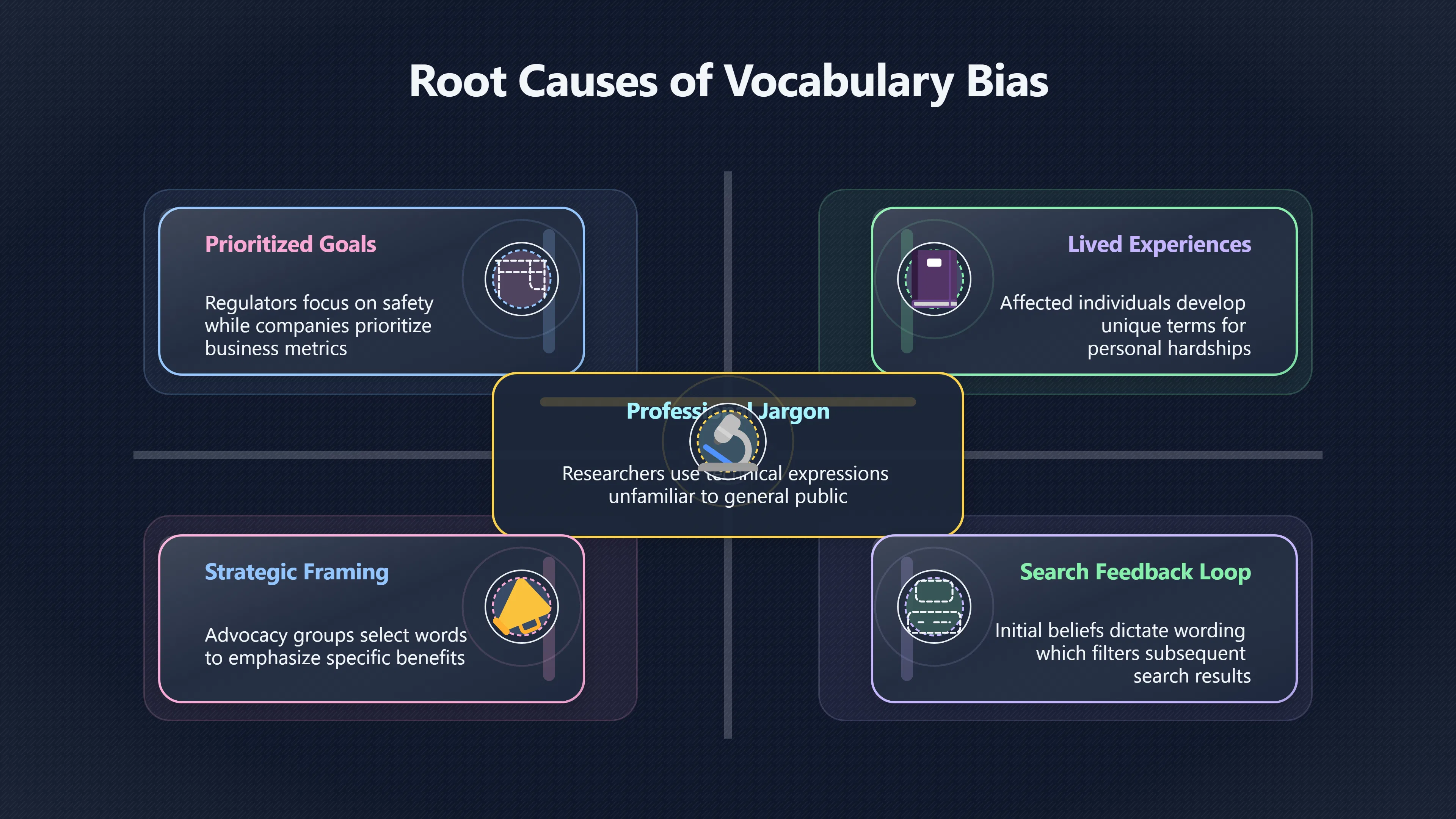
- Different priorities. Regulators may describe a problem in legal or safety terms, while companies describe the same issue using business language.
- Different experiences. People directly affected by an issue often develop vocabulary that differs from official descriptions.
- Professional jargon. Researchers may use technical expressions that ordinary searchers never think to enter.
- Strategic framing. Advocacy groups, political campaigns and commercial organisations often select words that emphasise either benefits or harms.
None of these differences automatically imply deception. However, they mean that searching with only one vocabulary can unintentionally filter out important evidence.
For example, someone investigating an online platform might search for “content moderation success”. Researchers studying the same systems may instead discuss “false positives”, “over-removal”, “algorithmic bias” or “appeals”. A search using only the first phrase is less likely to surface literature examining failures or unintended consequences.
How vocabulary quietly changes the evidence you see
Search engines work by matching your query to documents containing related concepts and terms. Although modern systems expand queries and recognise synonyms, they cannot fully bridge disagreements where different communities consistently use different language.
This creates a chain of effects:
- Your initial belief influences your wording.
- Your wording determines which documents appear relevant.
- Those documents introduce additional vocabulary from the same perspective.
- Later searches continue using that vocabulary, reinforcing the original framing.
Researchers describe this as a feedback loop between beliefs and search behaviour. Even when search engines themselves are not intentionally biased, biased queries can produce systematically different evidence streams. Similar effects have also been demonstrated in academic search engines, where searches emphasising “benefits” or “risks” returned noticeably different scientific literature. [PMC+2arXiv]pmc.ncbi.nlm.nih.govPMCThe narrow search effect and how broadeningNIHby E Leung · 2025 · Cited by 13 — This research documents the profound impact that confirmation bias can have on how people sear…
Examples where vocabulary changes the evidence stream
The mechanism becomes easier to recognise through concrete examples.
Health
Someone searching:
- “natural remedies that work”
is likely to retrieve different material from someone searching:
- “evidence for treatment effectiveness”
- “clinical trials”
- “systematic review”
- “adverse effects”
The underlying question may be identical, but the vocabulary changes which evidence becomes prominent.
Employment
Searching:
- “employee flexibility”
emphasises different sources than:
- “job insecurity”
- “precarious work”
- “labour rights”
Each phrase reflects a different way of describing similar workplace arrangements.
Technology
A company might describe software as using:
- “personalisation”
while critics investigate:
- “profiling”
- “behavioural targeting”
- “surveillance advertising”
Someone searching only the marketing terminology may overlook research discussing privacy risks.
Environmental debates
One side may discuss:
- “forest management”
while another discusses:
- “habitat loss”
- “biodiversity decline”
- “ecosystem fragmentation”
Both describe overlapping activities, but each vocabulary points towards different evidence.
The important lesson is not that one set of words is correct and another is wrong. Rather, each vocabulary opens some information while hiding other information.

Signs that your search vocabulary is too narrow
Several warning signs suggest you may be missing opposing evidence:
- Nearly every result agrees with your initial expectation.
- Different sources repeat almost identical language.
- Academic papers seem difficult to find despite extensive news coverage.
- Critics appear absent rather than merely unpersuasive.
- You keep refining searches using only words introduced by supportive sources.
When every search feels reassuring, it is worth asking whether the vocabulary itself is limiting what can be found.
Building a search vocabulary before judging a claim
Good investigators often spend time expanding their vocabulary before evaluating the evidence itself.
Useful techniques include:
Identify competing labels. Look for the different names used by governments, researchers, campaign groups, journalists, affected communities and industry.
Collect synonyms deliberately. Write down multiple descriptions of the same issue instead of relying on the first phrase that comes to mind.
Search for technical terms. Academic literature often uses more precise language than news articles.
Search the criticism directly. Instead of searching only for reasons something works, search for documented limitations, unintended effects, regulatory investigations or replication studies.
Borrow terminology from references. When reading a balanced article, note unfamiliar technical terms and search those separately rather than continuing with only your original wording.
This approach widens the search space before conclusions become fixed.
A practical vocabulary expansion exercise
Before deciding whether a claim is well supported, try constructing a small search map.
Start with your original phrase in the centre.
Then add alternative vocabulary from several perspectives:
PerspectivePossible search directionSupportersClaimed benefits, success stories, testimonialsCriticsRisks, failures, unintended consequencesResearchersTechnical terminology, measurement methods, systematic reviewsRegulatorsCompliance, investigations, enforcement, guidanceAffected groupsLived experiences, complaints, reported harms
Running searches from each branch does not guarantee perfect balance, but it greatly reduces the chance that important evidence remains hidden simply because nobody on the other side uses your preferred words.
The real question is not “Did I search?” but “Whose language did I search?”
One of the easiest ways confirmation bias survives online is through vocabulary rather than deliberate selectivity. People often believe they have investigated both sides because they searched repeatedly, when in reality every search inherited the same underlying assumptions from the same set of terms.
Improving analytical thinking therefore involves more than searching longer. It means recognising that disagreements frequently begin with language itself. Expanding your search vocabulary—especially by adopting the terms used by critics, researchers, regulators and affected communities—makes it far more likely that genuinely opposing evidence will enter your information stream, giving you a better foundation for judging the claim on its merits. [PMC+2arXiv]pmc.ncbi.nlm.nih.govPMCThe narrow search effect and how broadeningNIHby E Leung · 2025 · Cited by 13 — This research documents the profound impact that confirmation bias can have on how people sear…
Amazon book picks
Further Reading
Books and field guides related to The Counterargument May Use Different Words. Use these as the next step if you want deeper reading beyond the article.
The Scout Mindset
Encourages actively seeking disconfirming evidence and considering alternative framings.
Factfulness
Shows how misleading narratives and framing can distort understanding of evidence.
How to Read a Book
Develops better methods for evaluating sources, terminology, and arguments.
Calling Bullshit
Helps readers question claims, evaluate evidence, and recognize how wording influences interpretation.
eBay marketplace picks
Marketplace Samples
Live-tested eBay searches with available results related to this page.



Endnotes
-
Source: pmc.ncbi.nlm.nih.gov
Title: PMCThe narrow search effect and how broadening
Link: https://pmc.ncbi.nlm.nih.gov/articles/PMC12002208/Source snippet
NIHby E Leung · 2025 · Cited by 13 — This research documents the profound impact that confirmation bias can have on how people sear...
-
Source: arxiv.org
Link: https://arxiv.org/pdf/2311.09969Source snippet
Audit of academic search engines 1 The final version of...by C Kacperski · 2023 · Cited by 12 — This study examines whether confirmation...
-
Source: arxiv.org
Link: https://arxiv.org/abs/2311.09969 -
Source: pages.ucsd.edu
Title: nickerson Confirmation Bias
Link: https://pages.ucsd.edu/~mckenzie/nickersonConfirmationBias.pdfSource snippet
UC San Diego PagesConfirmation Bias: A Ubiquitous Phenomenon in Many...by RS Nickerson · 1998 · Cited by 12458 — Confirmation bias, as t...
-
Source: Wikipedia
Title: Confirmation bias
Link: https://en.wikipedia.org/wiki/Confirmation_biasSource snippet
Confirmation biasConfirmation bias is the tendency to search for, interpret, favor and recall information in a way that confirms or su...
-
Source: pmc.ncbi.nlm.nih.gov
Link: https://pmc.ncbi.nlm.nih.gov/articles/PMC11495861/Source snippet
(Diagnosing and Treating Confirmation...by RT Born · 2024 · Cited by 9 — Confirmation bias (CB) is a cognitive bias that allows us to fo...
-
Source: britannica.com
Title: confirmation bias
Link: https://www.britannica.com/science/confirmation-biasSource snippet
Definition, Examples, Psychology, & Facts11 Jun 2026 — Confirmation bias, people's tendency to process information by looking for, or int...
-
Source: subjectguides.lib.neu.edu
Link: https://subjectguides.lib.neu.edu/fakenews/biasSource snippet
Fake News/Misinformation...Confirmation bias, defined as the tendency to process information by looking for, or interpreting, informatio...
Additional References
-
Source: populismstudies.org
Link: https://www.populismstudies.org/Vocabulary/confirmation-bias/Source snippet
Confirmation BiasA tendency to gather evidence that confirms preexisting expectations, typically by emphasizing or pursuing supporting ev...
-
Source: thedecisionlab.com
Link: https://thedecisionlab.com/biases/confirmation-biasSource snippet
Confirmation BiasConfirmation bias describes our underlying tendency to notice, focus on, and provide greater credence to evidence that f...
-
Source: catalogofbias.org
Link: https://catalogofbias.org/biases/confirmation-bias/Source snippet
Confirmation biasBackground. Confirmation bias occurs when an individual looks for and uses the information to support their own ideas or...
-
Source: mrs.org.uk
Link: https://www.mrs.org.uk/glossarySource snippet
Glossary of Market Research TermsA term to describe the significant volume and variety of data available to organisations and the increas...
-
Source: youtube.com
Title: Mitigating Bias Through Controlled Vocabularies
Link: https://www.youtube.com/watch?v=X0PVYgwHhVoSource snippet
talk shares experiences in identifying ways to disrupt metadata bias. The goal of these efforts is to arrive at a process that...
-
Source: researchgate.net
Link: https://www.researchgate.net/profile/Marcelo-Machado-6/publication/386252966_Identifying_Confirmation_Bias_in_a_Search_as_Learning_Task_A_Study_on_The_Use_of_Artificial_Intelligence_in_Education/links/674b471aa7fbc259f1a1a789/Identifying-Confirmation-Bias-in-a-Search-as-Learning-Task-A-Study-on-The-Use-of-Artificial-Intelligence-in-Education.pdfSource snippet
Identifying Confirmation Bias in a Search as Learning Taskby M Machado · 2024 · Cited by 2 — Confirmation bias is a tendency to remember...
-
Source: libguides.uark.edu
Link: https://libguides.uark.edu/bias/toolsSource snippet
in Search Tools - Confronting Bias - Research Guides17 Apr 2026 — These vocabularies are created by people, and thus are susceptible to h...
-
Source: link.springer.com
Link: https://link.springer.com/article/10.1007/s10670-020-00252-1Source snippet
Erkenntnisby U Peters · 2022 · Cited by 416 — The term 'confirmation bias' has been used to refer to various distinct ways in which bel...
-
Source: youtube.com
Title: How the Languages We Speak Shape the Ways We Think
Link: https://www.youtube.com/watch?v=VHulvUwgFWoSource snippet
The moral bias behind your search results | Andreas Ekström...
-
Source: youtube.com
Title: Framing Bias Explaination- Cognitive Biases
Link: https://www.youtube.com/watch?v=NSQr9JhesKESource snippet
Introduction to Cognitive Bias: Crash Course Scientific Thinking #1...
Topic Tree