Within Critical Skills
The Habit of Checking Your Own Thinking
Planning, monitoring and evaluating one's reasoning helps turn critical thinking from a slogan into a repeatable habit.
On this page
- What metacognition means in practice
- Planning, monitoring and evaluating a judgement
- How feedback exposes hidden reasoning mistakes
Page outline Jump by section
Introduction
Critical thinking becomes dependable only when people develop the habit of checking the quality of their own thinking instead of merely defending their first conclusion. This habit is known as metacognition: the ability to become aware of, monitor and deliberately regulate one’s own reasoning. Rather than treating judgement as an automatic process, metacognition encourages people to ask whether they are using an appropriate strategy, whether the available evidence genuinely supports their conclusion, and whether new information should change their mind.
 This distinction matters because many reasoning failures do not arise from a lack of intelligence. They arise because people fail to notice weaknesses in their own thinking. Research from psychology, cognitive science and education consistently finds that individuals who actively plan, monitor and evaluate their reasoning are better able to solve unfamiliar problems, learn from mistakes and transfer thinking skills across different situations. Metacognition therefore turns critical thinking from an aspiration into a repeatable process. [EEF+2National Academies]educationendowmentfoundation.org.ukEEFMetacognition and Self-Regulated LearningThere is a strong body of research from psychology and education demonstrating the importance…
What metacognition means in practice
The term metacognition was introduced by developmental psychologist John Flavell during the 1970s to describe people’s knowledge of their own cognitive processes and their ability to regulate those processes. Since then, the concept has expanded beyond educational psychology into decision-making, medicine, management and expertise research because successful judgement repeatedly depends on recognising when one’s own thinking may be incomplete or mistaken. [education.nsw.gov.au]education.nsw.gov.auMetacognition: a key to unlocking learningFebruary 13, 2025 — This review paper aims to support these goals by assessing the evidence base for the teaching of metacognition as a f…
In everyday life, metacognition is less mysterious than the phrase “thinking about thinking” suggests. It involves simple but disciplined questions such as:
- What exactly am I trying to decide?
- What assumptions am I making without noticing?
- Which evidence matters most? [files.eric.ed.gov]files.eric.ed.govERICMetacognition and Self- Regulation: Evidence ReviewMay 12, 2020 — by D Muijs · 2020 · Cited by 280 — Key to effective metacognition is the ability to monitor and regulate learning, to deli…
- How confident should I really be?
- What information would change my conclusion?
- Have I confused familiarity with accuracy?
These questions interrupt automatic reasoning. Instead of allowing intuition to remain invisible, they expose it to inspection.
Importantly, metacognition is not constant self-doubt. The aim is not to distrust every judgement but to calibrate confidence appropriately. Someone with good metacognitive skills becomes neither permanently sceptical nor blindly confident. Instead, confidence becomes proportional to evidence.
The National Academies’ synthesis of learning science identifies metacognition as one of the central processes that allows people to direct and regulate learning throughout life. Self-regulated learners deliberately set goals, monitor progress, recognise confusion and adjust strategies instead of persisting with ineffective approaches. [National Academies]nationalacademies.orgNational AcademiesChapter: 4 Processes That Support LearningThree key ways are through metacognition, executive function, and self-regula…
Planning, monitoring and evaluating a judgement
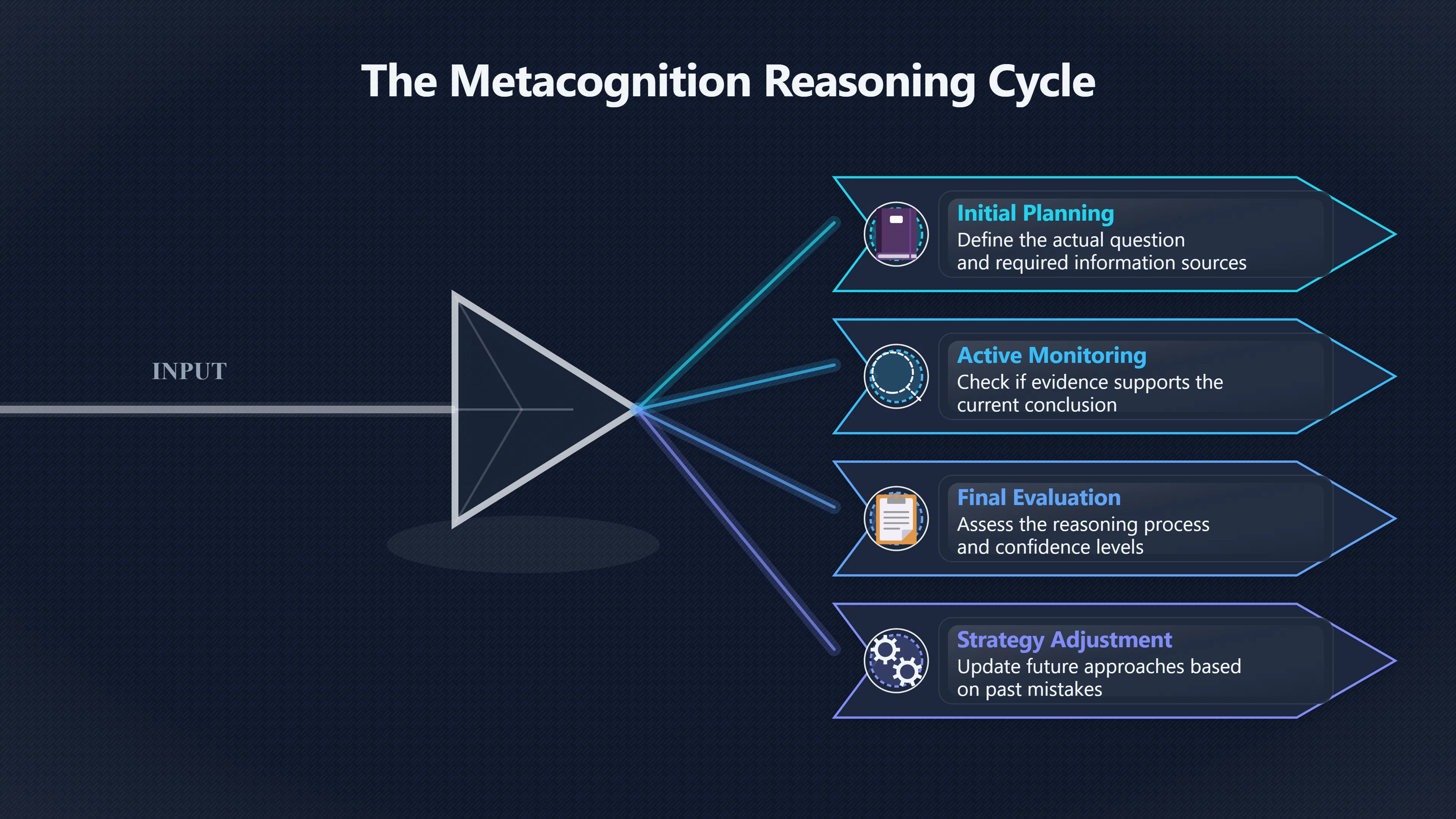
Most modern research organises metacognitive practice into three connected stages: planning, monitoring and evaluation. This cycle is particularly valuable because it can be applied to almost any reasoning task, from analysing scientific evidence to making workplace decisions.
Planning before reasoning begins
Planning occurs before attempting to solve a problem or make a judgement.
Rather than immediately searching for an answer, effective thinkers pause to decide how they will approach the problem. Typical planning questions include:
- What is the actual question?
- What information is required?
- Which sources are likely to be trustworthy?
- Which reasoning strategy fits this problem?
- Which biases am I most vulnerable to here?
This stage prevents a common failure of critical thinking: beginning with an answer and then searching only for supporting evidence.
The Education Endowment Foundation’s guidance on metacognition recommends explicitly teaching learners to choose appropriate strategies before beginning a task rather than assuming effective approaches will emerge automatically. Planning substantially improves later monitoring because people know what success should look like before they begin. [EEF]educationendowmentfoundation.org.ukEEFMetacognition and Self-Regulated LearningThere is a strong body of research from psychology and education demonstrating the importance…
Monitoring while reasoning
Monitoring is the continuous process of checking whether reasoning remains on course.
Instead of waiting until the end, metacognitive thinkers repeatedly ask themselves:
- Does this evidence actually support my conclusion?
- Have I ignored contradictory information?
- Am I becoming emotionally attached to one explanation?
- Have I misunderstood the problem?
- Is another explanation equally plausible?
Monitoring is especially important because human reasoning often feels correct long before it actually is. Many cognitive biases—including confirmation bias, anchoring and motivated reasoning—operate automatically. Monitoring provides opportunities to interrupt these tendencies before they become fixed conclusions.
Effective monitoring also includes recognising uncertainty. Experts frequently outperform novices not because they possess perfect knowledge but because they recognise the limits of what they know.
Evaluating after reaching a conclusion
Evaluation occurs once a judgement has been made.
Rather than asking only whether the answer was correct, metacognitive evaluation asks whether the reasoning process itself deserves confidence.
Useful evaluation questions include:
- What worked well?
- Which assumptions proved incorrect?
- Was the evidence sufficient?
- How accurate was my confidence?
- What would I do differently next time?
Evaluation transforms mistakes into information. Without reflection, people often repeat identical reasoning errors because they remember only the outcome rather than the thinking that produced it.
Evidence reviews consistently describe this planning–monitoring–evaluation cycle as the practical core of metacognitive instruction rather than viewing metacognition as a vague personality characteristic. [ERIC+2Digital Education Resource Archive]files.eric.ed.govERICMetacognition and Self- Regulation: Evidence ReviewMay 12, 2020 — by D Muijs · 2020 · Cited by 280 — Key to effective metacognition is the ability to monitor and regulate learning, to deli…

How feedback exposes hidden reasoning mistakes
One of the most valuable functions of metacognition is improving the relationship between confidence and accuracy.
Psychological research repeatedly demonstrates that people are often poor judges of their own performance. Individuals frequently express high confidence in incorrect answers while remaining uncertain about correct ones. Without feedback, these miscalibrated confidence judgements can persist for years.
Research using the Cognitive Reflection Test—a widely used measure of whether people override intuitive but incorrect responses—shows that many participants substantially overestimate their own reasoning performance. The largest errors often occur among poorer performers, illustrating that people can lack awareness of weaknesses in their own reasoning. [PMC]pmc.ncbi.nlm.nih.govOverconfidence in the Cognitive Reflection Test: Comparing…by A Mata · 2023 · Cited by 18 — This research examines the metacognitiv…
Feedback interrupts this cycle.
Rather than simply informing someone whether an answer is right or wrong, high-quality feedback allows individuals to compare:
- what they predicted, [structural-learning.com]structural-learning.comMetacognitive Monitoring: Fixing Learner Overconfidence4 Mar 2026 — Metacognitive monitoring helps learners judge what they understand…
- how confident they were,
- what actually happened,
- why the reasoning succeeded or failed.
This comparison gradually improves metacognitive calibration.
Recent research suggests that systematic performance feedback can reduce metacognitive blind spots by helping people better estimate their own abilities. Better self-assessment then supports more effective future decisions because individuals become more realistic about when they need additional evidence or expertise. [UC Press Online]online.ucpress.eduUC Press Online Reducing Blind Spots?Performance Feedback Reduces…10 Jun 2025 — Lack of metacognitive awareness (i.e., knowing one's skill level) is one barrier to improvi…
Making reasoning visible
Metacognition is difficult because thinking is largely invisible, even to the thinker.
For this reason, many successful interventions focus on making reasoning explicit rather than simply encouraging people to “think harder.”
Examples include:
- explaining each step of a decision aloud;
- writing down assumptions before analysing evidence;
- predicting confidence before checking the correct answer;
- comparing multiple possible explanations before selecting one;
- keeping short reflection notes after important decisions.
Educational research increasingly emphasises modelling expert thinking rather than merely presenting expert answers. When teachers, mentors or experienced professionals verbalise why they rejected one interpretation, reconsidered evidence or revised a conclusion, they reveal the monitoring process that novices would otherwise never observe. [Research Schools Network+2Life Sciences Education]researchschool.org.ukResearch Schools NetworkMetacognition and Self-Regulated Learning: A School…7 May 2026 — This helped move metacognition away from abstrac…
This approach transfers well beyond education. In workplaces, project reviews increasingly examine not only whether decisions succeeded but also whether the reasoning process was appropriately evidence-based. Aviation, medicine and engineering similarly use structured debriefs because analysing reasoning often prevents future mistakes more effectively than analysing outcomes alone.
Why metacognition improves transfer beyond school
One of the central challenges in critical thinking research is transfer: applying reasoning skills to new situations rather than only familiar classroom exercises.
Metacognition helps because it focuses attention on how thinking is being conducted rather than on memorising specific answers.
For example, someone evaluating:
- a news article,
- an investment proposal,
- a medical headline,
- or a workplace recommendation
cannot rely on identical factual knowledge.
However, they can repeatedly use the same metacognitive routines:
- clarify the question;
- identify assumptions;
- distinguish evidence from interpretation;
- assess confidence;
- seek disconfirming information;
- review the reasoning afterwards.
These routines provide a portable framework that adapts across domains while still recognising that subject knowledge remains essential. Good metacognition cannot compensate for complete ignorance, but it helps people recognise when they lack sufficient knowledge and should seek additional expertise.
The National Academies describe this combination of strategic monitoring and domain knowledge as central to lifelong learning rather than school-only performance. [National Academies]nationalacademies.orgNational AcademiesChapter: 4 Processes That Support LearningThree key ways are through metacognition, executive function, and self-regula…
Common misconceptions
Several misconceptions limit effective use of metacognitive routines.
Metacognition is not endless introspection. Excessive reflection can become counterproductive if it replaces action. Effective metacognition uses brief, purposeful monitoring rather than constant self-analysis.
Metacognition does not replace knowledge. Someone cannot critically evaluate medical research without understanding basic scientific concepts. Metacognitive routines improve the use of knowledge; they cannot substitute for it. [ERIC]files.eric.ed.govERICMetacognition and Self- Regulation: Evidence ReviewMay 12, 2020 — by D Muijs · 2020 · Cited by 280 — Key to effective metacognition is the ability to monitor and regulate learning, to deli…
Good thinkers still make mistakes. The difference is that they are more likely to detect and correct errors after receiving new evidence. Revision is a feature of effective reasoning rather than a sign of weakness.
Confidence is not evidence. One of the most robust findings in judgement research is that subjective certainty often exceeds objective accuracy. Metacognitive monitoring attempts to align confidence more closely with reality instead of rewarding certainty for its own sake. [PMC]pmc.ncbi.nlm.nih.govOverconfidence in the Cognitive Reflection Test: Comparing…by A Mata · 2023 · Cited by 18 — This research examines the metacognitiv…
Building metacognition into everyday decision-making
Metacognitive routines become most effective when they are practised consistently rather than reserved for unusually difficult decisions.
A practical implementation cycle can be kept deliberately simple:
- Pause before deciding. Clarify the question and define success before searching for evidence.
- State assumptions explicitly. Writing assumptions down makes them easier to challenge later.
- Monitor confidence. Estimate how certain you are before verifying the answer.
- Search for contradiction. Deliberately seek evidence that would weaken your preferred explanation rather than only confirming it.
- Review the outcome. After the decision, compare expectations with reality and identify which part of the reasoning proved strongest or weakest.
- Adjust future strategy. Treat every important judgement as feedback for improving the next one rather than as an isolated event.
These routines gradually shift critical thinking from an occasional effort into a repeatable habit. Instead of relying on intuition alone, people learn to observe, question and refine their own reasoning. That habit of deliberate self-monitoring is what allows critical thinking to transfer beyond classrooms into professional judgement, civic decision-making and everyday life. [ERIC+3EEF+3Life Sciences Education]educationendowmentfoundation.org.ukEEFMetacognition and Self-Regulated LearningThere is a strong body of research from psychology and education demonstrating the importance…
Amazon book picks
Further Reading
Books and field guides related to The Habit of Checking Your Own Thinking. Use these as the next step if you want deeper reading beyond the article.
Critical Thinking
Directly covers evaluating evidence, reflecting on reasoning and building reliable thinking habits.
Make It Stick
Shows how metacognitive strategies, feedback and self-testing improve learning and judgement.
The Art of Thinking Clearly
Provides practical examples of cognitive errors that encourage reflective self-checking.
How to Read a Book
Promotes disciplined questioning, self-monitoring and evaluation while engaging with complex ideas.
eBay marketplace picks
Marketplace Samples
Live-tested eBay searches with available results related to this page.




Endnotes
-
Source: educationendowmentfoundation.org.uk
Link: https://educationendowmentfoundation.org.uk/education-evidence/guidance-reports/metacognitionSource snippet
EEFMetacognition and Self-Regulated LearningThere is a strong body of research from psychology and education demonstrating the importance...
-
Source: education.nsw.gov.au
Title: Metacognition: a key to unlocking learning
Link: https://education.nsw.gov.au/content/dam/main-education/teaching-and-learning/education-for-a-changing-world/media/documents/Metacognition_Full_Report_FINAL.pdfSource snippet
February 13, 2025 — This review paper aims to support these goals by assessing the evidence base for the teaching of metacognition as a f...
Published: February 13, 2025
-
Source: files.eric.ed.gov
Title: ERICMetacognition and Self- Regulation: Evidence Review
Link: https://files.eric.ed.gov/fulltext/ED612286.pdfSource snippet
May 12, 2020 — by D Muijs · 2020 · Cited by 280 — Key to effective metacognition is the ability to monitor and regulate learning, to deli...
Published: May 12, 2020
-
Source: pmc.ncbi.nlm.nih.gov
Link: https://pmc.ncbi.nlm.nih.gov/articles/PMC10219213/Source snippet
Overconfidence in the Cognitive Reflection Test: Comparing...by A Mata · 2023 · Cited by 18 — This research examines the metacognitiv...
-
Source: nationalacademies.org
Link: https://www.nationalacademies.org/read/24783/chapter/6Source snippet
National AcademiesChapter: 4 Processes That Support LearningThree key ways are through metacognition, executive function, and self-regula...
-
Source: lifescied.org
Link: https://www.lifescied.org/doi/10.1187/cbe.20-12-0289Source snippet
Strong metacognitive skills have the power to impact student learning and performance.Read more...
-
Source: nationalacademies.org
Link: https://www.nationalacademies.org/projects/DBASSE-BBCSS-13-06Source snippet
How People Learn II: The Science and Practice of Learninglearning and cognitive strategies in children; metacognition and self-regulated...
-
Source: dera.ioe.ac.uk
Link: https://dera.ioe.ac.uk/id/eprint/31617/1/EEF_Metacognition_and_self-regulated_learning.pdf -
Source: online.ucpress.edu
Title: UC Press Online Reducing Blind Spots?
Link: https://online.ucpress.edu/collabra/article/11/1/138652/212095/Reducing-Blind-Spots-Performance-Feedback-ReducesSource snippet
Performance Feedback Reduces...10 Jun 2025 — Lack of metacognitive awareness (i.e., knowing one's skill level) is one barrier to improvi...
-
Source: researchschool.org.uk
Link: https://researchschool.org.uk/essex/news/metacognition-and-self-regulated-learning-a-school-journeySource snippet
Research Schools NetworkMetacognition and Self-Regulated Learning: A School…7 May 2026 — This helped move metacognition away from abstrac...
Published: May 2026
-
Source: educationendowmentfoundation.org.uk
Title: Self-regulated metacognitive strategies to their learning
Link: https://educationendowmentfoundation.org.uk/education-evidence/teaching-learning-toolkit/metacognition-and-self-regulationSource snippet
Metacognition and self-regulationMetacognition is the learner's ability to be aware of, reflect on, and direct their thinking...
-
Source: pmc.ncbi.nlm.nih.gov
Link: https://pmc.ncbi.nlm.nih.gov/articles/PMC11368603/Source snippet
by O Tungalag · 2024 · Cited by 9 — The study primarily aims to explore how young students are using metacognitive strategies in their...
-
Source: researchschool.org.uk
Title: metacognition 5 key changes in the new eef report
Link: https://researchschool.org.uk/blackpool/news/metacognition-5-key-changes-in-the-new-eef-reportSource snippet
Metacognition: 5 key changes in the new EEF report13 Nov 2025 — Metacognition and self-regulation approaches support pupils to think abou...
Additional References
-
Source: researchgate.net
Link: https://www.researchgate.net/publication/256547787_Metacognition_and_self-regulated_learning_in_student-centered_leaning_environmentsSource snippet
(PDF) Metacognition and self-regulated learning in student...17 Feb 2016 — This research indicates that learning with SCLEs is particula...
-
Source: st-michaelangels.lancs.sch.uk
Link: https://www.st-michaelangels.lancs.sch.uk/page/metacognition/146142Source snippet
MetacognitionMetacognition and self-regulation approaches to teaching support pupils to think about their own learning more explicitly.Re...
-
Source: thedecisionlab.com
Link: https://thedecisionlab.com/reference-guide/psychology/metacognitionSource snippet
MetacognitionMetacognition is the ability to think about your own thinking. It's how we plan, monitor, and adjust our learning strategies...
-
Source: alplearning.org.uk
Link: https://alplearning.org.uk/wp-content/uploads/2021/07/ALP-Journal-Issue-3-low-res.pdfSource snippet
Metacognition and self-regulated learningEach session outlined a particular metacognitive strategy, starting with metacogni- tive questio...
-
Source: thinkingmatters.com
Link: https://www.thinkingmatters.com/self-regulated-learning-and-the-meta-learnerSource snippet
Self-Regulated Learning and the Meta-LearnerMetacognition and self-regulated learning now rank as the top educational strategies for high...
-
Source: my.chartered.college
Link: https://my.chartered.college/impact_article/metacognition-self-regulation-and-self-regulated-learning-whats-the-difference/Source snippet
chartered.collegeMetacognition, self-regulation and self-regulated learningby J Mannion · Cited by 30 — Thought processes, emotions, beha...
-
Source: researchgate.net
Link: https://www.researchgate.net/publication/350728794_Dunning-Kruger_Effect_Intuitive_Errors_Predict_Overconfidence_on_the_Cognitive_Reflection_TestSource snippet
non-intuitive errors contribute to overestimation in the CRT at different levels of performance.Read more...
-
Source: chrisquigley.co.uk
Title: the benefits of metacognition and selfregulation in learning
Link: https://www.chrisquigley.co.uk/blog/the-benefits-of-metacognition-and-selfregulation-in-learning/Source snippet
The Benefits of Metacognition and Self-Regulation in...30 Aug 2023 — Metacognition and self-regulation are two key factors that help stu...
-
Source: structural-learning.com
Link: https://www.structural-learning.com/post/metacognitive-monitoring-fixing-studentSource snippet
Metacognitive Monitoring: Fixing Learner Overconfidence4 Mar 2026 — Metacognitive monitoring helps learners judge what they understand...
-
Source: libguides.derby.ac.uk
Title: derby.ac.uk Metacognition: Plan, Monitor and Evaluate
Link: https://libguides.derby.ac.uk/develop-at-derby/self-direction-and-planning/metacognition-plan-monitor-and-evaluateSource snippet
derby.ac.ukMetacognition: Plan, Monitor and Evaluate - Self-Direction...by G Baker · 2025 — The metacognition cycle has three distinct s...
Topic Tree