Within Open Mind
How to Stay Open Without Becoming Gullible
Open-minded thinkers can admit fallibility while still refusing to treat rumours, hunches and evidence as equal.
On this page
- Humility as fallibility, not surrender
- Three outcomes after a fair disagreement
- Standards that protect against both arrogance and softness
Page outline Jump by section
Introduction
Intellectual humility is the ability to recognise that your beliefs could be mistaken without treating every alternative as equally plausible. In real disagreements, this balance matters because two opposite failures are common. One is arrogance: refusing to revise a view regardless of the evidence. The other is gullibility: lowering your standards so far that rumours, confident assertions and well-supported evidence all receive similar respect. The strongest form of open-minded thinking avoids both errors. It keeps beliefs proportionate to the quality of the evidence, remains willing to change when justified, and resists changing merely because someone disagrees. Research increasingly suggests that intellectual humility supports better judgement, greater scrutiny of misinformation and more constructive disagreement, provided it is paired with disciplined standards rather than indiscriminate doubt. Greater Good Science Center+2BPS Psych Hub [ggsc.berkeley.edu]ggsc.berkeley.edu· Education/Learning · Political Dialogue and Polarization · Religion · Susceptibility to Misinformation.Read more…

Humility means accepting fallibility, not surrender
People sometimes misunderstand intellectual humility as thinking, “I might be wrong, therefore I should not trust my own judgement.” That is not what researchers describe.
Instead, intellectual humility is a form of metacognitive awareness: recognising the limits of your knowledge while continuing to evaluate evidence carefully. It involves distinguishing confidence from certainty. You may hold a belief confidently because the evidence is strong while still recognising that future evidence could justify revision. [John Templeton Foundation+2ERIC]templeton.orgJohn Templeton FoundationIntellectual HumilityIntellectual humility is a mindset that guides our intellectual conduct. In particular, it…
This distinction matters because confidence and humility are not opposites. Someone can confidently explain why they believe a medicine works, a bridge is safe, or a scientific theory is well supported while also acknowledging what evidence would make them reconsider. By contrast, someone who refuses to specify what could change their mind is displaying rigidity rather than confidence.
Humility therefore governs how beliefs are held rather than requiring that every belief remain weakly held.
Three possible outcomes after a fair disagreement
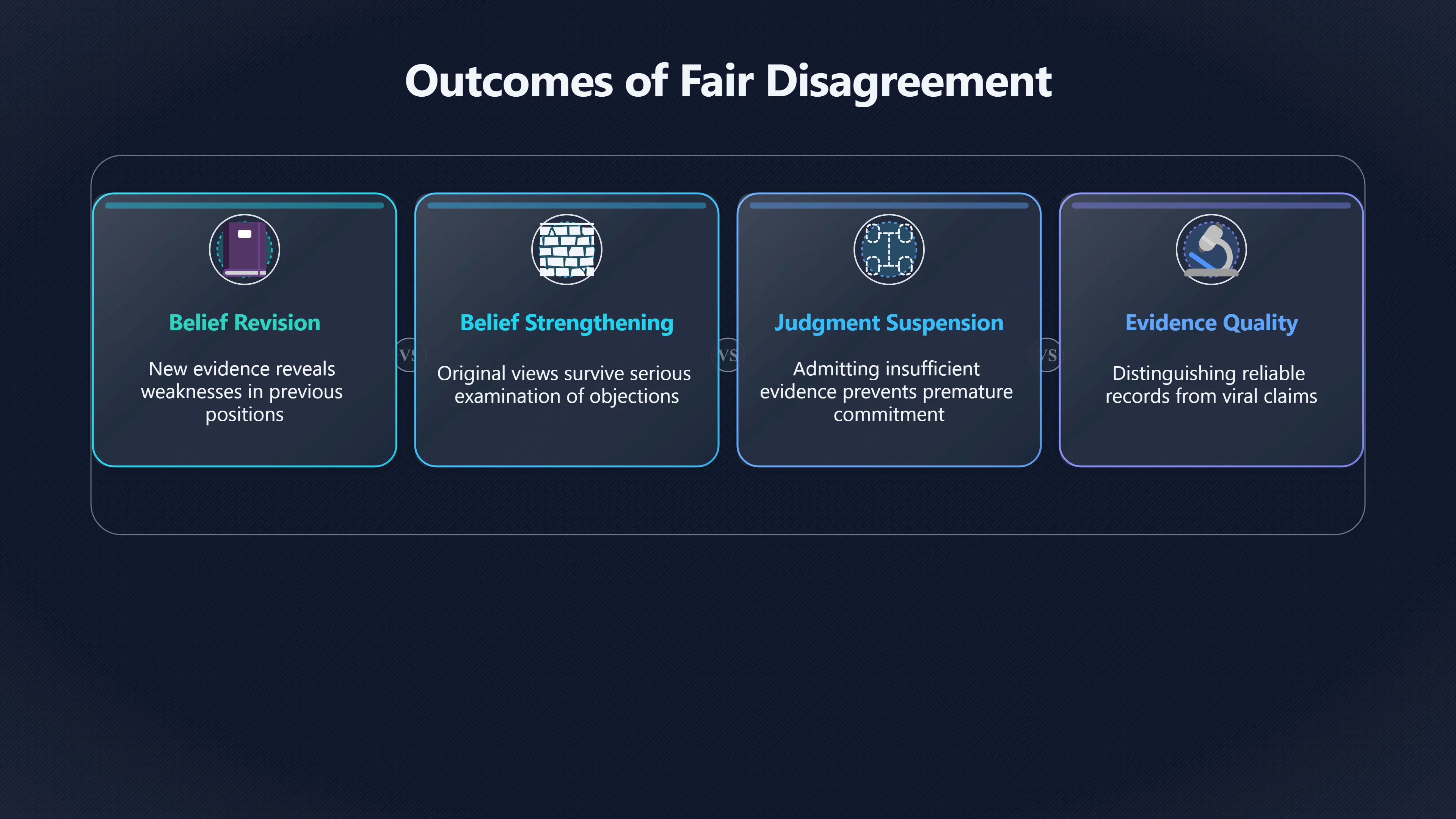
A genuine disagreement is not a contest that always ends with one side changing its mind. When both people apply consistent standards, three legitimate outcomes exist.
You revise your belief. New evidence, stronger reasoning or overlooked facts reveal weaknesses in your previous position. This is the ideal outcome when revision is warranted.
You strengthen your existing belief. After seriously examining objections, you conclude that your original view still best explains the available evidence. Importantly, this is not stubbornness if the opposing arguments were considered fairly rather than dismissed automatically. Philosophical work on disagreement argues that intellectual humility is compatible with remaining unconvinced after honest reflection when your evidence genuinely remains stronger. [Springer]link.springer.comIntellectual humility and the epistemology of disagreementby D Pritchard · 2021 · Cited by 45 — In being willing to reflect on on…
You suspend judgement. Sometimes neither side has sufficient evidence. Admitting “I don’t yet know” is often the most intellectually responsible conclusion. Delaying commitment avoids both premature certainty and premature concession.
These outcomes illustrate why open-mindedness should be measured by the quality of evaluation, not by whether someone changes their opinion.
Standards that protect against both arrogance and softness
The practical challenge is maintaining standards that prevent both dogmatism and excessive credulity.
Several questions act as useful safeguards:
- What is the quality of the evidence? Separate controlled evidence, direct observation and reliable records from anecdotes, speculation or viral claims.
- Would I apply the same standard if this supported the opposite side? This guards against myside bias.
- Is my confidence proportional to the evidence? Strong claims require correspondingly strong support.
- What evidence would genuinely change my view? If no answer exists, the belief may have become unfalsifiable.
- Am I updating because the evidence improved, or because someone sounded confident or socially influential?
These standards function as governance rules for reasoning. Rather than deciding each disagreement emotionally, they establish stable procedures that apply regardless of whose claim is under examination.
Why humility usually reduces gullibility rather than increasing it
A common fear is that admitting uncertainty makes people easier to deceive. Recent research generally points in the opposite direction.
People scoring higher on measures of intellectual humility tend to examine questionable claims more carefully, seek corroborating information and show lower susceptibility to fake news, conspiracy theories and some forms of misinformation. Importantly, these effects appear to reflect improved discrimination between reliable and unreliable claims rather than a blanket tendency to reject everything. In other words, intellectually humble individuals become better at telling true information from false information instead of simply becoming more sceptical overall. Open Encyclopedia of Cognitive Science+3Advances.in+3Greater Good Science Center [advances.in]advances.inHowever, a key aspect of…Read more…
One proposed explanation is straightforward. Recognising that you may be mistaken creates a reason to verify claims before accepting them. Instead of assuming either “I’m obviously right” or “everyone’s opinion is equally valid”, intellectually humble people are more likely to ask whether the evidence actually supports the claim.
When humility becomes excessive
Although humility is generally beneficial, recent philosophical work highlights an important qualification: too much humility can become counterproductive.
If people systematically reduce confidence even in beliefs supported by overwhelming evidence, they may become vulnerable to manufactured doubt. Someone who repeatedly treats expert consensus and unsupported speculation as equally deserving of reconsideration can end up less accurate rather than more open-minded. Experimental evidence suggests that inducing excessive humility may sometimes lower confidence in justified beliefs more than warranted. [PMC]pmc.ncbi.nlm.nih.govPMCToo humble for wordsby N Levy · 2023 · Cited by 18 — In this paper, I argue that an excess of humility also plays a role in allowing for the spread of mis…
This is particularly relevant in environments saturated with misinformation. Endless demands to “keep an open mind” can function rhetorically to blur distinctions between evidence-based conclusions and unsupported alternatives.
Healthy humility therefore includes an equally important companion principle: willingness to revise does not require reopening settled questions every time an unsupported claim appears.
Recognising when a claim deserves serious reconsideration
Not every disagreement merits the same level of investigation.
Reconsideration becomes more appropriate when:
- new empirical evidence emerges;
- multiple independent, credible sources converge on the same finding;
- recognised experts revise their previous position after new research;
- previously overlooked assumptions in your reasoning are exposed.
By contrast, simple repetition, social popularity, emotional appeal or confidence alone provide little reason to alter well-supported beliefs.
This distinction keeps inquiry responsive without allowing attention itself to become evidence.
A practical mindset for difficult conversations
During real disagreements, intellectual humility can be expressed through questions rather than immediate concessions.
Useful habits include asking:
- “What evidence convinced you?” [advances.in]advances.inIn both academic and public discourse, several terms are used to describe false content, and their…
- “What would change your mind?”
- “Am I evaluating both sides by the same criteria?”
- “Is there a difference between uncertainty and lack of evidence?”
These questions encourage reciprocal accountability. They communicate openness to learning while preserving the expectation that beliefs should earn confidence through evidence rather than assertion.
The goal is not perpetual doubt. It is calibrated belief: confidence that rises and falls with the quality of the available evidence. Intellectual humility succeeds when it makes people easier to correct, harder to mislead and more consistent in the standards they apply to themselves and to others.
Amazon book picks
Further Reading
Books and field guides related to How to Stay Open Without Becoming Gullible. Use these as the next step if you want deeper reading beyond the article.
The Scout Mindset
Directly addresses open-mindedness, updating beliefs, and balancing confidence with evidence.
How Minds Change
Explores how people change deeply held beliefs while emphasizing curiosity, humility, and evidence.
The Demon-Haunted World
Rating: 4.5/5 from 43 Google Books ratings
Promotes open inquiry while maintaining rigorous standards of evidence to avoid gullibility.
Mistakes Were Made (but Not by Me)
Shows why people resist changing beliefs and how intellectual humility can overcome self-justification.
eBay marketplace picks
Marketplace Samples
Live-tested eBay searches with available results related to this page.



Endnotes
-
Source: pmc.ncbi.nlm.nih.gov
Title: PMCPredictors and consequences of intellectual humility
Link: https://pmc.ncbi.nlm.nih.gov/articles/PMC9244574/Source snippet
Soc. Psychol. Personal. Sci. 2021 doi: 10.1177/1948550620988242. [DOI] [Google Scholar]...
-
Source: templeton.org
Link: https://www.templeton.org/discoveries/intellectual-humilitySource snippet
John Templeton FoundationIntellectual HumilityIntellectual humility is a mindset that guides our intellectual conduct. In particular, it...
-
Source: eric.ed.gov
Title: ERICOpen-Mindedness and Intellectual Humility
Link: https://eric.ed.gov/?id=EJ959729Source snippet
I explain why both of these traits are intellectual virtues and how they properly build off...Read more...
-
Source: link.springer.com
Link: https://link.springer.com/article/10.1007/s11229-018-02024-5Source snippet
Intellectual humility and the epistemology of disagreementby D Pritchard · 2021 · Cited by 45 — In being willing to reflect on on...
-
Source: advances.in
Link: https://advances.in/psychology/10.56296/aip00025/Source snippet
However, a key aspect of...Read more...
-
Source: pmc.ncbi.nlm.nih.gov
Title: PMCToo humble for words
Link: https://pmc.ncbi.nlm.nih.gov/articles/PMC10541816/Source snippet
by N Levy · 2023 · Cited by 18 — In this paper, I argue that an excess of humility also plays a role in allowing for the spread of mis...
-
Source: advances.in
Link: https://advances.in/psychology/10.56296/knowledge-hub/psychology-of-misinformation/Source snippet
In both academic and public discourse, several terms are used to describe false content, and their...
-
Source: ggsc.berkeley.edu
Link: https://ggsc.berkeley.edu/what_we_do/major_initiatives/intellectual_humility/introduction_intellectual_humility_researchSource snippet
· Education/Learning · Political Dialogue and Polarization · Religion · Susceptibility to Misinformation.Read more...
-
Source: bpspsychub.onlinelibrary.wiley.com
Link: https://bpspsychub.onlinelibrary.wiley.com/doi/10.1111/bjso.12732Source snippet
BPS Psych HubIntellectual humility as a tool to combat false beliefs: An...Feb 29, 2024 — In an effort to combat such misinformation and...
-
Source: oecs.mit.edu
Title: Open Encyclopedia of Cognitive Science Intellectual Humility
Link: https://oecs.mit.edu/pub/tstdnja3Source snippet
Open Encyclopedia of Cognitive ScienceIntellectual Humility - Open Encyclopedia of Cognitive ScienceJan 24, 2025 — Further, IH is associa...
-
Source: drcharlesmrusso.substack.com
Title: intellectual humility
Link: https://drcharlesmrusso.substack.com/p/intellectual-humilitySource snippet
Humility - by Dr. Charles M. Russo, PhDMisinformation & disinformation contexts: As analysts are increasingly asked to evaluate contested...
Additional References
-
Source: cambridge.org
Link: https://www.cambridge.org/core/journals/episteme/article/intellectual-humility-without-openmindedness-how-to-respond-to-extremist-views/2FB33B15521127B2EB763FE24D73B394Source snippet
misinformation to third-parties, and increase the availability of... (3) We argued that responding open-mindedly to extremist views can...
-
Source: skepticalinquirer.org
Link: https://skepticalinquirer.org/2020/09/intellectual-humility-a-guiding-principle-for-the-skeptical-movement/Source snippet
approach to evidence that the skeptical movement may wish to embrace as a guiding credo...Read more...
-
Source: reddit.com
Link: https://www.reddit.com/r/philosophy/comments/514lxn/open_mindedness_is_not_a_theoretical_position_but/Source snippet
terized by epistemic humility and adherence to a general ideal of intellectual...Read more...
-
Source: researchgate.net
Link: https://www.researchgate.net/publication/359133100_Clarifying_the_Relations_between_Intellectual_Humility_and_Pseudoscience_Beliefs_Conspiratorial_Ideation_and_Susceptibility_to_Fake_NewsSource snippet
nd conspiratorial beliefs (Bowes and Tasimi, 2022) and more factchecking behavior...
-
Source: powerofusnewsletter.com
Title: think youre open minded test yourself
Link: https://www.powerofusnewsletter.com/p/think-youre-open-minded-test-yourselfSource snippet
The Science of Knowing What You Don't KnowDec 11, 2025 — People who score high on these measures are less likely to spread conspiracy the...
-
Source: youtube.com
Title: Why People Believe Misinformation: The Psychology of Fear | Beyond the Books
Link: https://www.youtube.com/watch?v=_7otmig_7CoSource snippet
False: How Mistrust, Disinformation, and Motivated Reasoning Make Us Believe Things That Aren't True...
-
Source: youtube.com
Link: https://www.youtube.com/watch?v=c6OTuVoPRHASource snippet
What is intellectual humility? | John Lennox & George Church...
-
Source: youtube.com
Title: Intellectual humility: the rewards of being willing to change your mind
Link: https://www.youtube.com/watch?v=GUnIWyUwi6gSource snippet
Why People Believe Misinformation: The Psychology of Fear | Beyond the Books...
-
Source: youtube.com
Title: Intellectual humility is a key skill for tomorrow’s leaders
Link: https://www.youtube.com/watch?v=AeZoN4o1qxUSource snippet
Intellectual humility: the rewards of being willing to change your mind...
-
Source: journals.sagepub.com
Link: https://journals.sagepub.com/doi/10.1177/01461672251328800Source snippet
Tyler J. Hubeny...by TJ Hubeny · Cited by 19 — Actively open-minded thinking is key to combating fake news: A multimethod study. Informa...
Topic Tree
Follow this branch
Parent topic
Open Mind What Open Minded Thinking Actually RequiresRelated pages 5
- False Balance When Fairness Turns Into False Balance
- Myside Bias Why Unfriendly Evidence Feels Less Convincing
- Opposite Test The Question That Interrupts Defensive Reasoning
- Receptive Listening Listen First Without Surrendering Your Standards
- Steelmanning Can Your View Survive the Strongest Objection?