Within Lateral Reading
When looking it up makes misinformation stronger
Searching a false claim can backfire when low-quality pages repeat the same rumour and make it feel independently confirmed.
On this page
- How data voids create false corroboration
- Why repeated rumours can feel like evidence
- How source aware searching reduces the risk
Page outline Jump by section
Introduction
Looking up a doubtful claim on the web is often recommended as a sensible fact-checking habit. However, research now shows that searching is not automatically protective. Under some conditions, searching for evidence can make false claims seem more believable because search results may surface many low-quality pages repeating the same rumour, creating the impression of independent confirmation. This matters for lateral reading because the goal is not simply to open more tabs, but to find genuinely independent and authoritative evidence rather than counting how many pages appear to agree. Recent studies suggest that search is most reliable when users pay attention to where information comes from, not merely whether they can find multiple mentions of the claim. [Nature]nature.comOnline searches to evaluate misinformation can increase…by K Aslett · 2024 · Cited by 176 — We present consistent evidence that…

How data voids create false corroboration
One of the clearest demonstrations of this problem comes from a series of experiments published in Nature. Researchers asked participants to judge the truthfulness of news stories, with some participants encouraged to search online before making their judgement. Contrary to expectations, searching increased belief in false stories across multiple experiments. [Nature]nature.comOnline searches to evaluate misinformation can increase…by K Aslett · 2024 · Cited by 176 — We present consistent evidence that…
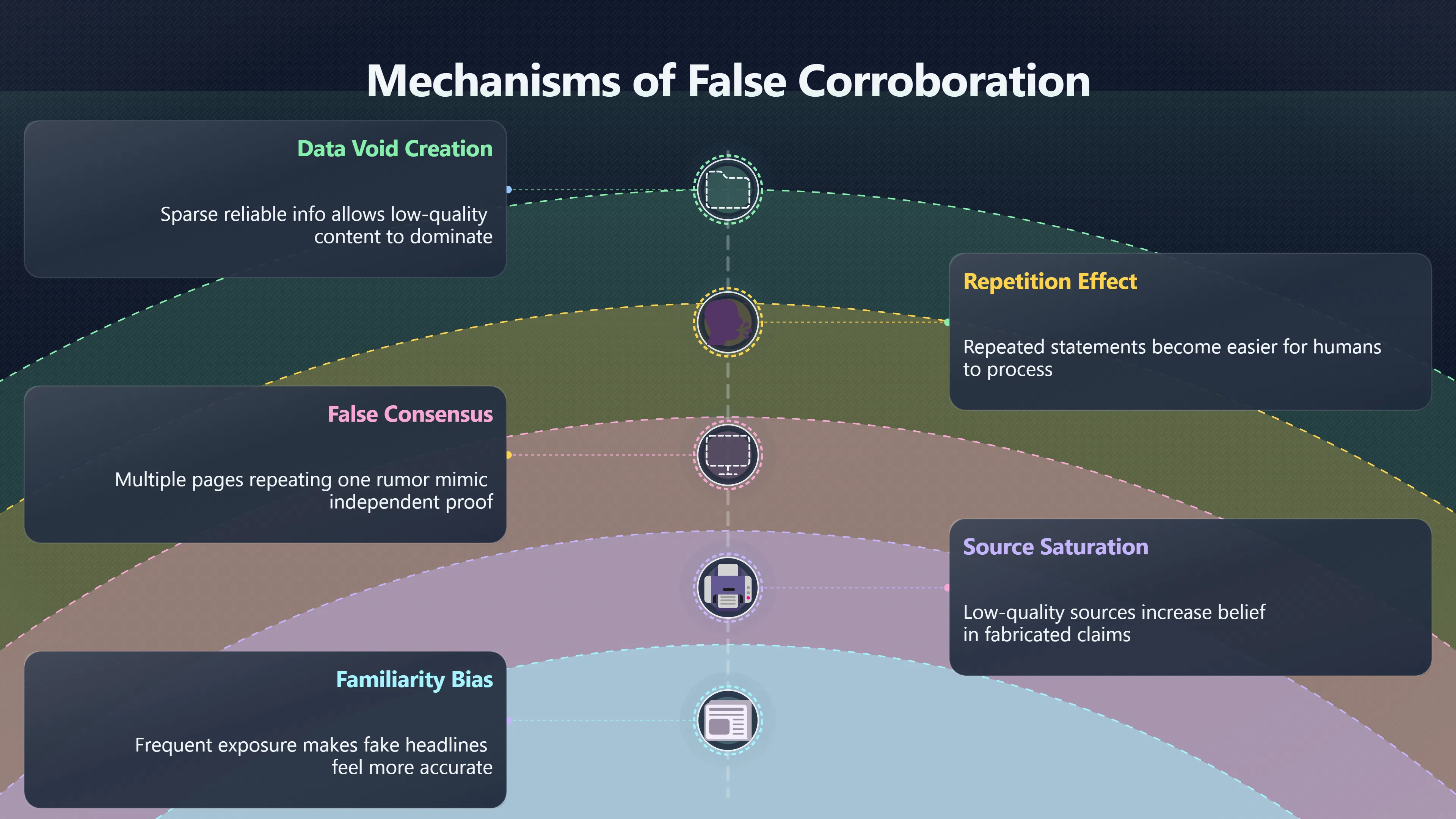
The researchers traced much of this effect to what they called data voids. A data void is an area of the web where reliable information is sparse but low-quality content is plentiful. This often happens with:
- newly emerging rumours;
- obscure conspiracy claims;
- fabricated quotations;
- invented scientific discoveries;
- misleading interpretations of breaking news.
When people search these topics, search engines may retrieve numerous pages that repeat the same unsupported story. Although these pages are not truly independent, their sheer number can create the illusion that the claim has been widely verified. The result is false corroboration—apparent agreement that comes from repetition rather than independent evidence. [Nature]nature.comOnline searches to evaluate misinformation can increase…by K Aslett · 2024 · Cited by 176 — We present consistent evidence that…
Importantly, the research found that the effect was strongest for users whose searches returned lower-quality sources. This suggests that the problem is not searching itself, but searching within an information environment dominated by poor evidence. [Nature]nature.comOnline searches to evaluate misinformation can increase…by K Aslett · 2024 · Cited by 176 — We present consistent evidence that…
Why repeated rumours can feel like evidence
Human judgement is influenced not only by evidence but also by familiarity. Psychologists refer to this as the illusory truth effect: repeated statements become easier to process mentally, and that increased fluency can make them feel more credible even when they are false.
Experiments by Gordon Pennycook, David Rand and colleagues found that even a single previous exposure to fake news headlines increased later perceptions of their accuracy. The effect persisted after a week and appeared even when headlines had previously been labelled as disputed or conflicted with participants’ political views. [PMC]pmc.ncbi.nlm.nih.govPrior exposure increases perceived accuracy of fake newsby G Pennycook · 2018 · Cited by 2009 — We show that even a single exposure in…
Searching online can unintentionally amplify this mechanism in two ways.
- First, a search exposes users to multiple versions of the same claim across different websites.
- Second, each repeated encounter increases familiarity, making later evaluations feel more intuitive even though the underlying evidence has not improved.
Crucially, ten websites repeating the same rumour do not constitute ten independent pieces of evidence. Many pages copy one another, quote the same original post, or rely on a single unverified source. Counting webpages rather than tracing evidence creates a misleading sense of consensus. [PMC]pmc.ncbi.nlm.nih.govPrior exposure increases perceived accuracy of fake newsby G Pennycook · 2018 · Cited by 2009 — We show that even a single exposure in…
How source-aware searching reduces the risk
The lesson is not that people should avoid searching. Instead, research suggests that searches become more effective when they are source-aware rather than claim-counting.
Instead of asking, “How many pages say this?”, lateral readers ask questions such as:
- Who first made this claim?
- Are multiple sources actually independent?
- Do recognised experts or institutions address it?
- Is every page ultimately pointing back to the same original rumour?
This changes the task from collecting agreement to evaluating evidence quality.
A practical example illustrates the difference. Suppose a search returns twenty blogs repeating a sensational medical claim and one review from a recognised medical authority explaining why the evidence is weak. Simply counting pages suggests broad agreement with the rumour. Source-aware searching instead recognises that the twenty blogs are not independent evidence, whereas the expert review summarises the underlying research.
Professional fact-checkers similarly use lateral reading to investigate publishers, organisations and evidence chains rather than remaining within a cluster of pages discussing the same claim. Studies of lateral reading show that this habit can be taught and substantially improves people’s ability to judge online credibility. [Misinformation Review+2SSRN]misinforeview.hks.harvard.eduMisinformation Review Lateral reading: College students learn to criticallyMisinformation ReviewLateral reading: College students learn to critically…February 23, 2021 — 23 Feb 2021 — A small body of research…
What this means for checking web credibility
The recent evidence slightly changes the common advice to “just Google it.” Searching can improve understanding when reliable sources dominate the results, but it can also strengthen misinformation when search results are saturated with copied rumours or low-quality pages.
For practical fact-checking, the safest approach is to treat search as a way to locate better evidence, not simply more mentions. Rather than stopping after seeing apparent agreement across multiple websites, ask whether those sites represent independent reporting, primary evidence, recognised expertise or merely repeated versions of the same unsupported story. That distinction lies at the heart of effective lateral reading and helps prevent online searches from turning repetition into false confidence. [Nature+2MPG Files]nature.comOnline searches to evaluate misinformation can increase…by K Aslett · 2024 · Cited by 176 — We present consistent evidence that…
eBay marketplace picks
Marketplace Samples
Live-tested eBay searches with available results related to this page.



Endnotes
-
Source: nature.com
Link: https://www.nature.com/articles/s41586-023-06883-ySource snippet
Online searches to evaluate misinformation can increase...by K Aslett · 2024 · Cited by 176 — We present consistent evidence that...
-
Source: files-mis.mpg.de
Title: D4.2 SoMe4Dem
Link: https://files-www.mis.mpg.de/mpi-typo3/SoMe4Dem/Deliverables/D4.2_SoMe4Dem.pdfSource snippet
MPG FilesBoosting media literacy using lateral reading and online...by L Oswald · 2025 · Cited by 1 — However, recent evidence demonstra...
-
Source: pmc.ncbi.nlm.nih.gov
Link: https://pmc.ncbi.nlm.nih.gov/articles/PMC10794132/Source snippet
searches to evaluate misinformation can increase its...by K Aslett · 2023 · Cited by 176 — We present consistent evidence that online se...
-
Source: pmc.ncbi.nlm.nih.gov
Link: https://pmc.ncbi.nlm.nih.gov/articles/PMC6279465/Source snippet
Prior exposure increases perceived accuracy of fake newsby G Pennycook · 2018 · Cited by 2009 — We show that even a single exposure in...
-
Source: papers.ssrn.com
Link: https://papers.ssrn.com/sol3/papers.cfm?abstract_id=3048994Source snippet
Less and Learning More When Evaluating Digital...by S Wineburg · 2019 · Cited by 88 — The Internet has democratized access to informatio...
-
Source: papers.ssrn.com
Link: https://papers.ssrn.com/sol3/papers.cfm?abstract_id=2958246Source snippet
Exposure Increases Perceived Accuracy of Fake Newsby G Pennycook · 2018 · Cited by 2008 — We show that even a single exposure increases s...
-
Source: misinforeview.hks.harvard.edu
Title: Misinformation Review Lateral reading: College students learn to critically
Link: https://misinforeview.hks.harvard.edu/article/lateral-reading-college-students-learn-to-critically-evaluate-internet-sources-in-an-online-course/Source snippet
Misinformation ReviewLateral reading: College students learn to critically...February 23, 2021 — 23 Feb 2021 — A small body of research...
Published: February 23, 2021
-
Source: pmc.ncbi.nlm.nih.gov
Link: https://pmc.ncbi.nlm.nih.gov/articles/PMC8224890/Source snippet
of individuals' belief in fake news: A scoping...by K Bryanov · 2021 · Cited by 304 — In this scoping review, we summarize the results o...
-
Source: dadun.unav.edu
Link: https://dadun.unav.edu/server/api/core/bitstreams/75296a69-6ac4-45b2-8018-8280e7781b66/contentSource snippet
Repeated Lies: The Impact of Fact-Checking on...by I Larraz · 2024 · Cited by 13 — Abstract. The rise of repeated false claims within po...
Additional References
-
Source: researchgate.net
Link: https://www.researchgate.net/publication/376684904_Online_searches_to_evaluate_misinformation_can_increase_its_perceived_veracitySource snippet
(PDF) Online searches to evaluate misinformation can...20 Dec 2023 — We present consistent evidence that online search to evaluate the t...
-
Source: law.stanford.edu
Title: online searches to evaluate misinformation can increase its perceived veracity
Link: https://law.stanford.edu/publications/online-searches-to-evaluate-misinformation-can-increase-its-perceived-veracity/Source snippet
searches to evaluate misinformation can increase its...20 Dec 2023 — We present consistent evidence that online search to evaluate the t...
-
Source: carnegieendowment.org
Title: countering disinformation effectively an evidence based policy guide
Link: https://carnegieendowment.org/research/2024/01/countering-disinformation-effectively-an-evidence-based-policy-guideSource snippet
Countering Disinformation Effectively: An Evidence-Based...31 Jan 2024 — A high-level, evidence-informed guide to some of the major prop...
-
Source: researchgate.net
Title: 317069544 Prior Exposure Increases Perceived Accuracy of Fake News
Link: https://www.researchgate.net/publication/317069544_Prior_Exposure_Increases_Perceived_Accuracy_of_Fake_NewsSource snippet
Prior Exposure Increases Perceived Accuracy of Fake News9 Feb 2026 — Using actual fake news headlines presented as they were seen on Face...
-
Source: mdpi.com
Link: https://www.mdpi.com/2227-7080/12/11/222Source snippet
Fake News Detection Revisited: An Extensive Review of...by S Harris · 2024 · Cited by 51 — This review evaluates the available datasets...
-
Source: news.mit.edu
Title: study twitter false news travels faster true stories 0308
Link: https://news.mit.edu/2018/study-twitter-false-news-travels-faster-true-stories-0308Source snippet
mit.eduStudy: On Twitter, false news travels faster than true stories8 Mar 2018 — A new study by three MIT scholars has found that false...
-
Source: Tech Policy Press
Title: new research suggests online search can increase belief in misinformation
Link: https://techpolicy.press/new-research-suggests-online-search-can-increase-belief-in-misinformationSource snippet
New Research Suggests Online Search Can Increase...20 Dec 2023 — Thus, the overarching finding suggests that online searches to evaluate...
-
Source: youtube.com
Title: Can We Rebuild Trust in the Information Environment?
Link: https://www.youtube.com/watch?v=G6gG3UGes1YSource snippet
This video discussion features the executive director of NYU's Center for Social Media and Politics as they examine the critical intersec...
-
Source: youtube.com
Title: Doing your own research can actually make you believe in misinformation further!
Link: https://www.youtube.com/watch?v=s0OVy8HsX_USource snippet
The Future of Search Engines in the Age of AI...
-
Source: youtube.com
Title: Ep 82: Josh Tucker on the Complex Truth About Social Media
Link: https://www.youtube.com/watch?v=jIj_XSBZAFMSource snippet
Beyond Facebook and Twitter: The Impact of New and Niche Platforms...
Topic Tree