Within Sharper Thinking
Trustworthy Source or Friendly Source?
Reliable analysis separates whether a source is trustworthy from whether it says what you hoped to hear.
On this page
- Signals of source quality
- Why agreement is not reliability
- Cross checking claims without cynicism
Page outline Jump by section
Introduction
A source can be trustworthy without agreeing with you, and a source can agree with you while being weak, careless, conflicted or simply wrong. The skill is to separate source quality from source agreement: first ask whether the source is in a position to know, uses sound methods, shows its evidence and has accountability; only then ask how its claim fits with other evidence. This matters because poor analysis often begins with a comfortable shortcut: “several sources say the same thing” becomes “it must be reliable”, or “this source disputes my view” becomes “it must be biased”.
Better thinking does not mean distrusting everything. It means checking whether agreement is independent, evidence-based and proportionate. A cluster of copied claims is not the same as corroboration. A lone high-quality source may be more useful than ten friendly repeats. And when strong sources disagree, the right response is not cynicism, but slower analysis: inspect methods, incentives, expertise, uncertainty and what each source is actually claiming.
The useful distinction: quality asks “can it know?”, agreement asks “does it match?”
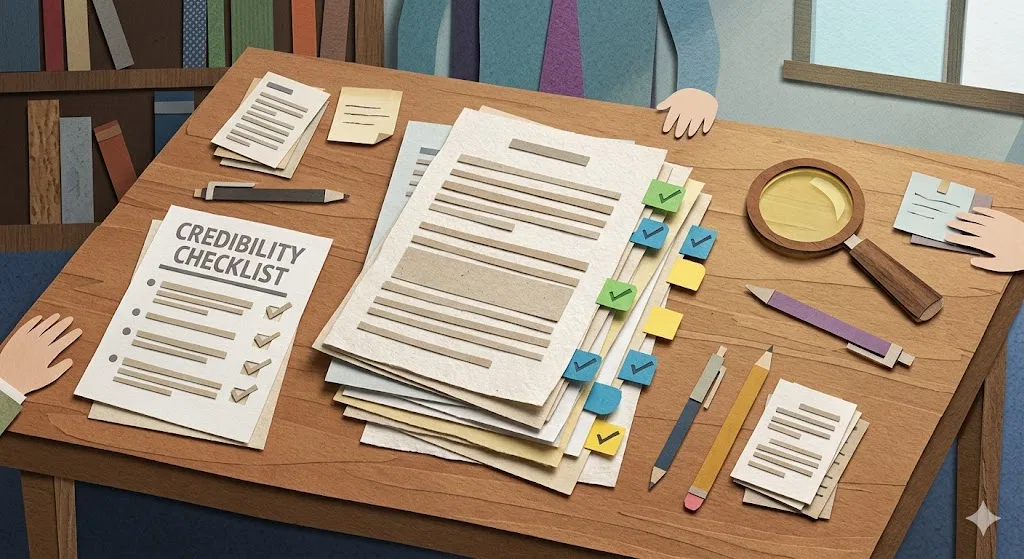
Source quality is about the source’s capacity and discipline. Does it have relevant expertise? Does it identify where the information came from? Is it transparent about uncertainty? Does it correct errors? Is it accountable to a professional, scientific, legal or editorial standard? These questions are different from whether the source supports your preferred conclusion.
Professional news standards make this distinction visible. Reuters says named sources should be used where possible because they are accountable for what they provide, while also stressing that the organisation remains responsible for accuracy and balance. The Associated Press says it tries to identify all sources and uses anonymity only when the source is reliable, in a position to know, and providing vital information rather than opinion or speculation. The BBC’s accuracy guidance warns that even normally reliable web sources may be wrong, and that user-generated or interest-group material may need corroboration before use. [Reuters Agency+2The Associated Press]reutersagency.comReuters AgencyReuters Journalistic StandardsUse named sources wherever possible because they are responsible for the information they pro…
Agreement, by contrast, is about fit with other claims. A source may agree with many others because the evidence is strong. It may also agree because everyone is relying on the same press release, wire copy, rumour, dataset, flawed paper, institutional incentive or social media post. For analytical thinking, agreement becomes powerful only when it comes from sources that reached the conclusion through sufficiently independent routes.
A practical example: three websites repeating that a policy changed yesterday may feel like confirmation. But if all three cite the same anonymous post, that is one evidential pathway, not three. A government notice, a primary legal text, a trade body update and a reputable report that checked the policy separately would carry more weight because they provide different kinds of access to the claim.
Signals of source quality
High-quality sources are not perfect sources. They are sources with better odds of being accurate because their incentives, methods and accountability make errors more likely to be caught. The most useful signals are concrete rather than cosmetic.
Proximity to the evidence. A source that directly observed an event, collected the data, issued the policy, ran the experiment or holds the document usually has a different status from a source commenting at a distance. Proximity is not enough on its own: eyewitnesses misremember, officials frame events strategically, and researchers can make mistakes. But proximity helps answer the first question: “How could this source know?”
Transparent method. Strong sources show how they reached a claim. Scientific papers describe methods, samples and limitations. Courts and public bodies publish documents or procedural records. Reputable journalism explains sourcing, gives context and distinguishes confirmed information from what remains unknown. The National Academies’ report on reproducibility and replicability defines replicability as obtaining consistent results across studies that use their own data to answer the same scientific question, which is a useful reminder that strong evidence is not merely repeated wording but repeated inquiry. [National Academies]nationalacademies.orgNational AcademiesReproducibility and Replicability in Science (2019)Replicability is obtaining consistent results across studies aimed a…
Accountability and correction. A source with an editorial process, peer review, public correction policy, audit trail or professional risk for getting things wrong is generally more valuable than a source that can publish and disappear. This does not mean institutions are always right. It means they often leave more evidence for readers to inspect: authorship, publication date, version history, funding, conflicts, corrections and criticism.
Relevant expertise. Expertise must fit the claim. A Nobel physicist is not automatically a good source on election law; a local eyewitness is not automatically a good source on epidemiology; a journalist with excellent political contacts may still be weak on statistical inference. The key is not prestige in general, but whether the source’s competence matches the question.
Incentive clarity. Bias is not only lying. Research on source perception distinguishes bias from untrustworthiness: a source may be sincere but still systematically skewed by loyalties, incentives, ideology, commercial interest or limited perspective. That is why a reader should ask not only “is this source honest?” but also “what would this source tend to notice, omit or emphasise?” [ResearchGate]researchgate.netResearch Gate(PDF) When Sources Honestly Provide Their Biased OpinionResearchGate(PDF) When Sources Honestly Provide Their Biased OpinionJuly 8, 2019 — Three studies demonstrate that source bias can have a…

Why agreement is not reliability
Agreement feels like reliability because, in everyday life, repeated claims often are useful signals. If several independent mechanics diagnose the same problem, or several weather services forecast rain, agreement is meaningful. The danger is that digital information often creates the appearance of independent agreement without the reality of it.
The first trap is duplication. Online claims are easily copied, syndicated, scraped, summarised and reposted. A claim that appears on twenty pages may have one origin. This is especially risky with breaking news, viral screenshots, health claims, investment rumours and political allegations, where speed rewards repetition before verification.
The second trap is shared upstream evidence. Sources can be independent organisations but still depend on the same dataset, official briefing, advocacy report or flawed study. In science, this is one reason replication matters: repeating the same analysis on the same data is not as strong as obtaining consistent results from new data or different methods. The National Academies distinguishes reproducibility, which involves getting consistent computational results from the same data and code, from replicability, which requires separate studies with their own data. [National Academies]nationalacademies.orgNational AcademiesReproducibility and Replicability in Science2019 · Cited by 1207 — As the result of a mandate from Congress, the Nation…
The third trap is social proof. People often treat agreement as more persuasive when the agreement flatters what they already believe. Raymond Nickerson’s classic review describes confirmation bias as seeking or interpreting evidence in ways partial to existing beliefs, expectations or hypotheses. In practice, this means a reader may call agreement “consensus” when it supports them and “groupthink” when it does not. [UC San Diego Pages]pages.ucsd.eduUC San Diego Pages Confirmation Bias: A Ubiquitous Phenomenon in ManyUC San Diego Pages Confirmation Bias: A Ubiquitous Phenomenon in Many
The fourth trap is low-quality consensus. A crowd can converge on a claim because it is emotionally satisfying, easy to understand or socially rewarded. Expert agreement can be highly informative, but its value rises when experts are using strong methods, working from evidence, exposing claims to criticism and retaining enough independence to avoid merely echoing one another. Philosophical work on expert independence makes the same point in abstract form: agreement among autonomous experts is generally more reliable than agreement produced by dependence, deference or a narrow shared perspective. [Cambridge University Press & Assessment]cambridge.orgOpen source on cambridge.org.
The strongest agreement has independent routes to the same answer
The best kind of agreement is not many people saying the same sentence. It is different evidence streams converging.
For a factual claim, independent routes might include:
- A primary document that establishes what was formally said, filed, passed, paid or recorded.
- A knowledgeable human source with direct access, named where possible or carefully described where anonymity is justified.
- A reputable secondary source that checked the claim rather than merely repeating it.
- A dataset or measurement that can be inspected, reproduced or compared.
- A dissenting or affected party’s response, especially when a claim is adverse or contested.
This is why good verification practice often sounds cautious. The AP says anonymous sourcing normally requires more than one source and that stories should be held while attempts are made to obtain confirmation or elaboration. Reuters says single anonymous-source stories are exceptional and require special authorisation when the source has direct knowledge and the information is credible. These rules are not rituals; they are safeguards against mistaking access, confidence or agreement for truth. [The Associated Press]ap.orgOpen source on ap.org.
Scientific inquiry has a parallel safeguard. A single study can be valuable, but confidence grows when findings survive different researchers, samples, instruments and assumptions. The National Academies’ framing of replication is helpful for everyday reasoning because it gives a general principle: agreement matters more when it is produced by separate attempts to answer the same question, not by repeated citation of the same answer. [National Academies]nationalacademies.orgNational AcademiesReproducibility and Replicability in Science (2019)Replicability is obtaining consistent results across studies aimed a…
“Friendly source” thinking: how agreement misleads analysis
A friendly source is not necessarily a bad source. It is a source that says what you are already inclined to accept. The risk is that friendliness can imitate quality.
One common pattern is selective upgrading: a reader notices the credentials, professionalism or detailed tone of a friendly source, but applies much harsher scrutiny to an unfriendly one. Another is asymmetric scepticism: “my side’s source has a few flaws but is broadly right; the other side’s source has a flaw, therefore it can be ignored.” Over time, this produces a distorted evidence map in which agreeable weak sources accumulate and disagreeable strong sources are discounted.
This is where analytical skill becomes metacognitive: the task is not only to evaluate the source, but to evaluate your reaction to the source. A useful test is to reverse the conclusion. If the same source, method and evidence supported the opposite claim, would you still treat it as strong? If not, the issue may be agreement rather than quality.
Research on online credibility evaluation shows why this matters. Stanford’s civic online reasoning work found that students often struggled to evaluate digital sources, while later studies found that instruction in lateral reading can improve people’s ability to assess online information. Lateral reading means leaving the original page to check what other credible sources say about the source and claim, rather than being seduced by the page’s own design, tone or self-description. Stanford Graduate School of Education+2Misinformation Review [ed.stanford.edu]ed.stanford.eduit doesn t take long learn how spot misinformation online stanford study findsit doesn t take long learn how spot misinformation online stanford study finds
Cross-checking claims without cynicism
Cross-checking is not the same as assuming everyone is lying. Cynicism says, “no source can be trusted.” Good analysis says, “sources vary in quality, and claims need evidence appropriate to their stakes.”
A simple cross-check begins with the claim, not the conclusion. Instead of searching “why this is true”, search for the exact claim, the strongest opposing claim, the primary document, and the source’s reputation. The SIFT method, developed by Mike Caulfield and widely used in information-literacy teaching, captures this habit in four moves: stop, investigate the source, find better coverage, and trace claims to the original context. [University of Chicago Library Guides]guides.lib.uchicago.eduUniversity of Chicago Library Guides The SIFT MethodUniversity of Chicago Library Guides The SIFT Method
For everyday analysis, the following sequence is usually enough:
Name the claim precisely. “This organisation is corrupt” is too broad. “This organisation awarded a contract to a director’s relative without competitive tender on 14 May” is checkable.
Classify the claim. Is it a claim about an event, number, law, scientific effect, motive, forecast or value judgement? Different claims require different evidence.
Trace the source chain. Ask who first made the claim, who has direct evidence, and who is merely repeating or reacting to it.
Look for independent confirmation. Prefer sources that reached the point through different access routes: documents, data, direct witnesses, expert analysis, official records, adversarial responses or replicated studies.
Check for motivated agreement. Ask whether the agreeing sources share incentives, ideology, funding, audience pressure, professional networks or a single upstream source.
Update proportionately. A weak but plausible claim may justify curiosity. A strong, well-corroborated claim may justify belief. A serious but unverified allegation may justify caution without becoming either accepted fact or dismissed rumour.
This approach keeps scepticism disciplined. It protects against gullibility without sliding into the lazy posture that all claims are equally unknowable.
When a high-quality source disagrees with many weaker ones
A difficult but important thinking skill is giving proper weight to a source that disrupts a comfortable pattern of agreement. Sometimes a high-quality source is wrong. Sometimes it is the first to notice what others missed. The question is not whether it agrees with the crowd, but whether it offers better access, method or reasoning.
A lone source deserves attention when it has direct evidence, clear methods, relevant expertise, a record of reliability and something at stake if it is wrong. It deserves less weight when it relies on insinuation, hides its evidence, exaggerates certainty, lacks relevant expertise or mainly offers an emotionally attractive interpretation.
This distinction is especially important in areas where early information is uneven. In breaking news, the first accurate account may initially be outnumbered by inaccurate repetition. In science, a careful replication failure may challenge years of confident citation. In public policy, a dry official document may contradict dozens of opinion pieces written from secondary summaries.
The right response is calibrated: do not automatically believe the outlier, but do not dismiss it because it is inconvenient. Ask whether the disagreement exposes a difference in evidence quality. If the outlier has stronger evidence, the “majority” may be little more than repeated agreement.
What to do when strong sources genuinely disagree
Sometimes disagreement remains after checking source quality. Competent researchers interpret mixed data differently. Reputable journalists receive conflicting accounts. Experts use different assumptions. Institutions have access to different evidence. In those cases, the goal is not to force premature certainty, but to map the disagreement.
The reader-facing questions are:
- What exactly do they disagree about? They may agree on the facts but disagree on interpretation, risk, responsibility or forecast.
- What evidence would resolve the dispute? A document, dataset, court finding, replication study or later outcome may be needed.
- Which source has the better method for this claim type? A statistician may be stronger on modelling; a local reporter may be stronger on direct witness access; a regulator may be stronger on formal status.
- How much uncertainty remains? Good sources often state limits. Weak sources often convert uncertainty into confidence.
- What decision has to be made now? For low-stakes beliefs, waiting is reasonable. For high-stakes choices, act on the best available evidence while preserving room to revise.
This is not fence-sitting. It is analytical hygiene. When the evidence is mixed, pretending to be more certain than the sources justify is not strength; it is a failure to track reality.
A practical quality-versus-agreement test
Before accepting a claim because many sources agree, run a quick test.
Source quality test
- Is the source named, accountable and dated?
- Is the author or institution in a position to know?
- Does it show evidence, method or sourcing?
- Does it distinguish fact, inference and opinion?
- Does it acknowledge uncertainty or limits?
- Does it have correction mechanisms or reputational costs?
- Are conflicts of interest visible enough to judge?
Agreement test
- Are the agreeing sources independent?
- Do they rely on separate evidence, or the same upstream claim?
- Are they using different methods or merely repeating language?
- Are there high-quality sources that disagree?
- Does disagreement concern facts, interpretation, values or forecasts?
- Would the agreement still impress you if it supported the opposite conclusion?
A strong claim usually passes both tests: credible sources, transparent evidence and meaningful convergence. A weak claim often passes only the emotional version of the agreement test: it is repeated often, by people you like, in language you already find persuasive.
The thinking habit that changes the outcome
The central habit is to stop treating sources as teams. A source is not good because it is friendly, and not bad because it is inconvenient. It is stronger or weaker depending on access, method, expertise, transparency, independence, incentives and accountability.
For improving analytical skill, this distinction has a powerful effect. It slows down motivated reasoning at the exact point where it usually wins: the moment a pleasing source appears to settle the question. It also prevents empty cynicism by giving you something better than “trust” or “distrust”: a way to rank evidence.
The best everyday rule is simple: reward quality before agreement, and reward agreement only when it is independent. That one distinction turns source-checking from a search for allies into a search for reality.
Amazon book picks
Further Reading
Books and field guides related to Trustworthy Source or Friendly Source?. Use these as the next step if you want deeper reading beyond the article.
Calling Bullshit
Directly teaches readers how to assess evidence quality rather than accept persuasive or agreeable claims.
The Demon-Haunted World
Rating: 4.5/5 from 43 Google Books ratings
Promotes evidence-based reasoning, source scrutiny, and intellectual humility.
Factfulness
Shows how to check assumptions against data and avoid misleading impressions from familiar narratives.
How to Read a Book
Helps readers evaluate arguments, claims, and the quality of what they read.
eBay marketplace picks
Marketplace Samples
Live-tested eBay searches with available results related to this page.




Endnotes
-
Source: researchgate.net
Title: Research Gate(PDF) When Sources Honestly Provide Their Biased Opinion
Link: https://www.researchgate.net/publication/334313178_When_Sources_Honestly_Provide_Their_Biased_Opinion_Bias_as_a_Distinct_Source_Perception_With_Independent_Effects_on_Credibility_and_PersuasionSource snippet
ResearchGate(PDF) When Sources Honestly Provide Their Biased OpinionJuly 8, 2019 — Three studies demonstrate that source bias can have a...
Published: July 8, 2019
-
Source: cambridge.org
Link: https://www.cambridge.org/core/journals/episteme/article/value-of-independence-between-experts-epistemic-autonomy-and-different-perspectives/BEC23E79E968EDB64273EF6AC668DDA3 -
Source: ed.stanford.edu
Title: it doesn t take long learn how spot misinformation online stanford study finds
Link: https://ed.stanford.edu/news/it-doesn-t-take-long-learn-how-spot-misinformation-online-stanford-study-finds -
Source: researchgate.net
Link: https://www.researchgate.net/publication/349535570_Lateral_reading_College_students_learn_to_critically_evaluate_internet_sources_in_an_online_course -
Source: researchgate.net
Link: https://www.researchgate.net/publication/385140909_Experts-Part_II_The_Sources_of_Epistemic_Authority -
Source: stanford.edu
Link: https://www.stanford.edu/ -
Source: stacks.stanford.edu
Title: Civic Online Reasoning National Portrait
Link: https://stacks.stanford.edu/file/gf151tb4868/Civic%20Online%20Reasoning%20National%20Portrait.pdf -
Source: plato.stanford.edu
Title: scientific reproducibility
Link: https://plato.stanford.edu/archives/win2021/entries/scientific-reproducibility/ -
Source: dictionary.cambridge.org
Link: https://dictionary.cambridge.org/vi/dictionary/english/national -
Source: trust.org
Title: before you publish a journalists guide to safer reporting
Link: https://www.trust.org/resource/before-you-publish-a-journalists-guide-to-safer-reporting/ -
Source: reutersagency.com
Link: https://reutersagency.com/about/standards-values/Source snippet
Reuters AgencyReuters Journalistic StandardsUse named sources wherever possible because they are responsible for the information they pro...
-
Source: ap.org
Title: The Associated Press News Values
Link: https://www.ap.org/about/news-values-and-principles/news-values-introduction/Source snippet
We abhor inaccuracies, carelessness, bias or distortions. · False information · Sources of our information. · Copyright · Conflicts...Re...
-
Source: nationalacademies.org
Link: https://www.nationalacademies.org/read/25303/chapter/3Source snippet
National AcademiesReproducibility and Replicability in Science (2019)Replicability is obtaining consistent results across studies aimed a...
-
Source: nationalacademies.org
Link: https://www.nationalacademies.org/projects/DBASSE-BBCSS-17-03/publication/25303Source snippet
National AcademiesReproducibility and Replicability in Science2019 · Cited by 1207 — As the result of a mandate from Congress, the Nation...
-
Source: pages.ucsd.edu
Title: UC San Diego Pages Confirmation Bias: A Ubiquitous Phenomenon in Many
Link: https://pages.ucsd.edu/~mckenzie/nickersonConfirmationBias.pdf -
Source: ap.org
Link: https://www.ap.org/wp-content/uploads/2024/02/ap-news-values-and-principles-1.pdf -
Source: misinforeview.hks.harvard.edu
Link: https://misinforeview.hks.harvard.edu/article/lateral-reading-college-students-learn-to-critically-evaluate-internet-sources-in-an-online-course/ -
Source: guides.lib.uchicago.edu
Title: University of Chicago Library Guides The SIFT Method
Link: https://guides.lib.uchicago.edu/c.php?g=1241077&p=9082322 -
Source: ap.org
Link: https://www.ap.org/about/news-values-and-principles/ -
Source: psychologicalscience.org
Link: https://www.psychologicalscience.org/policy/national-academies-issues-consensus-report-on-reproducibility-and-replicability-in-science.html -
Source: policycommons.net
Link: https://policycommons.net/artifacts/1756732/the-associated-press-statement-of-news-values-and-principles/2488629/ -
Source: Wikipedia
Title: Confirmation bias
Link: https://en.wikipedia.org/wiki/Confirmation_bias -
Source: nationalacademies.org
Link: https://www.nationalacademies.org/news/new-report-examines-reproducibility-and-replicability-in-science-recommends-ways-to-improve-transparency-and-rigor-in-research -
Source: nationalacademies.org
Link: https://www.nationalacademies.org/read/25303/chapter/10 -
Source: nap.nationalacademies.org
Link: https://nap.nationalacademies.org/collection/89/reproducibility -
Source: nationalacademies.org
Link: https://www.nationalacademies.org/read/25303/chapter/9 -
Source: libguides.milton.edu
Title: lateral reading
Link: https://libguides.milton.edu/lateral-reading -
Source: libguides.ucmerced.edu
Title: sift method
Link: https://libguides.ucmerced.edu/news/evaluation/sift-method -
Source: scienceofboosting.org
Title: Lateral Reading
Link: https://www.scienceofboosting.org/project/lateral-reading/ -
Source: crln.acrl.org
Link: https://crln.acrl.org/index.php/crlnews/article/view/26143/34085
Additional References
-
Source: downloads.bbc.co.uk
Link: https://downloads.bbc.co.uk/guidelines/editorialguidelines/pdfs/Section_03_Accuracy.pdfSource snippet
BBC DownloadsSECTION 3: ACCURACYWe should carefully scrutinise and, if necessary to achieve due accuracy, corroborate eyewitness accounts...
-
Source: youtube.com
Link: https://www.youtube.com/watch?v=GoQG6Tin-1ESource snippet
Who Can You Trust? Crash Course Navigating Digital Information #4...
-
Source: youtube.com
Title: Evaluating Sources & Fact Checking: Crash Course Scientific Thinking #6
Link: https://www.youtube.com/watch?v=Fm0MpfKIs5wSource snippet
Check Yourself with Lateral Reading: Crash Course Navigating Digital Information #3...
-
Source: youtube.com
Title: Who Can You Trust? Crash Course Navigating Digital Information #4
Link: https://www.youtube.com/watch?v=ih4dY9i9JKESource snippet
Evaluating Evidence: Crash Course Navigating Digital Information #6...
-
Source: media-diversity.org
Link: https://media-diversity.org/additional-files/documents/A%20Guides/MHM%20Editorial%20Ethics%20%5BEN%5D/2.Accuracy.php.pdf -
Source: facebook.com
Link: https://www.facebook.com/TheCJID/posts/speaking-on-the-methodology-of-fact-checking-temilade-onilede-awe2mira-stated-th/1385150293648878/ -
Source: hufocw.org
Link: https://www.hufocw.org/Download/file/31487 -
Source: lorentzcenter.nl
Link: https://www.lorentzcenter.nl/index.php?PHPSESSID=720d36fd32923f3d9731c349d96e4098&conBestandId=3653&id=1949&pntHandler=DownloadAction&pntType=ConPagina -
Source: thebaron.info
Link: https://www.thebaron.info/handbook-of-journalism -
Source: cor.inquirygroup.org
Link: https://cor.inquirygroup.org/curriculum/collections/teaching-lateral-reading/
Topic Tree