Within Sharper Thinking
Did It Cause It, or Just Happen Nearby?
Analytical thinking improves when you separate possible causes from outcomes that merely happened nearby.
On this page
- Why causes are hard in noisy settings
- Alternative explanations and confounders
- Everyday checks before claiming causation
Page outline Jump by section
Introduction
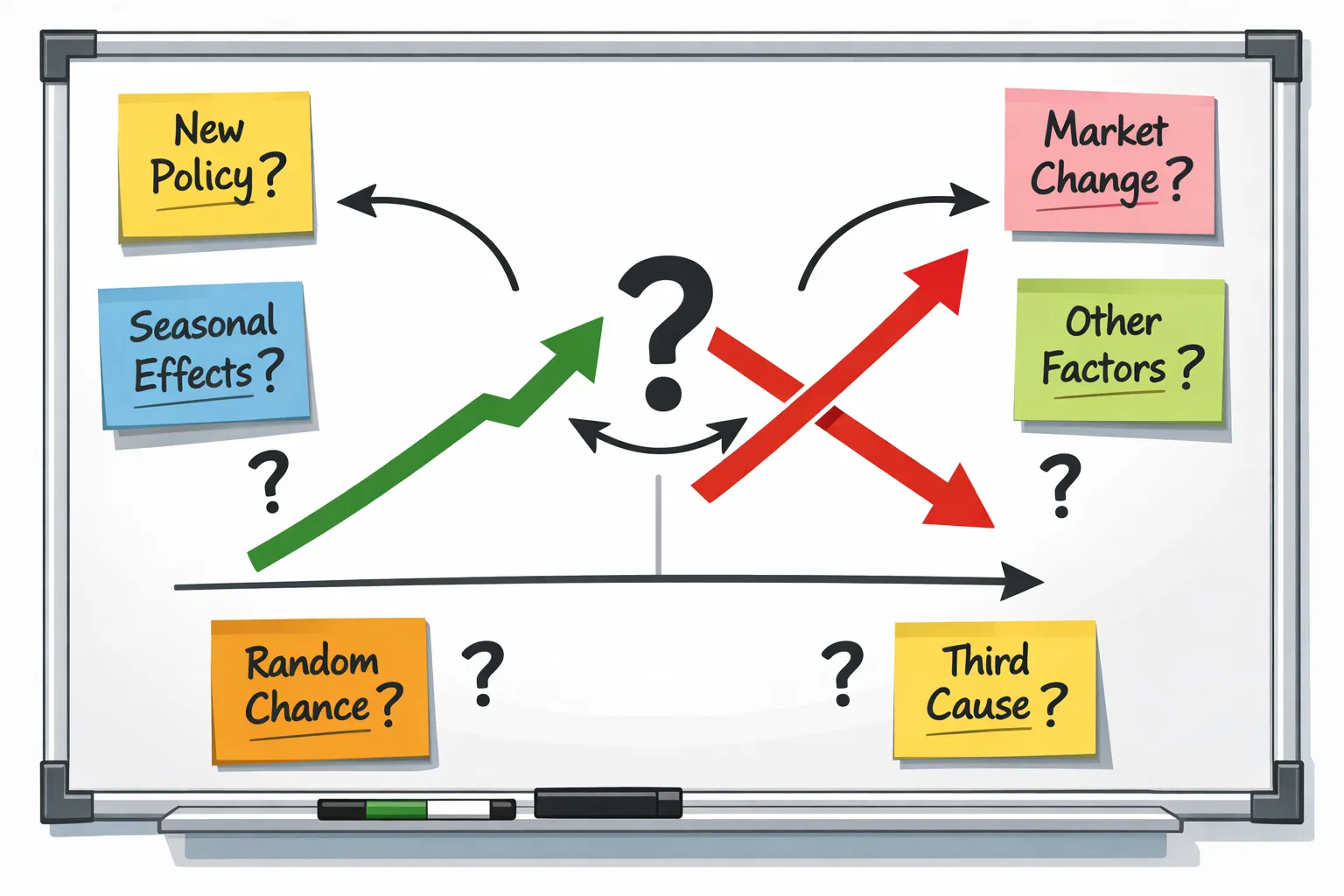
A messy outcome is one where many things changed at once: a child’s school results improved after a new routine, a team’s sales rose after a new manager arrived, a city’s crime rate fell after a policy change, or a patient felt better after trying a supplement. The central thinking skill is to separate possible causes from events that merely happened nearby. A correlation can be a useful clue, but it is not yet an explanation. To claim causation, you need a plausible mechanism, a fair comparison, attention to alternative explanations, and some idea of what would probably have happened without the alleged cause.
This matters because everyday reasoning often turns one visible before-and-after pattern into a story. The story may be right, partly right, backwards, or driven by a third factor. Modern causal-inference work makes the same point in more formal language: causal claims require assumptions about counterfactuals, interventions, confounding and bias, not just a strong association in observed data. [Taylor & Francis Online+2PMC]tandfonline.comObserved values of the potential outcomes…Read more…
Why causes are hard in noisy settings
In a clean experiment, one thing changes while everything else is kept roughly equal. In real life, this rarely happens. A business launches a new advert during a seasonal upswing. A person starts exercising at the same time as sleeping better. A school introduces a reading programme while also hiring new staff. The outcome changes, but the cause is not isolated.
The core problem is the missing comparison. If someone says, “The new routine caused the improvement,” the hidden question is: compared with what? In the potential-outcomes approach to causal inference, a causal effect is defined by comparing what would happen under one condition with what would happen under another condition for the same unit or population. The difficulty is that we cannot observe both versions of the same situation at once: the child both with and without the routine, the same team both with and without the new manager, the same patient both taking and not taking the treatment. [Taylor & Francis Online]tandfonline.comObserved values of the potential outcomes…Read more…
That is why randomised controlled trials are powerful. Random assignment makes groups more comparable before the intervention, so later differences are less likely to be caused by pre-existing differences. Cochrane’s guidance describes randomised trials as the preferred design for studying healthcare intervention effects in most circumstances, while noting that all study designs still need risk-of-bias assessment. [Cochrane]cochrane.orgIncluding non-randomized studies on intervention effectsAll Cochrane reviews must consider the risk of bias in individual primary…
But the real world often denies us a clean trial. We may be dealing with historical events, social policy, family decisions, product launches, workplace changes, or ethical questions where randomisation is impossible. In those cases, the question is not “Is there a correlation?” but “What comparison would make this causal claim fair?”
Association is a clue, not a verdict
A correlation means two things vary together. That can happen because one causes the other, because the second causes the first, because both are driven by a third factor, because the data have been grouped badly, or because chance produced a pattern in a large search space.
This is why “correlation does not imply causation” is useful but incomplete. It should not mean “ignore correlations”. In medicine, economics, psychology and public policy, associations often provide the first signal worth investigating. The better version is: correlation raises a causal question; it does not answer it by itself.
Judea Pearl’s “ladder” framing is helpful here because it separates three kinds of question. Association asks what patterns appear in observed data. Intervention asks what would happen if we deliberately changed something. Counterfactual reasoning asks what would have happened in an alternative version of the same case. Moving from the first to the second and third levels requires more than observing that two variables move together. [web.cs.ucla.edu]web.cs.ucla.eduThe Three Layer Causal HierarchyThe Three Layer Causal Hierarchy
A practical example: suppose people who cycle to work have lower average body weight than people who drive. Cycling may reduce weight. But people with lower body weight may also be more likely to choose cycling in the first place. Or both cycling and lower weight may be linked to income, neighbourhood design, job location, health habits or age. The correlation is interesting; the causal claim needs a better comparison.
Alternative explanations and confounders
A confounder is a factor that helps explain both the suspected cause and the outcome. Cochrane defines confounding as occurring when there are common causes of the intervention choice and the outcome; in that situation, the observed association differs from the causal effect. [Cochrane]cochrane.orgChapter 25: Assessing risk of bias in a non-randomized studyConfounding occurs when there are common causes of the choice of inte…
For everyday thinking, the idea is simple: before saying “A caused B”, ask what else might have pushed both A and B in the same direction.
Consider these common patterns:
- Common cause: Ice cream sales and drowning incidents may rise together because hot weather increases both. Ice cream does not cause drowning.
- Reverse causation: A company may observe that confident employees perform better. But success may increase confidence, rather than confidence being the original cause.
- Selection effects: People who join a voluntary programme may already be more motivated than people who do not, making the programme look stronger than it is.
- Regression to the mean: An unusually bad week is often followed by a more normal week, even if a new “fix” had little effect.
- Timing coincidence: A change that happens just before an outcome is memorable, but many other less visible conditions may have been building for months.
Directed acyclic graphs, often called DAGs, are one formal tool for making these assumptions visible. They map a hypothesised causal structure: which variables may affect which others, and which variables should or should not be adjusted for. Their value is not that they magically prove causation, but that they force the analyst to state the story clearly enough to inspect it. [Jclinepi]jclinepi.comOpen source on jclinepi.com.
The mistake is to treat “control for more variables” as automatically better. Some variables are confounders; others are mediators, colliders or consequences of the thing being studied. Adjusting for the wrong variable can introduce bias rather than remove it. This is one reason causal diagrams are used in health and social research: they help distinguish which variables belong in the comparison and which may distort it. [book.the-turing-way.org]book.the-turing-way.orgConfounding VariablesConfounding Variables
When the same numbers tell different stories
Messy outcomes become especially misleading when summary statistics hide structure. Simpson’s paradox is the classic case: a pattern in aggregated data reverses or changes once the data are split into meaningful groups.
The University of California, Berkeley graduate admissions case is widely used because the surface numbers appeared to show lower admission rates for women than men in 1973. When applications were examined by department, a different explanation emerged: women had applied disproportionately to more competitive departments with lower admission rates. The aggregate pattern did not straightforwardly reveal department-level discrimination in the way the headline comparison suggested. [Wikipedia]WikipediaSimpson's paradoxSimpson's paradox
A medical example makes the same point. In a kidney-stone treatment comparison, one treatment appeared better overall, yet the other treatment had better success rates within both small-stone and large-stone groups. The apparent contradiction came from different mixes of easier and harder cases. If one treatment was used more often on easier cases, the combined result could mislead. [Wikipedia]WikipediaSimpson's paradoxSimpson's paradox
The thinking lesson is not “always split the data”. It is “split the data by variables that matter to the causal story”. If the outcome depends heavily on age, severity, prior ability, department, season, location or baseline risk, an overall average may answer the wrong question.
Anscombe’s quartet teaches a related lesson. Four datasets can share nearly identical averages, variances, correlations and regression lines while having very different visual patterns. One may show a roughly linear relationship, another a curve, another an outlier-driven relationship, and another a high-leverage point. Summary statistics are not a substitute for looking at the shape of the evidence. [r-causal.github.io]r-causal.github.ioOpen source on github.io.
Mechanisms make causal claims more disciplined
A mechanism is the “how” between a proposed cause and an outcome. It does not prove causation by itself, but it makes a causal claim more testable.
For example, “the new meeting format improved output” is weak if it only points to a rise in completed tasks. It becomes stronger if the mechanism is specified: shorter meetings reduced context switching, clarified ownership, cut approval delays, and led to more completed work. Each link can then be checked. Did meeting time actually fall? Did handoffs become clearer? Did delays shrink? Did output improve most in teams where those intermediate steps changed?
Bradford Hill’s well-known viewpoints for assessing causality in epidemiology include ideas such as strength of association, consistency, temporality, biological gradient, plausibility and coherence. Modern reviews stress that these are better understood as viewpoints rather than mechanical criteria: they help structure judgement, but they do not replace causal modelling or study design. [PMC]pmc.ncbi.nlm.nih.govOpen source on nih.gov.
Mechanisms also guard against seductive but empty stories. Tyler Vigen’s “Spurious Correlations” project deliberately pairs unrelated datasets that happen to move together, such as odd correlations found across public data series. The point is not that statistics are useless; it is that a neat line on a chart can invite a story even where no credible mechanism exists. [tylervigen.com]tylervigen.comOpen source on tylervigen.com.
A good causal explanation usually has all three parts:(#endnote-5 “Endnote 5”) [web.cs.ucla.edu]web.cs.ucla.eduThe Three Layer Causal HierarchyThe Three Layer Causal Hierarchy
- A credible route: how the cause could affect the outcome.
- A fair comparison: what happened in a similar case without the cause.
- A pattern of evidence: timing, size, consistency and alternative explanations that fit the causal story better than rival stories.
Everyday checks before claiming causation
The goal is not to turn daily life into a statistics seminar. It is to build a compact habit of caution before drawing strong conclusions from noisy outcomes.
Use these checks when the stakes are high enough to matter.
1. State the causal claim clearly.
Replace “It worked” with “Changing X caused Y to improve, compared with what would probably have happened without X.” This exposes the comparison you need.
2. Ask what else changed at the same time.
Look for seasonality, incentives, personnel changes, baseline differences, outside events, measurement changes and selection effects. A new action often arrives in a bundle.
3. Check the direction of cause.
Does X plausibly cause Y, or might Y cause X? High-performing employees may receive more autonomy; autonomy may also improve performance. Both can be partly true.
4. Compare like with like.
Do not compare motivated volunteers with non-volunteers, severe cases with mild cases, or peak periods with quiet periods unless that difference is part of the question. Observational research is especially vulnerable to confounding, selection and measurement bias. [PMC]pmc.ncbi.nlm.nih.govby G Hammerton · 2021 · Cited by 390 — The goal of much observational research is to identify risk factors that have a causal effect o…
5. Look for dose, timing and mechanism.
If the proposed cause matters, did more of it usually produce more of the outcome? Did the cause come before the effect? Did the intermediate steps change in the expected order?
6. Search for disconfirming cases.
When did the outcome improve without the supposed cause? When did the cause appear without the outcome? Exceptions do not always disprove a claim, but they often reveal missing conditions.
7. Reduce confidence when the data were searched after the fact.
If someone examined many possible variables and reported only the most striking match, coincidence becomes more likely. A pattern found after a broad search needs fresh data or an out-of-sample test.
What stronger evidence looks like
Not all evidence has equal causal force. A single before-and-after anecdote is usually weak because many factors changed. A repeated pattern across comparable cases is stronger. A natural experiment, well-designed observational study or randomised trial may be stronger still, depending on whether it addresses the right comparison.
In healthcare, the distinction is formalised because the cost of false causal claims can be high. Randomised trials are valued because treatment assignment is designed to break the link between patient characteristics and treatment choice. Observational studies can still be useful, especially when trials are unethical, impractical or unrepresentative, but they require careful handling of confounding and bias. [Cochrane+2PMC]cochrane.orgIncluding non-randomized studies on intervention effectsAll Cochrane reviews must consider the risk of bias in individual primary…
For everyday analytical thinking, the evidence ladder can be translated into plain questions:
- Anecdote: Did one case change after X?
- Pattern: Do many similar cases change after X?
- Comparison: Did similar cases without X change less?
- Adjustment: Were obvious confounders considered?
- Mechanism: Did the expected intermediate steps occur?
- Replication: Does the pattern hold in new settings or fresh data?
- Intervention: When X is deliberately changed, does Y change as predicted?
The higher you climb, the more confidence you can reasonably have. But even strong designs have limits. Randomised trials may have narrow samples, short follow-up or artificial conditions. Observational data may be broader and more realistic, yet more confounded. Good analysis does not worship one method; it asks which design best answers the causal question at hand. [PMC]pmc.ncbi.nlm.nih.govPMCCausal Inference Methods for Combining Randomized TrialsPMCCausal Inference Methods for Combining Randomized Trials

How this improves analytical thinking
Cause-checking changes how you think because it slows the jump from outcome to explanation. Instead of asking, “What happened right before this?” you ask, “What would I expect to see if this really caused it, and what would I expect if a rival explanation were true?”
That shift improves judgement in ordinary decisions. A manager becomes less likely to credit the newest initiative for a result caused by seasonality. A student becomes less likely to assume a study technique worked because one exam went well. A citizen becomes less likely to accept a policy claim based only on a chart. A patient becomes less likely to over-interpret a symptom change that may have occurred naturally.
The habit is not cynicism. It is disciplined curiosity. Correlations, coincidences and before-and-after changes are often where investigation begins. Better thinking comes from refusing to stop there.
Amazon book picks
Further Reading
Books and field guides related to Did It Cause It, or Just Happen Nearby?. Use these as the next step if you want deeper reading beyond the article.
The Book of Why
Directly explains the difference between correlation and causation, confounding, and causal inference.
The Art of Statistics
Provides practical foundations for evaluating evidence, uncertainty, and claims about causes and effects.
How to Lie with Statistics
Shows how statistical associations can be misinterpreted or used to support false causal stories.
Calling Bullshit
Teaches readers to question causal claims, misleading statistics, and unsupported conclusions.
eBay marketplace picks
Marketplace Samples
Live-tested eBay searches with available results related to this page.


Endnotes
-
Source: pmc.ncbi.nlm.nih.gov
Link: https://pmc.ncbi.nlm.nih.gov/articles/PMC8020490/Source snippet
by G Hammerton · 2021 · Cited by 390 — The goal of much observational research is to identify risk factors that have a causal effect o...
-
Source: cochrane.org
Link: https://www.cochrane.org/authors/handbooks-and-manuals/handbook/current/chapter-25Source snippet
Chapter 25: Assessing risk of bias in a non-randomized studyConfounding occurs when there are common causes of the choice of inte...
-
Source: Wikipedia
Title: Rubin causal model
Link: https://en.wikipedia.org/wiki/Rubin_causal_model -
Source: cochrane.org
Link: https://www.cochrane.org/authors/handbooks-and-manuals/handbook/current/chapter-24Source snippet
Including non-randomized studies on intervention effectsAll Cochrane reviews must consider the risk of bias in individual primary...
-
Source: web.cs.ucla.edu
Title: The Three Layer Causal Hierarchy
Link: https://web.cs.ucla.edu/~kaoru/3-layer-causal-hierarchy.pdf -
Source: pmc.ncbi.nlm.nih.gov
Link: https://pmc.ncbi.nlm.nih.gov/articles/PMC2836213/ -
Source: jclinepi.com
Link: https://www.jclinepi.com/article/S0895-4356%2821%2900240-7/fulltext -
Source: pmc.ncbi.nlm.nih.gov
Link: https://pmc.ncbi.nlm.nih.gov/articles/PMC8128477/ -
Source: book.the-turing-way.org
Title: Confounding Variables
Link: https://book.the-turing-way.org/project-design/risks-of-bias/confounding-variables/ -
Source: Wikipedia
Title: Simpson’s paradox
Link: https://en.wikipedia.org/wiki/Simpson%27s_paradox -
Source: alexdeng.github.io
Link: https://alexdeng.github.io/causal/simpson.html -
Source: r-causal.github.io
Link: https://r-causal.github.io/quartets/ -
Source: pmc.ncbi.nlm.nih.gov
Link: https://pmc.ncbi.nlm.nih.gov/articles/PMC8206235/ -
Source: tylervigen.com
Link: https://www.tylervigen.com/spurious-correlations -
Source: pmc.ncbi.nlm.nih.gov
Link: https://pmc.ncbi.nlm.nih.gov/articles/PMC8882362/ -
Source: pmc.ncbi.nlm.nih.gov
Title: PMCCausal Inference Methods for Combining Randomized Trials
Link: https://pmc.ncbi.nlm.nih.gov/articles/PMC12499922/ -
Source: Wikipedia
Title: Bradford Hill criteria
Link: https://en.wikipedia.org/wiki/Bradford_Hill_criteria -
Source: Wikipedia
Link: https://en.wikipedia.org/wiki/Confounding -
Source: Wikipedia
Title: Anscombe’s quartet
Link: https://en.wikipedia.org/wiki/Anscombe%27s_quartet -
Source: Wikipedia
Title: Spurious relationship
Link: https://en.wikipedia.org/wiki/Spurious_relationship -
Source: Wikipedia
Title: Correlation does not imply causation
Link: https://en.wikipedia.org/wiki/Correlation_does_not_imply_causation -
Source: random.org
Link: https://www.random.org/lists/ -
Source: alexdeng.github.io
Link: https://alexdeng.github.io/causal/rcm.html -
Source: methods.cochrane.org
Link: https://methods.cochrane.org/defining-and-determining-which-quantitative-study-designs-include-your-systematic-review-effects -
Source: iris.who.int
Link: https://iris.who.int/bitstreams/5e1eadc6-7016-4829-be3a-77c593271129/download -
Source: jclinepi.com
Link: https://www.jclinepi.com/article/S0895-4356%2825%2900420-2/fulltext -
Source: tandfonline.com
Link: https://www.tandfonline.com/doi/abs/10.1198/016214504000001880Source snippet
Observed values of the potential outcomes...Read more...
-
Source: data.europa.eu
Link: https://data.europa.eu/apps/data-visualisation-guide/correlations -
Source: ncbi.nlm.nih.gov
Link: https://www.ncbi.nlm.nih.gov/books/NBK154456/ -
Source: pmc.ncbi.nlm.nih.gov
Link: https://pmc.ncbi.nlm.nih.gov/articles/PMC10795211/ -
Source: pmc.ncbi.nlm.nih.gov
Link: https://pmc.ncbi.nlm.nih.gov/articles/PMC5118066/ -
Source: pmc.ncbi.nlm.nih.gov
Link: https://pmc.ncbi.nlm.nih.gov/articles/PMC11658928/ -
Source: pmc.ncbi.nlm.nih.gov
Link: https://pmc.ncbi.nlm.nih.gov/articles/PMC3094752/ -
Source: pmc.ncbi.nlm.nih.gov
Link: https://pmc.ncbi.nlm.nih.gov/articles/PMC1898525/ -
Source: pmc.ncbi.nlm.nih.gov
Link: https://pmc.ncbi.nlm.nih.gov/articles/PMC4589117/ -
Source: pmc.ncbi.nlm.nih.gov
Link: https://pmc.ncbi.nlm.nih.gov/articles/PMC3740239/ -
Source: pmc.ncbi.nlm.nih.gov
Link: https://pmc.ncbi.nlm.nih.gov/articles/PMC12932701/ -
Source: ncbi.nlm.nih.gov
Link: https://www.ncbi.nlm.nih.gov/sites/books/NBK202085/ -
Source: tandfonline.com
Link: https://www.tandfonline.com/doi/full/10.1080/10691898.2020.1752859 -
Source: amazon.co.uk
Title: Spurious Correlations
Link: https://www.amazon.co.uk/Spurious-Correlations-Tyler-Vigen/dp/0316339431?tag=searcht-20
Additional References
-
Source: youtube.com
Link: https://www.youtube.com/watch?v=BAQIXS8dvaUSource snippet
The 2 Minute Intro to Causal Inference in Economics - YouTube The 2 Minute Intro to Causal Inference in Economics - YouTube...
-
Source: arxiv.org
Link: https://arxiv.org/abs/2011.08047 -
Source: arxiv.org
Link: https://arxiv.org/abs/2502.10161 -
Source: youtube.com
Title: The 11 Minute
Link: https://www.youtube.com/watch?v=lFKYfCeXiI4Source snippet
Counterfactuals: Causal Inference Bootcamp...
-
Source: researchgate.net
Link: https://www.researchgate.net/publication/308927020_Observational_Research_Rigor_Alone_Does_Not_Justify_Causal_Inference -
Source: researchgate.net
Link: https://www.researchgate.net/publication/309344659_Randomized_controlled_trials_vs_observational_studies_Why_not_just_live_together -
Source: researchgate.net
Link: https://www.researchgate.net/publication/322778777_Thinking_Clearly_About_Correlations_and_Causation_Graphical_Causal_Models_for_Observational_Data -
Source: causalai.net
Link: https://causalai.net/r60.pdf -
Source: simplexct.com
Link: https://simplexct.com/anscombe-quartet -
Source: linkedin.com
Link: https://www.linkedin.com/posts/richard-hahn-a1096050_the-so-called-bradford-hill-criteria-are-activity-7432457882136244224-7vEb
Topic Tree