Within Predictions
When surprise helps learning and when it does not
Surprise can make feedback more memorable, but only when the learner can resolve why the prediction failed.
On this page
- How prediction creates a before and after gap
- Why surprise can direct attention
- Why unresolved surprise can become noise
Page outline Jump by section
Introduction
Making a prediction before checking an answer changes what happens when you are wrong. Instead of simply receiving new information, you experience a comparison between what you expected and what actually occurred. That mismatch creates surprise, and under the right conditions surprise acts like a spotlight: it draws attention to the corrective information at exactly the moment it is most useful. Research on prediction-based learning suggests that this attentional shift is one reason why attempting an answer before seeing feedback often improves later memory, even when the original prediction was incorrect. [Springer]link.springer.comPredicting as a learning strategyPredicting as a learning strategy - Springer Natureby G Brod · 2021 · Cited by 77 — Initial evidence suggests that predicting boo…
 However, surprise is not automatically beneficial. It improves learning only when the learner can resolve the discrepancy by understanding why the prediction failed. If the feedback is confusing, incomplete or unrelated to the original prediction, surprise may become little more than distraction. The value of prediction lies not in being startled, but in turning an unexpected result into a clearer and more accurate mental model. [Springer]link.springer.comPredicting as a learning strategyPredicting as a learning strategy - Springer Natureby G Brod · 2021 · Cited by 77 — Initial evidence suggests that predicting boo…
How prediction creates a before-and-after gap
Without a prediction, an answer often feels merely informative. With a prediction, the answer becomes feedback about your own thinking.
This creates a clear before-and-after comparison:
- Before: your current explanation of how something works.
- After: the evidence or correct answer. [pubmed.ncbi.nlm.nih.gov]pubmed.ncbi.nlm.nih.govas a learning strategyby G Brod · 2021 · Cited by 77 — Initial evidence suggests that predicting boosts surprise about unexpected answers…
- Gap: the difference between the two.
Psychologists often describe this difference as a prediction error—the mismatch between expectation and outcome. Across many areas of learning and decision-making, prediction errors help determine when existing beliefs should be updated. Unexpected outcomes signal that the current mental model is incomplete or inaccurate, making them especially important learning opportunities. [Frontiers]frontiersin.orgFrontiersHow Prediction Errors Shape Perception, Attention, and…by HEM Den Ouden · 2012 · Cited by 636 — Prediction errors (PE) are a…
Importantly, prediction error is not identical to simply getting an answer wrong. Two people may both answer incorrectly, yet only the person who genuinely committed to a prediction experiences a meaningful discrepancy that demands explanation. That commitment is what gives later feedback its educational value.
Why surprise can direct attention
Surprise is useful because attention is limited. People cannot process every piece of incoming information equally deeply, so the brain gives priority to events that violate expectations.
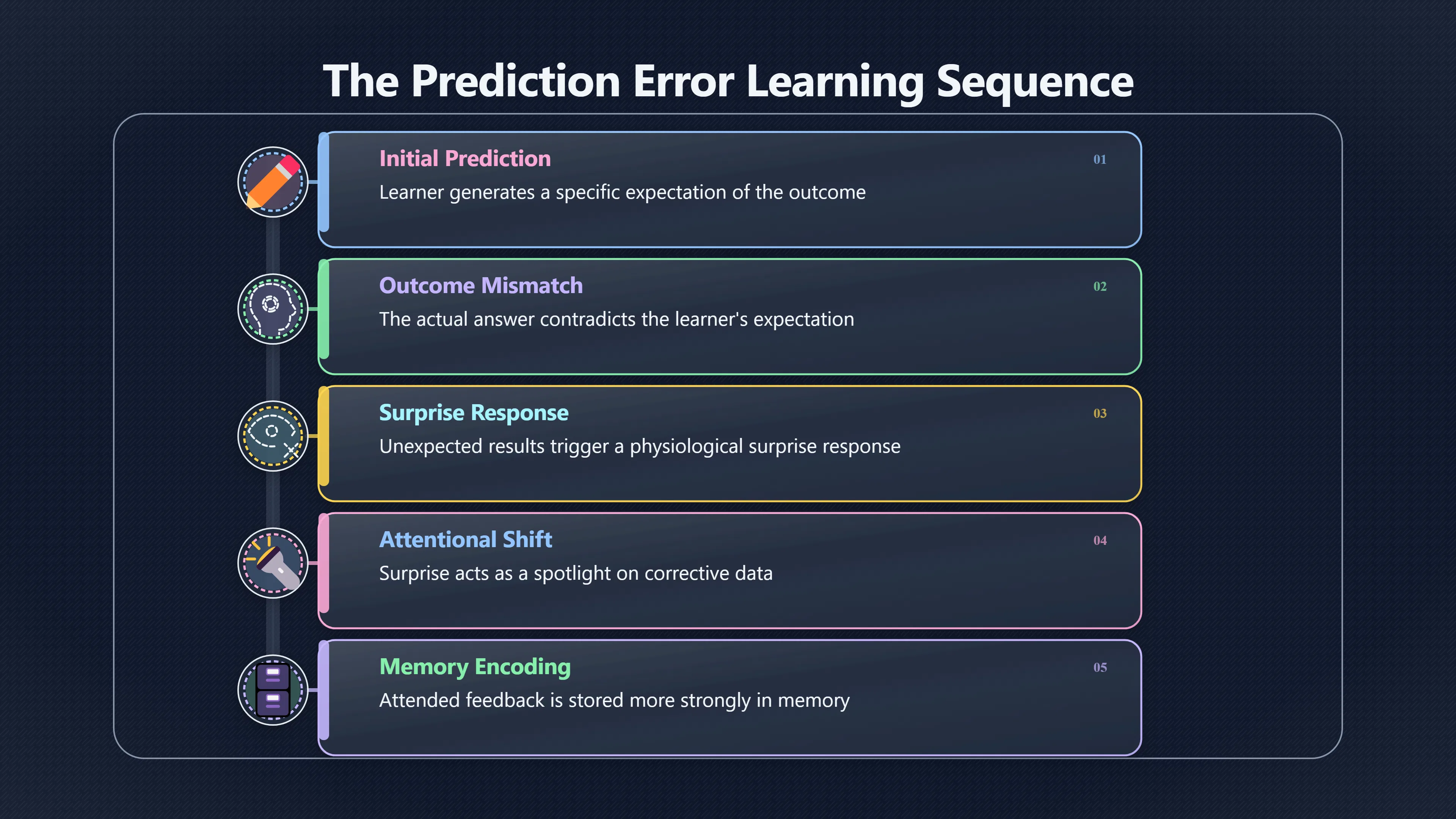
Research reviewing prediction as a learning strategy proposes a sequence of events:
- A learner generates a prediction.
- The prediction turns out to be incorrect.
- The unexpected answer produces surprise. [pubmed.ncbi.nlm.nih.gov]pubmed.ncbi.nlm.nih.govas a learning strategyby G Brod · 2021 · Cited by 77 — Initial evidence suggests that predicting boosts surprise about unexpected answers…
- Surprise increases attention to the corrective feedback.
- The attended feedback is encoded more strongly into memory.
Experimental studies support this account. Compared with conditions in which learners only state what they believed after seeing the answer, making a prediction beforehand produces stronger physiological indicators associated with surprise, including brief increases in pupil dilation when the unexpected answer appears. Those stronger surprise responses are linked with better later recall of the correct information. [Springer]link.springer.comPredicting as a learning strategyPredicting as a learning strategy - Springer Natureby G Brod · 2021 · Cited by 77 — Initial evidence suggests that predicting boo…
The mechanism is selective rather than indiscriminate. Expected answers receive relatively little extra processing because they confirm what is already believed. Unexpected answers receive additional attention precisely because they indicate that updating may be necessary. This fits broader theories of prediction error in learning, which argue that discrepancies between expectation and reality help determine when cognitive resources should be allocated to revision rather than routine processing. [PMC]pmc.ncbi.nlm.nih.govMini-Review: Prediction errors, attention and associative…by PC Holland · 2016 · Cited by 109 — Most modern theories of associative…
A practical example illustrates the point. Suppose you predict that a mathematical problem requires one formula, but the worked solution uses an entirely different principle. The surprise makes the alternative approach more noticeable than if you had simply read the solution without first committing yourself. The unexpected method stands out because it directly contradicts your existing explanation.
High-confidence mistakes can become powerful learning moments
One particularly interesting finding comes from research on the hypercorrection effect.
People often assume that highly confident mistakes are the hardest to correct because they are deeply held. In many learning situations, the opposite can occur. Errors made with high confidence are frequently corrected more successfully than uncertain mistakes after feedback is provided. [Springer]link.springer.comPredicting as a learning strategyPredicting as a learning strategy - Springer Natureby G Brod · 2021 · Cited by 77 — Initial evidence suggests that predicting boo…
The proposed explanation is straightforward:
- A confident prediction creates a strong expectation.
- Discovering that it is wrong produces greater surprise.
- Greater surprise captures more attention.
- Increased attention strengthens memory for the correction.
Studies have also found that learners sometimes remember not only the correct answer itself but incidental details surrounding the feedback, suggesting that surprise temporarily increases attention more broadly during the correction phase. [Springer]link.springer.comPredicting as a learning strategyPredicting as a learning strategy - Springer Natureby G Brod · 2021 · Cited by 77 — Initial evidence suggests that predicting boo…
This does not mean that overconfidence is desirable. Persistent overconfidence can still lead to poor judgement. Rather, it means that when confident errors are recognised and explained, they can become unusually memorable opportunities for updating knowledge.
Why unresolved surprise can become noise
Surprise helps only if the learner can make sense of it.
An unexpected answer without an understandable explanation leaves the original mental model unrepaired. The learner notices that something is wrong but lacks the information needed to replace it.
Several situations reduce the value of surprise:
- Missing explanations. Simply revealing the correct answer without explaining why it is correct leaves the prediction error unresolved.
- Ambiguous feedback. If multiple interpretations remain possible, the learner cannot determine which belief should change.
- Information overload. Too much new material at once can prevent attention from focusing on the critical correction.
- Irrelevant novelty. Entertaining or dramatic surprises may capture attention without improving understanding if they are unrelated to the concept being learned.
Research on pretesting consistently finds that corrective feedback is essential. Attempting an answer before instruction is beneficial because the prediction is followed by informative correction, not because making errors is inherently valuable. Immediate, clear feedback generally produces stronger learning than leaving incorrect predictions unresolved for long periods. [Journal of Cognition]journalofcognition.orgJournal of CognitionThe Pretesting Effect: Exploring the Impact of Feedback…by Y Mera · 2025 · Cited by 2 — The pretesting effect sugg…
In other words, surprise should answer a question rather than merely create one.
Turning surprise into better thinking
For improving analytical skills, the most valuable moment is immediately after an unexpected result appears.
Instead of asking only, “Why was I wrong?”, ask more specific questions:
- Which assumption failed?
- Which evidence did I overlook?
- Which cue did I overweight?
- What rule would have produced the correct prediction instead?
These questions transform surprise from an emotional reaction into model revision. The objective is not to eliminate mistakes but to make each mistake explainable.
This also reduces hindsight bias. Once the answer is known, it is easy to feel that it was obvious all along. Having a written prediction preserves the original belief, making it possible to identify precisely what changed rather than reconstructing memory after the fact. The surprise therefore becomes anchored to a specific comparison instead of fading into a vague feeling that “I learned something.”
The key mechanism
Prediction creates a meaningful expectation. When reality differs from that expectation, surprise highlights the discrepancy and directs attention towards the corrective information. If the learner can understand why the prediction failed, that heightened attention supports stronger encoding and more accurate future predictions. If the discrepancy remains unexplained, the same surprise is unlikely to produce lasting understanding.
The educational value of surprise therefore lies not in the emotional jolt itself, but in its ability to focus attention at exactly the moment when a mistaken mental model can be revised. [Springer+2PMC]link.springer.comPredicting as a learning strategyPredicting as a learning strategy - Springer Natureby G Brod · 2021 · Cited by 77 — Initial evidence suggests that predicting boo…
Amazon book picks
Further Reading
Books and field guides related to When surprise helps learning and when it does not. Use these as the next step if you want deeper reading beyond the article.
Why Don't Students Like School?
Discusses curiosity, surprise, memory, and effective learning.
eBay marketplace picks
Marketplace Samples
Live-tested eBay searches with available results related to this page.




Endnotes
-
Source: link.springer.com
Title: Predicting as a learning strategy
Link: https://link.springer.com/article/10.3758/s13423-021-01904-1Source snippet
Predicting as a learning strategy - Springer Natureby G Brod · 2021 · Cited by 77 — Initial evidence suggests that predicting boo...
-
Source: pmc.ncbi.nlm.nih.gov
Link: https://pmc.ncbi.nlm.nih.gov/articles/PMC4862921/Source snippet
Mini-Review: Prediction errors, attention and associative...by PC Holland · 2016 · Cited by 109 — Most modern theories of associative...
-
Source: link.springer.com
Link: https://link.springer.com/article/10.3758/s13423-024-02517-0Source snippet
the link between insight and prediction errorby M Becker · 2024 · Cited by 16 — A new theoretical framework has proposed a link between t...
-
Source: journalofcognition.org
Link: https://journalofcognition.org/articles/10.5334/joc.455Source snippet
Journal of CognitionThe Pretesting Effect: Exploring the Impact of Feedback...by Y Mera · 2025 · Cited by 2 — The pretesting effect sugg...
-
Source: frontiersin.org
Link: https://www.frontiersin.org/journals/psychology/articles/10.3389/fpsyg.2012.00548/fullSource snippet
FrontiersHow Prediction Errors Shape Perception, Attention, and...by HEM Den Ouden · 2012 · Cited by 636 — Prediction errors (PE) are a...
-
Source: pmc.ncbi.nlm.nih.gov
Link: https://pmc.ncbi.nlm.nih.gov/articles/PMC11680657/Source snippet
nih.govSurprise!—Clarifying the link between insight and prediction...by M Becker · 2024 · Cited by 16 — A new theoretical framework has...
-
Source: pubmed.ncbi.nlm.nih.gov
Link: https://pubmed.ncbi.nlm.nih.gov/33768503/Source snippet
as a learning strategyby G Brod · 2021 · Cited by 77 — Initial evidence suggests that predicting boosts surprise about unexpected answers...
-
Source: pmc.ncbi.nlm.nih.gov
Link: https://pmc.ncbi.nlm.nih.gov/articles/PMC11950122/Source snippet
pretesting effect under divided attention - PMCby J Bartl · 2025 · Cited by 3 — The present study examined whether this pretesting effect...
-
Source: pmc.ncbi.nlm.nih.gov
Link: https://pmc.ncbi.nlm.nih.gov/articles/PMC6866507/Source snippet
neural representations of prediction error valence...by E Fouragnan · 2018 · Cited by 193 — Learning occurs when an outcome differs from...
-
Source: pmc.ncbi.nlm.nih.gov
Link: https://pmc.ncbi.nlm.nih.gov/articles/PMC3518876/Source snippet
by HEM den Ouden · 2012 · Cited by 640 — Prediction errors (PE) are a central notion in theoretical models of reinforcement learning...
-
Source: frontiersin.org
Link: https://www.frontiersin.org/research-topics/80199/learning-from-surprise-neural-and-behavioral-[mechanismsSource snippet
neural and behavioral mechanisms of prediction errorWhen a prediction error occurs, the brain updates its expectations and adjusts future...
-
Source: journalofcognition.org
Link: https://journalofcognition.org/articles/455/files/687f6aa6dcf5d.pdfSource snippet
Exploring the Impact of Feedback and Final Test Timingby Y Mera · 2025 · Cited by 2 — The pretesting effect suggests that attempting and...
-
Source: ouci.dntb.gov.ua
Title: dntb.gov.ua Predicting as a learning strategy
Link: https://ouci.dntb.gov.ua/en/works/9joLjew7/Source snippet
as a learning strategyAbstractThis article attempts to delineate the procedural and mechanistic characteristics of predicting as a learni...
Additional References
-
Source: researchgate.net
Link: https://www.researchgate.net/publication/366086182_Pre-testing_effects_are_target-specific_and_are_not_driven_by_a_generalised_state_of_curiositySource snippet
(PDF) Pre-testing effects are target-specific and are not...7 Dec 2022 — Guessing an answer to an unfamiliar question prior to seeing th...
-
Source: cognitivepsychology.com
Link: https://www.cognitivepsychology.com/Error_Driven_LearningSource snippet
Error-Driven Learning — Cognitive Psychology ReferenceError-driven learning is the principle that learning occurs in proportion to the di...
-
Source: semanticscholar.org
Link: https://www.semanticscholar.org/paper/Predicting-as-a-learning-strategy-Brod/a10fd63cec0defeec4ddda4bc95356186545f97aSource snippet
Predicting as a learning strategyThis article attempts to delineate the procedural and mechanistic characteristics of predicting as a lea...
-
Source: researchgate.net
Link: https://www.researchgate.net/publication/297598270_Mini-Review_Prediction_errors_attention_and_associative_learningSource snippet
Prediction errors, attention and associative learningMost modern theories of associative learning emphasize a critical role for predictio...
-
Source: neurosity.co
Link: https://neurosity.co/guides/reward-prediction-error-dopamineSource snippet
Reward Prediction Error: The Dopamine Surprise SignalYour brain doesn't care about rewards. It cares about surprises. Learn how reward pr...
-
Source: researchgate.net
Title: 395978076 Attention and prediction error as mechanisms for theory protection
Link: https://www.researchgate.net/publication/395978076_Attention_and_prediction_error_as_mechanisms_for_theory_protectionSource snippet
Attention and Prediction Error as Mechanisms for Theory...29 Apr 2026 — Here, we discuss similarities between the notion of theory prote...
-
Source: learninglab.uchicago.edu
Link: https://learninglab.uchicago.edu/Pre-Testing_files/RichlandKornellKao.pdfSource snippet
ces long-term memory, particularly when the information is successfully retrieved from memory.Read more...
-
Source: pedocs.de
Title: When generating a prediction boosts learning
Link: https://www.pedocs.de/volltexte/2020/16102/pdf/Brod_When_generating_a_prediction_boosts_learning_2018_A.pdfSource snippet
G Brod · 2018 · Cited by 172 — These results suggest that a specific benefit of making predictions in learning contexts is that...
-
Source: researchgate.net
Title: 350390831 Predicting as a learning strategy
Link: https://www.researchgate.net/publication/350390831_Predicting_as_a_learning_strategySource snippet
(PDF) Predicting as a learning strategy29 Mar 2021 — Initial evidence suggests that predicting boosts surprise about unexpected answers...
-
Source: mindbrained.org
Title: surprise learning and the predictive brain
Link: https://www.mindbrained.org/2025/01/surprise-learning-and-the-predictive-brain/Source snippet
Surprise, Learning, and the Predictive Brain3 Jan 2025 — The key to understanding surprise is knowing it is a prediction error. They were...
Topic Tree