Within Explain It
Why Familiar Ideas Can Feel Understood
Trying to explain a familiar mechanism can expose the gap between feeling that you understand it and actually knowing the steps.
On this page
- How fluency creates false confidence
- What causal explanation makes visible
- How to spot missing steps without embarrassment
Page outline Jump by section
Introduction
Many people feel they understand familiar ideas until they are asked to explain, step by step, how those ideas actually work. This gap between subjective confidence and genuine causal understanding is known as the illusion of explanatory depth (IOED). It is especially common for everyday concepts and mechanisms that people regularly encounter—such as bicycles, zips, toilets, rain, or electricity—because familiarity creates a powerful sense of fluency that is easily mistaken for deep knowledge. Research shows that attempting a detailed explanation is one of the most reliable ways to expose this illusion, making it an especially useful tool for improving thinking and analytical skills when explaining concepts without notes. [PMC]pmc.ncbi.nlm.nih.govby L Rozenblit · 2002 · Cited by 1499 — We argue here that people's limited knowledge and their misleading intuitive epistemology comb…
How fluency creates false confidence
The illusion of explanatory depth differs from simply being overconfident. People may accurately remember facts or recognise an object, yet still lack an understanding of the causal chain that makes it function. Knowing that a bicycle moves when you pedal is different from explaining exactly how the chain, gears, rear wheel and forces interact to produce motion.
Leonid Rozenblit and Frank Keil, who introduced the concept in 2002, argued that people often mistake familiarity for explanation. Daily exposure to an object or idea creates an impression that its workings are stored in memory, when in reality much of the apparent knowledge depends on cues from the surrounding environment or on assumptions that have never been examined. [PMC]pmc.ncbi.nlm.nih.govby L Rozenblit · 2002 · Cited by 1499 — We argue here that people's limited knowledge and their misleading intuitive epistemology comb…
Several factors make familiar concepts especially vulnerable:
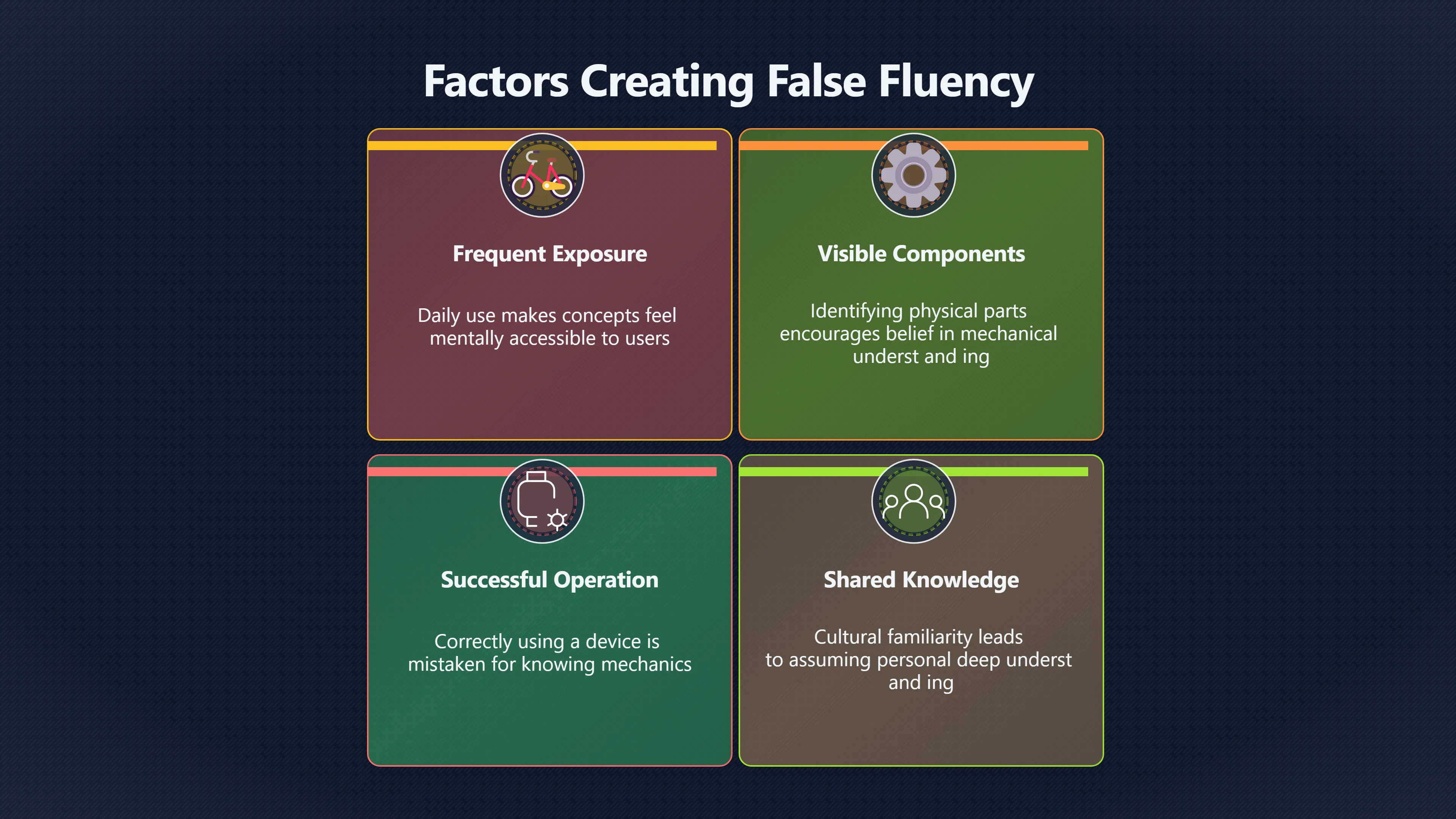
- Frequent exposure. Seeing or using something every day makes it feel mentally accessible.
- Visible components. Being able to identify parts encourages the belief that their interactions are also understood.
- Successful use. Operating an object correctly is mistaken for understanding its mechanism.
- Shared cultural knowledge. When “everyone knows” something, people assume they understand it themselves.
The result is false fluency: the ease of recognising an idea becomes confused with the ability to reconstruct its causal structure.
What causal explanation makes visible
The illusion usually disappears when people are required to explain how rather than simply state what.
In the original experiments, participants first rated how well they understood everyday devices and natural phenomena. They then attempted detailed explanations before rating their understanding again. Confidence consistently fell after the explanation attempt, because participants discovered missing links they had not previously noticed. This drop did not occur to the same degree for simple factual or narrative knowledge, suggesting that explanatory knowledge is a distinct category of understanding. [PMC]pmc.ncbi.nlm.nih.govby L Rozenblit · 2002 · Cited by 1499 — We argue here that people's limited knowledge and their misleading intuitive epistemology comb…
The process reveals several kinds of hidden gaps:
- Missing intermediate steps between cause and effect.
- Inability to explain why one component influences another.
- Confusion between describing appearances and explaining mechanisms.
- Reliance on vague phrases such as “it just happens” or “the system adjusts itself”.
For example, someone may confidently claim to understand how a flush toilet works until asked questions such as:
- What keeps water inside the tank?
- What exactly happens when the handle is pressed?
- Why does the tank refill automatically?
- What prevents continuous flow?
Each unanswered question exposes a missing causal connection rather than a missing vocabulary word.
Why everyday concepts are especially deceptive
The illusion is strongest for concepts that combine visible parts with hidden mechanisms.
Objects such as bicycles, locks, zips, refrigerators or toilets appear understandable because many components can be seen directly. Yet the crucial causal relationships often remain invisible unless deliberately studied. Rozenblit and Keil argued that people frequently confuse seeing an object’s structure with possessing a mental model of how its parts interact over time. [PMC]pmc.ncbi.nlm.nih.govby L Rozenblit · 2002 · Cited by 1499 — We argue here that people's limited knowledge and their misleading intuitive epistemology comb…
Natural phenomena produce similar effects. Many people feel they understand:
- why seasons change,
- how lightning forms,
- why earthquakes occur,
- how snow develops,
until they attempt a complete causal explanation. The familiar outcome is remembered, but the mechanism connecting each stage is incomplete. Later studies have shown that the same pattern appears across many explanatory domains while being much weaker for simple factual knowledge, such as remembering the capital of a country. [Cambridge University Press & Assessment]cambridge.orgCambridge University Press & AssessmentExplaining an unrelated phenomenon exposes the illusion…by EA Meyers · 2023 · Cited by 13 — The…
How to spot missing steps without embarrassment
One of the practical strengths of the illusion of explanatory depth is that it provides a low-cost diagnostic tool. The goal is not to expose ignorance publicly but to improve calibration between confidence and understanding.
When explaining a concept from memory, useful warning signs include:
- jumping directly from the beginning to the outcome;
- using broad labels instead of describing interactions;
- relying on analogies when precise mechanisms are required;
- repeating the same explanation with different words rather than adding causal detail;
- struggling when asked “What happens next?” several times in succession.
A simple self-check is to explain a concept to an imaginary beginner without consulting notes. Afterwards, compare the explanation against a reliable source and identify every omitted causal step. The discrepancy is usually more informative than whether the explanation was entirely correct.
This approach fits naturally with retrieval practice. Instead of treating explanation as a performance, it becomes a measurement of the quality of one’s mental model.

Why recognising the illusion improves analytical thinking
Analytical thinking depends on distinguishing recognition from explanation. A person who notices the illusion of explanatory depth becomes less likely to stop at familiar language and more likely to test whether a complete mechanism has actually been understood.
Research also suggests that prompting people to explain complex issues can reduce unwarranted certainty by making knowledge gaps visible. Rather than encouraging endless scepticism, explanation helps align confidence with evidence. That calibration improves judgement because it identifies exactly where further learning is needed instead of assuming understanding based on familiarity alone. [Cambridge University Press & Assessment]cambridge.orgCambridge University Press & AssessmentExplaining an unrelated phenomenon exposes the illusion…by EA Meyers · 2023 · Cited by 13 — The…
Within the broader practice of explaining concepts without notes, the illusion of explanatory depth serves as a useful reminder that fluent recognition is not the same as deep understanding. The moment an explanation stalls is often the moment genuine learning begins.
eBay marketplace picks
Marketplace Samples
Live-tested eBay searches with available results related to this page.


Endnotes
-
Source: pmc.ncbi.nlm.nih.gov
Link: https://pmc.ncbi.nlm.nih.gov/articles/PMC3062901/Source snippet
by L Rozenblit · 2002 · Cited by 1499 — We argue here that people's limited knowledge and their misleading intuitive epistemology comb...
-
Source: cambridge.org
Link: https://www.cambridge.org/core/journals/judgment-and-decision-making/article/broad-effects-of-shallow-understanding-explaining-an-unrelated-phenomenon-exposes-the-illusion-of-explanatory-depth/9B9B8927C3E530EBCF0453504730E3F3Source snippet
Cambridge University Press & AssessmentExplaining an unrelated phenomenon exposes the illusion...by EA Meyers · 2023 · Cited by 13 — The...
-
Source: youtube.com
Link: https://www.youtube.com/watch?v=Y_skmB3ZcTcSource snippet
The illusion of explanatory depth | Kerry Zheng | Glenforest Secondary School...
-
Source: youtube.com
Title: The illusion of explanatory depth | Kerry Zheng | Glenforest Secondary School
Link: https://www.youtube.com/watch?v=MqFUU8o0wVM -
Source: Wikipedia
Title: Illusion of explanatory depth
Link: https://en.wikipedia.org/wiki/Illusion_of_explanatory_depthSource snippet
Illusion of explanatory depthThe illusion of explanatory depth (IOED) is cognitive bias or an illusion where people tend to believe th...
-
Source: jarango.com
Title: the illusion of explanatory depth
Link: https://jarango.com/2019/02/06/the-illusion-of-explanatory-depth/Source snippet
Feb 6, 2019 — In a 2002 paper, Rozenblit and Keil explained that most of us think we know how things work, when in fact we have incomplet...
Additional References
-
Source: researchgate.net
Link: https://www.researchgate.net/publication/399436002_Design_and_Evaluation_of_an_Illusion_of_Explanatory_Depth_Scale_and_Its_Relationship_to_Certain_VariablesSource snippet
Design and Evaluation of an Illusion of Explanatory Depth...Jan 7, 2026 — The Illusion of Explanatory Depth (IOED) is a cognitive bias t...
-
Source: drbenvincent.medium.com
Link: https://drbenvincent.medium.com/the-illusion-of-explanatory-depth-why-our-mental-models-of-the-state-are-broken-62f1f4b91ef1Source snippet
Illusion of Explanatory Depth: Why Our Mental Models of...Psychologists call this the illusion of explanatory depth (Rozenblit & Keil, 2...
-
Source: onlinelibrary.wiley.com
Link: https://onlinelibrary.wiley.com/doi/10.1207/s15516709cog2605_1Source snippet
misunderstood limits of folk science: an illusion...Sep 1, 2002 — We demonstrate the illusion of depth with explanatory knowledge in Stu...
-
Source: researchgate.net
Title: The Misunderstood Limits of Folk Science
Link: https://www.researchgate.net/publication/50868445_The_Misunderstood_Limits_of_Folk_Science_An_Illusion_of_Explanatory_DepthSource snippet
Illusions23 May 2026 — Leon Rozenblit and Frank Keil introduced this concept in 2002, demonstrating that people routinely overestimate ho...
Published: May 2026
-
Source: douglaswise.co.uk
Title: illusion explanatory depth
Link: https://www.douglaswise.co.uk/blog/illusion-explanatory-depthSource snippet
The Illusion of Explanatory Depth4 Feb 2021 — The 'illusion of explanatory depth' is a cognitive bias that leads people to believe that t...
-
Source: thedecisionlab.com
Link: https://thedecisionlab.com/biases/the-illusion-of-explanatory-depthSource snippet
That is, they often mistake...Read more...
-
Source: youtube.com
Title: You Don’t Know Anything
Link: https://www.youtube.com/watch?v=_ak0k7GNCjMSource snippet
V. Humility and human cognition. Part 4: The illusion of explanatory depth (Prof. Frank Keil)...
-
Source: onlinelibrary.wiley.com
Title: s15516709cog2605 1
Link: https://onlinelibrary.wiley.com/doi/abs/10.1207/s15516709cog2605_1Source snippet
and Keil, F. (2002), The misunderstood limits of folk science: an illusion of explanatory depth. Cognitive Science, 26: 521-562.Read more...
-
Source: youtube.com
Title: The Illusion of Explanatory Depth: You Don’t Understand It Like You Think
Link: https://www.youtube.com/watch?v=yDJuCWUC5P8Source snippet
You Don't Know Anything - The Illusion of Explanatory Depth - FutureIQ...
-
Source: scienceblogs.com
Link: https://scienceblogs.com/mixingmemory/2006/11/16/the-illusion-of-explanatory-deSource snippet
The "Illusion of Explanatory Depth": How Much Do We Know...16 Nov 2006 — Rozenblit and Keil also found that in adults, the illusion of e...
Topic Tree