Within Spacing
Why review should start with recall
A delayed review is stronger when the learner first tries to recall, explain or solve before checking the answer.
On this page
- Why passive rereading is a weak form of spacing
- Recall, explanation and problem solving prompts
- How feedback corrects spaced retrieval errors
Page outline Jump by section
Introduction
Distributed practice becomes much more effective when each return to the material begins with an attempt to retrieve it from memory before looking at notes, answers or worked examples. Instead of immediately rereading, the learner first tries to recall key ideas, explain a concept, or solve a problem unaided. Only afterwards do they check what they remembered correctly and repair mistakes. This simple change transforms a review session from passive exposure into an active test of memory, making each spaced encounter a learning event rather than another reading session.
 The combination of spacing and retrieval is one of the strongest evidence-based approaches in cognitive psychology. Research consistently shows that retrieval practice strengthens long-term retention beyond repeated study alone, especially when retrieval is followed by accurate feedback. The value lies not in making learning feel easier during review, but in making knowledge more accessible when it is needed later. [Sage Journals]journals.sagepub.comSage JournalsThe Critical Importance of Retrieval—and Spacing…16 Dec 2015 — In a highly cited article, Karpicke and Roediger (2008) re…
Why passive rereading is a weak form of spacing
Spacing alone is helpful because time between study sessions introduces some forgetting. However, the benefits are reduced if learners respond to that forgetting simply by reading the material again.
Rereading mainly supports recognition. When the page is in front of you, familiar phrases create a feeling of knowing, even if you would have struggled to produce the information independently. This “illusion of competence” can make a review session feel productive while contributing relatively little to durable memory.
Starting with retrieval changes the mental task completely. Instead of recognising information that is already visible, the learner must reconstruct it. That reconstruction strengthens the routes needed to access knowledge later in real situations, where answers are rarely presented alongside the question.
Classic experiments by Henry L. Roediger III and Jeffrey D. Karpicke demonstrated this contrast. Learners who repeatedly retrieved studied material often remembered substantially more after a delay than learners who spent the same time repeatedly studying it, despite feeling less confident during practice. [PsychNet]psychnet.wustl.eduRoediger Karpicke 2006 PPSThe Power of Testing Memoryby HL Roediger III · Cited by 3273 — Expanding retrieval practice is thought to be an optimal schedule…
Why review should start with recall
Beginning a spaced session with retrieval has two complementary purposes.
First, it measures the current state of memory. The learner discovers which ideas remain accessible after the delay and which have faded. This diagnosis is far more informative than simply rereading the material.
Second, retrieval itself changes memory. Successfully recalling information strengthens later access to that information, making future retrieval easier. This phenomenon is often called the testing effect or retrieval practice effect, although the critical ingredient is not formal testing but the act of attempting to remember. [Sage Journals]journals.sagepub.comSage JournalsThe Critical Importance of Retrieval—and Spacing…16 Dec 2015 — In a highly cited article, Karpicke and Roediger (2008) re…
Importantly, retrieval should happen before review. Looking at notes first removes much of the desirable challenge. Even an incomplete retrieval attempt prepares the learner to notice precisely what was forgotten once the correct answer is revealed.
Recall, explanation and problem-solving prompts
Retrieval before review does not require formal quizzes. The essential feature is that answers are generated from memory before any reference materials are consulted.
Useful prompts include:
- Free recall: Write everything remembered about a topic before opening notes.
- Explanation prompts: Explain a concept aloud as though teaching another person.
- Comparison questions: Recall similarities and differences between related ideas.
- Worked-problem reconstruction: Solve a familiar problem from memory before checking the solution.
- Application questions: Use remembered principles to analyse a new example or case.
- Diagram reconstruction: Draw a process, model or concept map from memory, then compare it with the original.
These activities require increasingly rich retrieval rather than simple recognition. Educational guidance from cognitive scientists recommends ending spaced study sessions with retrieval and only then checking notes to identify omissions or misunderstandings. [The Learning Scientists]learningscientists.orgThe Learning ScientistsWhen do the 6 Strategies for Effective Learning Work Best?20 Apr 2017 — We have written a lot about the 6 strategi…
How feedback corrects spaced retrieval errors
Retrieval is most effective when followed by timely feedback.
Successful recall reinforces accurate knowledge, but retrieval attempts can also expose misconceptions or forgotten details. Without correction, those errors may persist. Feedback ensures that retrieval strengthens correct information rather than inaccurate reconstructions.
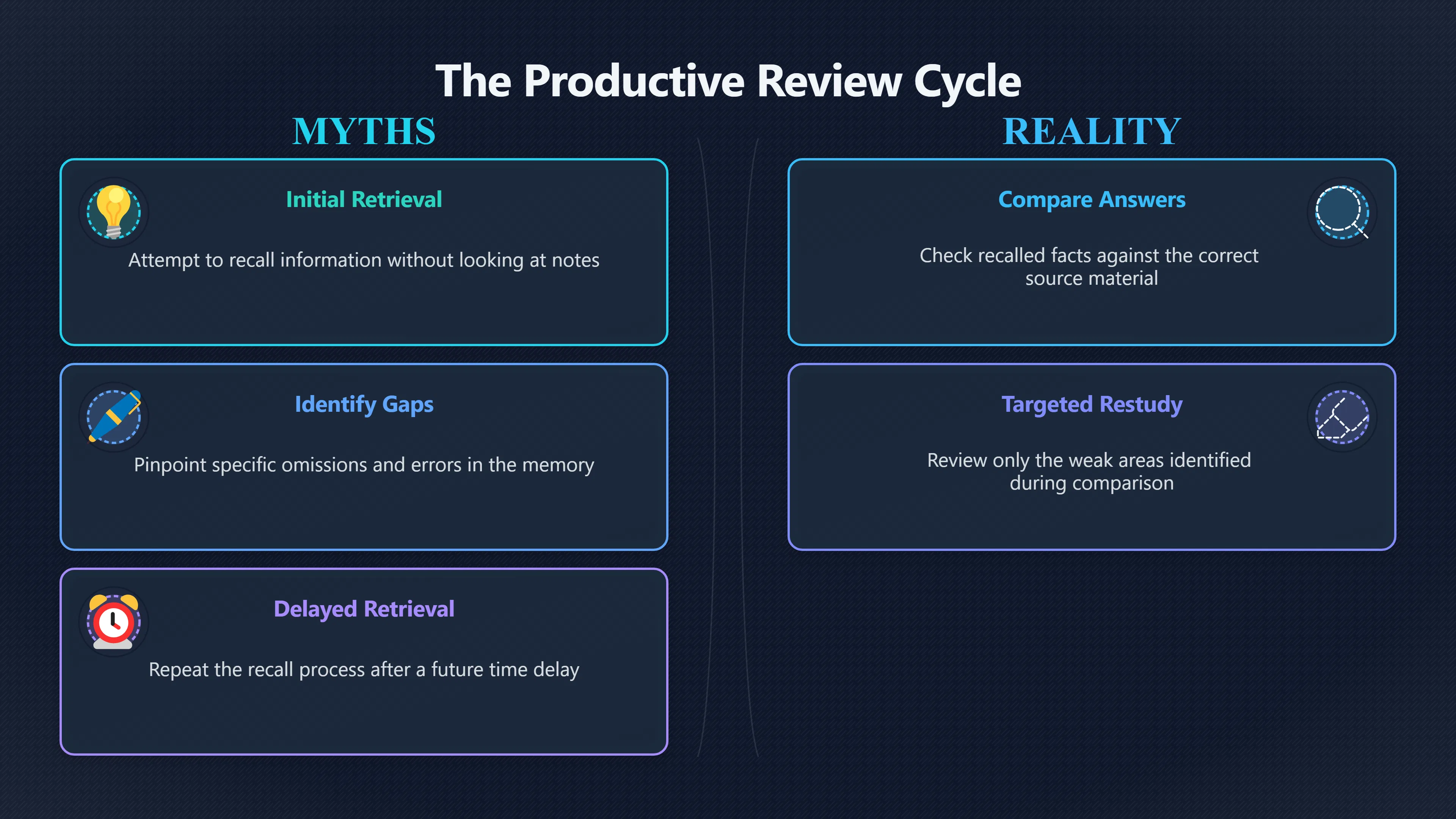
A productive review cycle therefore follows a simple sequence:
- Attempt retrieval without looking.
- Compare with the correct answer or worked example.
- Identify omissions and mistakes.
- Restudy only the weak areas.
- Retrieve again later after another delay.
Notice that review comes after retrieval, not before it. The correction stage is targeted because the learner already knows exactly which parts need attention.
Research also indicates that repeated retrieval combined with feedback supports stronger long-term learning than repeated studying alone, and that retrieval continues to provide benefits even after an answer has already been successfully recalled. [PubMed]pubmed.ncbi.nlm.nih.govWe examined the impact of repeated testing and repeated studying on long-term learning. In Experiment 1, we replicated Karpicke and Roedi…
Why effort matters—but only to a point
The goal is not to make retrieval impossible. Instead, it should be difficult enough to require genuine reconstruction while still allowing success most of the time.
This reflects the principle of “desirable difficulties”, associated with the work of Robert A. Bjork and Elizabeth Ligon Bjork. A retrieval attempt that requires effort can strengthen learning more than one that feels automatic, provided the learner ultimately retrieves the information or receives corrective feedback. If retrieval becomes consistently impossible because the interval is too long or the material is too unfamiliar, the benefits diminish. [PMC+2PMC]pmc.ncbi.nlm.nih.govRetrieval Practice and Spacing Effects in Young and Older…by GB Maddox · 2015 · Cited by 53 — Here, we focus on one account of the…
This balance explains why spaced retrieval often feels harder than repeated rereading while producing better retention weeks or months later.
Putting retrieval first into everyday spaced study
A practical spaced review session can remain brief while preserving the retrieval-first principle.
- Spend the first few minutes recalling from memory before opening any materials.
- Use blank paper rather than highlighted notes.
- Check answers immediately after the retrieval attempt.
- Correct only the missing or incorrect points.
- Schedule another retrieval session after an additional delay instead of repeatedly rereading the corrected notes.
Over multiple sessions, the emphasis gradually shifts from reviewing everything to retrieving increasingly large amounts independently. As knowledge becomes more accessible without external support, learners build the kind of durable memory needed for analysis, reasoning and problem-solving rather than short-lived familiarity.
By treating every spaced review as an opportunity to retrieve first and review second, learners exploit two complementary principles simultaneously: the benefits of distributed practice and the benefits of active retrieval. Together they create review sessions that measure learning, strengthen memory and reveal precisely what still needs improvement. [evidencebased.education]evidencebased.educationcombined, create powerful routines for lasting learning and exam success…

Amazon book picks
Further Reading
Books and field guides related to Why review should start with recall. Use these as the next step if you want deeper reading beyond the article.
Powerful Teaching
Focuses on retrieval practice, spacing, feedback, and practical implementation.
Make It Stick
Directly explains retrieval practice, spacing, feedback, and why active recall outperforms rereading.
How We Learn
Explores spacing, forgetting, memory retrieval, and durable learning in accessible language.
Small Teaching
Covers evidence-based learning strategies including retrieval and frequent low-stakes practice.
eBay marketplace picks
Marketplace Samples
Live-tested eBay searches with available results related to this page.




Endnotes
-
Source: pmc.ncbi.nlm.nih.gov
Link: https://pmc.ncbi.nlm.nih.gov/articles/PMC4480221/Source snippet
Retrieval Practice and Spacing Effects in Young and Older...by GB Maddox · 2015 · Cited by 53 — Here, we focus on one account of the...
-
Source: pmc.ncbi.nlm.nih.gov
Link: https://pmc.ncbi.nlm.nih.gov/articles/PMC4513285/Source snippet
behind the testing effect: an empirical investigation of...These findings indicate that testing helps learning when learners must invest...
-
Source: evidencebased.education
Link: https://evidencebased.education/resource/retrieval-and-spaced-practice-study-strategies-that-must-be-combined/Source snippet
combined, create powerful routines for lasting learning and exam success...
-
Source: journals.sagepub.com
Link: https://journals.sagepub.com/doi/10.1177/0956797615617778Source snippet
Sage JournalsThe Critical Importance of Retrieval—and Spacing...16 Dec 2015 — In a highly cited article, Karpicke and Roediger (2008) re...
-
Source: psychnet.wustl.edu
Title: Roediger Karpicke 2006 PPSSource snippet
The Power of Testing Memoryby HL Roediger III · Cited by 3273 — Expanding retrieval practice is thought to be an optimal schedule...
-
Source: learningscientists.org
Link: https://www.learningscientists.org/blog/2017/4/20-1Source snippet
The Learning ScientistsWhen do the 6 Strategies for Effective Learning Work Best?20 Apr 2017 — We have written a lot about the 6 strategi...
-
Source: pubmed.ncbi.nlm.nih.gov
Link: https://pubmed.ncbi.nlm.nih.gov/26674128/Source snippet
We examined the impact of repeated testing and repeated studying on long-term learning. In Experiment 1, we replicated Karpicke and Roedi...
-
Source: pmc.ncbi.nlm.nih.gov
Link: https://pmc.ncbi.nlm.nih.gov/articles/PMC12372469/Source snippet
practice enhances learning in real primary school...by L Franzoi · 2025 · Cited by 3 — Several studies have demonstrated that retrieval...
-
Source: pmc.ncbi.nlm.nih.gov
Link: https://pmc.ncbi.nlm.nih.gov/articles/PMC3983480/Source snippet
retrieval of previously studied information can increase its long-term retention more than repeated...
Additional References
-
Source: researchgate.net
Link: https://www.researchgate.net/publication/362093173_The_science_of_effective_learning_with_a_focus_on_spacing_and_retrieval_practiceSource snippet
The science of effective learning with a focus on spacing...2 Feb 2023 — In this Review, we discuss key research findings on two specifi...
-
Source: researchgate.net
Link: https://www.researchgate.net/publication/5574966_The_Critical_Importance_of_Retrieval_for_LearningSource snippet
(PDF) The Critical Importance of Retrieval for LearningThe results demonstrate the critical role of retrieval practice in consolidating l...
-
Source: teachertoolkit.co.uk
Link: https://www.teachertoolkit.co.uk/wp-content/uploads/2022/10/s44159-022-00089-1.pdfSource snippet
Review, we discuss key research findings on two specific learning strategies: spacing and retrieval practice. We focus on how these...Re...
-
Source: my.chartered.college
Link: https://my.chartered.college/research-hub/testing-and-spacing-effective-learning-strategies-for-the-classroom/Source snippet
and spacing: Effective learning strategies for the...We highlight two robust learning strategies which draw on a rich tradition of resea...
-
Source: cirl.etoncollege.com
Link: https://cirl.etoncollege.com/strategies-for-making-learning-last-retrieval-practice-spaced-practice-and-interleaving/Source snippet
2 Mar 2021 — The authors recommend interleaving as an effective strategy for spacing out retrieval practice (p. 204). Evidence sugges...
-
Source: apa.org
Link: https://www.apa.org/pubs/journals/features/stl-0000024.pdfSource snippet
(Roediger & Karpicke, 2006).... enhanced learning in a middle school science class- room: The...Read more...
-
Source: potentialplusuk.org
Title: Cognitive Science in the classroom Evidence and practice
Link: https://potentialplusuk.org/wp-content/uploads/2022/02/Cognitive_Science_in_the_classroom_-Evidence_and_practice.pdfSource snippet
based learning (Jabbar and Felicia, 2015), spaced repetition (Kang, 2016), and the role of instructional explanations in example-based le...
-
Source: notes.andymatuschak.org
Title: re-reading, despite the fact that students will be less
Link: https://notes.andymatuschak.org/zYB7kwEFRu8QALcbzbcoy9TSource snippet
difficulties, after Bjork - Andy Matuschak's notesRetrieval practice leads to more durable long-term memory than simply studying material...
-
Source: recallify.ai
Title: evidence for active recall and spaced repetition
Link: https://recallify.ai/evidence-for-active-recall-and-spaced-repetition/Source snippet
The Evidence for Active Recall and Spaced RepetitionThe most cited evidence comes from Roediger and Karpicke's 2006 study, which showed t...
-
Source: learninglab.psych.purdue.edu
Title: 2025 Karpicke Retrieval Based Learning Review
Link: https://learninglab.psych.purdue.edu/downloads/2025/2025_Karpicke_Retrieval_Based_Learning_Review.pdfSource snippet
purdue.edu4.21 Retrieval-based learningby JD Karpicke · 2025 — (2014) created a computer-based learning system that implemented repeated...
Topic Tree