Within Domain Knowledge
What Chess Teaches About Expertise
Chess studies show that experts recognise meaningful patterns, but their advantage weakens when the pattern has no real structure.
On this page
- Meaningful positions and expert recall
- Why random positions weaken the advantage
- Lessons for judging real world patterns
Page outline Jump by section
Introduction
Chess memory studies show that expert judgement is not just quicker thinking; it is quicker recognition of meaningful structure. Skilled players can briefly view a realistic chess position and reconstruct far more of it than weaker players, because they see familiar relationships among pieces rather than isolated objects. But when the same pieces are arranged randomly, the expert advantage becomes much smaller. That finding matters for improving thinking because it separates genuine expertise from generic cleverness: experts are powerful when a situation contains real patterns their knowledge can organise, but less powerful when the apparent pattern has no underlying structure. iiif.library.cmu.edu+2Brunel University Research Archive [iiif.library.cmu.edu]iiif.library.cmu.eduPERCEPTION IN CHESSApril 27, 2012 — In the perception task, we ask chess players to reconstruct a chess position while it remains in plai…

Meaningful positions reveal organised knowledge
The classic line of research began with Adriaan de Groot’s work on chess thinking and was extended by William Chase and Herbert Simon. In memory tasks, players were shown a chess position briefly and then asked to reconstruct it. Strong players did much better than weak players when the position came from a plausible game, even though all participants were looking at the same pieces for the same short time. [PagePlace]api.pageplace.deTHOUGHT AND CHOICE IN CHESSMay 31, 2014 — What is so special about the thought processes underlying the skilled chess player's c…
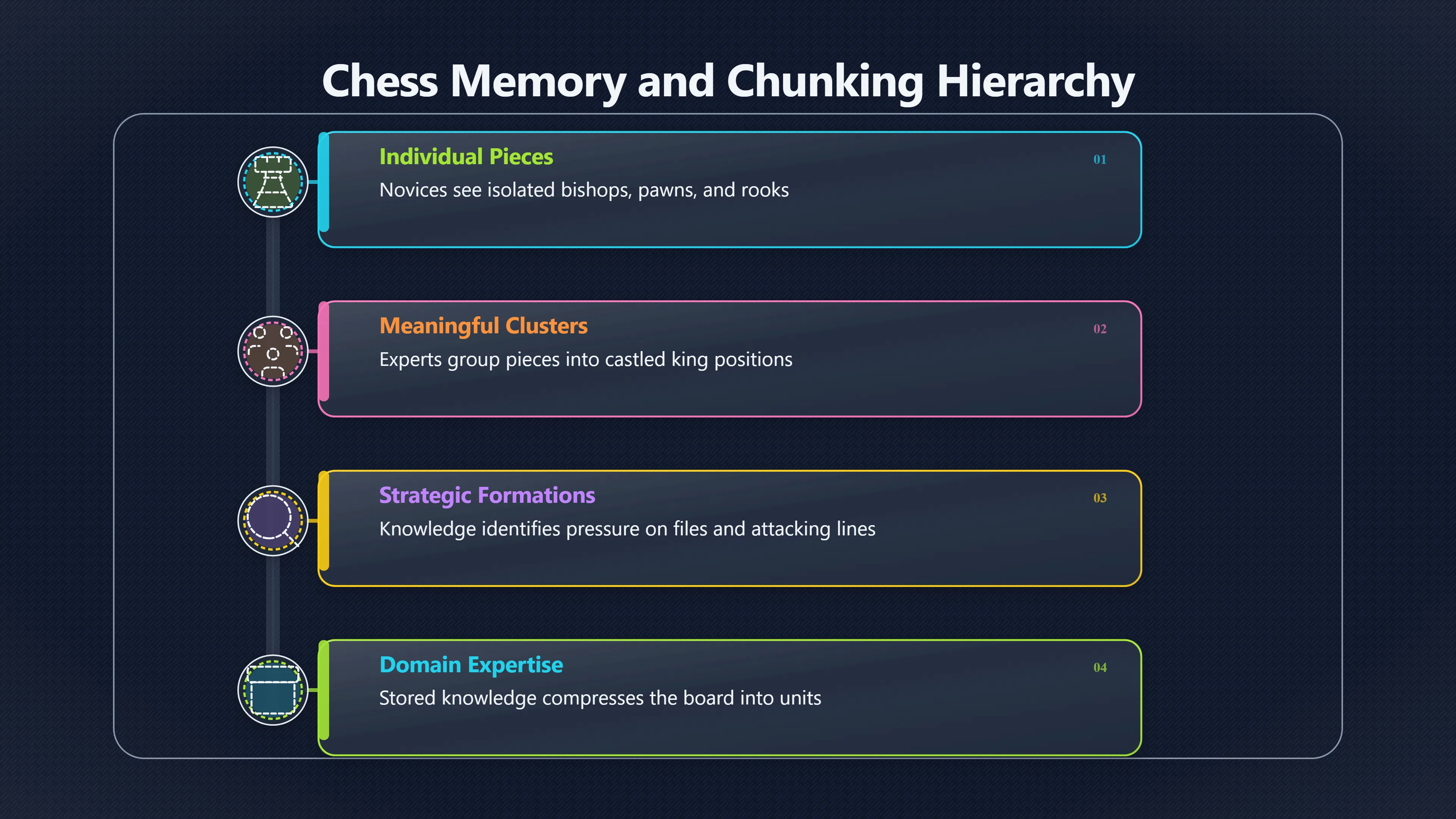
The key explanation was “chunking”: experts do not remember every bishop, pawn and rook as separate items. They perceive clusters that already mean something in chess: a castled king position, a pawn structure, pressure on a file, or a familiar attacking formation. Chase and Simon’s work argued that masters still have ordinary limits in short-term memory, but each remembered unit is richer because it is tied to stored chess knowledge. [Springer]link.springer.comRecall memory for visually presented chess positionsRecall memory for visually presented chess positions
This is why chess memory is such a useful window into expert judgement. The master’s advantage is not photographic memory. It is selective encoding: knowing which relations matter allows the expert to compress the board into meaningful units. In real analysis, the equivalent is seeing the structure of a market, legal case, medical symptom pattern or engineering fault rather than treating every detail as equally informative.
Random positions weaken the advantage
The most memorable result is the contrast with random boards. When pieces are placed in arrangements that do not reflect real chess play, much of the expert recall advantage falls away. The reason is straightforward: a random board does not offer the familiar strategic and tactical relationships that expert memory is built to recognise. The expert can still identify pieces, but the board no longer “speaks chess” in the same way. [Brunel University Research Archive]bura.brunel.ac.ukFull TextBrunel University Research ArchiveRecall of rapidly presented random chess positions is a…by F Gobet · 1996 · Cited by 296 — A widely…
Later research refined the simple version of the story. Gobet and Simon argued that the expert advantage does not always vanish completely with random positions. Strong players may still recall somewhat more than weaker players, partly because a large store of chess chunks can sometimes match small accidental patterns even in random material. However, the relative advantage is much smaller than with real game positions. [Brunel University Research Archive]bura.brunel.ac.ukFull TextBrunel University Research ArchiveRecall of rapidly presented random chess positions is a…by F Gobet · 1996 · Cited by 296 — A widely…
That refinement makes the finding more useful, not less. It shows that expertise is neither magic nor useless outside perfect conditions. Domain knowledge can still help at the margins, but its greatest power appears when the situation contains authentic structure. Expert judgement is therefore conditional: it depends on whether the environment has patterns that past learning can legitimately recognise.
What this teaches about judgement
Chess memory warns against two opposite mistakes. The first is undervaluing expertise by saying, “Experts are just using intuition.” In chess, the intuition is built from thousands of learned configurations, not from a vague gut feeling. Reviews of expertise research describe expert knowledge as organised around meaningful concepts and connected to the conditions in which those concepts apply. [National Academies]nationalacademies.orgNational AcademiesChapter: 2 How Experts Differ from NovicesThis chapter illustrates key scientific findings that have come from the stud…
The second mistake is overvaluing expertise by assuming that fast pattern recognition is always reliable. The random-board result shows the danger: when a situation lacks real structure, the expert’s usual advantage weakens. In practical thinking, this means an analyst should ask a simple question before trusting intuitive judgement: “Is this situation enough like the expert’s learned environment for their patterns to apply?”
A useful rule follows:
- Trust expertise most when the problem has recurring, meaningful structure. Chess positions from real games reward accumulated pattern knowledge.
- Be cautious when the pattern may be artificial, noisy or novel. Random boards reduce the value of stored patterns.
- Ask what the expert is recognising. Good judgement depends not just on seeing a pattern, but on seeing one that genuinely belongs to the domain.
The lasting lesson
Chess memory research makes domain knowledge visible. It shows why experts can appear to “just see” the answer: their knowledge changes what they perceive and remember. But it also shows the boundary of that power. Expertise improves judgement when the world contains meaningful patterns similar to those the expert has learned. When the structure is missing, distorted or random, expert intuition becomes less diagnostic.
For improving thinking, the practical lesson is not to reject intuition, but to discipline it. Strong analysis asks whether a recognised pattern is real, whether the domain is familiar enough for expertise to apply, and whether the situation might be closer to a random board than to a meaningful game position.

Amazon book picks
Further Reading
Books and field guides related to What Chess Teaches About Expertise. Use these as the next step if you want deeper reading beyond the article.
The Art of Learning
Draws extensively on chess to explain how experts build deep pattern recognition and transferable skill.
Peak
Provides the scientific framework behind expert performance, reinforcing why domain knowledge matters more than raw memory.
The Amateur's Mind
Shows how experienced players perceive meaningful positions differently from novices, echoing the memory studies discussed.
The Psychology of Chess
Covers the cognitive science of chess expertise, including chunking, memory, and pattern recognition.
eBay marketplace picks
Marketplace Samples
Live-tested eBay searches with available results related to this page.

Endnotes
-
Source: iiif.library.cmu.edu
Link: https://iiif.library.cmu.edu/file/Simon_box00005_fld00354_bdl0001_doc0001/Simon_box00005_fld00354_bdl0001_doc0001.pdfSource snippet
PERCEPTION IN CHESSApril 27, 2012 — In the perception task, we ask chess players to reconstruct a chess position while it remains in plai...
Published: April 27, 2012
-
Source: api.pageplace.de
Link: https://api.pageplace.de/preview/DT0400.9783110800647_A22699189/preview-9783110800647_A22699189.pdfSource snippet
THOUGHT AND CHOICE IN CHESSMay 31, 2014 — What is so special about the thought processes underlying the skilled chess player's c...
Published: May 31, 2014
-
Source: link.springer.com
Title: Recall memory for visually presented chess positions
Link: https://link.springer.com/content/pdf/10.3758/BF03213216.pdf -
Source: iiif.library.cmu.edu
Link: https://iiif.library.cmu.edu/file/Simon_box00081_fld06512_bdl0007_doc0001/Simon_box00081_fld06512_bdl0007_doc0001.pdf -
Source: link.springer.com
Link: https://link.springer.com/article/10.3758/BF03200937 -
Source: link.springer.com
Link: https://link.springer.com/article/10.3758/BF03212414 -
Source: link.springer.com
Link: https://link.springer.com/article/10.3758/s13421-016-0663-2 -
Source: bura.brunel.ac.uk
Title: Full Text
Link: https://bura.brunel.ac.uk/bitstream/2438/1346/1/FullText.pdfSource snippet
Brunel University Research ArchiveRecall of rapidly presented random chess positions is a...by F Gobet · 1996 · Cited by 296 — A widely...
-
Source: nationalacademies.org
Link: https://www.nationalacademies.org/read/9853/chapter/5Source snippet
National AcademiesChapter: 2 How Experts Differ from NovicesThis chapter illustrates key scientific findings that have come from the stud...
-
Source: bura.brunel.ac.uk
Title: Multiple boards
Link: https://bura.brunel.ac.uk/bitstream/2438/1339/1/Multiple_boards.pdf -
Source: bura.brunel.ac.uk
Link: https://bura.brunel.ac.uk/handle/2438/1346 -
Source: brainly.com
Link: https://brainly.com/question/31365442
Additional References
-
Source: youtube.com
Title: Stop Thinking Like Everyone Else | The Chunking Method
Link: https://www.youtube.com/watch?v=ajlEK5RuRVESource snippet
What makes Magnus Carlsen unbeatable? The psychology behind chess – with Fernand Gobet | Part 1...
-
Source: youtube.com
Title: Memory for chess positions (featuring grandmaster Patrick Wolff)
Link: https://www.youtube.com/watch?v=rWuJqCwfjjcSource snippet
How Chess Grandmasters Memorize Everything (It Works Scary Fast)...
-
Source: youtube.com
Title: How Chess Grandmasters Memorize Everything (It Works Scary Fast)
Link: https://www.youtube.com/watch?v=u-9K0YSVuKYSource snippet
Why Deep Thinkers Remember Everything | Chunking Explained...
-
Source: youtube.com
Title: Why Deep Thinkers Remember Everything | Chunking Explained
Link: https://www.youtube.com/watch?v=zELbHyPnUSsSource snippet
Stop Thinking Like Everyone Else | The Chunking Method...
-
Source: researchgate.net
Link: https://www.researchgate.net/publication/47642330_[Mechanisms -
Source: researchgate.net
Link: https://www.researchgate.net/publication/225336454_Recall_of_random_and_distorted_chess_positions_Implications_for_the_theory_of_expertise -
Source: chessprogramming.org
Link: https://www.chessprogramming.org/Adriaan_de_Groot -
Source: academia.edu
Link: https://www.academia.edu/82542304/Expert_Chess_Memory_Revisiting_the_Chunking_Hypothesis -
Source: cambridge.org
Link: https://www.cambridge.org/core/books/cambridge-handbook-of-expertise-and-expert-performance/expertise-in-chess/6E7F07A536AED091520EE9AE31128CCE -
Source: quizlet.com
Link: https://quizlet.com/gb/290778082/experts-flash-cards/
Topic Tree