Within Spacing
The evidence for the spacing sweet spot
Large spacing studies show that longer gaps help only up to a point, and the best interval expands with the retention goal.
On this page
- What large spacing studies compared
- Why longer gaps are not always better
- How the evidence translates into planning rules
Page outline Jump by section
Introduction
One of the most influential questions in research on distributed practice is not whether spacing works, but how long the gap between study sessions should be. A series of large experiments led by Nicholas Cepeda and colleagues showed that there is no single “best” interval. Instead, the ideal spacing gap depends on how long you want to remember the material. Longer gaps usually improve long-term retention—but only up to a point. Beyond that point, waiting even longer begins to reduce performance because too much forgetting has occurred before the next review. [PubMed]pubmed.ncbi.nlm.nih.govSpacing effects in learning: a temporal ridgeline of optimal…by NJ Cepeda · 2008 · Cited by 1035 — In a study aimed at character…
 This finding replaced the simplistic idea that “more spacing is always better” with a more useful principle: there is a spacing sweet spot. For anyone trying to build durable knowledge for analytical thinking, the practical lesson is to match review intervals to the expected retention goal rather than choosing review dates arbitrarily.
What the large spacing studies compared
Earlier spacing research typically compared cramming with spaced study over relatively short periods. Cepeda and colleagues designed a much broader experiment to answer a more practical question: how should spacing change when the desired retention period changes? [PubMed]pubmed.ncbi.nlm.nih.govSpacing effects in learning: a temporal ridgeline of optimal…by NJ Cepeda · 2008 · Cited by 1035 — In a study aimed at character…
The 2008 study involved more than 1,350 participants who learned factual material, reviewed it after one of many different spacing intervals, and then completed a final test after delays ranging from about one week to one year. Rather than testing only one or two schedules, the researchers systematically varied both:
- the gap between the original study session and the review session (the inter-study interval), and
- the retention interval, meaning the time from the final review until the final test. [PubMed]pubmed.ncbi.nlm.nih.govSpacing effects in learning: a temporal ridgeline of optimal…by NJ Cepeda · 2008 · Cited by 1035 — In a study aimed at character…
This design allowed the researchers to map the interaction between study spacing and long-term retention more comprehensively than previous laboratory experiments.
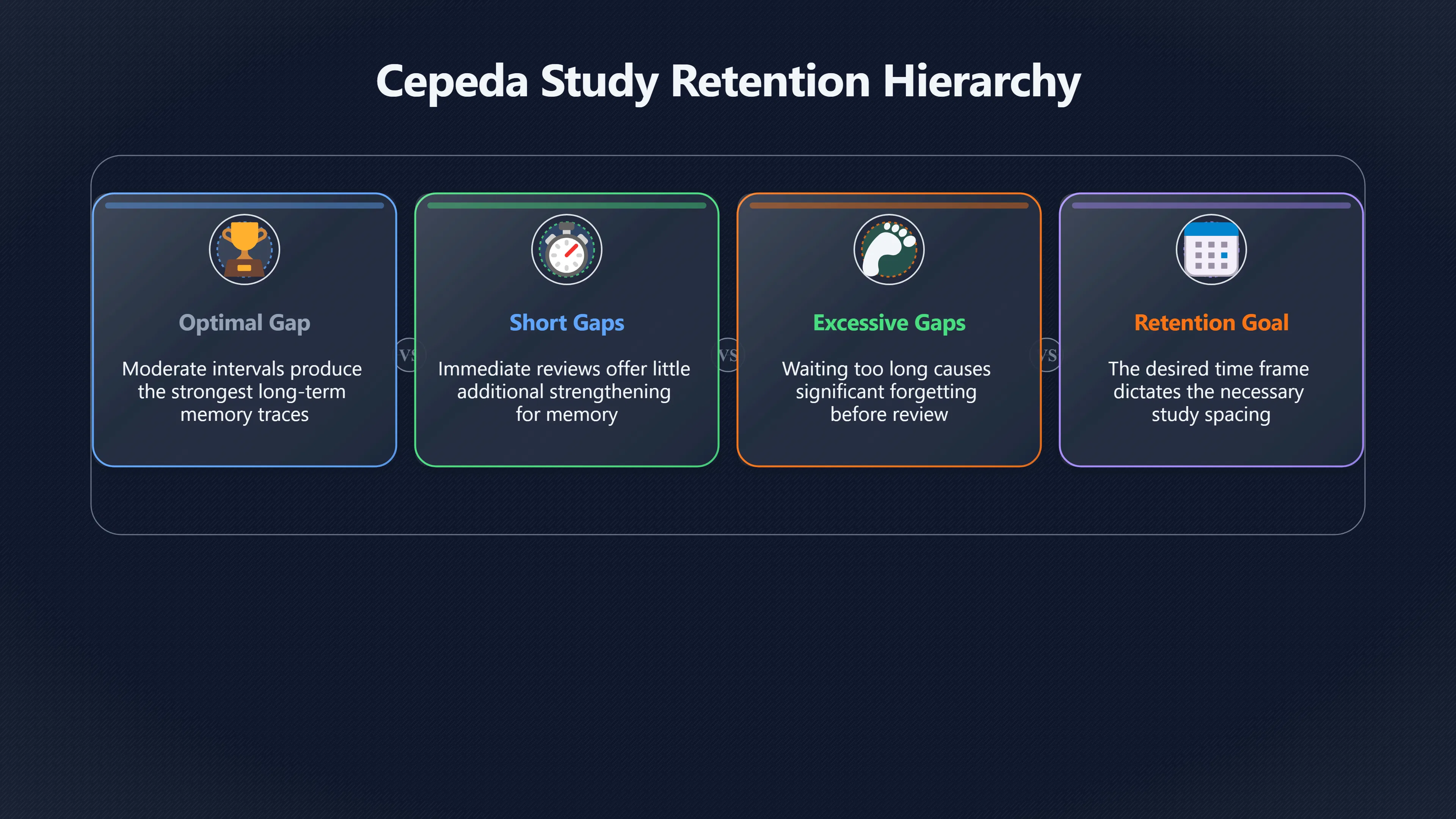
The results produced what the authors described as a temporal ridgeline of optimal retention. For every intended retention period, memory performance followed the same general pattern:
- very short gaps produced weaker long-term retention;
- moderate gaps produced the best results; and
- excessively long gaps caused performance to decline again. [PubMed]pubmed.ncbi.nlm.nih.govSpacing effects in learning: a temporal ridgeline of optimal…by NJ Cepeda · 2008 · Cited by 1035 — In a study aimed at character…
Rather than a straight line in which more spacing continually improved learning, the relationship formed an inverted-U pattern.
Why longer gaps are not always better
The most important contribution of the Cepeda studies was demonstrating that spacing has diminishing returns.
If a learner reviews material almost immediately after first studying it, the second encounter is so easy that relatively little additional strengthening occurs. The review largely confirms information that is already highly accessible.
At the opposite extreme, if the learner waits too long, retrieval may become extremely difficult or fail altogether. Instead of strengthening an existing memory, the learner may have to relearn substantial parts of the material from scratch. Both situations produce poorer long-term retention than a moderately challenging review. [PubMed]pubmed.ncbi.nlm.nih.govSpacing effects in learning: a temporal ridgeline of optimal…by NJ Cepeda · 2008 · Cited by 1035 — In a study aimed at character…
The experiments showed that the optimal gap grows as the desired retention interval grows. However, it does not grow in direct proportion.
For example:
- when the goal is remembering material for roughly one week, the optimal gap is relatively short;
- when the goal is remembering for several months, considerably longer review intervals become advantageous;
- when retention is expected to last a year, the optimal gap is longer still, but represents only a small fraction of the total retention period. [PubMed]pubmed.ncbi.nlm.nih.govSpacing effects in learning: a temporal ridgeline of optimal…by NJ Cepeda · 2008 · Cited by 1035 — In a study aimed at character…
One of the most widely cited findings is that the optimal spacing interval is often approximately:
- 20–40% of a one-week retention interval, but
- only about 5–10% of a one-year retention interval. [Sage Journals]journals.sagepub.comSage Journals Spacing Effects in LearningCepeda, Edward…by NJ Cepeda · 2008 · Cited by 1033 — However, when measured as a proportion of test delay, the optimal gap declined fr…
These figures are best understood as broad empirical tendencies rather than precise rules. Different materials, learners and testing conditions shift the exact optimum.
How the evidence translates into planning rules
The Cepeda findings suggest several practical planning principles.
Begin with the retention goal rather than the calendar. Instead of asking, “When should I review?”, first decide when you expect to need the knowledge. Preparing for next week’s meeting, a university examination in two months, or professional work over several years naturally calls for different review schedules. [Sage Journals]journals.sagepub.comSage Journals Spacing Effects in LearningCepeda, Edward…by NJ Cepeda · 2008 · Cited by 1033 — However, when measured as a proportion of test delay, the optimal gap declined fr…
Allow enough forgetting to make retrieval effortful. Reviews should feel slightly challenging rather than effortless. Moderate retrieval difficulty appears to strengthen long-term accessibility more effectively than immediate repetition. [Andy Matuschak]andymatuschak.orgAndy Matuschak Using Spacing to Enhance Diverse Forms of Learningby SK Carpenter · Cited by 737 — Expanded vsequal interval spaced retrieval practice: Exploring different schedules of spacing and retention interval in younger and older adults. Ag…
Avoid interpreting “more spacing” as universally better. Once gaps become excessively long relative to the retention goal, performance begins to decline. The evidence argues against both cramming and neglect.
Adjust spacing over time. As knowledge stabilises, review intervals can generally become longer. This principle underlies many modern spaced-repetition systems, although practical algorithms often adapt intervals dynamically according to individual recall success rather than following fixed percentages. [York University]yorku.caJ., Vul, E., Rohrer, D., Wixted, J. T., & Pashler, H. (2008). Spacing effects in learning: A temporal ridgeline of optimal retention.Read…
What the studies do—and do not—show
The Cepeda studies are frequently summarised as proving a universal spacing formula. That overstates the evidence.
The experiments primarily involved factual learning under controlled conditions. Although later educational research broadly supports applying distributed practice in classrooms and professional learning, the precise optimal intervals vary with factors such as:
- prior knowledge;
- material complexity;
- retrieval difficulty;
- number of review sessions;
- individual forgetting rates; and
- whether learners actively retrieve information or merely reread it. [York University+2Andy Matuschak]yorku.caJ., Vul, E., Rohrer, D., Wixted, J. T., & Pashler, H. (2008). Spacing effects in learning: A temporal ridgeline of optimal retention.Read…
For that reason, the reported percentages should be viewed as useful planning heuristics rather than exact prescriptions.
The enduring contribution of the Cepeda research is therefore conceptual rather than numerical. It demonstrated convincingly that the best spacing interval depends on the desired retention interval, and that successful distributed practice requires balancing two competing risks: reviewing too soon, when little additional learning occurs, and reviewing too late, when too much has already been forgotten. That evidence provides one of the strongest empirical foundations for planning learning that is intended to support lasting analytical thinking rather than short-lived exam performance. [PubMed]pubmed.ncbi.nlm.nih.govSpacing effects in learning: a temporal ridgeline of optimal…by NJ Cepeda · 2008 · Cited by 1035 — In a study aimed at character…

Amazon book picks
Further Reading
Books and field guides related to The evidence for the spacing sweet spot. Use these as the next step if you want deeper reading beyond the article.
How We Learn
Covers spacing, forgetting, memory consolidation, and practical study scheduling in accessible language.
Make It Stick
Explains spaced practice, retrieval practice, and durable learning using the research behind the spacing effect.
Powerful Teaching
Applies spacing and retrieval research to real-world planning and instructional practice.
Small Teaching
Shows how evidence from learning science, including distributed practice, can improve long-term retention.
eBay marketplace picks
Marketplace Samples
Live-tested eBay searches with available results related to this page.



Endnotes
-
Source: pubmed.ncbi.nlm.nih.gov
Link: https://pubmed.ncbi.nlm.nih.gov/19076480/Source snippet
Spacing effects in learning: a temporal ridgeline of optimal...by NJ Cepeda · 2008 · Cited by 1035 — In a study aimed at character...
-
Source: journals.sagepub.com
Title: Sage Journals Spacing Effects in Learning
Link: https://journals.sagepub.com/doi/abs/10.1111/j.1467-9280.2008.02209.xSource snippet
Cepeda, Edward...by NJ Cepeda · 2008 · Cited by 1033 — However, when measured as a proportion of test delay, the optimal gap declined fr...
-
Source: andymatuschak.org
Link: https://andymatuschak.org/[promptsSource snippet
equal interval spaced retrieval practice: Exploring different schedules of spacing and retention interval in younger and older adults. Ag...
-
Source: yorku.ca
Link: https://www.yorku.ca/ncepeda/publications/CVRWP2008.htmlSource snippet
J., Vul, E., Rohrer, D., Wixted, J. T., & Pashler, H. (2008). Spacing effects in learning: A temporal ridgeline of optimal retention.Read...
-
Source: notes.andymatuschak.org
Title: Spacing effect
Link: https://notes.andymatuschak.org/Spacing_effectSource snippet
effect13 Jul 2023 — Spacing produces better recall because it encodes memory traces with a wider variety of psychological contexts, provi...
Additional References
-
Source: laplab.ucsd.edu
Link: https://laplab.ucsd.edu/articles/Cepeda%20et%20al%202008_psychsci.pdfSource snippet
Temporal Ridgeline of Optimal Retentionby NJ Cepeda · Cited by 3 — Effects of the gap between exposures on later memory are usually terme...
-
Source: sciencedaily.com
Title: And larger gaps between study sessions result in better
Link: https://www.sciencedaily.com/releases/2008/11/081118141708.htmSource snippet
Improving Long-term Learning Through Spacing Of Lessons19 Nov 2008 — Proper spacing of lessons, the researchers report, can dramatically...
-
Source: edresearch.edu.au
Title: spacing and retrieval practice guide full publication
Link: https://www.edresearch.edu.au/guides-resources/practice-guides/spacing-and-retrieval-practice-guide-full-publicationSource snippet
AEROSpacing and retrieval practice guide14 Sept 2021 — Spacing and retrieval practice can improve students' long-term retention of their...
-
Source: researchgate.net
Link: https://www.researchgate.net/publication/261773056_Retrieval_practice_over_the_long_term_Should_spacing_be_expanding_or_equal-intervalSource snippet
that optimal spacing depends on retention goals and material difficulty.Read more...
-
Source: medium.com
Link: https://medium.com/language-mind/the-spacing-effect-how-to-triple-your-language-learning-retention-d9c90cf4d3f4Source snippet
es of 80% or higher, even after several months, compared with 20–30...Read more...
-
Source: researchgate.net
Link: https://www.researchgate.net/publication/23657355_Spacing_Effects_in_Learning_A_Temporal_Ridgeline_of_Optimal_RetentionSource snippet
Cepeda et al. (2008) demonstrated that the optimal...
-
Source: youtube.com
Title: How the Brain Learns Vocabulary | TESOL & The Science of Language Learning
Link: https://www.youtube.com/watch?v=K2hQlqF_h8sSource snippet
Lamine Yamal & Marcus Rashford score in Barcelona’s 3-1 win over Elche | LaLiga Highlights...
-
Source: eric.ed.gov
Link: https://eric.ed.gov/?id=ED505660Source snippet
by NJ Cepeda · 2008 · Cited by 1022 — The optimum gap value was about 20% of the test delay for delays of a few weeks, falling to abo...
-
Source: structural-learning.com
Link: https://www.structural-learning.com/post/spaced-practice-a-teachers-guideSource snippet
Classroom Practice | Spaced Practice: A Teacher's Guide24 Apr 2026 — The optimal spacing gap depends on the retention interval: longer re...
-
Source: get-alfred.ai
Title: spacing effect
Link: https://get-alfred.ai/blog/spacing-effectSource snippet
The Spacing Effect: Why Cramming Fails and Distributed...19 Feb 2026 — The Cepeda 2008 study found the optimal spacing gap is roughly 10...
Topic Tree