Within Metacognition
Is That a Fact or a Story?
A clear split between what happened and what it means can stop a convenient story from taking over the evidence.
On this page
- Why interpretations often disguise themselves as facts
- How to restate a judgement as observable details
- Workplace and study examples where the split changes the conclusion
Page outline Jump by section
Introduction
One of the most useful metacognitive habits is learning to separate what you observed from what you think those observations mean. Many poor decisions do not begin with faulty logic; they begin with an unnoticed shift from evidence to interpretation. A colleague arrives late to a meeting and the mind quietly changes “they arrived ten minutes after the start” into “they are unreliable”. A sales figure falls and “revenue dropped by 8%” becomes “customers have lost confidence”. By the time the decision is made, the interpretation often feels as factual as the observation itself.
 Slowing down at this point creates a small but powerful gap between noticing and explaining. That gap makes it easier to test assumptions, consider alternatives and seek evidence that genuinely distinguishes between competing explanations rather than simply confirming the first story that came to mind. Research on metacognition, cognitive bias and organisational decision-making consistently shows that this deliberate separation improves judgement, particularly in complex or uncertain situations. [PMC+2Wikipedia]pmc.ncbi.nlm.nih.govThe Impact of Cognitive Biases on Professionals' Decision…by V Berthet · 2022 · Cited by 306 — The author reviewed the research on…
Why interpretations often disguise themselves as facts
The human brain does not passively record reality. It filters, selects and organises information into meaningful patterns. This makes everyday life manageable but also encourages people to mistake their explanations for direct observations.
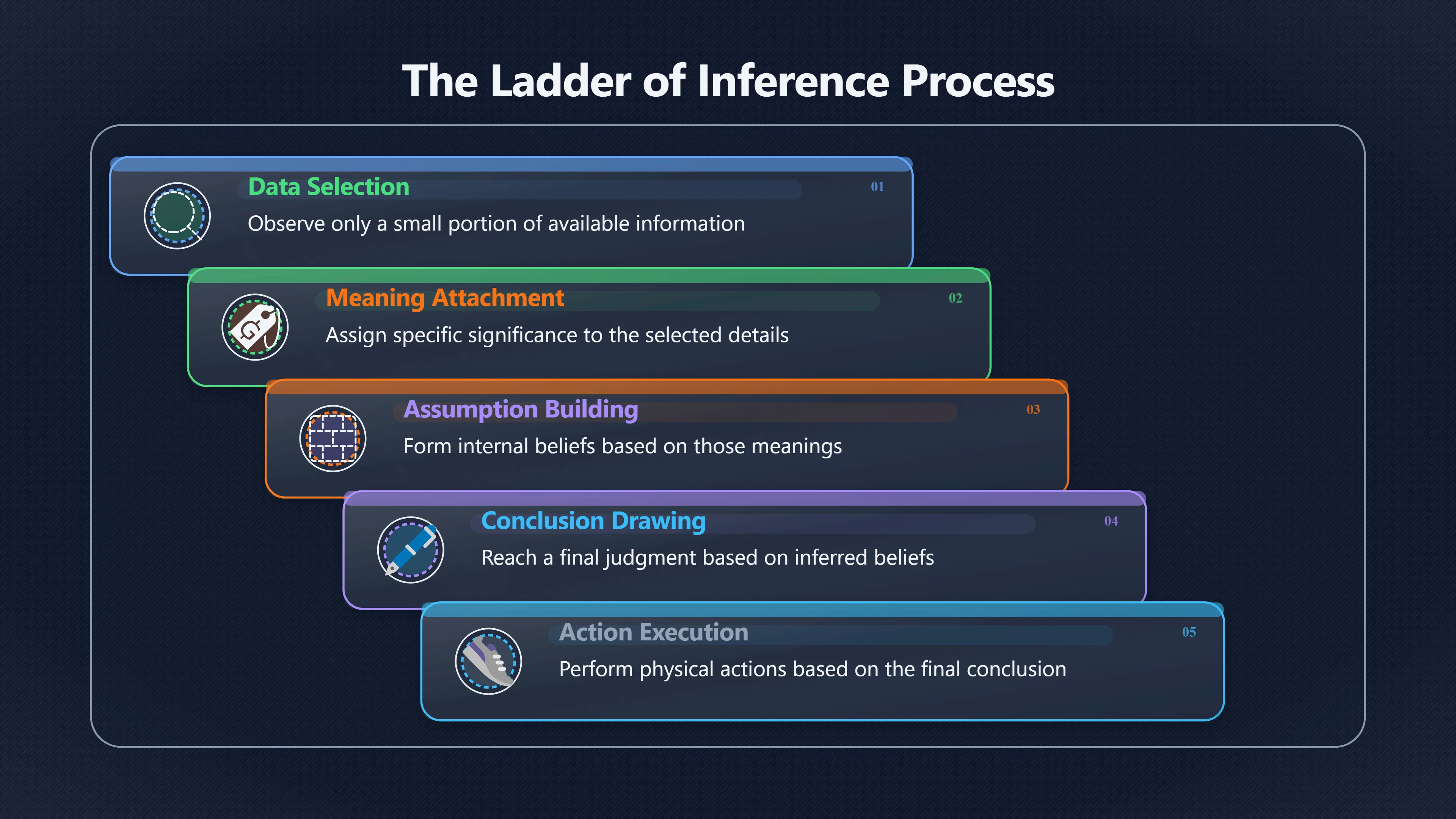
A common description of this process is the Ladder of Inference, developed by organisational theorist Chris Argyris. Rather than moving directly from facts to decisions, people typically:
- Observe only part of the available information.
- Select the details that seem important.
- Attach meaning to those details.
- Make assumptions. [blog.tcea.org]blog.tcea.orgladder of inferenceCognitive Bias with the Ladder of Inference26 Mar 2024 — The Ladder of Inference, developed by organizational psychologist Chris Argyris…
- Draw conclusions.
- Form beliefs. [sourcesofinsight.com]sourcesofinsight.comheir beliefs based on their observations and experiences.Read more…
- Act on those beliefs.
The critical point is that most of these steps happen automatically. By the time someone reaches a conclusion, they may no longer remember which parts were directly observed and which parts were inferred. [USC Gould School of Law]gould.usc.eduUSC Gould School of LawUnderstanding the Ladder of Inference: Navigating…28 Nov 2023 — The ladder of inference illustrates the mental…
This explains why disagreements often persist even when people believe they are arguing about “the facts”. Frequently they are working from the same observations but different interpretations.
For example:
- Observation: Three team members remained silent during a meeting.
- Interpretation A: They disagreed with the proposal.
- Interpretation B: They had not yet formed an opinion.
- Interpretation C: The meeting structure discouraged participation.
Only the first statement is directly observable. The others require additional evidence.
A simple test: could a camera record it?
One practical way to distinguish facts from stories is to imagine a video recording of the event.
If a camera could capture it without explanation, it is probably an observation.
Examples of observations include:
- “The report was submitted two days after the deadline.”
- “Five customers cancelled their subscriptions this week.”
- “The student answered four of ten questions correctly.”
By contrast, these are interpretations:
- “The employee lacks commitment.”
- “Customers are losing trust.”
- “The student did not study.”
Those interpretations may eventually prove correct, but they are hypotheses rather than observations. Treating them as established facts reduces the chance of testing alternative explanations.
This distinction resembles good scientific reasoning, where observations are separated from hypotheses so that explanations can be challenged rather than assumed. [Wikipedia]WikipediaOpen source on wikipedia.org.
How to restate a judgement as observable details
Many decisions become clearer when a judgement is rewritten in purely observable language.
Consider the following examples.
JudgementObservable restatement”The client is unhappy.”“The client requested three revisions, declined the proposed timeline and has not replied for five days.”“The project is failing.”“Milestones one and two were missed, costs are 18% above plan and two suppliers withdrew.”“The manager dislikes my ideas.”“During the last four meetings, none of my proposals were selected and the manager asked follow-up questions only on other proposals.”“The candidate lacked leadership.”“The candidate described individual achievements but gave no examples of leading a team during the interview.”
Notice that the observable version often feels less dramatic. That is precisely its strength. It creates a description that other people can verify independently before debating what it means.
Once observations are stated clearly, multiple explanations become easier to compare.
Why this improves decision quality
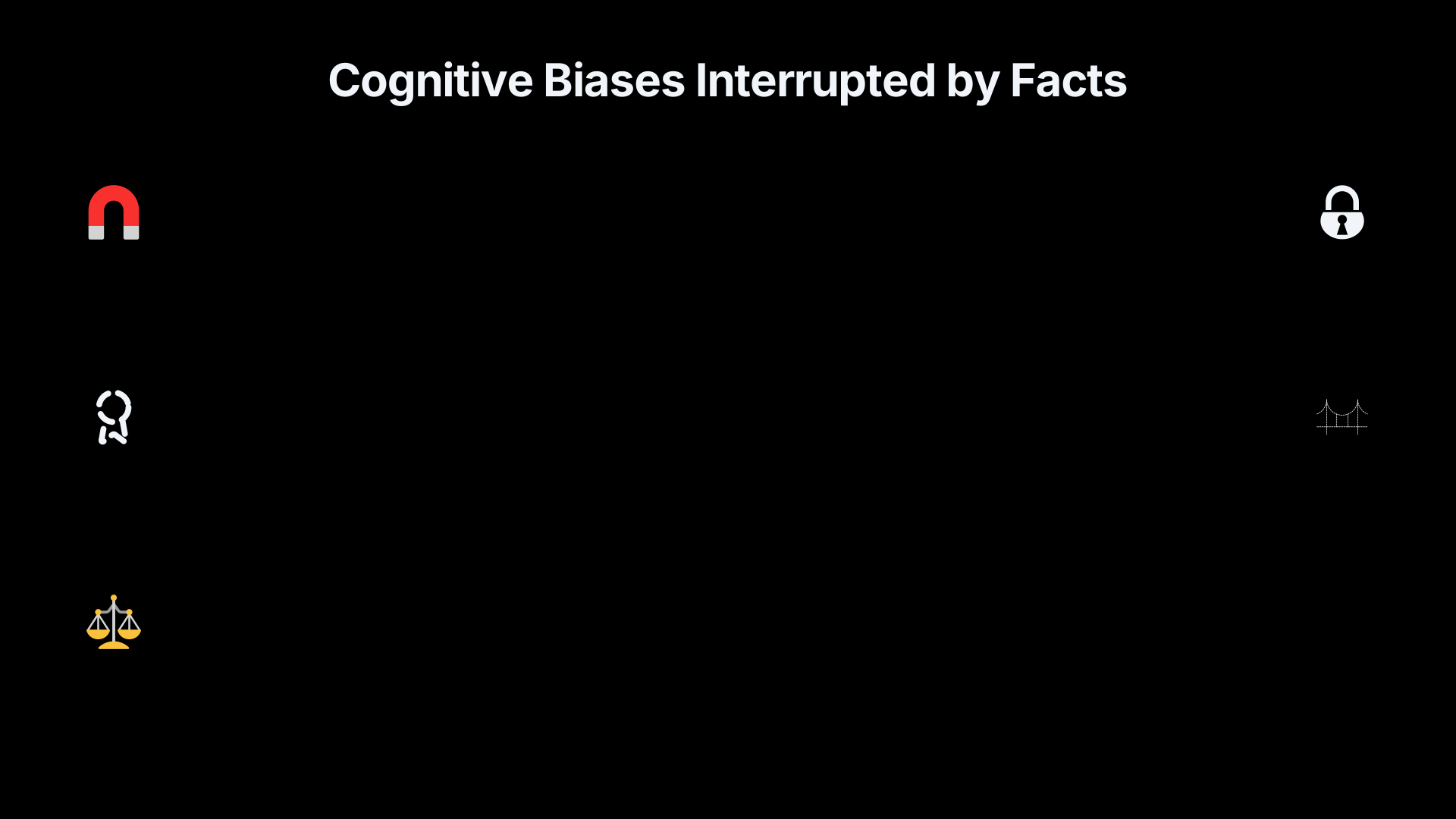
Separating observations from interpretations interrupts several well-known cognitive biases.
Confirmation bias. Once an interpretation forms, people naturally notice evidence that supports it while overlooking contradictory information. Keeping observations separate makes it easier to ask, “What evidence would change my mind?” [PMC+2ODI: Think change]pmc.ncbi.nlm.nih.govThe Impact of Cognitive Biases on Professionals' Decision…by V Berthet · 2022 · Cited by 306 — The author reviewed the research on…
Premature closure. Decision-makers often stop searching once an explanation appears plausible. Explicitly distinguishing facts from interpretations keeps alternative explanations alive for longer. [Wikipedia]WikipediaOpen source on wikipedia.org.
Overconfidence. People frequently become more certain than the evidence justifies because they mistake coherent stories for established facts. Separating the two naturally reduces unwarranted confidence and improves calibration between confidence and evidence. [PMC]pmc.ncbi.nlm.nih.govThe Impact of Cognitive Biases on Professionals' Decision…by V Berthet · 2022 · Cited by 306 — The author reviewed the research on…
These improvements do not require abandoning intuition altogether. Instead, they encourage treating intuition as a source of hypotheses that still need testing.

Workplace examples where the split changes the conclusion
Performance management
A manager concludes that an employee is “unmotivated”.
The observable evidence is:
- attendance remains normal;
- deadlines have been missed twice;
- email response times have doubled.
Possible interpretations include low motivation, excessive workload, unclear priorities, illness, family responsibilities or technical obstacles.
Without separating facts from explanations, the manager may choose disciplinary action when additional support or clearer expectations would solve the problem.
Product development
A team claims that “customers dislike the new feature.”
The observations show:
- usage is lower than expected;
- users abandon the feature after thirty seconds;
- support requests increased.
These observations could indicate dislike, but they could equally indicate confusing design, poor onboarding or technical defects.
The decision about what to fix depends on distinguishing these possibilities rather than assuming only one explanation.
Recruitment
Interviewers often describe candidates using broad labels such as “confident”, “not strategic” or “good cultural fit”.
A stronger assessment records observable behaviours:
- asked clarifying questions before answering;
- gave three examples with measurable outcomes;
- interrupted twice during panel questions;
- failed to explain how conflicting priorities were managed.
The later judgement is then traceable to evidence rather than impressions alone.
Study situations where the distinction matters
Students also benefit from separating facts from stories about their own learning.
Suppose a student thinks, “I’m terrible at mathematics.”
The observations may instead be:
- scored 48% on the last algebra test;
- answered geometry questions accurately;
- spent less time revising algebra than other topics.
These observations suggest more targeted explanations than a global judgement about ability.
Similarly:
- “I understand this chapter” becomes “I can correctly explain three of the five key concepts without looking at my notes.”
- “The exam was unfair” becomes “Four questions covered material not listed in the published revision guide.”
The observable versions are easier to evaluate and improve.
Questions that expose hidden interpretations
When a conclusion feels obvious, a few deliberate questions can reveal whether it rests on observations or assumptions.
- What exactly did I observe?
- Which part of my conclusion cannot be directly observed?
- Could another reasonable person describe the same event differently?
- What alternative explanation also fits these observations?
- What additional evidence would distinguish between those explanations?
- Which parts of my statement could be verified independently?
These questions slow the transition from perception to judgement without preventing decisive action when sufficient evidence exists.
A useful habit: write facts before explanations
A simple decision discipline is to separate notes into two columns.
Observations
- What was directly seen, heard, measured or recorded?
Interpretations
- What explanation currently seems most likely?
- What other explanations remain plausible?
- What evidence would favour one explanation over another?
This format does not eliminate uncertainty. Instead, it keeps uncertainty visible. Decisions are then based on evidence that can be inspected rather than stories that quietly become accepted as fact.
Within metacognitive practice, this habit is valuable because it exposes assumptions before they become invisible. The goal is not to suppress interpretation—interpretation is essential for understanding—but to ensure that explanations remain open to revision as new evidence appears. That small distinction between “this happened” and “this is what I think it means” is often where analytical thinking becomes noticeably more accurate.
Amazon book picks
Further Reading
Books and field guides related to Is That a Fact or a Story?. Use these as the next step if you want deeper reading beyond the article.
The Scout Mindset
Focuses on separating evidence from belief and updating conclusions based on facts.
Mistakes Were Made (but Not by Me)
Shows how people justify interpretations and defend beliefs despite contrary evidence.
The Fifth Discipline
Introduces the Ladder of Inference and practical methods for distinguishing observable data from assumptions.
The Art of Thinking Clearly
Provides practical examples of cognitive errors that arise when interpretations are mistaken for facts.
eBay marketplace picks
Marketplace Samples
Live-tested eBay searches with available results related to this page.


Endnotes
-
Source: pmc.ncbi.nlm.nih.gov
Link: https://pmc.ncbi.nlm.nih.gov/articles/PMC8763848/Source snippet
The Impact of Cognitive Biases on Professionals' Decision...by V Berthet · 2022 · Cited by 306 — The author reviewed the research on...
-
Source: Wikipedia
Link: https://en.wikipedia.org/wiki/Metacognition -
Source: gould.usc.edu
Link: https://gould.usc.edu/news/understanding-the-ladder-of-inference-navigating-cognitive-pitfalls/Source snippet
USC Gould School of LawUnderstanding the Ladder of Inference: Navigating...28 Nov 2023 — The ladder of inference illustrates the mental...
-
Source: Wikipedia
Link: https://en.wikipedia.org/wiki/Observation -
Source: odi.org
Link: https://odi.org/en/insights/how-cognitive-biases-affect-monitoring-evaluation-and-learning-and-what-can-be-done-about-it/Source snippet
How cognitive biases affect monitoring, evaluation and...4 Mar 2020 — Cognitive biases affect everyone. Putting structures in place can...
-
Source: Wikipedia
Link: https://en.wikipedia.org/wiki/Decision-making -
Source: asana.com
Title: ladder of inference
Link: https://asana.com/resources/ladder-of-inferenceSource snippet
How to use the ladder of inference for better decisions14 Mar 2026 — The ladder of inference is a mental model developed by Chris Argyris...
-
Source: blog.tcea.org
Title: ladder of inference
Link: https://blog.tcea.org/ladder-of-inference/Source snippet
Cognitive Bias with the Ladder of Inference26 Mar 2024 — The Ladder of Inference, developed by organizational psychologist Chris Argyris...
Additional References
-
Source: tempo.io
Link: https://www.tempo.io/blog/ladder-of-inferenceSource snippet
The ladder of inference: How thoughts shape decisionsIt's called the ladder of inference, a concept that explains how people turn a simpl...
-
Source: manchesterdigital.com
Link: https://www.manchesterdigital.com/post/bridcon-business-and-management-consulting/the-ladder-of-inference-a-useful-model-used-in-the-decision-making-processSource snippet
ble insights into the way our minds work and how we make decisions.Read more...
-
Source: sourcesofinsight.com
Link: https://sourcesofinsight.com/ladder-of-inference/Source snippet
heir beliefs based on their observations and experiences.Read more...
-
Source: jmla.pitt.edu
Link: https://jmla.pitt.edu/ojs/jmla/article/view/2209Source snippet
biases as interrupters in evidence based practice...by JD Eldredge · 2025 — Discussion: This study identified commonly observed cognitiv...
-
Source: youtube.com
Link: https://www.youtube.com/watch?v=cJt5Hzas1wcSource snippet
PHILOSOPHY - Language: Conditionals #1 [HD]...
-
Source: youtube.com
Title: conditional reasoning
Link: https://www.youtube.com/watch?v=q2Ur9cDet8ESource snippet
How to Think About Thinking — The Metacognition Explained...
-
Source: youtube.com
Title: How to Think About Thinking — The Metacognition Explained
Link: https://www.youtube.com/watch?v=tn2jyKgwHMgSource snippet
Analytical Skills Everyone Should Know...
-
Source: youtube.com
Link: https://www.youtube.com/watch?v=4Zxp2-_pLCESource snippet
conditional reasoning...
-
Source: youtube.com
Title: Analytical Skills Everyone Should Know
Link: https://www.youtube.com/watch?v=mRsiPFJG2u4
Topic Tree