Within Open Mind
The Question That Interrupts Defensive Reasoning
Deliberately asking what would be visible if you were wrong can reduce biased judgement more than simply trying to be fair.
On this page
- Why trying to be unbiased is often too weak
- What consider the opposite prompts ask you to notice
- How to use the prompt without forced reversal
Page outline Jump by section
Introduction
Heated arguments rarely fail because people have no arguments. They fail because each side becomes better at defending its existing position than at testing it. One of the simplest evidence-based ways to interrupt this pattern is the consider-the-opposite technique: instead of asking yourself to “be unbiased”, deliberately ask what you would expect to see if your current view were mistaken. Research in reasoning and actively open-minded thinking suggests that this kind of directed search for disconfirming evidence is often more effective than a vague intention to be fair because it changes what you actively look for, question and remember. [PMC+2UCSD Pages]pmc.ncbi.nlm.nih.govPMCActively Open-Minded Thinking and Its Measurementby KE Stanovich · 2023 · Cited by 131 — Actively open-minded thinking (AOT) is measured by items that tap the willingness to consider…
 Within real disagreements, the goal is not to argue against yourself for the sake of balance. The goal is to expose blind spots before they harden into certainty. The technique works best when emotions are high precisely because those are the moments when people are most likely to scrutinise opposing evidence far more critically than evidence supporting their own side. [Frank Baumgartner]fbaum.unc.eduFrank Baumgartner Biased Assimilation and Attitude Polarization: The EffectsROSS, AND M. LEPPER attitudes and beliefs did change after each new piece of evidence was presented, and from the beginning to the end of…
Why trying to be unbiased is often too weak
Simply telling yourself to “keep an open mind” leaves your existing habits of reasoning largely unchanged. Confirmation bias and myside bias do not usually operate through conscious dishonesty. Instead, they influence which questions feel worth asking, which flaws seem important, and which explanations appear naturally plausible. [UCSD Pages+2ResearchGate]pages.ucsd.edunickerson Confirmation BiasUCSD PagesConfirmation Bias: A Ubiquitous Phenomenon in Many…by RS Nickerson · 1998 · Cited by 12458 — Confirmation bias, as the term…
The consider-the-opposite prompt changes the task itself. Rather than asking:
“Am I being fair?”
it asks:
“If my conclusion were wrong, what evidence or events should I expect to find?”
That subtle shift matters because it directs attention towards evidence that your mind might otherwise ignore. Studies of actively open-minded thinking consistently describe a willingness to seek contradictory evidence and postpone premature closure as central features of better judgement rather than optional personality traits. [PMC+2Cambridge University Press & Assessment]pmc.ncbi.nlm.nih.govPMCActively Open-Minded Thinking and Its Measurementby KE Stanovich · 2023 · Cited by 131 — Actively open-minded thinking (AOT) is measured by items that tap the willingness to consider…
This approach also reduces the temptation to confuse confidence with accuracy. During emotionally charged disagreements, increased confidence often reflects successful self-defence rather than improved understanding.
What consider-the-opposite prompts ask you to notice
The technique is practical because it asks concrete questions instead of encouraging abstract fairness.
Useful prompts include:
- What observation would genuinely weaken my conclusion?
- Which fact would surprise me if the other person were actually correct?
- Am I applying a stricter standard to their evidence than to mine?
- Would I judge this evidence differently if it supported my opponent instead?
- Which explanation have I dismissed without really testing it?
- If someone I trusted defended the opposite position, what reasons might they give?
Notice that none of these questions require abandoning your current view. They require identifying conditions under which you would be willing to revise it.
This distinction is important because genuine open-mindedness is conditional rather than indiscriminate. It asks whether your belief is responsive to evidence, not whether every competing claim deserves equal confidence. [PMC]pmc.ncbi.nlm.nih.govPMCActively Open-Minded Thinking and Its Measurementby KE Stanovich · 2023 · Cited by 131 — Actively open-minded thinking (AOT) is measured by items that tap the willingness to consider…

A concrete example from disagreement research
One reason these prompts matter comes from classic work by Charles Lord, Lee Ross and Mark Lepper on the death penalty. Participants who already favoured or opposed capital punishment read the same mixed collection of studies. Instead of moving towards one another, both groups typically became more convinced that they had been right all along.
The striking finding was not that participants ignored contrary evidence entirely. Rather, they evaluated it differently. Evidence supporting their own position was accepted relatively easily, while evidence supporting the opposing position attracted much more detailed criticism. Identical standards were not being applied to both sides. [Frank Baumgartner]fbaum.unc.eduFrank Baumgartner Biased Assimilation and Attitude Polarization: The EffectsROSS, AND M. LEPPER attitudes and beliefs did change after each new piece of evidence was presented, and from the beginning to the end of…
A consider-the-opposite prompt interrupts precisely this pattern. Before deciding that a contrary study is weak, it encourages asking:
- Would I have noticed this flaw if the study agreed with me?
- What would persuade me if I did not already hold my current opinion?
- Is my criticism aimed at improving the conclusion, or protecting it?
These questions do not guarantee agreement, but they make asymmetric evaluation harder to sustain unnoticed.
How to use the prompt without forced reversal
The technique is sometimes misunderstood as requiring equal confidence in every alternative. That is not its purpose.
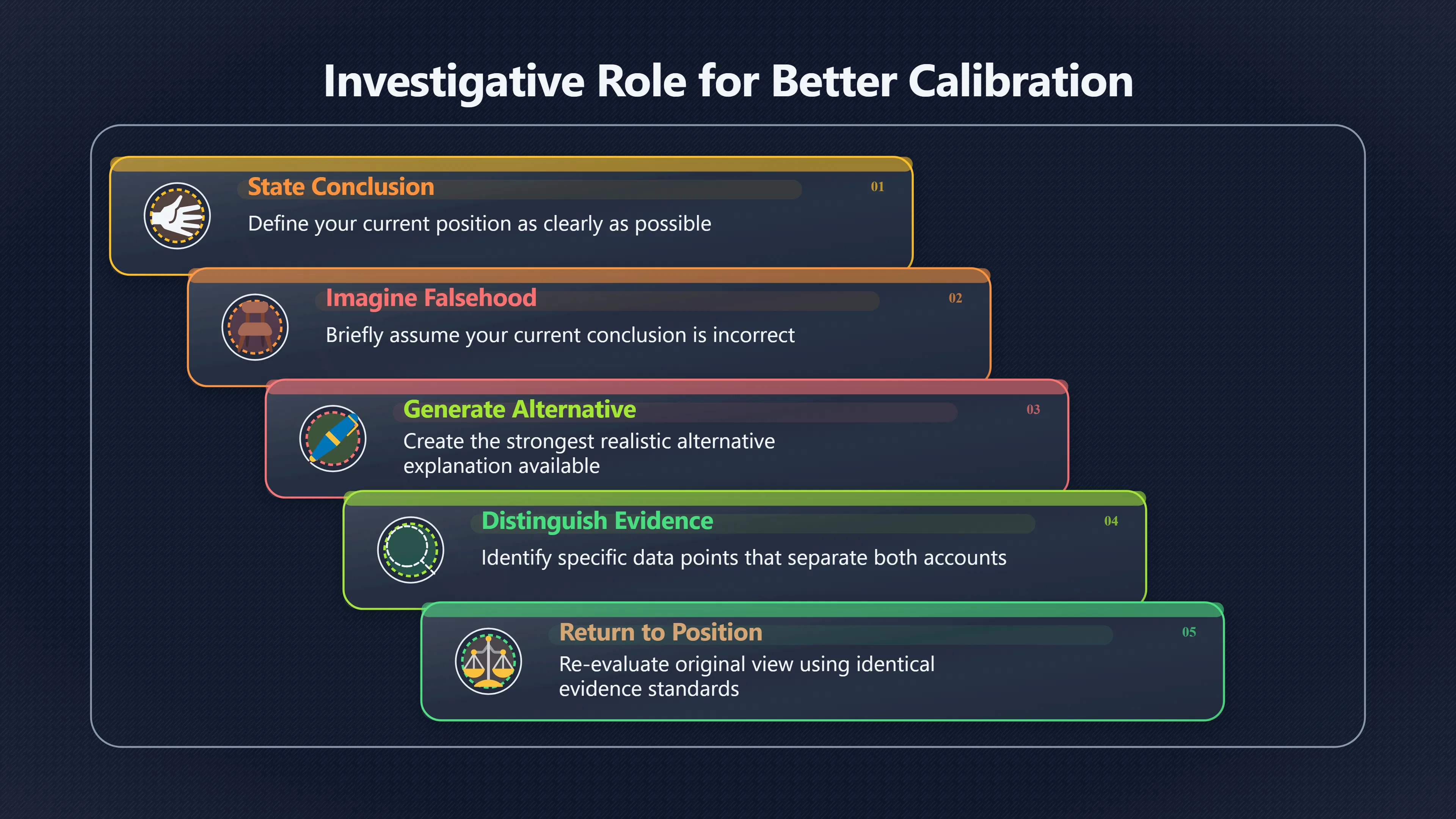
Instead, treat it as a temporary investigative role.
- State your current conclusion as clearly as possible.
- Imagine, briefly, that it is false.
- Generate the strongest realistic alternative explanation.
- Ask what evidence would distinguish the two accounts.
- Return to your original position only after evaluating both by the same standards.
This sequence differs from “playing devil’s advocate” merely for debate. The objective is not performance or rhetorical balance but better calibration between confidence and evidence.
Importantly, the exercise can finish exactly where it started. If your original position survives serious testing, your confidence may become better justified. If it changes, the change is grounded in evidence rather than social pressure.

When the technique works best—and when it struggles
Consider-the-opposite prompts are especially useful when:
- both sides possess some relevant evidence;
- emotions make defensive reasoning likely;
- important decisions depend on interpreting uncertain information;
- confidence has risen faster than the available evidence.
They become less effective when people refuse to imagine any realistic alternative, when group identity makes concession feel like betrayal, or when participants treat the exercise as a rhetorical game rather than a genuine test. Open-minded thinking depends on willingness as well as cognitive skill. [PMC+2Taylor & Francis Online]pmc.ncbi.nlm.nih.govPMCActively Open-Minded Thinking and Its Measurementby KE Stanovich · 2023 · Cited by 131 — Actively open-minded thinking (AOT) is measured by items that tap the willingness to consider…
Another limitation is that generating poor counterarguments does little to reduce bias. Research on argument quality suggests that people often underestimate the strength of opposing positions because they imagine weaker versions than serious advocates actually hold. Whenever possible, the “opposite” should therefore be the strongest credible alternative rather than an easily dismissed caricature. [JASSS]jasss.orgThe Wisdom of the Small Crowd: Myside Bias and Group…by E Baccini · 2023 · Cited by 15 — The my-side bias is a well-documented co…
The question that interrupts defensive reasoning
The most valuable consider-the-opposite prompt is surprisingly simple:
“What would I expect to see if I were wrong?”
Unlike “be objective” or “stay open-minded”, this question creates a concrete search task. It shifts attention from defending an existing conclusion towards identifying observations that could genuinely change it.
In heated disagreements, that shift is often enough to slow premature certainty. It encourages people to judge both their own position and their opponent’s using comparable standards of evidence—a central aim of actively open-minded thinking rather than a demand for false balance. [PMC+2UCSD Pages]pmc.ncbi.nlm.nih.govPMCActively Open-Minded Thinking and Its Measurementby KE Stanovich · 2023 · Cited by 131 — Actively open-minded thinking (AOT) is measured by items that tap the willingness to consider…
Amazon book picks
Further Reading
Books and field guides related to The Question That Interrupts Defensive Reasoning. Use these as the next step if you want deeper reading beyond the article.
The Scout Mindset
Directly addresses actively seeking disconfirming evidence and updating beliefs.
Mistakes Were Made (but Not by Me)
Shows why people defend existing beliefs and how defensive reasoning develops.
How Minds Change
Explores evidence-based approaches to reducing defensiveness and encouraging open-minded reasoning.
Thinking, Fast and Slow
Explains confirmation bias, overconfidence, and reasoning errors that consider-the-opposite techniques are designed to counter.
eBay marketplace picks
Marketplace Samples
Live-tested eBay searches with available results related to this page.



Endnotes
-
Source: pmc.ncbi.nlm.nih.gov
Title: PMCActively Open-Minded Thinking and Its Measurement
Link: https://pmc.ncbi.nlm.nih.gov/articles/PMC9966223/Source snippet
by KE Stanovich · 2023 · Cited by 131 — Actively open-minded thinking (AOT) is measured by items that tap the willingness to consider...
-
Source: pages.ucsd.edu
Title: nickerson Confirmation Bias
Link: https://pages.ucsd.edu/~mckenzie/nickersonConfirmationBias.pdfSource snippet
UCSD PagesConfirmation Bias: A Ubiquitous Phenomenon in Many...by RS Nickerson · 1998 · Cited by 12458 — Confirmation bias, as the term...
-
Source: researchgate.net
Link: https://www.researchgate.net/publication/232555483_Biased_assimilation_and_attitude_polarization_The_effects_of_prior_theories_on_subsequently_considered_evidenceSource snippet
[Biased assimilation]({{ 'mixed-evidence-accf68/' | relative_url }}) and attitude polarization: The effects of...People who hold strong opinions on complex social issues are likely to e...
-
Source: researchgate.net
Link: https://www.researchgate.net/publication/258127972_Myside_Bias_Rational_Thinking_and_IntelligenceSource snippet
(PDF) Myside Bias, Rational Thinking, and IntelligenceMyside bias occurs when people evaluate evidence, generate evidence, and test hypot...
-
Source: cambridge.org
Link: https://www.cambridge.org/core/journals/judgment-and-decision-making/article/role-of-actively-openminded-thinking-in-information-acquisition-accuracy-and-calibration/1D78BE16863F3F6B2D1C8B5307C9C3B3Source snippet
Thus, we expected it to be the most predictive...Read more...
-
Source: jasss.org
Link: https://www.jasss.org/26/4/7.htmlSource snippet
The Wisdom of the Small Crowd: Myside Bias and Group...by E Baccini · 2023 · Cited by 15 — The my-side bias is a well-documented co...
-
Source: researchgate.net
Link: https://www.researchgate.net/publication/265394044_The_Role_of_Actively_Open-Minded_Thinking_in_Information_Acquisition_Accuracy_and_CalibrationSource snippet
tendency to maximize or satisfice when making decisions.Read more...
-
Source: cambridge.org
Link: https://www.cambridge.org/core/books/cognitive-science-of-belief/building-better-beliefs-through-actively-openminded-thinking/140F5F32706B3B2CBC5A83CC99F174A4Source snippet
s by increasing the depth and – more importantly – the breadth of information...Read more...
-
Source: fbaum.unc.edu
Title: Frank Baumgartner Biased Assimilation and Attitude Polarization: The Effects
Link: https://fbaum.unc.edu/teaching/articles/jpsp-1979-Lord-Ross-Lepper.pdfSource snippet
ROSS, AND M. LEPPER attitudes and beliefs did change after each new piece of evidence was presented, and from the beginning to the end of...
-
Source: tandfonline.com
Link: https://www.tandfonline.com/doi/abs/10.1080/13546783.2024.2360491Source snippet
Taylor & Francis Onlinemyside bias and [uncertainty]({{ 'uncertainty/' | relative_url }}) aversion: Thinking & Reasoningby J Baron · 2024 · Cited by 14 — Actively open-minded t...
-
Source: Wikipedia
Title: Confirmation bias
Link: https://en.wikipedia.org/wiki/Confirmation_biasSource snippet
Confirmation biasConfirmation bias is the tendency to search for, interpret, favor and recall information in a way that confirms or su...
-
Source: pmc.ncbi.nlm.nih.gov
Link: https://pmc.ncbi.nlm.nih.gov/articles/PMC10623627/Source snippet
Parsimony in Bias Research: A Proposed Common...by A Oeberst · 2023 · Cited by 213 — We propose that different biases even share the sam...
-
Source: pmc.ncbi.nlm.nih.gov
Link: https://pmc.ncbi.nlm.nih.gov/articles/PMC3735824/Source snippet
Illusion of Argument Justification - PMC - NIHby M Fisher · 2013 · Cited by 72 — Thus, a potential source of greater objectivity is “cons...
Additional References
-
Source: preprints.apsanet.org
Title: confronting core issues a critical test of attitude polarization
Link: https://preprints.apsanet.org/engage/api-gateway/apsa/assets/orp/resource/item/63d560216bc5ca3b341e2d73/original/confronting-core-issues-a-critical-test-of-attitude-polarization.pdfSource snippet
Critical Test of Attitude Polarizationby Y Velez · 2023 · Cited by 13 — A long-standing debate in the political psychology literature con...
-
Source: facebook.com
Title: A strategy that works is: ask yourself how you’d have reacted
Link: https://www.facebook.com/groups/polymathmafia/posts/2669982003179854/Source snippet
Strategies for Overcoming Confirmation Bias in Decision...Michael Keenan writes: tl;dr: Merely striving to be unbiased doesn't fix confi...
-
Source: reddit.com
Link: https://www.reddit.com/r/science/comments/9mnj5o/myside_bias_makes_it_difficult_for_us_to_see_the/Source snippet
disagree with, finds a new study in the Journal of Cognitive Psychology.Read more...
-
Source: research.rug.nl
Title: qt8nq023zs noSplash 944c2b8ba5ca05bb8ef709bc02e1d089
Link: https://research.rug.nl/files/1266847446/qt8nq023zs_noSplash_944c2b8ba5ca05bb8ef709bc02e1d089.pdfSource snippet
Groningen Research PortalUniversity of Groningen The Myside Bias in Argument...by E Baccini · 2022 · Cited by 4 — In the literature, the...
-
Source: sjdm.org
Link: https://sjdm.org/dmidi/Actively_Open-Minded_Thinking_Beliefs.htmlSource snippet
ciding") is good. This scale is based on a much longer version...Read more...
-
Source: semanticscholar.org
Link: https://www.semanticscholar.org/paper/Biased-Assimilation-and-Attitude-Polarization%3A-The-Lord-Ross/16ae4cf82e87451492d0eb12190acfb63294e305Source snippet
Biased Assimilation and Attitude Polarization: The Effects...1 Nov 1979 — People who hold strong opinions on complex social issues are l...
-
Source: sjdm.org
Link: https://sjdm.org/~jbaron/ms/talks/aot.pdfSource snippet
hould take into consideration evidence that goes...Read more...
-
Source: uclascnlab.com
Link: https://www.uclascnlab.com/s/Dolbier-2025.pdfSource snippet
UCLA SCN LabOpen-Mindedness: An Integrative Review of Interventionsby SY Dolbier · 2024 · Cited by 26 — Interventions can promote open-mi...
-
Source: aura.american.edu
Link: https://aura.american.edu/articles/thesis/Consider_the_opposite_An_application_of_scientific_thinking_to_mitigate_assimilation_bias/23868252Source snippet
Consider the opposite: An application of scientific thinking...by DD Laughlin · 2001 · Cited by 1 — In 1979, Lord, Ross and Lepper ident...
-
Source: scienceopen.com
Link: https://www.scienceopen.com/document?vid=a3f5de91-e8e5-4ecd-bba6-33a7a45543b5Source snippet
Biased assimilation and attitude polarization: The effects of...Biased assimilation and attitude polarization: The effects of prior theo...
Topic Tree