Within Domain Knowledge
Facts Are Not Enough By Themselves
Usable knowledge is organised so it helps people interpret new cases, not just recall isolated definitions or dates.
On this page
- Rote recall versus usable knowledge
- Why conditional knowledge matters
- How to turn facts into interpretive tools
Page outline Jump by section
Introduction
Improving analytical thinking requires more than accumulating facts. Facts matter because they provide the raw material for reasoning, but facts become genuinely useful only when they are organised into knowledge that helps people interpret unfamiliar situations. This distinction lies at the heart of expertise. Someone who has memorised a long list of historical dates, scientific definitions or legal rules may perform well on a recall test, yet still struggle to explain a new case or predict what will happen next. By contrast, someone with usable knowledge recognises underlying patterns, knows which ideas are relevant, and understands the conditions under which a principle applies. Research on learning consistently shows that the highest-quality education combines accurate factual memory with knowledge that transfers to new problems rather than treating memorisation and thinking as competing alternatives. [National Academies]nationalacademies.orgNational AcademiesChapter: 3 Learning and TransferProcesses of learning and the transfer of learning are central to understanding how peo…

Rote recall versus usable knowledge
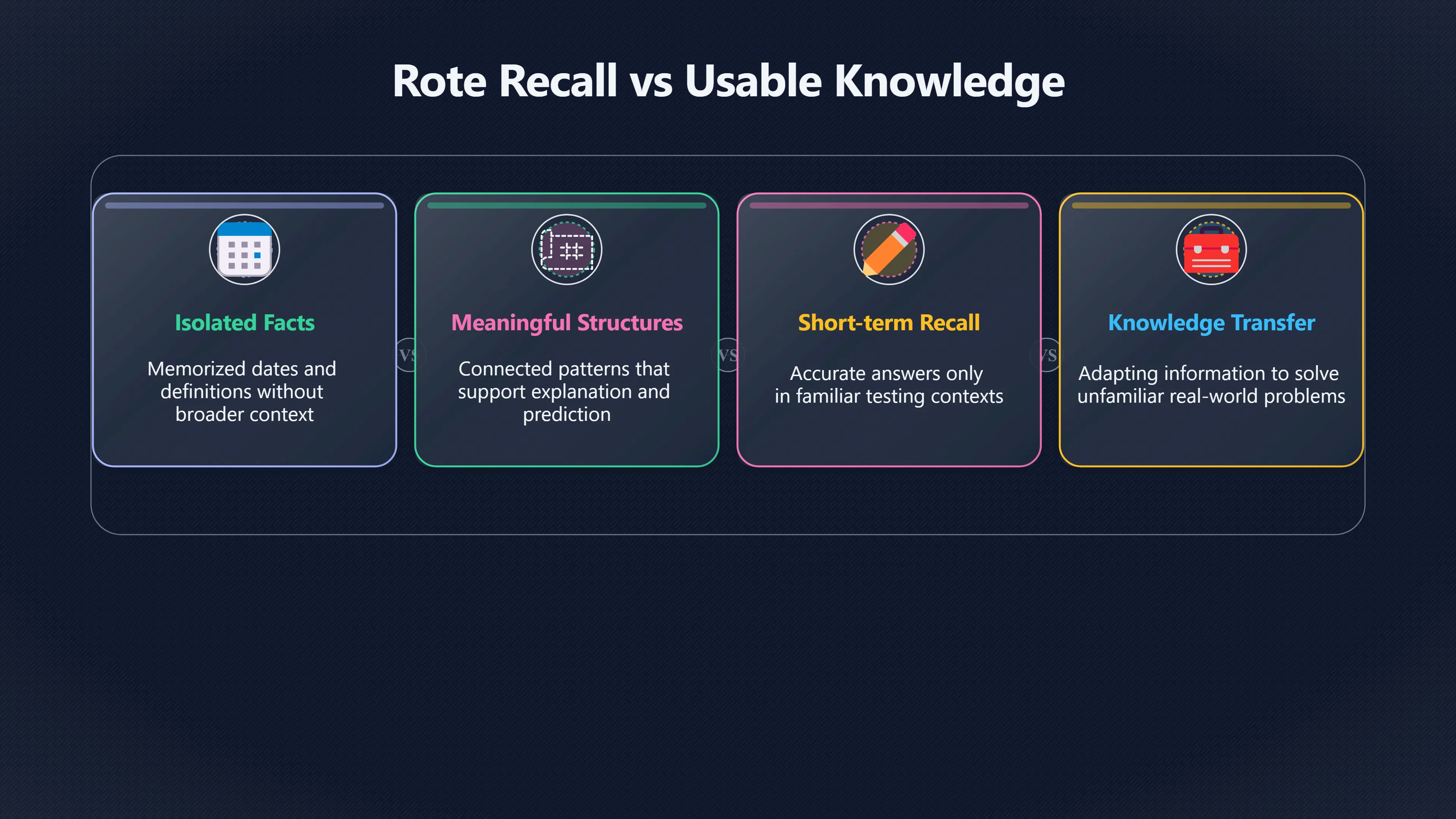
The debate between memorisation and understanding is often presented as a choice, but cognitive research suggests this is a false contrast. Facts stored in memory are essential because reasoning depends on information that can be retrieved quickly. However, isolated facts are only the starting point. They become usable knowledge when they are connected into meaningful structures that support explanation, comparison and prediction. [National Academies]nationalacademies.orgNational AcademiesChapter: 3 Learning and TransferProcesses of learning and the transfer of learning are central to understanding how peo…
The difference can be illustrated by considering two history students:
- One remembers that a revolution began in a particular year and can recite key names.
- The other understands how economic pressures, political institutions, public opinion and elite divisions interacted to produce revolutionary conditions.
Both possess factual knowledge, but only the second can analyse an unfamiliar revolution by asking whether similar causal conditions exist. The memorised facts have become interpretive tools rather than isolated pieces of information.
Educational research has long found that different teaching approaches may produce similar short-term recall while leading to very different levels of transfer. Learners who only remember facts often struggle when questions are presented in unfamiliar forms, whereas learners who understand relationships can adapt their knowledge to new situations. [National Academies]nationalacademies.orgNational AcademiesChapter: 3 Learning and TransferProcesses of learning and the transfer of learning are central to understanding how peo…
This helps explain why experts appear to “see” more than novices. Their advantage is not simply larger memory stores but better organised memory. Information is structured around concepts, principles and recurring patterns instead of remaining as disconnected items.
Why conditional knowledge matters
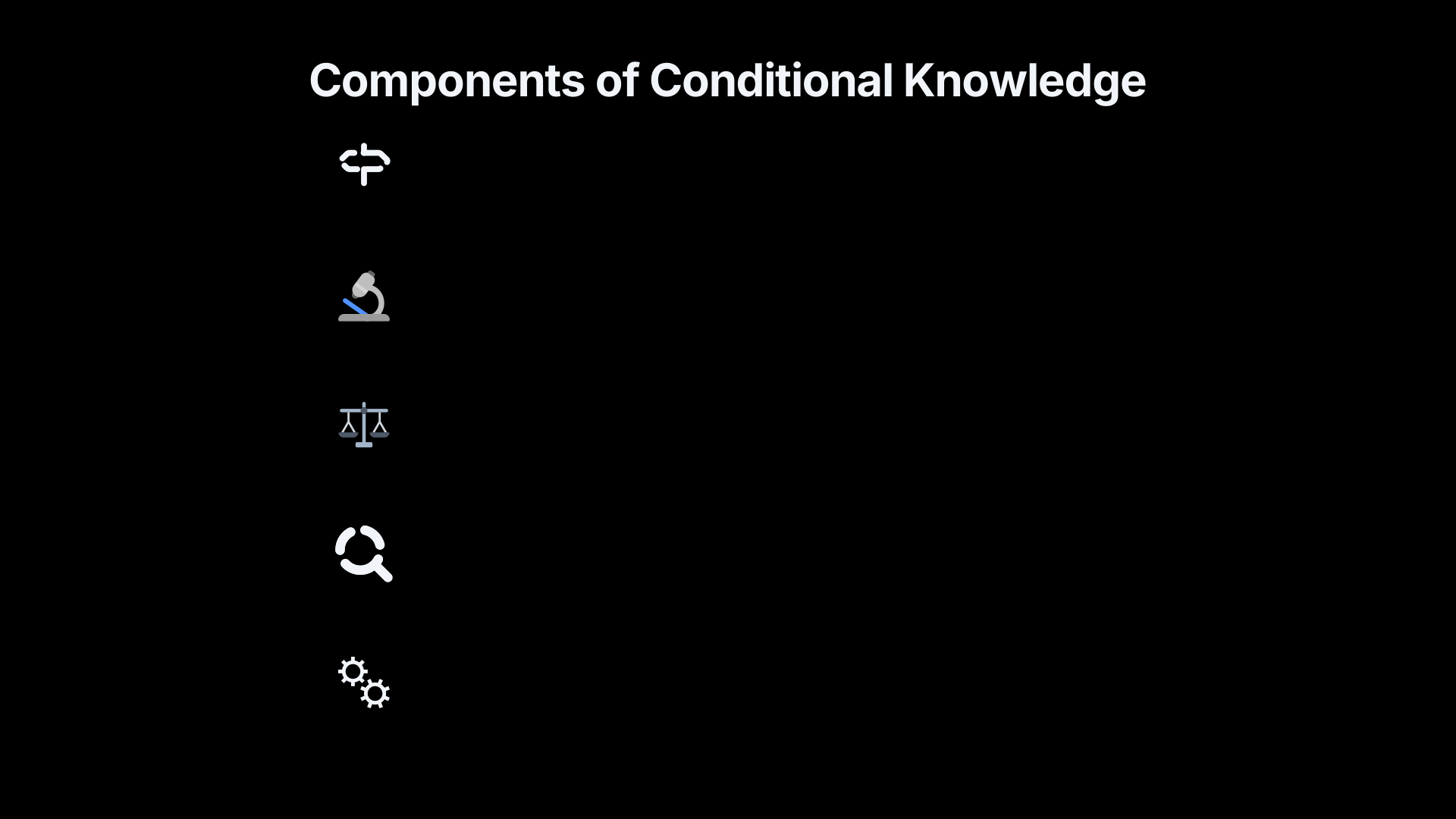
One of the defining characteristics of usable knowledge is what learning researchers describe as conditional knowledge: knowing not only what is true but when, where and why it applies.
A principle is rarely universal. Every field contains exceptions, boundary conditions and situations in which apparently similar cases should be treated differently.
Consider a scientific law. Memorising its wording allows someone to reproduce it in an examination. Usable knowledge means recognising:
- when the law provides the right explanation;
- when simplifying assumptions no longer hold;
- which competing principles may become more important;
- what evidence would indicate that another explanation fits better.
This conditional understanding is central to analytical thinking because real-world problems seldom announce which concept should be used. Analysts must decide which knowledge is relevant before they can reason effectively.
The National Research Council’s synthesis How People Learn argues that expert knowledge is organised around important concepts and is “conditionalised”—linked to the circumstances in which it can be applied. This organisation makes transfer possible because experts retrieve knowledge according to meaning rather than superficial similarity. [National Academies]nationalacademies.orgNational AcademiesChapter: 3 Learning and TransferProcesses of learning and the transfer of learning are central to understanding how peo…
Prior knowledge also influences how new information is interpreted. Studies across higher education have found that learners with well-developed conceptual and procedural knowledge are better able to integrate new material and solve unfamiliar problems than those whose knowledge remains largely declarative. [PMC]pmc.ncbi.nlm.nih.govby T Hailikari · 2008 · Cited by 538 — Prior knowledge from previous courses significantly influenced student achievement. Procedural…
How facts become interpretive tools
Facts become analytically useful through organisation rather than accumulation alone.
Instead of remembering isolated information, experienced thinkers connect new facts into larger frameworks by asking questions such as:
- What does this fact explain?
- What other facts does it connect to?
- Under what conditions is it important?
- What would I expect to observe if this principle were true?
- When would it fail?
These questions transform information into models that support interpretation.
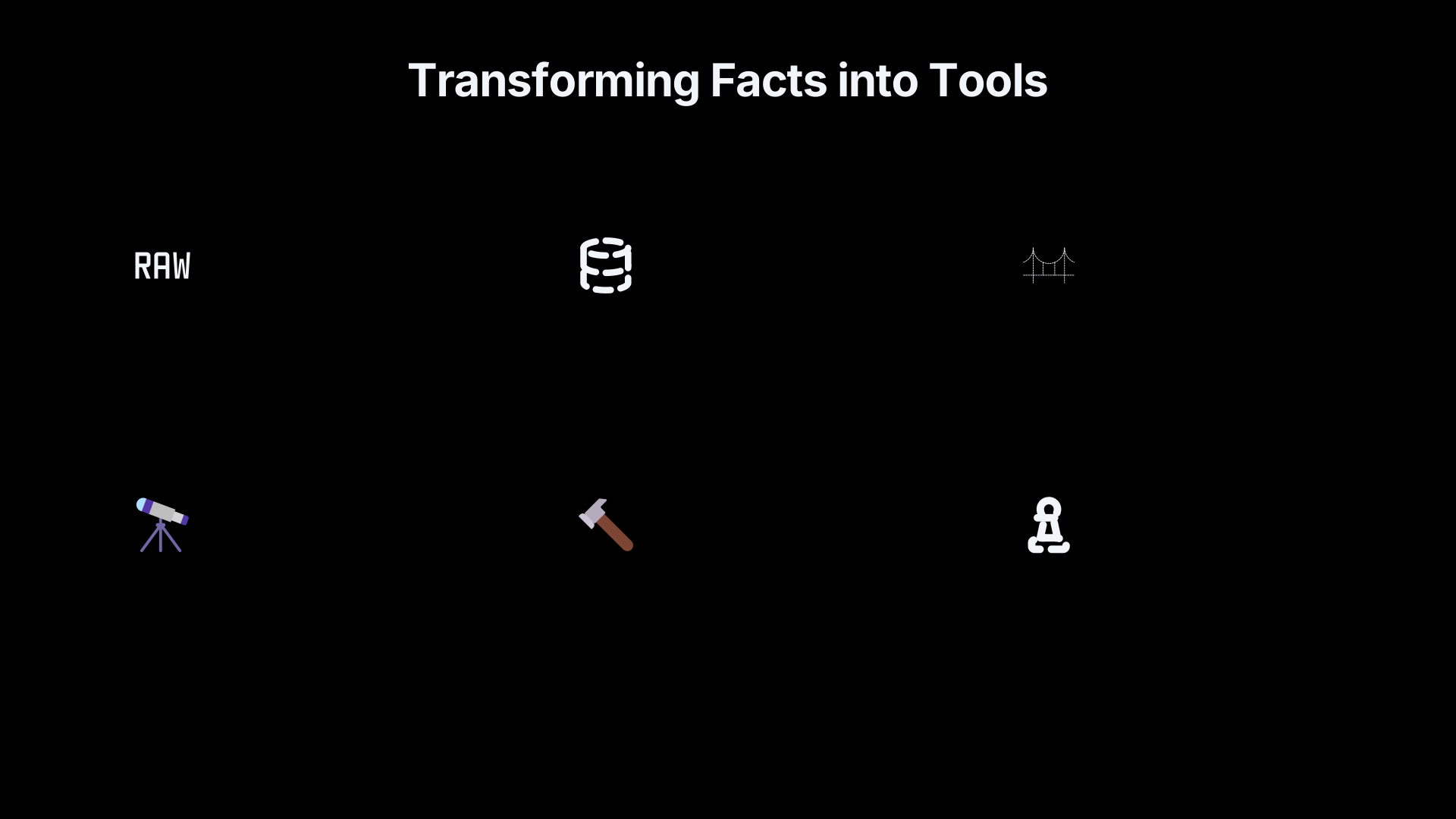
For example, learning that inflation can reduce purchasing power is a fact. Turning it into usable knowledge means understanding how inflation interacts with wages, interest rates, productivity, expectations and government policy. When analysing a new country’s economy, the learner is no longer recalling a definition but using an explanatory framework.
The same process appears in medicine, engineering, law and business. Professionals rarely rely on memorised checklists alone. Instead, they organise knowledge around causal mechanisms, diagnostic cues and typical patterns, allowing them to interpret novel cases without treating every situation as entirely unique.
Why memorisation still matters
Rejecting rote learning altogether would be a mistake. Analytical thinking cannot operate without information that is readily available in memory.
Working memory—the mental system used for active reasoning—has limited capacity. If every basic fact must be looked up, there is little cognitive space left for analysing relationships or evaluating alternatives. Automatic recall of important facts therefore supports higher-level thinking rather than competing with it. [THE EDUCATION HUB]theeducationhub.org.nzthe role of memory knowledge and understanding in learningTHE EDUCATION HUBThe role of memory, knowledge, and understanding in…2 Mar 2021 — Research shows that information is much better recal…
The key distinction is between memorisation as an endpoint and memorisation as a foundation.
When memorisation is treated as the final goal, learners often produce accurate answers only in familiar contexts. When it serves as the foundation for explanation, comparison and application, the same factual knowledge becomes part of a flexible reasoning system.
Recent discussions in science education continue to emphasise this relationship. Recall supports understanding, but understanding enables learners to explain, connect and apply knowledge in situations that differ from those originally studied. [Eurasia Journal]ejmste.comEurasia JournalThe interplay between recall and understanding in physicsby A Motlhabane · 2025 — This conceptual paper explores the inter…
A historical shift in educational thinking
Educational debates have repeatedly swung between prioritising factual knowledge and prioritising generic thinking skills. Modern cognitive science increasingly argues that this opposition is misleading.
Early educational reforms sometimes assumed that teaching broad thinking strategies would automatically transfer across subjects. Research on transfer challenged this assumption by showing that reasoning depends heavily on domain-specific knowledge. At the same time, critics of purely fact-based instruction demonstrated that memorised information often fails to transfer unless learners understand the underlying concepts and relationships. [National Academies]nationalacademies.orgNational AcademiesChapter: 3 Learning and TransferProcesses of learning and the transfer of learning are central to understanding how peo…
The emerging consensus is therefore more balanced:
- factual knowledge provides the material for thought;
- conceptual organisation gives facts meaning;
- conditional knowledge determines when ideas apply;
- repeated application turns knowledge into practical analytical skill.
This view explains why experts are not simply people with larger memories. They possess knowledge that has been reorganised through experience into structures that support interpretation, prediction and judgement.
The practical test of usable knowledge
A simple way to distinguish usable knowledge from memorised facts is to ask whether the knowledge helps explain something new.
Someone relying mainly on memorisation can usually answer questions such as:
- “What is the definition?”
- “When did this happen?”
- “What is the formula?”
Someone with usable knowledge can additionally answer:
- “Why did this happen?”
- “What would happen if one condition changed?”
- “Which previous cases are genuinely comparable?”
- “Which apparent similarities are misleading?”
- “Which evidence would change my conclusion?”
Those questions move beyond recall into analysis. They require facts, but they also require those facts to be organised into a structure that supports interpretation. That is the crucial difference between possessing information and possessing knowledge that genuinely improves thinking.
Amazon book picks
Further Reading
Books and field guides related to Facts Are Not Enough By Themselves. Use these as the next step if you want deeper reading beyond the article.
Peak
Shows how experts organise knowledge for flexible reasoning rather than simple recall.
Make It Stick
Directly addresses turning factual knowledge into durable, transferable understanding.
Thinking, Fast and Slow
Provides broader context on how knowledge influences judgment, interpretation, and decision-making.
How We Learn
Explains how knowledge is retained, connected, and applied beyond rote memorisation.
eBay marketplace picks
Marketplace Samples
Live-tested eBay searches with available results related to this page.



Endnotes
-
Source: pmc.ncbi.nlm.nih.gov
Link: https://pmc.ncbi.nlm.nih.gov/articles/PMC2630138/Source snippet
by T Hailikari · 2008 · Cited by 538 — Prior knowledge from previous courses significantly influenced student achievement. Procedural...
-
Source: theeducationhub.org.nz
Title: the role of memory knowledge and understanding in learning
Link: https://theeducationhub.org.nz/the-role-of-memory-knowledge-and-understanding-in-learning/Source snippet
THE EDUCATION HUBThe role of memory, knowledge, and understanding in...2 Mar 2021 — Research shows that information is much better recal...
-
Source: nationalacademies.org
Link: https://www.nationalacademies.org/read/9853/chapter/6Source snippet
National AcademiesChapter: 3 Learning and TransferProcesses of learning and the transfer of learning are central to understanding how peo...
-
Source: ejmste.com
Link: https://www.ejmste.com/article/the-interplay-between-recall-and-understanding-in-physics-a-case-of-newtons-laws-17502Source snippet
Eurasia JournalThe interplay between recall and understanding in physicsby A Motlhabane · 2025 — This conceptual paper explores the inter...
Additional References
-
Source: researchgate.net
Link: https://www.researchgate.net/post/If_AI_can_already_recall_and_apply_knowledge_instantly_why_are_we_still_relying_on_rote_memorization_in_educationSource snippet
If AI can already recall and apply knowledge instantly, why...2 Sept 2025 — With the rapid rise of AI tools capable of solving problems...
-
Source: youtube.com
Link: https://www.youtube.com/watch?v=KS1tI5fBtCgSource snippet
Conceptual Understanding in Science: Moving Beyond Rote to Meaningful Learning...
-
Source: medium.com
Link: https://medium.com/educreation/the-untold-story-of-learning-in-the-age-of-ai-5666b904b282Source snippet
ming mere information into usable knowledge...
-
Source: educationfutures.com
Title: we cannot manage knowledge
Link: https://educationfutures.com/post/we-cannot-manage-knowledge/Source snippet
9 Mar 2025 — However, memorization is not the same as knowledge. Learning is a process of transformation, not just accumulation. To make...
-
Source: youtube.com
Link: https://www.youtube.com/watch?v=blAvP001oWcSource snippet
ng, understanding how information connects and applying it...
-
Source: youtube.com
Link: https://www.youtube.com/watch?v=EXhfzqYbePYSource snippet
The 2 Types of Knowledge You Need to Learn Anything...
-
Source: arxiv.org
Link: https://arxiv.org/pdf/2507.21914Source snippet
Generalizing over Memorized Data in LLMsby Q Wu · 2025 · Cited by 5 — Many researchers argue that rote learning hinders generalization be...
-
Source: youtube.com
Title: Why Deep Thinkers Learn Differently Than Everyone Else
Link: https://www.youtube.com/watch?v=9UTPErZaK_0Source snippet
What Is the Difference Between Deep and Surface Learning Strategies? | Learn As An Adult...
-
Source: youtube.com
Title: The 2 Types of Knowledge You Need to Learn Anything
Link: https://www.youtube.com/watch?v=TuGITbfFmLISource snippet
Why Deep Thinkers Learn Differently Than Everyone Else...
-
Source: youtube.com
Title: Conceptual Understanding in Science: Moving Beyond Rote to Meaningful Learning
Link: https://www.youtube.com/watch?v=k4civCCnGGs
Topic Tree