Within Steelman
The Strongest Case for Office Time
A steelman of return-to-office policies separates control-based suspicions from real concerns about learning, coordination, and trust.
On this page
- The weak rebuttal and the better objection
- Mentorship, coordination, and workplace trust
- How a steelman leads to more precise hybrid policies
Page outline Jump by section
Introduction
One of the easiest ways to weaken your own thinking is to dismiss return-to-office (RTO) policies as nothing more than managerial control or nostalgia. While some organisations have undoubtedly used office mandates for questionable purposes, that is not the strongest version of the case. A genuine steelman asks why informed leaders, acting in good faith, might still believe that spending more time together in person improves organisational performance. Only after understanding those arguments can they be tested against evidence and practical alternatives.
 The strongest case for office attendance is not primarily about monitoring employees. It is about whether organisations lose important forms of learning, coordination, trust and culture when too much work becomes physically dispersed. The key analytical question is therefore not “office or remote?” but which kinds of work genuinely benefit from shared physical presence, and how often.
The weak rebuttal and the better objection
A common anti-RTO response assumes that office advocates simply distrust employees or want to justify expensive buildings. Those motives may exist in some organisations, but treating them as the whole explanation creates a strawman.
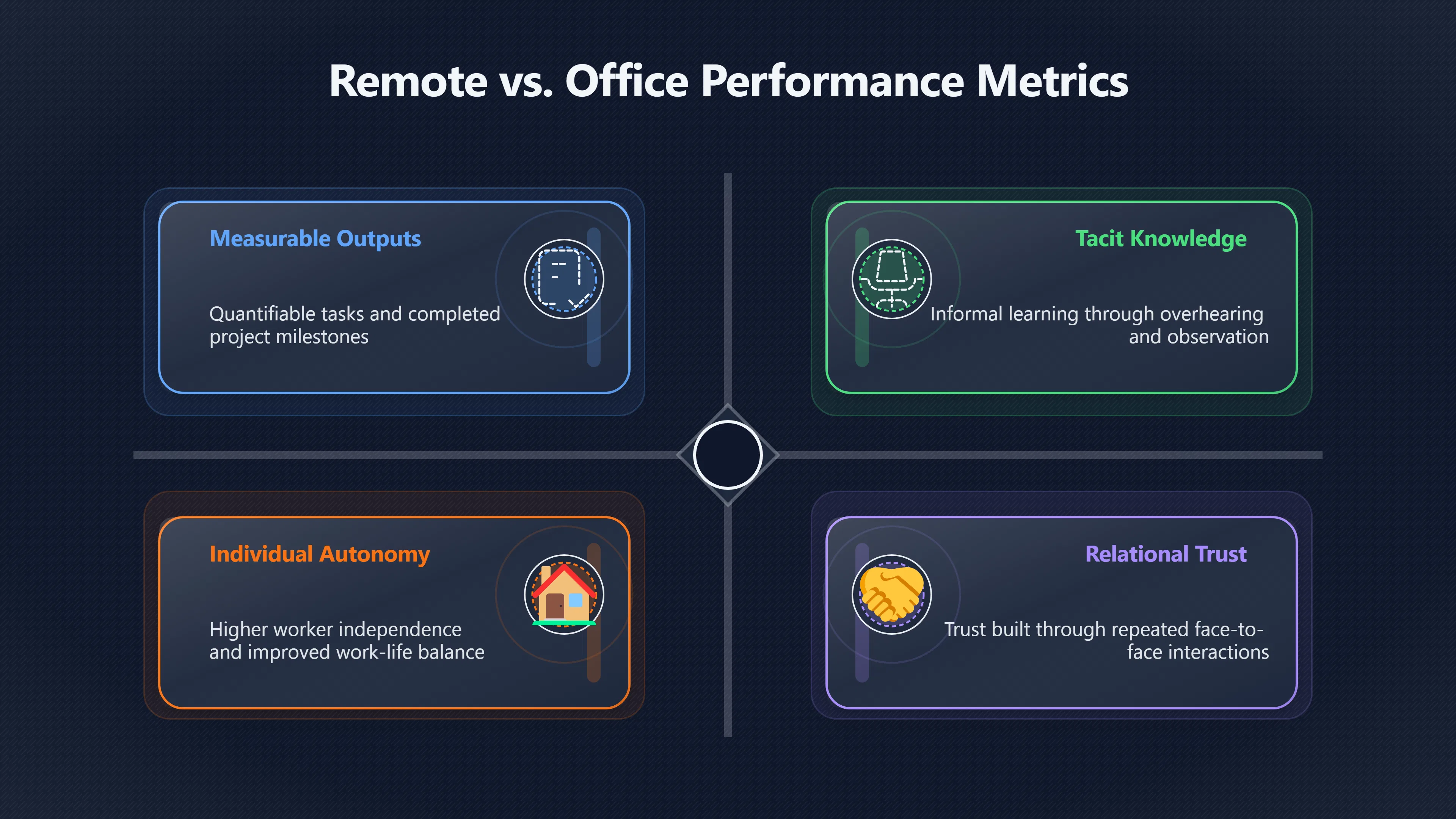
The stronger argument begins from a different premise: some aspects of organisational performance are difficult to measure directly. Productivity metrics may capture completed tasks while overlooking how people learn, exchange tacit knowledge, develop judgement or build relationships that make future work easier. Leaders concerned about these less visible processes are not necessarily rejecting evidence about remote productivity; they may believe that the longer-term effects are harder to quantify. [PMC]pmc.ncbi.nlm.nih.govPMCShould employees be required to return to the office?by CB Gibson · 2023 · Cited by 181 — Many employees strongly resist a return to the office. They have experienced well-being, producti…
A better objection therefore accepts that these concerns are legitimate before asking harder questions:
- Which activities actually require physical presence?
- Are all employees affected equally, or mainly new hires and junior staff?
- Does requiring everyone to attend solve the identified problem?
- Can the same benefits be achieved through targeted hybrid arrangements instead?
This shifts the debate from motives to mechanisms.
Mentorship, coordination, and workplace trust
The strongest practical argument for office time concerns forms of learning that happen informally rather than through scheduled meetings.
Junior employees often acquire skills by overhearing conversations, asking quick questions, watching experienced colleagues solve unexpected problems and receiving immediate feedback. Much of this knowledge is difficult to formalise into documents or training programmes. Researchers studying software teams, for example, found that remote and hybrid work changes coordination patterns, with communication quality, cohesion and trust becoming critical determinants of success. Poor coordination creates misunderstandings, slower help-seeking and less clearly defined work. [arXiv]arxiv.orgA Grounded Theory of Coordination in Remote-First and Hybrid Software TeamsFebruary 21, 2022…
Similarly, studies of knowledge work suggest that physical proximity can increase opportunities for spontaneous feedback, idea exchange and innovation, even where individual task productivity remains similar. Existing research increasingly points towards differences between fully remote work and well-designed hybrid work rather than a simple office-versus-home comparison. [American Economic Association]aeaweb.orgAmerican Economic Association Determinants and Consequences of Return to OfficeAmerican Economic AssociationDeterminants and Consequences of Return to Office…November 19, 2025 — Importantly, existing literature su…
Trust also runs in both directions.
Employees often interpret mandatory attendance as signalling that management does not trust them. Yet managers may argue that trust is also built through repeated face-to-face interaction, especially among colleagues who have never worked together before. Teams that already possess strong relationships may coordinate effectively at a distance, while newly formed teams often need richer interaction before remote work becomes frictionless.
Seen this way, office attendance is not simply about supervision. It is about accelerating relationship formation and reducing coordination costs that become visible only over months rather than days.
Why the evidence produces disagreement rather than a simple verdict
The evidence on return-to-office policies rarely supports absolute positions because different outcomes point in different directions.
Many studies find that remote and hybrid workers report higher autonomy, lower commuting burdens and improved work-life balance. Some field experiments have found little or no decline in measurable productivity under hybrid arrangements while also reducing employee turnover. [Forbes]forbes.comRemote Work vsRTO: What 14 Studies Actually Say8 days ago — The strongest consensus across the dataset is that hybrid work of typically two to three da…
At the same time, researchers continue to investigate whether prolonged physical separation affects innovation, mentoring and organisational learning in ways that are slower to detect. Those concerns help explain why some employers emphasise collaboration even when short-term productivity data appear favourable to remote work. [American Economic Association]aeaweb.orgAmerican Economic Association Determinants and Consequences of Return to OfficeAmerican Economic AssociationDeterminants and Consequences of Return to Office…November 19, 2025 — Importantly, existing literature su…
This explains why reasonable people can examine similar evidence yet reach different conclusions. One side places greater weight on measurable outputs today; the other worries about capabilities that emerge over years.
A steelman recognises that these are different empirical questions rather than assuming one side is ignoring evidence.
How a steelman leads to more precise hybrid policies
Once the strongest office arguments are understood, the policy discussion becomes more specific.
Instead of asking whether everyone should return permanently, organisations can ask where in-person work creates unusually high value. Examples include:
- onboarding new employees and graduates;
- mentoring and coaching;
- creative planning sessions involving uncertain problems;
- conflict resolution and relationship repair;
- major cross-functional coordination;
- customer workshops or design activities requiring rapid iteration.
Routine individual work that depends mainly on concentration may gain comparatively little from compulsory attendance.
This reasoning increasingly appears in recommendations from employment researchers and professional bodies, which emphasise designing office time around purposeful collaboration rather than measuring attendance for its own sake. Coordinated in-office days, role-specific expectations and clear explanations of why physical presence matters generally align better with available evidence than blanket mandates. [King's College London+2CIPD]kcl.ac.ukKing's College LondonUK workers increasingly rejecting return-to-office mandates…May 21, 2025 — 21 May 2025 — “An increasing amount of…
What this example teaches about steelmanning
[return to office]gable.toOffice: What Workplace Leaders Need To Know In 2026 - Gable23 Dec 2024 — Return to office in 2026: data-driven strategies, RTO policy tem… fice debate illustrates why steelmanning improves analytical thinking.
The weakest criticism attacks an exaggerated claim: “Managers just want control.” The strongest criticism begins by acknowledging that organisations may have legitimate concerns about learning, coordination and trust, then asks whether broad attendance mandates are the most effective response.
That produces a more demanding debate. Rather than arguing over motives, it examines evidence about particular organisational functions, distinguishes between different kinds of work, and leaves room for hybrid policies that preserve the genuine advantages of both flexibility and face-to-face collaboration.
The result is not necessarily agreement. It is a disagreement that focuses on the real trade-offs instead of a caricature.
Amazon book picks
Further Reading
Books and field guides related to The Strongest Case for Office Time. Use these as the next step if you want deeper reading beyond the article.
Remote
Provides a strong case for remote work that readers can critically evaluate and steelman.
How to Have Impossible Conversations
Supports fair evaluation of contested workplace policies.
The Culture Code
Explores trust, collaboration, and team dynamics central to office-versus-remote debates.
eBay marketplace picks
Marketplace Samples
Live-tested eBay searches with available results related to this page.




Endnotes
-
Source: pmc.ncbi.nlm.nih.gov
Title: PMCShould employees be required to return to the office?
Link: https://pmc.ncbi.nlm.nih.gov/articles/PMC10126217/Source snippet
by CB Gibson · 2023 · Cited by 181 — Many employees strongly resist a return to the office. They have experienced well-being, producti...
-
Source: cipd.org
Title: employers return to office plans
Link: https://www.cipd.org/uk/views-and-insights/thought-leadership/insight/employers-return-to-office-plans/Source snippet
What are employers' return to the office plans for 2025?20 Jan 2025 — Some employers are calling for more days in the office to get bette...
-
Source: arxiv.org
Link: https://arxiv.org/abs/2202.10445Source snippet
A Grounded Theory of Coordination in Remote-First and Hybrid Software TeamsFebruary 21, 2022...
Published: February 21, 2022
-
Source: forbes.com
Title: Remote Work vs
Link: https://www.forbes.com/advisor/business/remote-work-vs-rto-statistics/Source snippet
RTO: What 14 Studies Actually Say8 days ago — The strongest consensus across the dataset is that hybrid work of typically two to three da...
-
Source: youtube.com
Title: The Return to Office Debate
Link: https://www.youtube.com/watch?v=9jB8eoRJNc8Source snippet
Return to Office Mandates Are Destroying Company Culture...
-
Source: youtube.com
Title: Return to Office Mandates Are Destroying Company Culture
Link: https://www.youtube.com/watch?v=j_iYoYTlVkcSource snippet
The Future of Remote Work: A Fireside Chat with Nick Bloom...
-
Source: aeaweb.org
Title: American Economic Association Determinants and Consequences of Return to Office
Link: https://www.aeaweb.org/conference/2026/preliminary/paper/hFn8f62sSource snippet
American Economic AssociationDeterminants and Consequences of Return to Office...November 19, 2025 — Importantly, existing literature su...
Published: November 19, 2025
-
Source: kcl.ac.uk
Link: https://www.kcl.ac.uk/news/uk-workers-increasingly-rejecting-return-to-office-mandates-study-findsSource snippet
King's College LondonUK workers increasingly rejecting return-to-office mandates...May 21, 2025 — 21 May 2025 — “An increasing amount of...
Published: May 21, 2025
-
Source: softwareseni.com
Title: return to office mandates in 2025 whats really happening and what it means
Link: https://www.softwareseni.com/return-to-office-mandates-in-2025-whats-really-happening-and-what-it-means/Source snippet
Return-to-Office Mandates in 2025 - What's Really Happening...27 Dec 2025 — Companies claim they need office presence for productivity w...
-
Source: gable.to
Title: return to office
Link: https://www.gable.to/blog/post/return-to-officeSource snippet
Office: What Workplace Leaders Need To Know In 2026 - Gable23 Dec 2024 — Return to office in 2026: data-driven strategies, RTO policy tem...
-
Source: blog.perceptyx.com
Title: the return to office debate one year later where do we stand
Link: https://blog.perceptyx.com/the-return-to-office-debate-one-year-later-where-do-we-standSource snippet
Return-to-Office Debate: One Year Later, Where Do...20 Mar 2025 — The data suggests that while remote work is stabilizing, stricter retu...
Additional References
-
Source: linkedin.com
Link: https://www.linkedin.com/posts/mikebedford_returntooffice-rto-flexibleworking-activity-7281627396909236224-qb5NSource snippet
ted thinking rather than a solution to real challenges.Read more...
-
Source: youtube.com
Title: Remote Work Secrets: How Nick Bloom Sees the Future of Work
Link: https://www.youtube.com/watch?v=vYgm9tjqm_ASource snippet
The Return to Office Debate...
Topic Tree