Within Critical Skills
The Teaching Move That Makes Thinking Visible
Learners improve more reliably when critical thinking moves are named, modelled, practised and checked instead of hidden inside coursework.
On this page
- Why vague advice like think harder fails
- A repeatable routine for analysing claims
- How feedback turns routines into skill
Page outline Jump by section
Introduction
Critical thinking becomes more reliable when the reasoning process is made explicit rather than assumed. Telling learners to “think harder”, “be more analytical”, or “show critical thinking” rarely explains what successful thinking actually looks like. Research instead suggests that people improve when teachers, trainers, or mentors identify the specific reasoning moves they expect, demonstrate those moves aloud, provide structured opportunities to practise them, and give feedback on the quality of the reasoning rather than only the final answer. This approach helps learners develop habits they can recognise and reuse beyond school, making critical thinking more transferable to workplaces, everyday decisions, and civic life. [NSW Education+2EEF]education.nsw.gov.auNSW Education How to Teach Critical ThinkingWillingham earned his B.A. from Duke University in 1983 and his Ph.D. in. Cognitive Psychology from. Harvard University in 1990.Read more…
Why vague advice like “think harder” fails
Advice such as “analyse more deeply” assumes that learners already know what analysing involves. In reality, novices often see only the finished product—a persuasive essay, a scientific conclusion, or a business recommendation—without seeing the sequence of decisions that produced it.
Cognitive psychologist Daniel Willingham argues that critical thinking is not a single general-purpose skill that automatically develops through exposure to challenging tasks. Instead, it consists of identifiable processes that should be taught explicitly within particular subjects and contexts. Learners benefit when educators specify exactly which thinking operations matter—for example, distinguishing evidence from opinion, identifying assumptions, comparing competing explanations, or evaluating the credibility of a source. [NSW Education]education.nsw.gov.auNSW Education How to Teach Critical ThinkingWillingham earned his B.A. from Duke University in 1983 and his Ph.D. in. Cognitive Psychology from. Harvard University in 1990.Read more…
The same principle appears in research on metacognition—the ability to plan, monitor and evaluate one’s own thinking. The Education Endowment Foundation (EEF) concludes that learners make stronger progress when these strategies are explicitly taught rather than left to emerge incidentally. Simply assigning difficult work does not reliably produce better thinking unless students understand how expert reasoning proceeds. [EEF]educationendowmentfoundation.org.ukEEFMetacognition and Self-Regulated LearningTeachers can use metacognitive and self-regulatory approaches to support pupils to think abou…
This distinction explains why two classrooms covering identical content can produce different outcomes. In one, students complete tasks independently with occasional corrections. In the other, the teacher regularly names the thinking moves involved, models them openly, and discusses why particular decisions are stronger than alternatives. The second classroom makes reasoning visible enough to inspect, practise and improve.
A repeatable routine for analysing claims
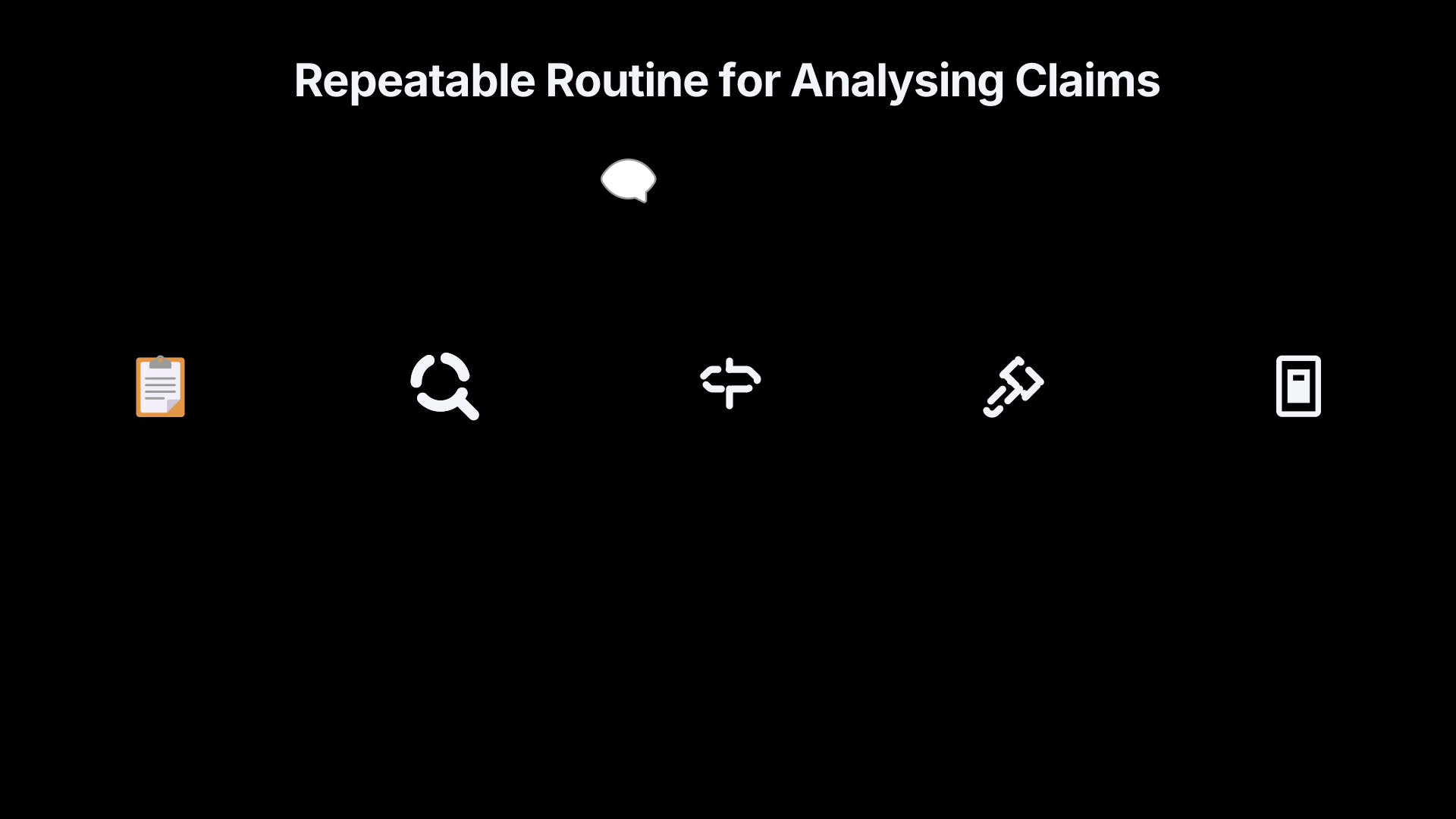
Explicit instruction works best when it replaces abstract advice with routines that learners can apply repeatedly. A routine is not a script that guarantees correct answers. Instead, it provides a stable sequence of questions that reduces cognitive load while encouraging disciplined reasoning.
One effective sequence is:
- State the claim clearly. What is actually being asserted?
- Identify the supporting evidence. What observations, data or sources support the claim?
- Judge the quality of that evidence. Is it reliable, representative and relevant?
- Generate alternative explanations. Could the same evidence fit another interpretation?
- Reach a provisional conclusion. Which explanation currently has the strongest support?
- Consider what would change your mind. What additional evidence could strengthen or weaken the conclusion?
These routines encourage learners to separate reasoning from intuition. Instead of responding immediately with agreement or disagreement, they work through observable steps that another person can examine and discuss.
Research from Harvard’s Project Zero has developed numerous “thinking routines” with the same purpose. Short prompts such as “What makes you say that?” or “Claim–Support–Question” encourage learners to externalise their reasoning, making it easier for both teachers and learners themselves to identify strengths and weaknesses. The goal is not mechanical compliance but repeated practice until the underlying habits become increasingly automatic. [Project Zero]pz.harvard.eduProject ZeroPZ Thinking RoutinesWhat Is a Thinking Routine? A thinking routine is a set of questions or a brief sequence of steps used to…
How teachers make reasoning visible
Making reasoning visible involves more than explaining procedures. It requires demonstrating how an experienced thinker approaches uncertainty.
One widely supported technique is the “think aloud”. Rather than simply solving a problem, the instructor verbalises the internal decisions normally hidden from learners:
- why one source appears more trustworthy than another;
- why a particular interpretation is rejected;
- what uncertainty remains;
- how evidence changes confidence in a conclusion.
This modelling exposes processes that experts often perform automatically and therefore forget to explain.
Educational guidance on explicit teaching emphasises deliberate modelling followed by gradual transfer of responsibility. Initially, learners observe the reasoning process. Next, they complete parts of it with support. Finally, they perform the routine independently while monitoring their own thinking. This progression helps students build metacognitive control rather than merely copying answers. [education.ky.gov]education.ky.govExplicit Teaching and ModelingAugust 4, 2023 — Deliberate, purposeful modeling is a powerful instructional strategy which makes learning visible by verbalizing the tea…
Importantly, modelling should include uncertainty. Expert thinkers rarely present reasoning as perfectly linear. Demonstrating moments of hesitation, reconsideration or evidence weighing shows learners that changing one’s mind in response to better evidence is a normal feature of sound judgement rather than a sign of weakness.
How feedback turns routines into skill
Practice alone does not reliably improve reasoning. Learners also need feedback that targets the quality of their thinking process.
Feedback is most useful when it addresses questions such as:
- Did the learner identify the central claim accurately?
- Was the evidence relevant or merely persuasive?
- Were alternative explanations genuinely considered?
- Did the conclusion reflect the strength of the available evidence?
- Were assumptions made explicit?
This differs from marking only whether the final answer was correct. Two students may reach the same conclusion for entirely different reasons. One may have evaluated competing evidence carefully, while the other simply guessed correctly. Explicit feedback distinguishes these cases and reinforces better habits.
The EEF’s guidance recommends embedding planning, monitoring and evaluation into normal classroom activity rather than treating reflection as a separate exercise. Over time, learners begin asking these questions independently before submitting work or making decisions. [EEF]educationendowmentfoundation.org.ukEEFMetacognition and Self-Regulated LearningTeachers can use metacognitive and self-regulatory approaches to support pupils to think abou…
Why explicit teaching supports transfer beyond school
One concern is that structured routines might encourage formulaic thinking. Research suggests the opposite when routines are used appropriately.
The routine itself is not the objective. Instead, it provides a scaffold that allows learners to recognise recurring patterns across different situations. The same habit of identifying claims, weighing evidence and considering alternatives can appear in evaluating a medical headline, reviewing a workplace proposal or comparing financial products, even though the subject knowledge differs.
Transfer remains difficult because every new domain requires relevant background knowledge. Explicit instruction does not remove that requirement. Instead, it increases the likelihood that learners will recognise when familiar reasoning strategies apply in a new setting and adapt them appropriately rather than relying on intuition alone. Willingham argues that successful transfer depends on repeatedly connecting thinking routines to meaningful subject knowledge rather than teaching generic critical thinking in isolation. [NSW Education]education.nsw.gov.auNSW Education How to Teach Critical ThinkingWillingham earned his B.A. from Duke University in 1983 and his Ph.D. in. Cognitive Psychology from. Harvard University in 1990.Read more…
Common implementation mistakes
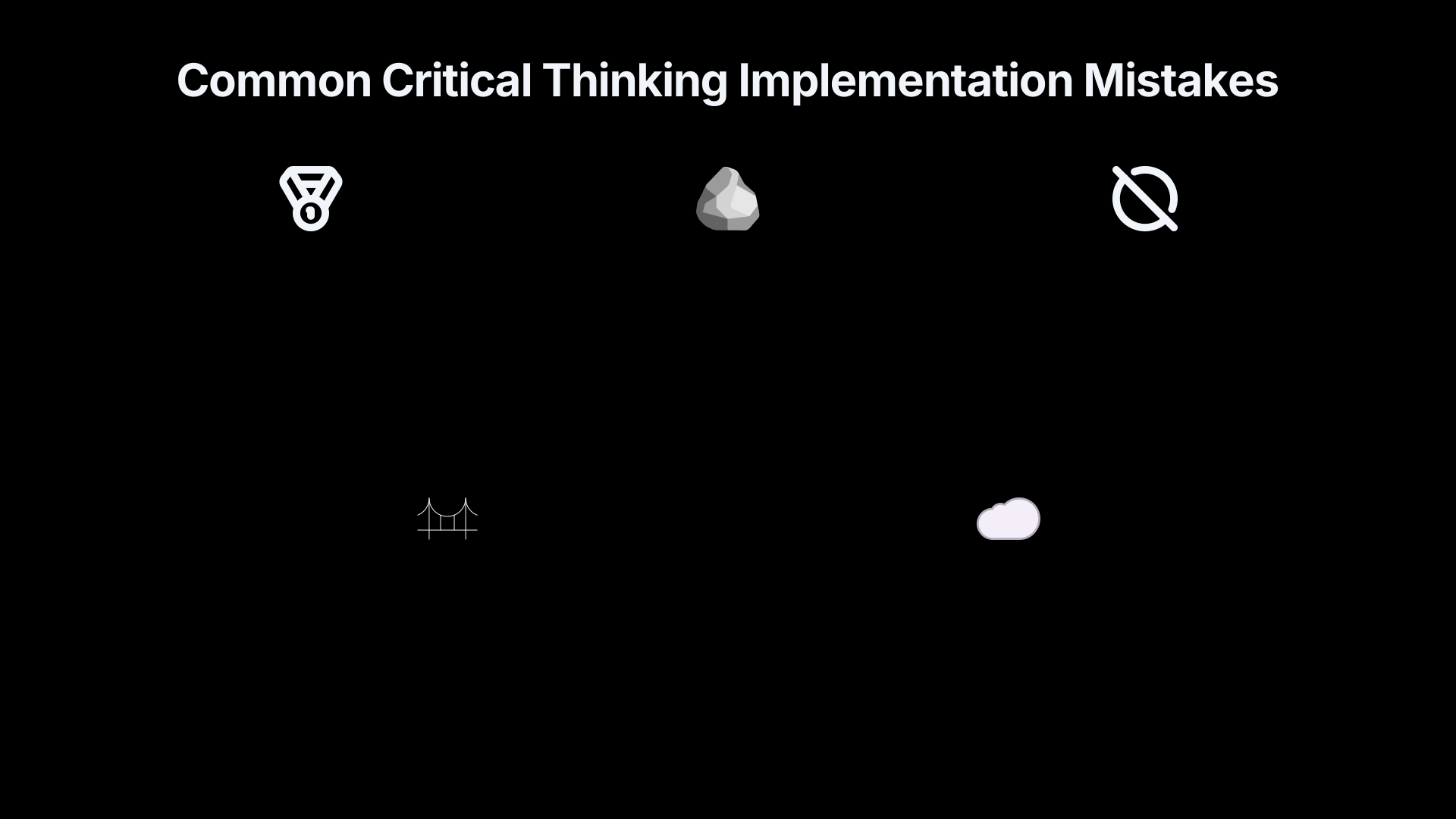
Schools and organisations sometimes adopt the language of critical thinking without changing instruction. Several common mistakes limit effectiveness.
Treating critical thinking as a personality trait. Praising people for “being analytical” gives little guidance about what they actually did well.
Teaching only through difficult tasks. Complexity alone does not reveal effective reasoning. Learners often need examples of how experts approach similar problems.
Focusing only on correct answers. When assessment ignores reasoning quality, learners have little incentive to improve the thinking process.
Separating thinking skills from subject knowledge. Generic exercises detached from meaningful content rarely transfer effectively because reasoning depends heavily on understanding the domain being analysed. NSW Education+2Tips for Teachers by Craig Barton [education.nsw.gov.au]education.nsw.gov.auNSW Education How to Teach Critical ThinkingWillingham earned his B.A. from Duke University in 1983 and his Ph.D. in. Cognitive Psychology from. Harvard University in 1990.Read more…
The broader significance
Explicit teaching makes critical thinking observable. Instead of assuming that learners will discover good reasoning through experience, it identifies the mental operations experts use, demonstrates them openly, provides repeated practice, and offers feedback on how well those operations were performed.
That approach does more than improve classroom performance. It helps people develop routines for analysing claims, questioning assumptions, weighing evidence and revising conclusions—habits that remain useful long after formal education ends because they can be recognised, practised and adapted whenever new problems demand careful judgement. [Project Zero+2EEF]pz.harvard.eduProject ZeroPZ Thinking RoutinesWhat Is a Thinking Routine? A thinking routine is a set of questions or a brief sequence of steps used to…
Amazon book picks
Further Reading
Books and field guides related to The Teaching Move That Makes Thinking Visible. Use these as the next step if you want deeper reading beyond the article.
Making Thinking Visible
Directly addresses routines that make reasoning explicit and visible in teaching.
The Teaching for Understanding Guide
Explains how to teach for understanding through explicit learning goals, performances, and feedback.
Why Don't Students Like School?
Explains how thinking and learning work, supporting explicit teaching of reasoning processes.
Embedded Formative Assessment
Strongly aligns with improving reasoning through structured feedback and iterative practice.
eBay marketplace picks
Marketplace Samples
Live-tested eBay searches with available results related to this page.




Endnotes
-
Source: education.nsw.gov.au
Title: NSW Education How to Teach Critical Thinking
Link: https://education.nsw.gov.au/content/dam/main-education/teaching-and-learning/education-for-a-changing-world/media/documents/How-to-teach-critical-thinking-Willingham.pdfSource snippet
Willingham earned his B.A. from Duke University in 1983 and his Ph.D. in. Cognitive Psychology from. Harvard University in 1990.Read more...
-
Source: educationendowmentfoundation.org.uk
Link: https://educationendowmentfoundation.org.uk/education-evidence/guidance-reports/metacognitionSource snippet
EEFMetacognition and Self-Regulated LearningTeachers can use metacognitive and self-regulatory approaches to support pupils to think abou...
-
Source: educationendowmentfoundation.org.uk
Link: https://educationendowmentfoundation.org.uk/education-evidence/teaching-learning-toolkit/metacognition-and-self-regulationSource snippet
Metacognition and self-regulation | EEFMetacognition and self-regulation approaches to teaching support pupils to think about their own l...
-
Source: pz.harvard.edu
Link: https://pz.harvard.edu/thinking-routinesSource snippet
Project ZeroPZ Thinking RoutinesWhat Is a Thinking Routine? A thinking routine is a set of questions or a brief sequence of steps used to...
-
Source: education.ky.gov
Title: Explicit Teaching and Modeling
Link: https://www.education.ky.gov/curriculum/standards/kyacadstand/Documents/EBIP_3_Explicit_Teaching_and_Modeling.pdfSource snippet
August 4, 2023 — Deliberate, purposeful modeling is a powerful instructional strategy which makes learning visible by verbalizing the tea...
Published: August 4, 2023
-
Source: support-for-early-career-teachers.education.gov.uk
Title: education.gov.uk Evidence
Link: https://support-for-early-career-teachers.education.gov.uk/education-development-trust/year-1-developing-effective-classroom-practice/spring-week-2-ect-evidence/Source snippet
Support for early career teachers - GOV.UKAccording to the Education Endowment Foundation (EEF), there is a strong body of research that...
-
Source: tipsforteachers.co.uk
Title: Tips for Teachers by Craig Barton Research: Critical thinking
Link: https://tipsforteachers.co.uk/research-critical-thinking-why-is-it-so-hard-to-teach/Source snippet
Instead, it should be integrated into regular classroom instruction within specific subjects.Read more...
-
Source: educationendowmentfoundation.org.uk
Title: how do we teach metacognition
Link: https://educationendowmentfoundation.org.uk/news/how-do-we-teach-metacognitionSource snippet
We know that metacognition is important, but how do...25 Nov 2025 — Self-regulated learners, like Tanya, apply metacognitive strategies...
-
Source: educationendowmentfoundation.org.uk
Title: updated eef guide to metacognition and self regulation
Link: https://educationendowmentfoundation.org.uk/news/updated-eef-guide-to-metacognition-and-self-regulationSource snippet
The updated EEF guide to metacognition and self-regulation.14 Nov 2025 — Helping pupils plan, monitor, and evaluate learning through meta...
-
Source: educationendowmentfoundation.org.uk
Link: https://educationendowmentfoundation.org.uk/education-evidence/teaching-learning-toolkit/metacognition-and-self-regulation/technical-appendixSource snippet
Metacognition and self-regulation: Technical AppendixMetacognition and self-regulation approaches to teaching support pupils to think abo...
-
Source: educationendowmentfoundation.org.uk
Title: promoting metacognitive talk in the classroom
Link: https://educationendowmentfoundation.org.uk/news/promoting-metacognitive-talk-in-the-classroomSource snippet
EEF4 Mar 2026 — Recommendation 4 of the EEF's Metacognition and Self-regulated Learning guidance states: promote and develop metacognitiv...
-
Source: educationendowmentfoundation.org.uk
Title: metacognition and self regulation guidance report
Link: https://educationendowmentfoundation.org.uk/education-evidence/evidence-reviews/metacognition-and-self-regulation-guidance-reportSource snippet
Metacognition and self-regulation evidence review9 Sept 2024 — Review of the evidence commissioned by the EEF to inform the Metacognition...
-
Source: educationendowmentfoundation.org.uk
Title: the metacognition lab explorations in student thinking for english resits
Link: https://educationendowmentfoundation.org.uk/16-19/the-metacognition-lab-explorations-in-student-thinking-for-english-resitsSource snippet
Scott graduates his feedback to ensure learners can focus on manageable improvements over time.Read more...
Additional References
-
Source: scribd.com
Link: https://www.scribd.com/document/389837267/EEF-Metacognition-and-Self-regulated-LearningSource snippet
EEF Metacognition Guidance Report | PDFThe document provides guidance on developing students' metacognition and self-regulated learning a...
-
Source: linkedin.com
Link: https://www.linkedin.com/posts/greenshaw-research-school_metacognition-and-self-regulated-learning-activity-7394674207554699264-oUQySource snippet
EEF updates guidance on metacognition and self-...The Education Endowment Foundation (EEF) has released updated guidance on Metacognitio...
-
Source: linkedin.com
Link: https://www.linkedin.com/posts/ammarmerhbi_how-to-teach-critical-thinking-activity-7299673833563709440-pPn6Source snippet
How to Teach Critical Thinking in NSW SchoolsVery timely paper on "How to Teach Critical Thinking" by Daniel Willingham, a paper commissi...
-
Source: my.chartered.college
Link: https://my.chartered.college/impact_article/how-to-teach-critical-thinking/Source snippet
to teach critical thinkingby D Willingham · Cited by 153 — Teaching critical thinking for transfer across domains: Disposition, skills, s...
-
Source: dera.ioe.ac.uk
Link: https://dera.ioe.ac.uk/id/eprint/31617/1/EEF_Metacognition_and_self-regulated_learning.pdfSource snippet
Report METACOGNITION AND SELF-REGULATED...Effective metacognitive strategies get learners to think about their own learning more explici...
-
Source: teaching.uchicago.edu
Link: https://teaching.uchicago.edu/resources/make-learning-visible-thinking-routinesSource snippet
Teaching at ChicagoMake Learning Visible with Thinking RoutinesThinking routines offer a practical and easy-to-implement series of steps...
-
Source: danielwillingham.com
Link: https://www.danielwillingham.com/uploads/5/0/0/7/5007325/willingham_2019_nsw_critical_thinking2.pdfSource snippet
elop a program to teach critical thinking: (1) identify a list of critical thinking skills for each subject...Read mo...
-
Source: eani.org.uk
Link: https://www.eani.org.uk/Source snippet
Education AuthorityThe Education Authority is responsible for delivering education services across Northern Ireland · Admissions · Home t...
-
Source: researchgate.net
Title: 242479451 Critical Thinking Why Is It So Hard to Teach
Link: https://www.researchgate.net/publication/242479451_Critical_Thinking_Why_Is_It_So_Hard_to_TeachSource snippet
Willingham (2008) Critical Thinking: Why Is It So Hard to Teach?, Arts Education Policy Review, 109:4, 21-32, DOI: 10.3200/AEPR.109.4.21...
-
Source: evidenceforlearning.org.au
Link: https://evidenceforlearning.org.au/education-evidence/guidance-reports/metacognitionSource snippet
elf-regulation can lead to learning gains of months over the course...Read more...
Topic Tree