Within Explain It
How Examples Become Real Understanding
Good explanations link examples, rules, and principles instead of simply repeating the words in a source.
On this page
- Why paraphrase is not enough
- How strong learners connect steps to principles
- Prompts that turn examples into transferable knowledge
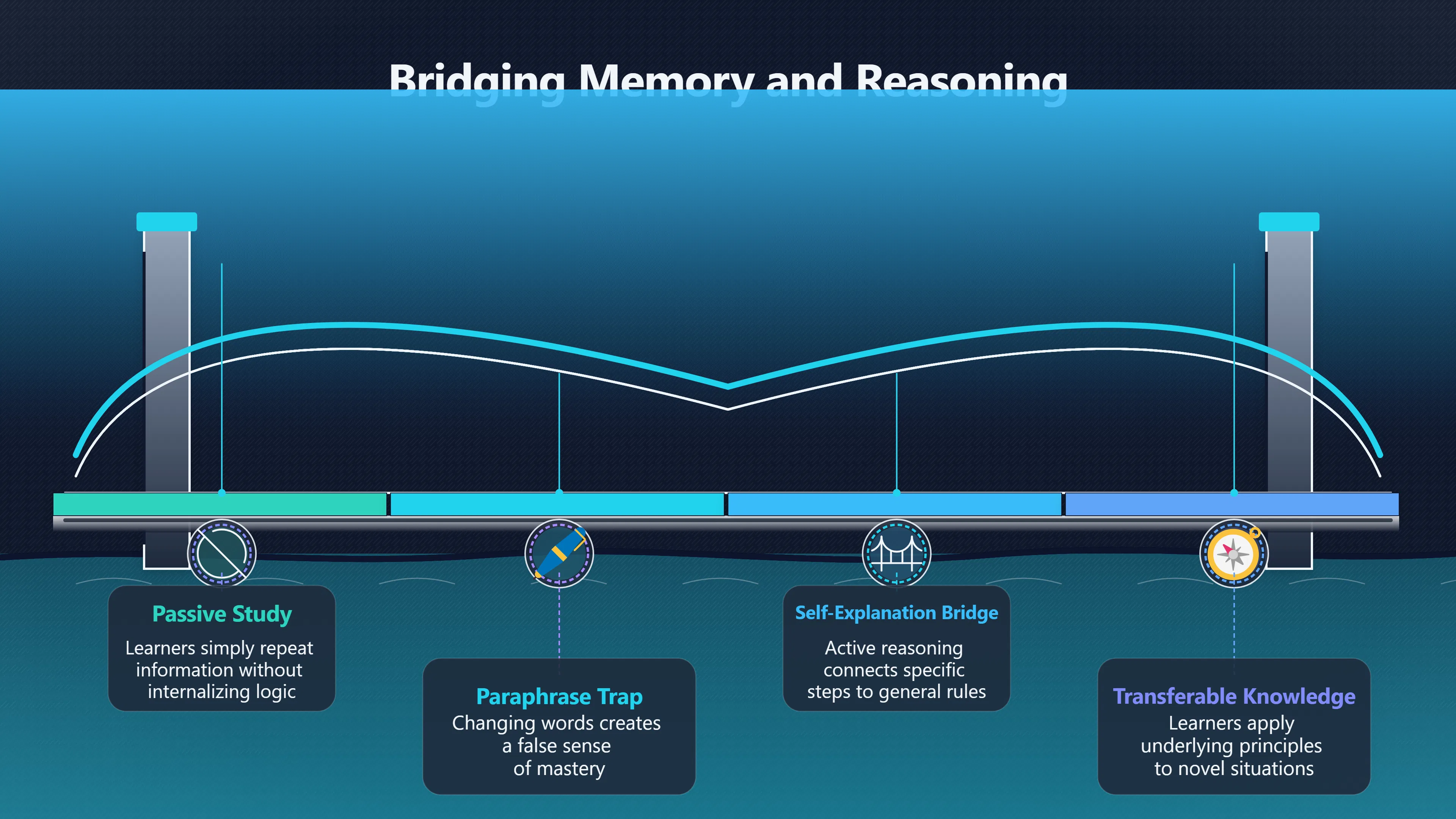
Page outline Jump by section
Introduction
Self-explanation is more than describing an example in your own words. Its real value comes from explaining why each step works, which principle justifies it, and how the same idea would apply in a different situation. That shift—from retelling an example to extracting its underlying rule—is what helps learners build knowledge they can transfer beyond a single worked problem. Research spanning several decades shows that learners who generate these kinds of explanations tend to develop stronger conceptual understanding and perform better on new problems than learners who simply study examples passively. Mary Lou Fulton College+2mr barton maths [education.asu.edu]education.asu.eduself explanation effectIt was often found that examples were similar to problems in…
 Within the broader practice of explaining concepts without notes, self-explanation acts as a bridge between memory and reasoning. Instead of asking, “Can I repeat what I saw?”, it asks, “What general idea made this example work?” That question produces explanations that are more flexible, more accurate, and more useful when facing unfamiliar situations.
Why paraphrase is not enough
Paraphrasing can create the comforting feeling that you understand material because the wording has changed. However, changing the words often leaves the underlying reasoning untouched. A learner may successfully restate a solution while still being unable to explain why one method was chosen instead of another.
Studies of self-explanation distinguish between repeating information and generating new inferences. The learning benefit appears when students actively fill in missing reasoning, identify the governing principle, and explain causal links that are not explicitly stated in the example. Simply restating the text rarely produces the same gains. Mary Lou Fulton College+2mr barton maths [education.asu.edu]education.asu.eduself explanation effectIt was often found that examples were similar to problems in…
This distinction also helps counter the “illusion of explanatory depth”—the tendency to believe we understand a mechanism until we are asked to explain it in detail. When learners must connect an example to a broader principle, missing links quickly become visible. [PMC]pmc.ncbi.nlm.nih.govby L Rozenblit · 2002 · Cited by 1507 — We argue that the illusion of depth seen with explanatory knowledge is a separate phenomenon f…
Consider the difference:
- Paraphrase: “The solution divided both sides by three.”
- Self-explanation: “Dividing both sides by three preserves equality because the same operation is applied to each side. That principle would also apply if the divisor were five or a variable, provided it is not zero.”
The second explanation identifies a transferable rule rather than describing a single event.
How strong learners connect steps to principles
Worked examples become valuable when each step is interpreted as evidence of a general rule rather than an isolated action. Effective learners continually ask themselves what each action reveals about the concept.
Several kinds of connections are especially useful:
- Step to rule: Which mathematical, scientific or logical principle justified this step?
- Rule to goal: How did that principle move the solution closer to the objective?
- Example to class: What category of problems does this example belong to?
- Example to variation: Which features could change without changing the underlying method?
- Method to limitation: When would this approach stop working?
Research on worked examples consistently finds that prompting learners to generate these connections increases conceptual understanding and improves transfer to novel problems compared with studying examples alone. [mr barton maths+2PMC]mrbartonmaths.comSelf explanation Rittle Johnsonmr barton mathsPromoting Transfer: Effects of Self-Explanation and Direct…by B Rittle-Johnson · 2006 · Cited by 628 — This study evalu…
The important shift is from asking “What happened?” to asking “Why did this happen, and when would it happen again?”
Prompts that turn examples into transferable knowledge
Good self-explanation prompts encourage reasoning rather than recall. They are open enough to require thought but focused enough to direct attention towards principles.
Identifying the governing principle
Instead of concentrating on the visible procedure, ask:
- Which rule justifies this step?
- What assumption makes this reasoning valid?
- Why is this operation appropriate here but not elsewhere?
- Which concept explains why this result follows?
These prompts encourage learners to retrieve conceptual knowledge alongside procedural knowledge.
Looking beyond the current example
Once the principle is identified, widen its scope:
- What features of this example actually matter?
- Which details are incidental?
- How could the numbers or context change while the same principle still applies?
- Can I invent another example that uses exactly the same rule?
Generating a fresh example forces the learner to separate surface features from structural relationships—a key requirement for transfer. [mr barton maths]mrbartonmaths.comSelf explanation Rittle Johnsonmr barton mathsPromoting Transfer: Effects of Self-Explanation and Direct…by B Rittle-Johnson · 2006 · Cited by 628 — This study evalu…

Explaining alternatives
Powerful understanding often comes from considering rejected possibilities:
- Why would another method fail?
- Why was this principle stronger than another candidate?
- What mistake would someone commonly make here?
- Which misconception does this example correct?
Comparing alternatives deepens analytical thinking because it requires discrimination rather than simple recall.
Testing the boundary
General principles always have limits.
Useful prompts include:
- Under what conditions would this explanation no longer hold?
- What assumption is hidden?
- What would have to change before I chose a different approach?
- Is this always true, or only true under specific conditions?
Thinking about exceptions strengthens understanding because it forces the learner to define the rule more precisely.
A practical example
Imagine studying a worked example showing why increasing competition can reduce prices in a simple economic market.
A weak explanation might be:
“More competition caused prices to fall because more firms entered.”
A stronger self-explanation would develop the principle: [education.asu.edu]education.asu.eduself explanation effectIt was often found that examples were similar to problems in…
“The example illustrates supply increasing relative to demand. Greater competition gives consumers more alternatives, reducing each firm’s pricing power. The same principle should apply in other markets where suppliers can easily enter, although markets with monopolies or strong regulation may behave differently.”
Notice how the second explanation:
- identifies the governing principle,
- distinguishes principle from example,
- predicts where it should transfer,
- recognises important limits.
That is the type of reasoning self-explanation aims to develop. [education.asu.edu]education.asu.eduself explanation effectIt was often found that examples were similar to problems in…
Common mistakes when using self-explanation
Self-explanation can become ineffective if learners mistake activity for analysis. [education.asu.edu]education.asu.eduself explanation effectIt was often found that examples were similar to problems in…
Common pitfalls include:
- Narrating instead of explaining. Describing every step without explaining why it was taken.
- Repeating definitions. Memorised wording is not the same as understanding relationships.
- Ignoring principles. Focusing only on calculations or procedures.
- Skipping transfer. Never asking where the same idea would apply again.
- Avoiding uncertainty. Genuine learning often begins when an explanation reaches a point where it breaks down.
Research on worked examples suggests that prompts are most effective when they require learners to generate missing reasoning rather than merely copy visible information. Mary Lou Fulton College+2mr barton maths [education.asu.edu]education.asu.eduself explanation effectIt was often found that examples were similar to problems in…
Building the habit during no-notes explanations
When explaining a topic from memory, pause after each major idea and ask three questions:
- Which principle does this example illustrate?
- How would I recognise the same principle in a different situation?
- What assumption or condition makes this explanation true?
These brief prompts naturally transform explanation from recollection into analysis. They also expose places where understanding is incomplete, reducing overconfidence and making later review far more targeted. Combined with retrieval practice, this approach helps learners move beyond familiarity towards knowledge that can be adapted and applied in new contexts. learninglab.psych.purdue.edu+2psychnet.wustl.edu [learninglab.psych.purdue.edu]learninglab.psych.purdue.edu2009 Karpicke Butler RoedigerDo students practise retrieval when they study on their own?1 May 2009 — We propose that many students experience illusions of competence…
Amazon book picks
Further Reading
Books and field guides related to How Examples Become Real Understanding. Use these as the next step if you want deeper reading beyond the article.
Powerful Teaching
Discusses strategies that promote deep understanding through explanation and retrieval.
How We Learn
Explains why actively generating understanding outperforms passive review.
Teach Yourself How to Learn
Encourages metacognition and explaining reasoning rather than memorizing procedures.
Small Teaching
Applies cognitive science principles that reinforce conceptual understanding and explanation.
eBay marketplace picks
Marketplace Samples
Live-tested eBay searches with available results related to this page.




Endnotes
-
Source: pmc.ncbi.nlm.nih.gov
Link: https://pmc.ncbi.nlm.nih.gov/articles/PMC3062901/Source snippet
by L Rozenblit · 2002 · Cited by 1507 — We argue that the illusion of depth seen with explanatory knowledge is a separate phenomenon f...
-
Source: pmc.ncbi.nlm.nih.gov
Link: https://pmc.ncbi.nlm.nih.gov/articles/PMC4414367/Source snippet
nih.govExample-based learning: comparing the effects of additionally...by JO Dyer · 2015 · Cited by 53 — This study compares the effects...
-
Source: learninglab.psych.purdue.edu
Title: 2009 Karpicke Butler Roediger
Link: https://learninglab.psych.purdue.edu/downloads/2009/2009_Karpicke_Butler_Roediger.pdfSource snippet
Do students practise retrieval when they study on their own?1 May 2009 — We propose that many students experience illusions of competence...
Published: May 2009
-
Source: psychnet.wustl.edu
Title: Roediger Karpicke 2006 PPSSource snippet
The Power of Testing Memoryby HL Roediger III · Cited by 3306 — In this article, we review research from both experimental and educationa...
-
Source: youtube.com
Title: Making Use of a Worked Example to Improve Learning
Link: https://www.youtube.com/watch?v=KwhGofOV5HsSource snippet
Worked Examples | A Simple Way To Accelerate Student Learning...
-
Source: youtube.com
Title: Worked Examples | A Simple Way To Accelerate Student Learning
Link: https://www.youtube.com/watch?v=gTbgFy9cLisSource snippet
Best study techniques: Elaborative Interrogation...
-
Source: education.asu.edu
Title: self explanation effect
Link: https://education.asu.edu/sites/g/files/litvpz656/files/lcl/self-explanation_effect.pdfSource snippet
It was often found that examples were similar to problems in...
-
Source: mrbartonmaths.com
Title: Self explanation Rittle Johnson
Link: https://mrbartonmaths.com/resourcesnew/8.%20Research/Self%20explanations/Self%20explanation%20-%20Rittle%20Johnson.pdfSource snippet
mr barton mathsPromoting Transfer: Effects of Self-Explanation and Direct...by B Rittle-Johnson · 2006 · Cited by 628 — This study evalu...
-
Source: education-ni.gov.uk
Link: https://www.education-ni.gov.uk/sites/default/files/2025-04/May%20Newsletter%20-%20Retrieval%20Practice%20%20What%20it%20is%2C%20Why%20it%20Works%20and%20How%20to%20Do%20It%20Better.PDFSource snippet
Retrieval Practice:Karpicke and Roediger (2008) noted that students who repeatedly re-read texts may develop an “illusion of competence.”...
-
Source: pmc.ncbi.nlm.nih.gov
Link: https://pmc.ncbi.nlm.nih.gov/articles/PMC12053339/Source snippet
nih.govUnderstanding, fast and shallow - PMCby C Gaviria · 2024 · Cited by 4 — The aim of this study was to establish whether the ability...
-
Source: pmc.ncbi.nlm.nih.gov
Link: https://pmc.ncbi.nlm.nih.gov/articles/PMC9170123/Source snippet
the relationship between retrieval practice, self...by AN Frankenstein · 2022 · Cited by 37 — Across two experiments, we examine the pot...
Additional References
-
Source: escholarship.org
Link: https://escholarship.org/content/qt3db931gm/qt3db931gm_noSplash_bbb9738f4fc0d814acdd63429d45bc1b.pdf?t=sh6jbbSource snippet
The Effects of Self-Explanation on Studying Examples and...subjects who self-explained worked examples were able to more efficiently sol...
-
Source: researchgate.net
Link: https://www.researchgate.net/publication/352704150_Illusion_of_explanatory_depth_and_social_desirability_of_historical_knowledgeSource snippet
Illusion of explanatory depth and social desirability...Jun 23, 2021 — The Illusion of Explanatory Depth (IOED) occurs when people overe...
-
Source: yukaichou.com
Link: https://yukaichou.com/gamification-analysis/retrieval-[practice-testingSource snippet
Retrieval practice is the learning strategy of actively recalling information from memory, through self-testing, free recall...Read more...
-
Source: youtube.com
Link: https://www.youtube.com/watch?v=G6u9_lbW2hY -
Source: elementsoflearning.home.blog
Link: https://elementsoflearning.home.blog/2022/09/29/enhancing-worked-examples-with-self-explanation/Source snippet
worked examples with self-explanationSep 29, 2022 — Self-explanation provides a route to meaningful engagement with worked examples...
-
Source: my.chartered.college
Title: using evidence based practices that support metacognition
Link: https://my.chartered.college/impact_article/using-evidence-based-practices-that-support-metacognition/Source snippet
evidence-based practices that support metacognition26 Feb 2024 — The aim of this article is to investigate the efficacy of integrating re...
-
Source: researchgate.net
Link: https://www.researchgate.net/publication/200772684_Transitioning_From_Studying_Examples_to_Solving_Problems_Effects_of_Self-Explanation_Prompts_and_Fading_Worked-Out_StepsSource snippet
from studying examples to solving problems by gradually fading out scaffolding (...
-
Source: cambridge.org
Link: https://www.cambridge.org/core/journals/judgment-and-decision-making/article/broad-effects-of-shallow-understanding-explaining-an-unrelated-phenomenon-exposes-the-illusion-of-explanatory-depth/9B9B8927C3E530EBCF0453504730E3F3Source snippet
Cambridge University Press & AssessmentExplaining an unrelated phenomenon exposes the illusion...by EA Meyers · 2023 · Cited by 12 — The...
-
Source: youtube.com
Title: Best study techniques: Elaborative Interrogation
Link: https://www.youtube.com/watch?v=B5ov5HmcNA4Source snippet
Elaborative Interrogation Study Guide outlines how asking "why" and "how" questions serves as a core active learning strategy that deepen...
-
Source: link.springer.com
Link: https://link.springer.com/article/10.1007/s42113-026-00271-1Source snippet
of Understanding in the Sciences - Springer Natureby R Shiffrin · 2026 · Cited by 15 — Most often scientists believe they understand more...
Topic Tree